Examination Failure and Flight
Failed the civil examination in Chang'an; fled southward to Poyang upon the outbreak of the An Lushan Rebellion.
卢纶
Lu Lun (c. 737–799), courtesy name Yunyan, was a native of Puzhou in Hezhong with ancestral roots in Fanyang, hailing from the eminent Fanyang Lu clan. A distinguished literary master of the middle Tang dynasty, he is celebrated as the foremost figure among the Ten Talents of the Dali Era. Orphaned at a young age, Lu Lun fled the catastrophic turmoil of the An Lushan Rebellion, seeking sanctuary around Lake Poyang in…
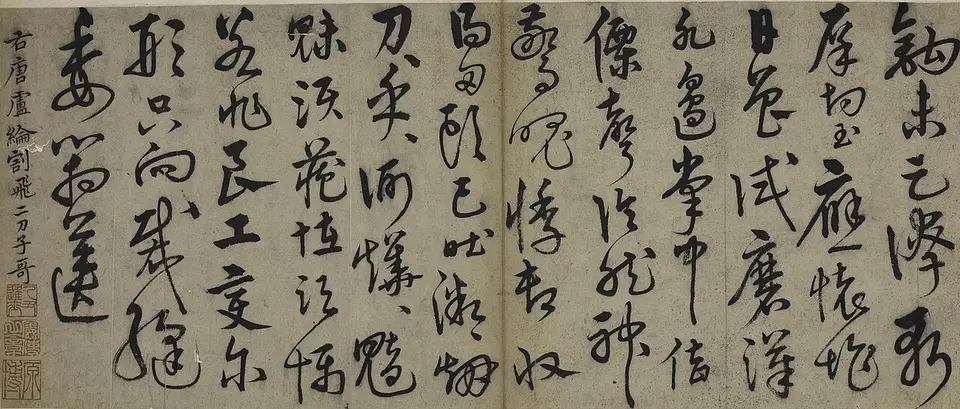
Lu Lun (c. 737–799), courtesy name Yunyan, was a native of Puzhou in Hezhong with ancestral roots in Fanyang, hailing from the eminent Fanyang Lu clan. A distinguished literary master of the middle Tang dynasty, he is celebrated as the foremost figure among the Ten Talents of the Dali Era. Orphaned at a young age, Lu Lun fled the catastrophic turmoil of the An Lushan Rebellion, seeking sanctuary around Lake Poyang in Jiangnan. Failing the imperial examinations in Chang'an during the late Tianbao and early Yongtai eras despite his evident genius, his poetic fame eventually caught the attention of Chancellor Yuan Zai in 771, who commissioned him as Defender of Wenxiang. Later recommended by Chancellor Wang Jin, Lu Lun was elevated to Scholar of the Academy of Scholarly Worthies (Jixian Hall) and Investigating Censor. In 777, the sudden purge of Yuan Zai and the exile of Wang Jin triggered severe political retribution against their proteges, resulting in Lu Lun's dismissal from central ministries and prolonged demotion to regional clerkships in Shanzhou and Mixian. In 788, recognizing his steadfast loyalty during the Zhu Ci rebellion, Emperor Dezong appointed him Magistrate of Zhaoying. Soon after, celebrated general Hun Jian, Prince of Xianning, invited Lu Lun into his headquarters as Military Administrative Assistant of the Hezhong Military Commission, where Lu Lun attained the title of Acting Vice Director in the Ministry of Revenue. Serving in the northern border army until his death in 799, Lu Lun transformed his frontier experiences into enduring verse. His celebrated suite Border Songs (Sai Xia Qu), featuring immortal lines such as "In dark night the wild geese soar; the Chanyu flees into the shadows. We ready light cavalry to pursue, heavy snow covering bows and blades," stands as an indelible monument of Tang martial poetry.
Failed the civil examination in Chang'an; fled southward to Poyang upon the outbreak of the An Lushan Rebellion.
Returned to the dual capitals following the war but repeatedly met failure in competitive civil examinations.
Recommended directly by Chancellor Yuan Zai and appointed Defender of Wenxiang, entering civil administration.
Promoted by Chancellor Wang Jin to Scholar of Jixian Hall and Investigating Censor, joining the Ten Talents.
Demoted to Clerk of Shanzhou following the fall and execution of patrons Yuan Zai and Wang Jin.
Traveled hazardous routes to pay homage to Emperor Dezong in Liangzhou during the Zhu Ci rebellion.
Appointed Magistrate of Zhaoying, then recruited by general Hun Jian as Military Administrative Assistant in Hezhong.
Promoted to Acting Vice Director in the Ministry of Revenue in recognition of distinguished logistical service.
Passed away from illness in his military quarters at Puzhou at approximately sixty years of age.
Lu Lun belonged to the prestigious Fanyang Lu clan, one of medieval China's most celebrated northern aristocratic houses. His great-grandfather and grandfather had served as imperial magistrates, and his father, Lu Zhihan, served as Vice Magistrate of Linhuang in Weijun. However, Lu Lun suffered severe misfortune in his early childhood: his father died prematurely, and his mother, Lady Wei of Jingzhao, passed away when Lu Lun was still an infant. Deprived of direct parental protection, he was reared by maternal relatives of the Jingzhao Wei clan and later assisted by his in-laws, the Hedong Zhao clan.
In the final year of Emperor Xuanzong's Tianbao era, the young Lu Lun traveled to Chang'an to sit for the imperial examinations. His hopes were abruptly shattered by the outbreak of the An Lushan Rebellion. As rebel armies captured Luoyang and breached the Tong Pass, nineteen-year-old Lu Lun joined waves of aristocratic refugees fleeing southward. He sought sanctuary around the scenic shores of Lake Poyang in Jiangnan. During these years of dislocation, Lu Lun immersed himself in classical literature, forging close companionships with fellow refugee poets Li Duan and Han Hong, gradually establishing an esteemed literary reputation across Jiangnan.
Following the suppression of the An Lushan Rebellion during the Baoying and Guangde reigns of Emperor Daizong, Lu Lun returned to Chang'an with high ambitions. However, post-war examinations were fiercely competitive and dominated by entrenched factional networks. Despite his brilliant poetic mastery, Lu Lun suffered repeated rejections at the examination gates between 765 and 770, languishing in prolonged poverty in capital hostels.
His fortunes shifted dramatically in 771 when Chancellor Yuan Zai examined Lu Lun's manuscripts. Deeply impressed by his elegant style, Yuan Zai bypassed the civil bureaucracy to award Lu Lun the office of Defender of Wenxiang. In 774, fellow Chancellor and Vice Commander Wang Jin similarly championed his brilliance, successfully memorializing the throne to appoint Lu Lun as Scholar of Jixian Hall and Collator in the Palace Library, subsequently promoting him to Investigating Censor. During this zenith of his career, Lu Lun engaged in brilliant poetic exchanges in Chang'an alongside Li Duan, Han Hong, Qian Qi, and Sikong Shu, universally acknowledged by their peers as the Ten Talents of the Dali Era, with Lu Lun celebrated as the foremost poet of the circle.
Lu Lun's fortunes reversed abruptly in the third month of 777. Emperor Daizong launched a sweeping purge of the central court: Chancellor Yuan Zai was condemned to death for corruption and tyranny, and Chancellor Wang Jin was banished to Lingnan. Because Lu Lun's rapid elevation had been sponsored exclusively by these fallen patrons, he became an immediate target of bureaucratic recrimination.
Stripped of his academic and censorial titles, Lu Lun was exiled to Shanzhou as an administrative clerk, subsequently transferred to the magistrate's seat of Mixian. For over a decade, Lu Lun endured humiliating demotions across provincial backwaters. Yet this prolonged exile detached his poetry from superficial banquet conventions, forcing him to witness rural destitution and military devastation firsthand, which infused his verse with deep emotional resonance and solemn melancholy.
In 788, Emperor Dezong recalled Lu Lun's perilous journey to pay court homage during the Zhu Ci insurrection, appointing him Magistrate of Zhaoying. Soon after, celebrated mid-Tang military titan Hun Jian, Prince of Xianning, was appointed Military Commissioner of Hezhong and Vice Supreme Commander. Recognizing Lu Lun's literary brilliance and practical wisdom, Hun Jian enlisted him as Chief Administrative Assistant in his military headquarters at Puzhou (modern Yongji, Shanxi).
Within Hun Jian's northern border command, Lu Lun inspected strategic garrisons along the Yellow River and drafted military dispatches. Hun Jian treated the aging poet with exceptional respect, relying heavily on his counsel. Reinvigorated by the stark heroism of military life, Lu Lun composed his immortal suite Border Songs (Sai Xia Qu). Depicting nocturnal pursuits across blizzard-swept steppes and legendary archery feats, these poems revitalized early Tang frontier vigor.
Rewarded for his logistical service, Lu Lun was elevated to Acting Vice Director in the Ministry of Revenue in 792. In 799, exhausted by decades of administrative travel, Lu Lun passed away in his quarters at Puzhou. His four sons—Lu Jianci, Lu Hongzheng, Lu Jianqiu, and Lu Jianneng—all subsequently passed the imperial examinations and attained high ministerial rank, establishing a celebrated family tradition known as the "Dali Family Style."
As the recognized leader of the Ten Talents of the Dali Era, Lu Lun guided the stylistic transition of Tang poetry following the An Lushan Rebellion. Turning away from the soaring, unfettered romanticism of the High Tang, Lu Lun championed a refined five-character regulated verse (wuyan lüshi) characterized by structural precision, meticulous tonal balance, and evocative natural imagery, providing a definitive aesthetic standard for mid-Tang literati.
Lu Lun's most enduring cultural legacy resides in his martial frontier quatrains, exemplified by his Border Songs. The memorable quatrain "In dark night the wild geese soar; the Chanyu flees into the shadows. We ready light cavalry to pursue, heavy snow covering bows and blades" encapsulates intense dramatic anticipation and military valor in twenty concise characters, revered throughout Chinese history as an unexcelled masterwork of frontier poetry.
Beyond heroic frontier quatrains, Lu Lun was celebrated for composing deeply moving parting poems during an era of dynastic dislocation. Displaced by rebellions, he exchanged poignant verses with Sikong Shu, Qian Qi, and literary companions, capturing the sorrow of separation and the warmth of enduring fraternal fellowship with delicate emotional depth.
FIGURES ASSOCIATED WITH THIS DYNASTY