Life and Career
Hereditary Lineage and Early Official Career
Lu Jianzeng was born into an esteemed bureaucratic and book-collecting lineage in Dezhou, Shandong. His father, Lu Daoyue, was a Jinshi of 1670 who served as Magistrate of Yanshi, supervising Lu Jianzeng's education strictly. Possessing natural gifts and broad classical learning, Lu studied under poetry master Wang Shizhen and classical scholar Tian Wen in his youth, establishing a solid foundation in literature and evidential scholarship. In 1711, he passed the Shandong provincial examination as a Juren, followed by success in the metropolitan and palace examinations in 1721.
In 1725, Lu was appointed Magistrate of Hongya County in Sichuan. Hongya was a remote district burdened by extortionate levies and neglected legal cases. Upon taking office, Lu abolished irregular surcharges, expedited legal proceedings, and practiced administrative frugality, earning the praise of the regional populace.
In 1735, Lu was transferred to Yingzhou as magistrate. The Yingzhou West Lake had served as a water conservancy reservoir since Northern Song administrator Ouyang Xiu's tenure, but had become choked with silt and encroached upon by local estates, resulting in chronic flooding during heavy rains. Lu conducted field surveys, persuaded local residents of the collective benefits of public works, and directed the dredging of the lake and surrounding canals, eliminating floods and irrigating farmlands across the prefecture.
First Term in Salt Administration and Frontier Exile
In 1736, recognized for his administrative competence, Lu was promoted to Salt Distribution Commissioner of Lianghuai, stationed in Yangzhou. The Lianghuai salt administration generated essential revenue for the imperial treasury. At the time, wealthy salt merchants colluded with corrupt clerks, seizing the brine wells of hereditary salt-producing households (zaohu).
Lu investigated the plight of ordinary salt workers, resisting pressure from commercial cartels and issuing a legal ruling that guaranteed salt-boiling pans and brine pools to the workers while ensuring that grain taxes were paid directly by producers, legally safeguarding their livelihoods. However, this reform challenged the illicit profits of monopolistic merchants and corrupt officials, who submitted falsified petitions accusing him of misconduct.
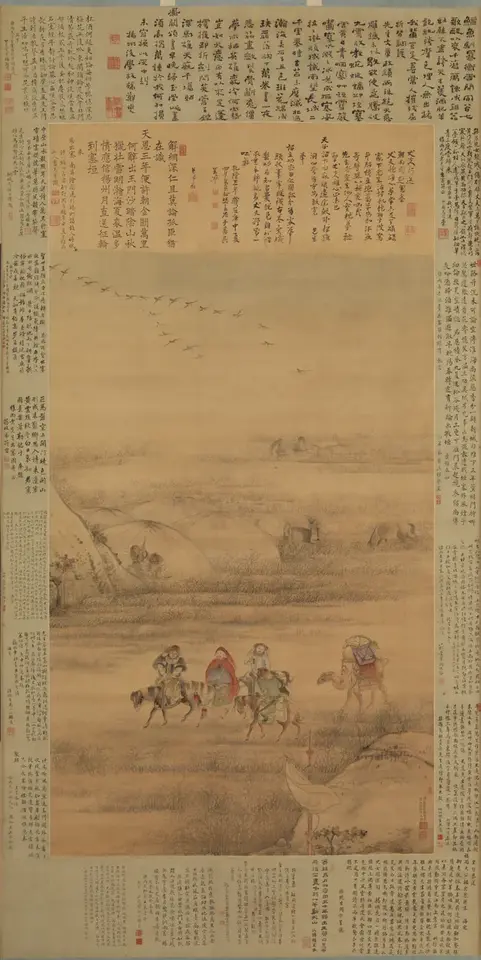
In 1740, the imperial court accepted these unsubstantiated allegations, stripping Lu of his rank and exiling him to the northern frontier. Facing exile with composure, Lu observed military regulations and focused on classical writing, composing the poetic collection Chusai Ji to express his fortitude.
Exoneration and Reappointment to Lianghuai
In 1744, Lu's case was officially reinvestigated and exonerated, prompting the court to reappoint him Magistrate of Luanzhou in Zhili. In 1745, he was promoted to Prefect of Yongping. The Yang River in Yongping frequently breached its embankments during summer flash floods, threatening the county seat of Funing. Lu personally surveyed dangerous breaches and supervised the construction of a stone diversion dam, deflecting torrential floods and protecting the city.
In 1753, Lu was reappointed Salt Distribution Commissioner of Lianghuai, returning to Yangzhou. Yangzhou was low-lying and plagued by silted moats and canals that produced chronic urban flooding. Lu raised funds to dredge the internal canals and exterior moats, fortifying stone embankments to eliminate waterlogging.
Alongside water management, Lu renovated historic landmarks along the Xiao Qinhuai River, restoring the Hongqiao Bridge and surrounding pavilions. In spring 1757, he convened a grand purification gathering (xiuxi) at Hongqiao, hosting prominent literati including Zheng Xie, Chen Zhuan, Li E, Hui Dong, Shen Dacheng, and Chen Zhang. Lu initiated four regulated poems, prompting scholars across Jiangnan to contribute over seven thousand verses compiled into a three-hundred-fascicle anthology that marked a high point of mid-Qing literary culture.
Retirement and Late Life Misfortunes
In 1762, at seventy-three, Lu retired from office, returning to Dezhou to instruct his grandsons and collate rare books. In 1765, during his fourth southern inspection tour, the Qianlong Emperor summoned the retired official, presenting him with a calligraphic plaque inscribed "Elder Hero of Dezhou Waters" to honor his long service.
In 1768, an investigation into extensive salt voucher deficits across the Lianghuai salt administration erupted, involving substantial sums. Because Lu had twice directed the bureau and maintained personal ties with accused officials, he was implicated and arrested, transported to Yangzhou for interrogation. Elderly and weakened by harsh prison conditions, Lu fell ill and passed away in Jiangdu prison. Subsequent investigations directed by Grand Secretary Liu Tongxun confirmed that Lu had not embezzled public funds, resulting in his complete posthumous exoneration.
Major Achievements
Dredging West Lake and Harnessing the Yang River
Throughout his administrative career, Lu prioritized public water conservancy to protect regional communities. In Yingzhou, recognizing that the historical West Lake waterworks established by Ouyang Xiu had been abandoned to private encroachment, Lu overcame regional opposition to re-excavate the reservoir, clearing silted canals and restoring irrigation for miles of farmland.
As Prefect of Yongping, confronting violent flash floods from the Yang River that repeatedly threatened Funing, Lu surveyed the riverbed and organized laborers to construct stone diversion dams that permanently channeled floodwaters, earning him high commendation from Zhili Governor-General Nasutu as an exemplary administrator.
Relieving Distressed Scholars and Literary Patronage
Lu was renowned for generosity toward impoverished scholars, utilizing his official income to support struggling writers across southern China. When novelist Wu Jingzi resided in poverty in Yangzhou without means of subsistence, Lu provided food, clothing, and lodgings, enabling Wu to complete his satirical masterpiece Rulin Waishi (The Scholars).
Following Wu Jingzi's death in an inn, his family lacked the funds to arrange a funeral. Grieved by the loss, Lu provided funds for a coffin, supported Wu's widow and orphans, and financed the transportation of his remains back to his ancestral home for burial. Prominent scholars including Li E, Hang Shijun, Shen Dacheng, and Hui Dong similarly resided as honoured guests in Lu's private academy, pursuing research and writing under his patronage.
Yayutang Congshu and Textual Collation
Inheriting the Duting and Fu Xuan libraries established by his grandfather Lu Shijuan, Lu expanded his Yayu Hall library in Dezhou and Yangzhou, amassing over one hundred thousand fascicles of rare editions, including dozens of Song and Yuan imprints. He employed scholars such as Hui Dong and Shen Dacheng to collate variants.
Lu edited and published the renowned Yayutang Congshu, gathering rare ancient texts including Yiwei Qianzuodu, Zhan'guoce, Shangshu Dachuan, Zhouyi Jijie, and the Shiguwen, providing critical prefaces analyzing textual origins for each work. He also financed the publication of early Qing scholar Zhu Yizun's monumental bibliographical treatise Jingyikao. Scholars such as Fa Shishan praised his editions for their textual accuracy and fine typography, establishing their reputation in Qing bibliographical history.
Textual Defense of Li Qingzhao
In classical textual criticism, Lu was known for rigorous evidential research. Challenging the widespread historical rumor that Song female poet Li Qingzhao had remarried Zhang Ruzhou in her old age, Lu conducted a detailed analysis of Song historical documents and literary miscellanies. He demonstrated that the remarriage claim originated in defamatory gossip created by contemporary political adversaries, restoring Li Qingzhao's historical reputation and initiating the Qing evidential defense of her biography.