Birth in Gusu
Born into the eminent Lu clan of Wu County, displaying early scholarly quietude, mastering the classics, exegesis, and phonology.
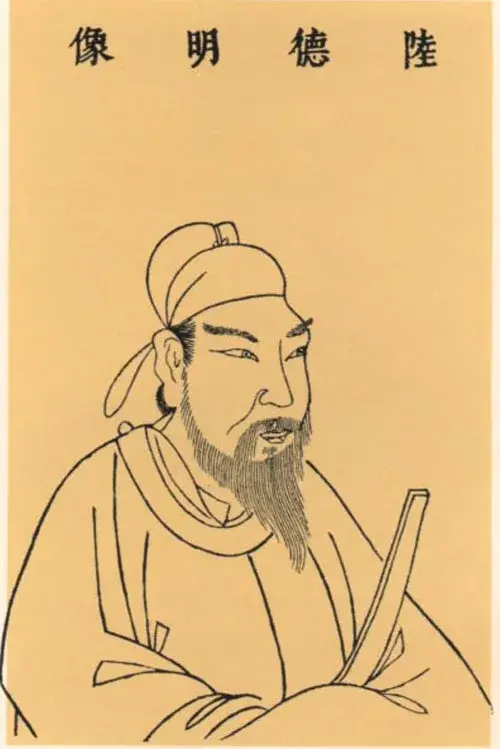
陆德明
Lu Deming (陆德明, 550–630), original given name Yuanlang, commonly known by his courtesy name Deming, was a native of Wu County in Wu Commandery (modern Suzhou, Jiangsu). He was a paramount Confucian classicist, phonetician, and textual critic during the Chen, Sui, and Early Tang dynasties. Descended from the eminent Lu lineage of Wu Commandery, he was quiet, studious, and deeply learned from youth, mastering ancient phonology…
Lu Deming (陆德明, 550–630), original given name Yuanlang, commonly known by his courtesy name Deming, was a native of Wu County in Wu Commandery (modern Suzhou, Jiangsu). He was a paramount Confucian classicist, phonetician, and textual critic during the Chen, Sui, and Early Tang dynasties. Descended from the eminent Lu lineage of Wu Commandery, he was quiet, studious, and deeply learned from youth, mastering ancient phonology and classical exegesis under the Liang-Chen master Zhou Hongzheng. At age twenty, he famously defeated National University Chancellor Xu Ke in a debate on the classics before the Southern Chen court. Serving across the Southern Chen and Sui dynasties as Advisory Counselor and Erudite of the National University, Lu Deming dedicated decades to collating divergent textual readings and regional pronunciations. Following the founding of the Tang, Li Shimin, Prince of Qin, invited him to join his prestigious Literary Hall, honoring him as one of the celebrated Eighteen Scholars of the Prince of Qin and appointing him tutor to Crown Prince Li Chengqian. During the imperial ancestral sacrifice in 624, Lu Deming famously debated Confucian, Buddhist, and Daoist scholars, earning highest praise from Emperor Gaozu and Emperor Taizong. Under Emperor Taizong, he was appointed Erudite of the National University and ennobled as Baron of Wu County. His crowning legacy was the monumental thirty-volume Jingdian Shiwen (Textual Explanations of the Classics), which synthesized the phonetic and textual variants of over two hundred commentators, permanently unifying the phonology and exegetical tradition of the Confucian canons throughout Chinese history.
Born into the eminent Lu clan of Wu County, displaying early scholarly quietude, mastering the classics, exegesis, and phonology.
Attended the imperial lecture at Chengxian Hall at age twenty, refuting Chancellor Xu Ke in public debate.
Entered civil service as Advisory Counselor to Prince Chen Shuling, focusing quietly on collating classical pronunciation.
Relocated to Chang'an after the Sui conquest, appointed Erudite of the National University and Assistant Editorial Director.
Recruited by Li Shimin as Scholar of the Literary Hall, lecturing on classical statecraft and tutoring Prince Li Chengqian.
Refuted Xu Wenyuan, monk Hui Cheng, and Daoist Liu Jinxi at the imperial sacrifice, earning high praise from Emperor Gaozu.
Promoted to Erudite of the National University under Emperor Taizong and ennobled as Baron of Wu County.
Completed the thirty-volume Jingdian Shiwen before passing away in Chang'an, receiving imperial silk gifts for his family.
Lu Deming was born in 550 into the illustrious Lu clan of Wu County, one of the premier aristocratic lineages of the southern dynasties renowned for deep classical erudition and rigorous moral discipline. From childhood, Lu Deming was calm and introspective, shunning frivolous pastimes and dedicating himself entirely to ancient canonical texts. He studied under Master Zhou Hongzheng, the foremost classicist of the Southern Liang and Chen dynasties who synthesized the Three Ritual Classics with Wei-Jin metaphysics.
In 570, during the early Taijian era, the Southern Chen Crown Prince convened the realm's most celebrated scholars at Chengxian Hall to lecture on the classics. At age twenty, Lu Deming attended as a young candidate. National University Chancellor Xu Ke, the most revered classicist in Jiangnan, occupied the podium and dominated the assembly with aggressive rhetorical eloquence, intimidating the assembled scholars. Lu Deming stepped forward alone to challenge Xu Ke. Drawing upon ancient texts, he systematically dismantled Xu Ke's arguments with razor-sharp logic. The debate concluded with Xu Ke unable to respond, stunning the court and earning Lu Deming imperial rewards from Emperor Xuan of Chen.
During the Zhide era, Lu Deming began his official career as Advisory Counselor to Chen Shuling, Prince of Shixing. Although Prince Shuling gathered ambitious literati around him, Lu Deming remained detached from court factions, secluding himself in his study day and night to collect variant readings of the classics. When Prince Shuling was subsequently executed for treason, his associates were punished, but Lu Deming was exonerated due to his spotless integrity and scholarly detachment.
In 589, the Sui Dynasty conquered the Southern Chen, and Lu Deming relocated northward to Chang'an alongside other southern scholar-gentry. Emperor Wen of Sui appointed him Erudite of the National University and subsequently Assistant Editorial Director. During the Sui period, Lu Deming observed that centuries of political division had created massive discrepancies between northern and southern scholarship in script variants, phonological pronunciation, and semantic interpretation. He resolved to undertake a monumental project: synthesizing the commentaries of over two hundred scholars across the Han, Wei, and Six Dynasties to create a unified phonological and exegetical standard.
Following the rise of the Tang Dynasty, Li Shimin, Prince of Qin, established his renowned Literary Hall in 621 to gather the empire's greatest minds. Revered for his profound mastery of the classics, Lu Deming was invited to join as one of the Eighteen Scholars of the Prince of Qin, frequently advising Li Shimin on statecraft and tutoring his eldest son Li Chengqian.
In 624, Emperor Gaozu conducted the grand imperial sacrifice ceremony (Shidian) at the National University. The emperor arranged a public intellectual debate among representatives of the three great teachings: Confucian classicist Xu Wenyuan, Buddhist master Hui Cheng, and Daoist master Liu Jinxi. Each speaker delivered brilliant discourses on their respective doctrines. Lu Deming ascended the podium to debate all three masters sequentially. Demonstrating vast erudition and effortless rhetorical command, he refuted their difficult philosophical paradoxes while harmonizing the ethical truths of the three traditions. Both Emperor Gaozu and Li Shimin expressed boundless admiration, with Gaozu declaring Lu Deming a true universal scholar.
Upon Li Shimin's accession as Emperor Taizong in 626, Lu Deming was elevated to Erudite of the National University, granted special teaching responsibilities for imperial heirs, and ennobled as Baron of Wu County. In this prestigious role, he guided generations of scholars at the National University.
In his final years, Lu Deming finalized his life's masterwork, the thirty-volume Jingdian Shiwen, which had taken more than three decades of meticulous research. Shortly after completing the manuscript in 630, Lu Deming passed away in Chang'an at the age of eighty-one. Emperor Taizong was deeply saddened and issued an imperial edict bestowing generous gifts of silk and cloth upon his family in recognition of his monumental cultural contributions.
Lu Deming's crowning historical monument is the compilation of the thirty-volume Jingdian Shiwen (Textual Explanations of the Classics). Covering fourteen canonical works including the Book of Changes, the Book of Documents, the Book of Songs, the Three Ritual Classics, the Three Commentaries on the Spring and Autumn Annals, the Analects, the Classic of Filial Piety, the Erya, and the Zhuangzi, the text gathered phonological pronunciations and variant character forms from over two hundred scholars across the Han, Wei, and Six Dynasties.
Prior to Lu Deming, Chinese scholarship suffered from severe regional divergence in pronunciation and orthography. The Jingdian Shiwen critically evaluated these divergences, establishing an authoritative phonetic standard that bridged northern and southern intellectual traditions. The work preserved thousands of ancient readings and lost commentaries that would otherwise have vanished, serving as an indispensable compass for subsequent classicists and laying the linguistic foundation for the Tang imperial Five Classics with Correct Meanings (Wujing Zhengyi).
As one of the preeminent members of the Eighteen Scholars of the Prince of Qin, Lu Deming played a crucial role in shaping the cultural and educational institutions of the Early Tang. He provided classical counsel to Li Shimin during the consolidation of the empire and served as official tutor to Crown Prince Li Chengqian. His pedagogical leadership at the National University nurtured a generation of high officials and Confucian scholars who sustained the administrative brilliance of the Zhenguan reign.
FIGURES ASSOCIATED WITH THIS DYNASTY