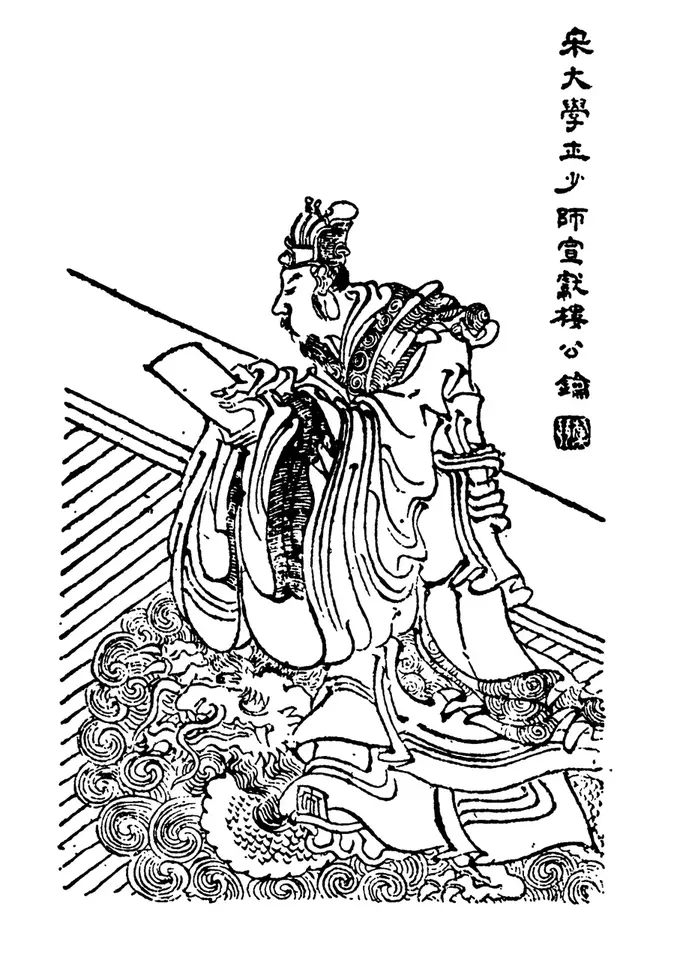
Life and Career
Familial Scholarship and the Northern Embassy
Lou Yue was born into a distinguished scholar-official clan in Yin County, Mingzhou, that exerted profound cultural influence across eastern Zhejiang. His grandfather Lou Yu had amassed a library of over ten thousand volumes along the shores of Moon Lake, while his father Lou Qu rose to Minister of Personnel and Hanlin Academician under Emperor Xiaozong. As the third son of Lou Qu, Lou Yue was immersed in canonical texts, epigraphy, and historical chronicles from early childhood. He pursued rigorous classical studies alongside his kin and contemporaries like Yuan Xie under respected local masters such as Wang Mo and Li Hongjian, establishing a comprehensive grounding in philology and institutional history.
In 1163, at age twenty-seven, Lou Yue passed the provincial and metropolitan examinations, winning his jinshi degree. The celebrated statesman Hu Quan read his examination paper and proclaimed that Lou possessed the refined intellect worthy of a Hanlin Academician. His initial assignments included serving as Professor of Wenzhou, where his lucid pedagogy earned him the deep affection of local scholars. In 1169, during a period awaiting imperial assignment, Lou Yue was selected to accompany his maternal uncle, Vice Minister of Personnel Wang Dayou, on an imperial diplomatic embassy to congratulate the Jurchen Jin court on New Year's Day.
Over thousands of miles traversing the Central Plains, Lou Yue meticulously observed topography, fortifications, administrative structures, and the conditions of Han residents under Jurchen subjugation. Recording his experiences day by day, he produced the two-fascicle Diary of the Northern Mission. The work presented an unvarnished chronicle of wartime devastation, abandoned farmlands, and cultural ruin across northern China, infused with profound patriotic grief over the partitioned empire, becoming one of the most vital geographic and diplomatic records preserved from the Southern Song period.
Outspoken Remonstrance and Imperial Drafting
During the Chunxi era of Emperor Xiaozong, Lou Yue served in various regional and central posts, including Vice Prefect of Taizhou, Assistant Minister of the Imperial Clan Court, and Prefect of Wenzhou. Throughout these provincial tenures, he implemented benevolent policies, repaired seawalls, curbed local corruption, and audited fiscal accounts with exemplary fairness. Upon the accession of Emperor Guangzong, Lou was recalled to Lin'an, serving as Director in the Ministry of Rites, Vice Minister of the Court of the Imperial Treasury, and Imperial Diarist concurrently acting as Secretariat Drafter. Observing early court volatility, Lou submitted earnest memorials urging the sovereign to conserve national strength, lighten taxes, and maintain administrative discipline.
Operating within the inner court, Lou Yue was renowned for uncompromising frankness. He spoke with complete candor regardless of royal displeasure, prompting Emperor Guangzong to remark with genuine reverence: "Secretariat Drafter Lou is upright and principled; whenever he steps forward to advise, I myself feel a deep sense of awe!" He was soon elevated to Supervising Secretary, exercising vital veto powers over imperial proclamations.
In 1194, when Emperor Guangzong's protracted mental illness and refusal to attend the funerary rites of his father plunged the court into paralysis, grand councilor Zhao Ruyu orchestrated the abdication of Guangzong and the enthronement of Emperor Ningzong. At this perilous moment, Lou Yue was commissioned overnight to draft the imperial abdication edict. Lou applied consummate literary skill, framing the dynastic transition with graceful restraint and filial dignity. His text reassured the empire and quieted political factions, winning universal admiration across the bureaucracy.
Defiance of Han Tuozhou and Thirteen Years of Seclusion
Following the accession of Emperor Ningzong, Lou Yue wielded supreme authority over imperial secretarial pronouncements, drafting major state decrees, royal investitures, and sacrificial liturgies. His diction was majestic, balanced, and steeped in classical decorum, establishing him as the foremost secretarial stylist of his era. He was soon promoted to Supervising Secretary and Acting Minister of Personnel, serving as imperial lecturer to Emperor Ningzong.
However, political equilibrium disintegrated as the imperial relative Han Tuozhou consolidated dictatorial control, purging Grand Councilor Zhao Ruyu and targeting Neo-Confucian intellectuals. Han sought to recruit the prestigious Lou Yue into his political clique, but Lou sternly declined. When Zhu Xi was dismissed from his post as imperial lecturer for criticizing Han's overreach, courtiers remained terrified into silence. Alone on the palace steps, Lou Yue submitted an impassioned memorial defending Zhu Xi as an irreplaceable national scholar and begging the throne to retain him.
Lou's unbending resistance provoked Han Tuozhou's fury. In 1196, Han launched the Qingyuan Proscription against "false learning," placing Lou Yue on the official blacklist. Stripped of central office, he was demoted to regional posts in Wuzhou and Ningguo, and subsequently deprived of all honorary sinecures. Unshaken by persecution, Lou returned to his ancestral home beside Moon Lake in Ningbo, retreating to his library tower to read, write, and instruct disciples, living in private seclusion for thirteen years.
Leadership in the Bureau of Military Affairs and Late Career
In 1207, Han Tuozhou was assassinated following the disastrous collapse of his northern military campaign, bringing an end to the Qingyuan Proscription. The seventy-one-year-old Lou Yue was summoned back to Lin'an with the highest honors. Emperor Ningzong appointed him Hanlin Academician, Minister of Personnel, and Lecturer in Waiting. In 1208, he was promoted to Associate Commissioner of the Bureau of Military Affairs and subsequently Co-Administrator, entering the supreme military council.
In 1209, Lou was elevated to Assistant Grand Councilor and Grand Academician of the Zizheng Hall. In central administration, Lou labored to rectify institutional damage wrought by the preceding dictatorship, rebuilding frontier defenses and promoting scholars who had been suppressed during the purges. When dealing with colleagues, he was courteous and modest, yet resolute on matters of state integrity, often moderating the autocratic tendencies of Grand Councilor Shi Miyuan.
In 1213, Lou Yue fell gravely ill at his official residence and passed away at the age of seventy-seven. Deeply grieved, Emperor Ningzong suspended court audiences, posthumously conferred upon him the rank of Junior Preceptor, and granted the illustrious posthumous name Xuanxian in recognition of his lifelong devotion to dynastic virtue.
Major Achievements
Defining the Dynastic Secretarial Style and the Collected Works of Gongkui
Lou Yue stands as one of the preeminent masters of official rhetoric in Song Dynasty literary history. Presiding over the Drafting Office and Hanlin Academy under Emperors Guangzong and Ningzong, he authored virtually all paramount state documents. His imperial edicts integrated profound classical exegesis with lucid, dignified prose, rectifying the obscure affectation and shallow ornamentation of earlier decades to establish the definitive model of imperial pronouncement. His massive 120-fascicle Collected Works of Gongkui preserved extensive diplomatic correspondence, funerary inscriptions, and institutional analyses, constituting an indispensable source for the study of Song history.
Historical Eyewitness in the Diary of the Northern Mission
Lou Yue's two-fascicle Diary of the Northern Mission is an enduring masterpiece of Chinese historical geography and diplomatic literature. Documenting his embassy to the Jin capital, he recorded with journalistic precision the condition of provincial garrisons, geographic passes, and administrative shifts across the divided empire. Beyond its topographic utility, the text provided a moving eyewitness testament to the suffering of northern Chinese under foreign rule, embodying the historical anguish of loyalist intellectuals.
Assembling the "East Tower" Library to Educate the Realm
Lou Yue played a transformative role in Chinese bibliographical history. Expanding upon his grandfather's collection, he constructed the "East Tower" library along Moon Lake, assembling over ten thousand volumes of rare manuscripts and woodblock editions. Demonstrating exceptional philological discipline, he personally collated and transcribed more than half of the holdings, mobilizing his household to verify textual variants. Unlike reclusive collectors who hoarded texts, Lou made his library freely accessible to scholars, eagerly loaning manuscripts to aspiring students and fostering a brilliant cultural flowering across eastern Zhejiang.
Uncompromising Rectitude and Defense of Zhu Xi
Lou Yue embodied the highest moral integrity of Southern Song scholar-officials. Confronted with the rising tyranny of Han Tuozhou, he refused all inducements to join the ruling faction. At the outbreak of the Qingyuan Proscription, he risked execution to defend Zhu Xi before the throne. Enduring thirteen years of political banishment without complaint, his life stood as an unblemished testament to Confucian fortitude and loyalty.