Birth in Shanyin
Born a posthumous child in Shanyin, Shaoxing; reared in ascetic poverty by his widowed mother and grandfather.
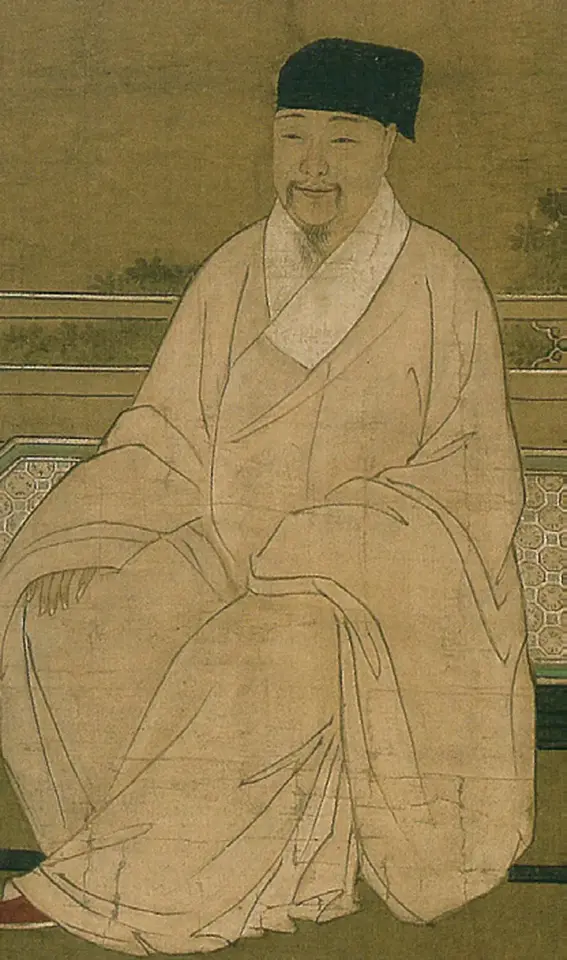
刘宗周
Liu Zongzhou (刘宗周, 1578–1645), courtesy name Qidong, literary name Niantai, honored by scholars as Master Jishan (Jishan Xiansheng), was a native of Shanyin in Shaoxing Prefecture, Zhejiang (modern Yuecheng District, Shaoxing). He was a paramount philosopher, moral theorist, and senior statesman of the late Ming Dynasty, the founding architect of the Jishan School, and the revered preceptor of early Qing philosopher Huang…
Liu Zongzhou (刘宗周, 1578–1645), courtesy name Qidong, literary name Niantai, honored by scholars as Master Jishan (Jishan Xiansheng), was a native of Shanyin in Shaoxing Prefecture, Zhejiang (modern Yuecheng District, Shaoxing). He was a paramount philosopher, moral theorist, and senior statesman of the late Ming Dynasty, the founding architect of the Jishan School, and the revered preceptor of early Qing philosopher Huang Zongxi. Orphaned before birth and reared in Spartan simplicity by his widowed mother, Liu obtained the metropolitan graduate (jinshi) degree in 1601 during the Wanli reign. Serving across the reigns of Wanli, Tianqi, Chongzhen, and the Southern Ming Hongguang emperor, he rose to Left Censor-in-Chief of the Censorate. Uncompromising in moral conviction and fearless in remonstrance, Liu repeatedly challenged imperial authority and autocratic corruption. In the Tianqi era, he denounced the usurpations of the eunuch dictator Wei Zhongxian, suffering dismissal and narrowly escaping execution. Recalled under Emperor Chongzhen, he memorialized dozens of times warning against arbitrary executions, excessive taxation, and reliance on court eunuchs, fearlessly impeaching Senior Grand Secretary Wen Tiren and War Minister Yang Sichang. Appointed Left Censor-in-Chief under the Hongguang court in Nanjing, he resigned in protest against the corruption of Ma Shiying and Ruan Dacheng, retiring to Jishan Academy to teach disciples. In philosophical thought, Liu harmonized the orthodox Cheng-Zhu school's investigation of things with Wang Yangming's intuitionism, establishing the Jishan School centered upon the doctrine of "vigilance in solitude" (shendu) and sincere moral intention (chengyi). In July 1645, following the Qing capture of Nanjing, Hangzhou, and Shaoxing, Liu refused to submit to the foreign conquerors or shave his hair. He declared a hunger strike, refusing all food and water for twenty consecutive days before dying peacefully in a seated meditative posture at the age of sixty-eight. He was posthumously honored with the name "Zhongduan" and enshrined in the Confucian Temple.
Born a posthumous child in Shanyin, Shaoxing; reared in ascetic poverty by his widowed mother and grandfather.
Passed the metropolitan civil examination with the jinshi degree, appointed messenger in the Messenger Office.
Promoted to Vice Minister of the Court of Imperial Entertainments; submitted memorials demanding the dismissal of Wei Zhongxian.
Following the purge of the eunuch faction, recalled as Governor of Shuntian and elevated to Left Vice Minister of Works.
Dismissed after impeaching Senior Grand Secretary Wen Tiren and Yang Sichang; established Jishan Academy in Shaoxing.
Recalled to Beijing as Left Censor-in-Chief to rectify administrative discipline and purge bureaucratic corruption.
Following Beijing's fall, accepted appointment as Left Censor-in-Chief in Nanjing; resigned over factional malfeasance.
Following the fall of Shaoxing to Qing forces, starved himself for twenty days, dying in righteous protest at age sixty-eight.
Liu Zongzhou was born in Shanyin County, Shaoxing Prefecture, into an impoverished literati household. His father passed away several months prior to his birth, rendering Liu a posthumous child. His mother, Lady Zhang, widowed at the age of twenty-four, dedicated herself to weaving and needlework to support her son's classical education. Reared in extreme frugality, Liu developed an unyielding, introspective, and dignified character.
Under the tutelage of his maternal grandfather Zhang Ying, Liu immersed himself in the Confucian canons, drawing profound inspiration from Song Neo-Confucian masters Zhou Dunyi, the Cheng brothers, and Zhu Xi. In 1601, at the age of twenty-four, Liu traveled to Beijing and passed the metropolitan examination with distinction, receiving the jinshi degree and an appointment as Messenger. Soon afterward, his mother died. Liu withdrew from office to observe three years of mourning beside her grave, his profound filial piety moving the regional community.
During the late Wanli era, factional discord paralyzed imperial governance. Upon the accession of Emperor Tianqi in 1621, Liu was summoned back to officialdom as Vice Minister of the Court of Imperial Entertainments.
At court, the Grand Eunuch Wei Zhongxian grasped absolute power, terrorizing honest officials with the assistance of the palace wet-nurse, Lady Ke. Viewing the realm as teetering on the precipice of ruin, Liu submitted his celebrated memorial Memorial on Cultivating Virtue to Achieve Governance, fearlessly criticizing the young emperor's indolence and demanding the immediate expulsion of Wei Zhongxian and Lady Ke. Wei was beside himself with fury, weeping before the throne and securing an imperial reprimand and salary forfeiture for Liu.
In 1624, when Donglin stalwarts Yang Lian and Zuo Guangdou submitted memorials enumerating Wei Zhongxian's twenty-four capital crimes, Wei unleashed the Imperial Bodyguard to execute Donglin literati. Liu immediately memorialized in defense of Yang Lian. Enraged, Wei fabricated an edict stripping Liu of all ranks and honors, dispatching assassins to stalk him. Liu departed quietly, returning safely to his native village in Shaoxing.
In 1628, the Chongzhen Emperor mounted the throne, executing Wei Zhongxian and rehabilitating purged officials. Liu was appointed Governor of Shuntian and subsequently elevated to Left Vice Minister of Works.
Although Emperor Chongzhen was diligent, his suspicious and volatile nature led to frequent purges of ministers and disastrous strategic vacillations. In imperial audiences, Liu repeatedly urged the sovereign to embrace patience and moral self-cultivation rather than punitive severity. He submitted over twenty memorials impeaching Senior Grand Secretary Wen Tiren for factional tyranny and attacking War Minister Yang Sichang's "Ten-Sided Net" strategy for bankrupting the peasantry through crushing military surtaxes. Displeased by his blunt reproaches, Chongzhen dismissed Liu on multiple occasions.
During his periods of forced retirement, Liu established the Jishan Academy at the foot of Mount Jishan in northern Shaoxing. Scholars from across the lower Yangtze assembled to attend his lectures. Brilliant thinkers including Huang Zongxi, Chen Que, and Zhu Yuan became his disciples, transforming the Jishan School into an intellectual fortress of late Ming scholarship.
In 1642, following the disastrous defeat at the Battle of Songjin and the rapid expansion of Li Zicheng's peasant rebellion, Chongzhen recalled Liu as Left Censor-in-Chief. Liu traveled to the besieged capital, executing corrupt censors and memorializing for the elimination of eunuch military overseers. Recognizing that the dynastic crisis was irreversible, he resigned and returned south.
In April 1644, Li Zicheng captured Beijing, and Emperor Chongzhen hanged himself on Meishan. In May, Southern Ming loyalists in Nanjing installed Zhu Yousong (the Prince of Fu) as the Hongguang Emperor, appointing Liu as Left Censor-in-Chief.
Arriving in Nanjing, Liu discovered that court favorites Ma Shiying and Ruan Dacheng were selling offices and factionally persecuting rivals while regional warlords acted with lawless impunity. Liu submitted memorial after memorial advocating military preparedness and institutional reform, fiercely condemning the court's moral degradation. Met with bitter intrigue, Liu sighed: "The dynastic enterprise is beyond salvation!" He resigned and returned to Shaoxing.
In May 1645, Qing forces under Prince Dodo crossed the Yangtze, capturing Nanjing. In June, Hangzhou fell and Qing cavalry advanced on Shaoxing. Upon hearing the news, Liu attempted suicide by drowning but was rescued by his household. On the eighth day of the intercalary sixth month, Qing soldiers occupied Shaoxing. Liu closed his courtyard gates, refused audience to imperial collaborationist officials, and announced a hunger strike unto death.
As disciples led by Huang Zongxi wept beside his couch, begging him to take water, Liu remained seated upright, copying Tao Yuanming's elegiac verse and writing his final testament: "Weeping blood in the desolate grass, I preserve solitary fidelity. Heaven, earth, and divine spirits bear witness to this sorrow." On the twentieth day of his fast, Liu adjusted his robes, folded his hands, and closed his eyes forever at the age of sixty-eight.
Liu Zongzhou is revered in Chinese intellectual history as the moral conscience of the late Ming and the ultimate embodiment of scholar-official integrity.
His disciple Huang Zongxi wrote in his biographical account The Life of Master Liu: "The master's philosophy took vigilance in solitude (shendu) as its core. His conduct was as august as divine spirits; his spirit as warm as spring sunshine. Amidst the decay of the late Ming, he stood alone against the raging tide, writing his name in martyrs' blood—truly an incomparable exemplar across a thousand years!"
Qing scholar Quan Zuwang concluded in Records of the Jishan School: "The ultimate summation of Ming Neo-Confucianism resides within Master Jishan alone. His martyrdom by twenty days of fasting shines with unyielding moral majesty down the centuries!"
Modern intellectual historians observe that Liu's synthesis of Zhu Xi's epistemic discipline and Wang Yangming's moral intuitionism produced a rigorous philosophy of conscientious introspection, providing the tragic yet glorious intellectual finale of Song-Ming Neo-Confucian thought.
FIGURES ASSOCIATED WITH THIS DYNASTY