Goguryeo Expedition
Served under the Sui banner during Emperor Yang's invasion of Goguryeo, promoted to garrison colonel.
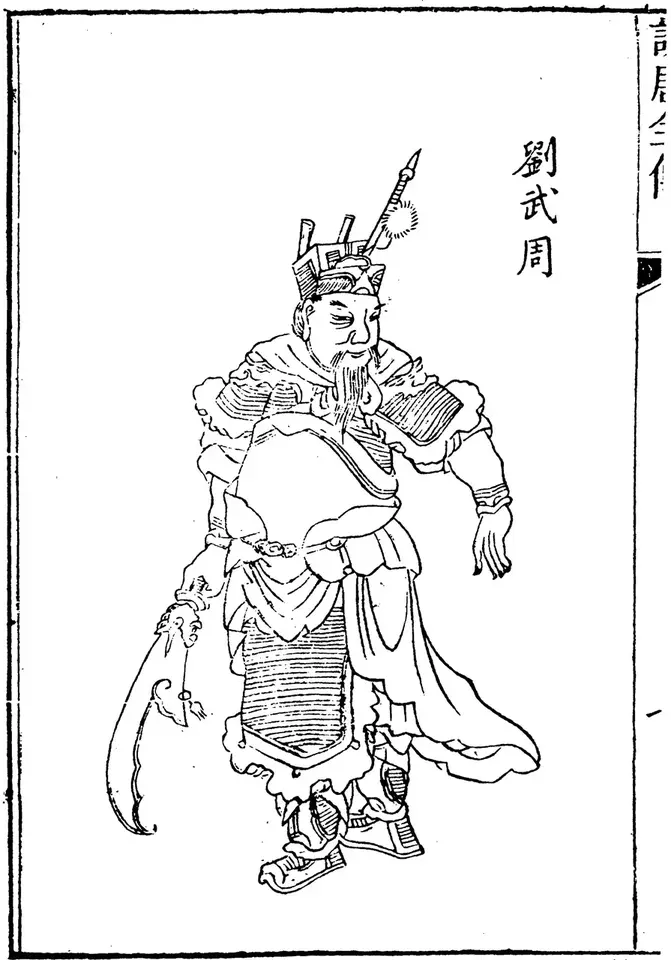
刘武周
Liu Wuzhou (刘武周, ?–620) was a prominent northern warlord and ruler of the Dingyang regime during the transition from the Sui dynasty to the Tang dynasty. Hailing ancestrally from Jingcheng in Hejian and later settling in Mayi (modern Shuozhou, Shanxi Province), he was famed for his physical bravery, mounted archery, and charismatic leadership among local warriors. Serving under Sui general Yang Yichen during campaigns…
Liu Wuzhou (刘武周, ?–620) was a prominent northern warlord and ruler of the Dingyang regime during the transition from the Sui dynasty to the Tang dynasty. Hailing ancestrally from Jingcheng in Hejian and later settling in Mayi (modern Shuozhou, Shanxi Province), he was famed for his physical bravery, mounted archery, and charismatic leadership among local warriors. Serving under Sui general Yang Yichen during campaigns against agrarian uprisings and taking part in Emperor Yang's expeditions against Goguryeo, Liu was appointed Colonel of the Soaring Falcon Garrison in Mayi. In 617, amidst widespread famine and peasant uprisings, Liu assassinated the intransigent Mayi Governor Wang Rengong, opened imperial granaries to feed starving refugees, and raised an army of tens of thousands. Recognizing the overwhelming power of the Eastern Turkic Khaganate, he submitted to Shibi Khan, receiving the title "Dingyang Khan" and a wolf-head banner, and subsequently proclaimed himself Emperor under the era name Tianxing. In 619, reinforced by his premier general Song Jingang, Liu launched a massive southern campaign into Hedong, seizing Taiyuan, routing Tang forces under Prince of Qi Li Yuanji and Chancellor Pei Ji, and threatening Guanzhong across the Yellow River. In 620, Qin Prince Li Shimin launched a decisive counteroffensive, defeating Song Jingang at Baobi and Queshugu. Liu fled north into the Eastern Turkic Khaganate, where he was slain later that year following a failed attempt to return to Mayi.
Served under the Sui banner during Emperor Yang's invasion of Goguryeo, promoted to garrison colonel.
Assassinated Mayi Governor Wang Rengong, opened granaries, and rebelled against the Sui dynasty.
Formed an alliance with Shibi Khan, receiving the title Dingyang Khan and assuming the imperial title.
Captured Fenyang Palace, sending captured palace maidens and treasures to the Turkic court.
Welcomed defeated northern commander Song Jingang, granting him the title King of Song to spearhead southern operations.
Invaded Hedong, routing Li Yuanji and capturing the historic northern capital of Jinyang (Taiyuan).
Annihilated the Tang relief army commanded by Chancellor Pei Ji at Duosuo Field.
Confronted Tang forces led by Li Shimin, who established fortified lines at Baobi.
Suffered total collapse against Li Shimin's cavalry at Queshugu and Jiexiu, abandoning Hedong.
Fled into the Eastern Turkic Khaganate; executed by the Turks after plotting to reclaim Mayi.
Liu Wuzhou was born into a wealthy merchant and gentry family in Mayi, his father Liu Kuang having served as a Sui civil official. From an early age, Liu was renowned for his martial prowess, physical agility, and passion for martial fellowship. He spent lavishly to entertain outlaws and local champions, prompting his elder brother Liu Shanbo to warn him that his reckless generosity would bring ruin upon their clan.
During the Daye era of Emperor Yang of Sui, Liu enlisted in the army of Grand Master of the Imperial Stud Yang Yichen, fighting against peasant rebels in Henan and Hebei. Promoted to Adjutant of the Construction Battalion, he subsequently took part in all three campaigns against Goguryeo in Liaodong, distinguishing himself as a fearless shock commander. Upon returning west, he was appointed Colonel of the Soaring Falcon Garrison in Mayi.
By 616, severe drought and exorbitant taxes plunged northern Shanxi into catastrophic famine. Mayi Governor Wang Rengong hoarded grain in fortified granaries and refused to relieve the starving populace, while harshly executing dissenters. Liu Wuzhou, who had conducted a secret affair with one of Wang's concubines and feared discovery, coordinated secretly with garrison officers Zhang Ziyu and Gao Peng to prepare an armed uprising.
In the second month of 617, starving townsmen gathered outside the Mayi administrative compound. Liu Wuzhou led several dozen armed conspirators into the provincial hall under the pretext of reporting military intelligence. Denouncing Wang Rengong for callous cruelty, Liu drew his sword and decapitated the governor in full view of the assembled officials. He immediately opened the imperial granaries, feeding thousands of starving peasants and recruiting an army of over ten thousand men within days.
Cognizant of his isolated geographical position between the collapsing Sui court and the formidable Eastern Turkic Khaganate, Liu dispatched envoys to Shibi Khan, offering tribute and submission. Pleased by this strategic submission, Shibi Khan bestowed upon him the title "Dingyang Khan" alongside a wolf-head battle standard and one thousand warhorses.
With Turkic cavalry support, Liu seized Loufan Commandery, stormed the imperial palace at Loufan, and raided the luxurious Fenyang Palace, capturing vast stores of gold, brocade, and imperial concubines, which he sent as tribute to the Turkic khagan. Later that year, Liu erected a sacrificial altar at Mayi, proclaimed himself Emperor of Dingyang, and declared the era name Tianxing.
In 618, northern warlord Song Jingang suffered a severe defeat against Yizhou forces and retreated south to seek refuge. Recognizing Song's strategic brilliance and cavalry command, Liu warmly received him, invested him as the King of Song, and entrusted him with the supreme field command of the Dingyang army. Song advised Liu to consolidate Shanxi, capture the ancestral Tang base at Taiyuan, and march south into Guanzhong.
In the third month of 619, Liu and Song launched an all-out offensive into Hedong. The Dingyang army swept through Pingyao and Jiexiu, threatening Jinyang. Tang Gaozu dispatched Prince of Qi Li Yuanji to hold Taiyuan, but Li Yuanji panicked, abandoned his post under cover of darkness, and fled back to Chang'an. Liu Wuzhou entered Jinyang in triumph, establishing his headquarters in the Tang prince's palace.
In autumn 619, Tang Gaozu sent Chancellor Pei Ji with tens of thousands of infantry and cavalry to recover Hedong. Song Jingang ambushed the imperial army at Duosuo Field near Jiexiu, inflicting a catastrophic defeat. Pei Ji fled alone on horseback, while Liu's army captured Jinzhou, Jiangzhou, and Longmen. Looking across the Yellow River toward Chang'an, Liu Wuzhou threatened the very existence of the fledgling Tang dynasty, prompting Tang Gaozu to draft an order proposing the abandonment of all territories east of the Yellow River.
In November 619, Qin Prince Li Shimin volunteered to lead the Tang armies across the frozen Yellow River. Stationing his forces in an impregnable fortified camp at Baobi, Li Shimin recognized that the Dingyang army relied entirely on plundered provisions and held extended supply lines back to Mayi. Li Shimin strictly forbade pitched battles, deploying mobile cavalry to intercept Dingyang foraging parties.
By April 620, having exhausted all available grain, Song Jingang's army began slaughtering its warhorses for meat. Facing imminent starvation, Song initiated a general retreat north. Li Shimin immediately unleashed the Tang heavy cavalry, pursuing the retreating enemy day and night through the narrow mountain defile of Queshugu. In twenty-four hours, Li Shimin fought eight consecutive battles, routing the enemy at every turn. At the Battle of Jiexiu, the Dingyang army was utterly destroyed, with over twenty thousand soldiers slain or captured.
Hearing of the catastrophe, Liu Wuzhou panicked, abandoned Jinyang, and fled with a few hundred mounted retainers across the northern border to seek asylum among the Eastern Turks. Despondent and humiliated in the Turkic camp, Liu secretly plotted with his remaining officers to escape back to Mayi to raise another army. The conspiracy was betrayed to the Turkic khagan, who dispatched horsemen to surround Liu's tent. Liu Wuzhou was slain in the northern steppes in August 620, ending his bid for imperial power.
Liu Wuzhou demonstrated exceptional opportunism and leadership in transforming an isolated garrison uprising at Mayi into a formidable regional empire. By securing the patronage of the Eastern Turkic Khaganate, he dominated northern Shanxi for over three years, checking both Sui imperial forces and the early expansion of the Tang dynasty.
His coordinated military campaign in 619, spearheading the conquest of Taiyuan and the annihilation of Tang armies under Li Yuanji and Pei Ji, stood as one of the most threatening strategic assaults faced by the early Tang dynasty, showcasing advanced operational coordination with nomadic cavalry.
FIGURES ASSOCIATED WITH THIS DYNASTY