Birth in Jiashan
Born into a destitute family in Jiashan, Zhejiang; sold in childhood to the Gui courtyard in Shengze.
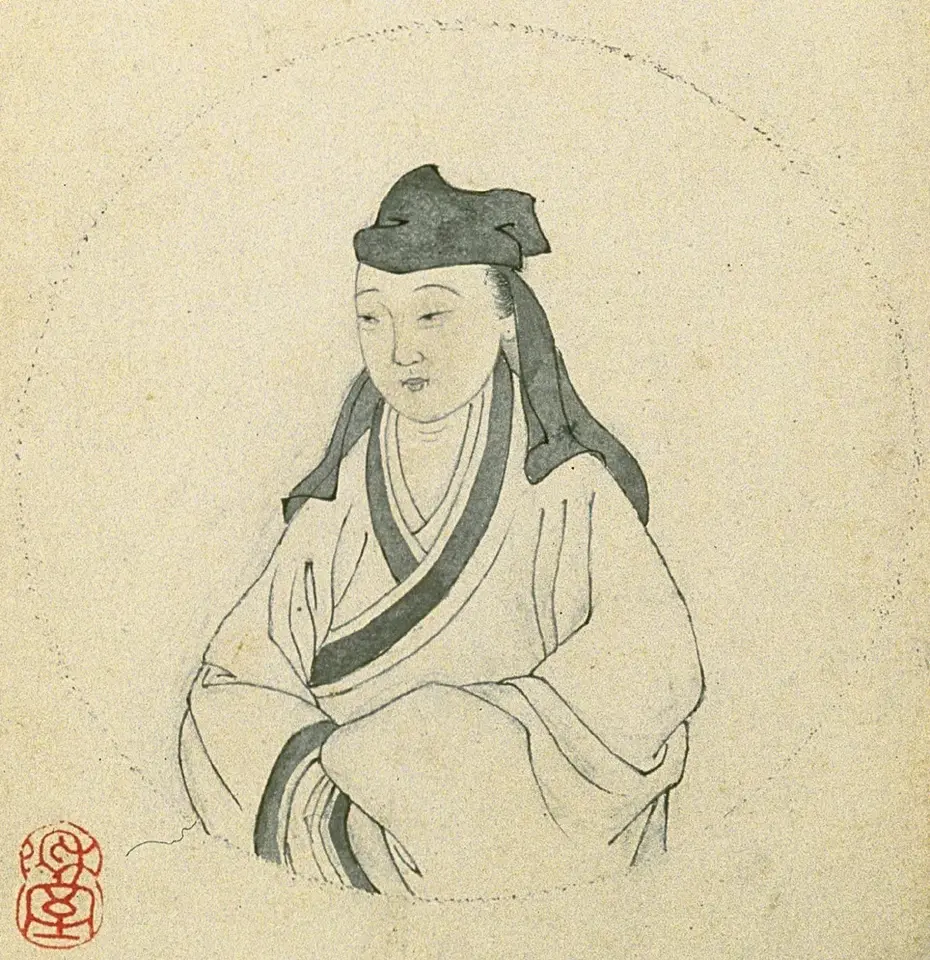
柳如是
Liu Rushi (柳如是, 1618–1664), originally named Yang Ai, later renamed Liu Yin, courtesy names Rushi and Miwu, art names Hedong Jun and Wowen Jushi, was a native of Jiashan County, Jiaxing Prefecture, Zhejiang. She was an extraordinary female poet, essayist, calligrapher, and landscape painter of the late Ming and early Qing periods, ranked foremost among the celebrated "Eight Beauties of Qinhuai" (Qinhuai Bayan), and a heroic…
Liu Rushi (柳如是, 1618–1664), originally named Yang Ai, later renamed Liu Yin, courtesy names Rushi and Miwu, art names Hedong Jun and Wowen Jushi, was a native of Jiashan County, Jiaxing Prefecture, Zhejiang. She was an extraordinary female poet, essayist, calligrapher, and landscape painter of the late Ming and early Qing periods, ranked foremost among the celebrated "Eight Beauties of Qinhuai" (Qinhuai Bayan), and a heroic woman renowned for uncompromising dynastic integrity. Born into poverty, Liu Rushi was sold in early youth into the Gui family pleasure quarters in Shengze, Wujiang, where she studied literature, calligraphy, and painting under the renowned courtesan Xu Fo. During the Chongzhen reign, she resided in Songjiang, frequently dressing in male scholar attire to mingle with Fushe and Jishe scholars including Chen Zilong, Song Zhengyu, and Li Cunwo, cohabiting in Nanlou with Chen Zilong to compose poetry before separation due to ritual propriety. In the winter of 1640, she sailed alone to Changshu to visit cultural arbiter Qian Qianyi, former Vice Minister of Rites. Awe-struck by her intellect, Qian married her in 1641 with ceremonies reserved for principal wives, building the "I-Have-Heard Room" (Wowen Shi) and Crimson Cloud Tower (Jiangyun Lou) for her study, prompting contemporaries to call her "Scholar Liu." In 1645, as Qing armies breached Nanjing, Liu Rushi urged Qian Qianyi to commit suicide for the falling dynasty, attempting to drown herself in a lotus pond when he hesitated. When Qian temporarily submitted to the Qing, she refused to accompany him north; after he returned south, she orchestrated his secret anti-Qing resistance, pawning her jewelry to fund armies under Koxinga (Zheng Chenggong) and Zhang Huangyan. In 1664, after Qian Qianyi passed away, predatory clan members attempted to seize her estate; Liu Rushi hanged herself to protect her daughter and property at age forty-seven. Renowned twentieth-century historian Chen Yinke devoted ten years to authoring the 800,000-word An Alternative Biography of Liu Rushi, lauding her "independent spirit and free intellect."
Born into a destitute family in Jiashan, Zhejiang; sold in childhood to the Gui courtyard in Shengze.
Resided in Songjiang under the alias Yinglian, donning male scholar attire to interact with literati.
Formed a profound romance with loyalist scholar Chen Zilong, cohabiting in Nanlou and composing poetry.
Sailed alone in male scholar robes to Changshu to call upon literary titan Qian Qianyi.
Married Qian Qianyi with principal-wife ceremonies, taking residence in the Crimson Cloud Tower.
Nanjing fell; urged Qian Qianyi to martyr himself and attempted suicide in a lotus pond when he hesitated.
After Qian was imprisoned in the Huang Yuqi case, mobilized resources to secure his release and funded resistance fighters.
Following Qian's death, resisted rapacious clan members extorting her estate, hanging herself at age forty-seven.
Liu Rushi was born in 1618 into a destitute household in Jiashan County, Jiaxing Prefecture, Zhejiang, originally named Yang Ai. Uprooted by family hardship in infancy, she was kidnapped and sold to the Gui family courtesan house in Shengze, Wujiang. Shengze was a bustling silk weaving center, and the Gui residence trained young female entertainers.
Intelligent and naturally graceful, young Liu was taken under the wing of eminent courtesan Xu Fo. Under Xu Fo's strict tutelage, Liu mastered classical Confucian poetry, histories, and prose, acquiring exceptional skill in freehand ink-wash flower painting and running-cursive calligraphy. Enduring worldly hardship from youth forged in her a proud, fearless disposition far transcending ordinary female conventions. Later, she was purchased as a concubine into the mansion of former Grand Secretary Zhou Daodeng; her intellect won Zhou's favor, arousing jealousy among older consorts who framed her, forcing her expulsion into the floating world of courtesans in Songjiang at age fourteen.
In 1632, fourteen-year-old Liu Rushi settled in Songjiang. Observing the callousness of society, she adopted the name "Liu Rushi," inspired by Song poet Xin Qiji's famous verse: "I see the green hills are charming, and reckon the green hills must see me likewise." She also assumed the art name "Yinglian" (Pitying Shadows) to express solitary self-reflection in turbulent times.
In Songjiang's vibrant intellectual atmosphere, Liu Rushi cast aside traditional gender constraints. Wearing scholar caps and Confucian robes, she moved freely among young literati. At the time, figures like Xia Yunyi, Chen Zilong, and Song Zhengyu had founded the Jishe (Restoration Society branch), allied with Zhang Pu's nationwide Fushe. Possessing political vision, Liu debated historical rise and fall and contemporary statecraft during gatherings, astonishing male literati with her eloquence.
In 1635, Liu fell in love with Jishe leader Chen Zilong. Blessed with mutual intellectual passion, they cohabited in the "South Tower" (Nanlou) in Songjiang, writing verse and editing the poetry collection Youyou Ji. However, strict Confucian clan hierarchies barred their union; Chen's principal wife led family members to disrupt Nanlou. Though deeply attached to Chen, Liu's fierce pride rejected subjugation as a secondary concubine, prompting her to pack her belongings and sail away. Chen Zilong later threw himself into the river as a loyalist martyr resisting Qing invaders.
In 1638, traveling on West Lake in Hangzhou, Liu met Qian Qianyi, former Vice Minister of Rites and paramount leader of the late-Ming literary world. In the winter of 1640, dressed in male scholar robes, Liu sailed her solitary skiff to Mount Yu in Changshu, delivering her visiting card at Qian's Banve Hall. Reading her poetry, Qian was captivated by her transcendent genius and expansive worldview.
In 1641, fifty-nine-year-old Qian Qianyi defied contemporary social taboos by marrying twenty-three-year-old Liu Rushi on a decorated barge in Suzhou with rites reserved for principal wives. Drawing upon the Buddhist sutra phrase "Thus have I heard" (rushi wowen), Qian built the "I-Have-Heard Room" in Changshu, followed by the majestic Crimson Cloud Tower (Jiangyun Lou), housing tens of thousands of Song and Yuan rare editions and antiquities. Liu assisted Qian in collating texts and compiling Ming dynastic chronicles. Observing her masculine erudition, Qian affectionately addressed her as "Scholar Liu."
In 1644, the Ming empire collapsed as Emperor Chongzhen hanged himself on Meishan. In May, the Prince of Fu established the Southern Ming Hongguang regime in Nanjing. Liu Rushi urged Qian Qianyi to accept the appointment of Minister of Rites, accompanying him in military dress in hopes of revitalizing imperial river defenses.
In May 1645, Prince Dodo led Qing cavalry across the Yangtze, capturing Nanjing. On the eve of surrender, Liu Rushi confronted Qian Qianyi: "The state is ruined; as a leading minister of the realm, you should uphold righteous martyrdom and plunge into the water to repay our sovereign!" Qian hesitated, walking slowly to the lotus pond. Touching the water with his hand, he demurred: "The water is too cold; one cannot jump in." Disgusted by his cowardice, Liu denounced his capitulation and hurled herself toward the deep pond to die for the dynasty. Panicked, Qian and servants grabbed her clothes, dragging her drenched body back to shore. When Qian shaved his hair and submitted to the Qing court in Beijing, Liu refused to accompany him north, staying in Changshu to disassociate herself from his surrender.
In 1646, feeling deep shame and inspired by Liu Rushi's moral fortitude, Qian Qianyi resigned his Qing post and returned south. Under Liu's persistent encouragement, Qian committed himself to the underground anti-Qing resistance movement.
Displaying profound patriotism, Liu Rushi pawned her personal jewelry and savings to furnish secret funding for coastal resistance armies. She helped Qian establish contact with loyalist commanders Koxinga (Zheng Chenggong), Zhang Huangyan, and Qu Shisi, dispatching couriers to transport provisions to the Zhoushan archipelago. In 1647, when Qian was imprisoned in Nanjing over the anti-Qing conspiracy of Huang Yuqi, Liu, despite severe illness, traveled relentlessly between Suzhou and Nanjing, exhausting her resources in bribes to secure his release in 1648, earning universal respect from southern scholars.
On May 24, 1664, eighty-three-year-old Qian Qianyi passed away. Before his body was cold, rapacious clan members and local thugs invaded the estate under the pretext of settling debts, smashing furniture and demanding thousands of taels of silver. Recognizing that she and her seventeen-year-old daughter were defenseless, Liu Rushi entrusted her daughter to a loyal servant. On June 28, she dressed neatly and hanged herself with a silk sash in Rongmu Tower to shame the extortionists. Terrified by her suicide, the conspirators fled, and magistrates intervened to punish the culprits. Ending her life at forty-seven, she was buried at the foot of Fushui Rock on Mount Yu.
Liu Rushi occupies an illustrious position in Chinese literary history as the foremost among the Eight Beauties of Qinhuai and a monumental female writer.
Her writings transcended conventional feminine lamentations, fusing personal dislocation with the tragic fate of the falling empire. Her poetry possessed heroic cadence and solemn depth rivaling Han, Wei, and High Tang masters. Her thirty-one extant epistolary letters (Chidu) featured magnificent prose, moral backbone, and elegant diction, celebrated by contemporaries as equaling the prose of Wei and Jin masters. Major surviving works include Hushang Cao, Wuyin Cao, Poems of Liu Rushi, and Chidu, occupying a unique pinnacle in Ming-Qing literature.
Far from being a cloistered poetess, Liu Rushi was an active organizer behind the Southern Ming anti-Qing resistance.
Her residence with Qian Qianyi functioned as a crucial intelligence and communications hub linking southern loyalists with maritime forces. In addition to dissuading Qian from serving the Qing, she liquidized her personal fortune to subsidize loyalist armies. She maintained clandestine communications with Koxinga and Zhang Huangyan, actively preparing logistics when Koxinga's northern expeditionary fleet reached Nanjing, demonstrating exceptional bravery against foreign invaders.
Throughout her life, Liu Rushi rejected fatalism and feudal patriarchal constraints, demonstrating modern independence of character.
Facing rigid social hierarchies, she donned male scholar robes to engage as an equal with the foremost scholars of her time; confronting the fall of her country, she attempted suicide to uphold moral integrity, shaming compromising officials; and facing predatory relatives, she chose self-immolation to safeguard her daughter and household dignity. Her "independent spirit and free intellect," as celebrated by modern historians, elevated her into an enduring symbol of Chinese moral resilience.
Southern Chronicles of the Late Ming (Mingji Nanlüe, Volume 4) records: "When Prince Yu entered Nanjing, Qianyi surrendered. Rushi urged Qianyi to die for the dynasty, but Qianyi hesitated. Rushi threw herself into the lotus pond; Qianyi pulled her out to prevent her death."
Late Qing scholar Wang Guowei wrote in verse: "Wearing scholar caps and Daoist robes with singular distinction, hailed as brother without a doubt. Do not blame the woman for being too bold; how many real men stood among the courtiers of the northern gate?" He forcefully lamented that court officials submitting to the Qing lacked Liu Rushi's moral spine.
Celebrated historian Chen Yinke devoted his final decade to authoring the 800,000-word An Alternative Biography of Liu Rushi, writing in its introduction: "The resolve to destroy Qin and the sorrowful verses mourning Ying, even if voiced by scholar-officials of that day, should be treasured and amplified to honor our nation's independent spirit and free intellect. How much more so when originating from a graceful maiden of the pleasure quarters... Truly she was a chivalric heroine and supreme cultural pillar of the realm!"
Modern cultural historians regard Liu Rushi not only as a pinnacle of classical female art, but as a towering historical monument of moral character and political courage during the Ming-Qing transition.
FIGURES ASSOCIATED WITH THIS DYNASTY