Born in Cao Wei
Born during the Three Kingdoms era, demonstrating precocious intellectual talent in calendar science, arithmetic, and classical studies.
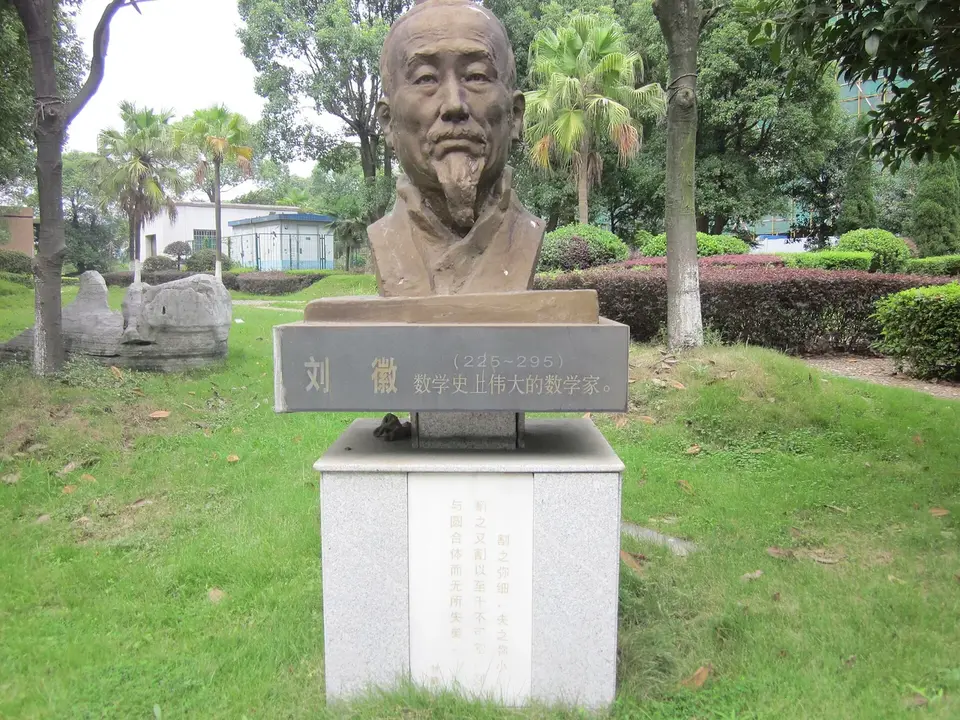
刘徽
Liu Hui (刘徽, fl. 3rd century CE), active during the Three Kingdoms (Cao Wei) and Western Jin periods, was one of the greatest mathematicians in ancient China and the foundational figure who established the theoretical and deductive framework of classical Chinese mathematics. In 263 CE (4th year of the Jingyuan era of Cao Wei), Liu Hui completed his monumental masterpiece, *Commentary on the Nine Chapters on the Mathematical…
Liu Hui (刘徽, fl. 3rd century CE), active during the Three Kingdoms (Cao Wei) and Western Jin periods, was one of the greatest mathematicians in ancient China and the foundational figure who established the theoretical and deductive framework of classical Chinese mathematics. In 263 CE (4th year of the Jingyuan era of Cao Wei), Liu Hui completed his monumental masterpiece, Commentary on the Nine Chapters on the Mathematical Art (Jiuzhang Suanshu Zhu). Systematically reorganizing pre-Qin and Han mathematical knowledge, he provided rigorous logical proofs and philosophical interpretations for practical algorithms for the first time, elevating traditional computational rules into a comprehensive deductive theoretical system. In geometry, he pioneered the "cyclotomic method" (circle-division method), introducing the concept of limits through infinite polygon approximation to calculate the precise value of pi, termed the "Hui ratio" (pi approximately equal to 3.1416). He innovated the "bicylinder" (mouhe fangge) geometric model to solve the volume of a sphere. In algebra, he introduced decimal fractions, formulated rules for positive and negative numbers, refined Gaussian-like matrix elimination, and solved indeterminate problems. In survey mathematics, he composed the Haidao Suanjing (The Sea Island Mathematical Manual), advancing right-angle triangulation into multiple observations. His work preceded similar Western and Indian achievements by centuries, earning him historical renown as the "Newton of Chinese mathematics."
Born during the Three Kingdoms era, demonstrating precocious intellectual talent in calendar science, arithmetic, and classical studies.
Mastered ancient mathematical treatises, tracing the historical compilation of the Nine Chapters by Zhang Cang and Geng Shouchang.
Authored the nine-volume Commentary on the Nine Chapters on the Mathematical Art, pioneering the cyclotomic method and the bicylinder model.
Appended the ninth treatise on double differences (Chongcha), designing nine complex surveying problems using sighting poles.
Conducted rigorous geometrical analysis on Han and Wei standard dry measures (hu), correcting computational errors of previous astronomers.
Passed away in the Western Jin Dynasty; his commentaries and Haidao Suanjing became authoritative textbooks across subsequent dynasties.
Liu Hui lived during the dramatic political transition from the Three Kingdoms (Cao Wei) to the Western Jin Dynasty. During this era, the intellectual climate in northern China was marked by Neo-Daoist Xuanxue philosophy, which placed intense emphasis on abstract logic, conceptual definitions, and ontological debate. Although imperial dynastic histories did not allocate an independent biography to Liu Hui—suggesting he belonged to the commoner class or minor scholar-gentry—his writings demonstrate extraordinary mathematical genius and unwavering scholarly devotion.
In his early years, Liu Hui immersed himself in classical philosophy, astronomy, and government mathematical handbooks surviving from the pre-Qin and Western Han dynasties. He meticulously examined the historical origins of the ancient "Nine Branches of Mathematics," identifying how Western Han Chancellor Zhang Cang and Grand Minister of Agriculture Geng Shouchang had edited and expanded Warring States fragments into the canonical Nine Chapters on the Mathematical Art. Liu Hui recognized that while the Nine Chapters compiled two hundred and forty-six exquisite solutions across agriculture, commerce, engineering, and taxation, it presented empirical operational rules without deductive proofs, leaving practitioners unaware of the underlying mathematical principles. Consequently, Liu resolved to reconstruct mathematics upon a firm foundation of rigorous logical demonstration.
In 263 CE, Liu Hui completed his life's masterwork, the Commentary on the Nine Chapters on the Mathematical Art. Departing fundamentally from the narrow philological glosses favored by traditional Confucian commentators, Liu Hui made mathematical demonstration the living core of his commentary. He articulated a groundbreaking scientific methodology, emphasizing that divergent mathematical branches all spring from a unified theoretical root and can be synthesized through inductive reasoning and deductive derivation.
In geometry, he introduced the revolutionary "cyclotomic method," starting with an inscribed regular hexagon and doubling its sides iteratively up to a 3,072-gon, applying the philosophical concept of limits to prove the circle area formula and determine pi as 3.1416. In solid geometry, he uncovered the substantial error within the Han formula for spherical volume and invented the celebrated "bicylinder" (mouhe fangge) model, formed by the perpendicular intersection of two identical cylinders. In algebra, he systematized the concept of ratios, defined positive and negative numbers with precise arithmetic operational rules, and developed mutual multiplication cancellation for linear systems, creating an enduring theoretical edifice for ancient Chinese mathematics.
Simultaneously with his commentary, Liu Hui addressed complex practical surveying challenges encountered in civil engineering, hydraulic construction, and military topography by appending the treatise Chongcha (Double Differences) to the final section of his work. In this treatise, Liu Hui formulated the method of double differences, establishing two vertical sighting poles of equal height to measure distant and inaccessible heights and depths through geometric relationships of similar right triangles.
The Chongcha treatise featured nine sophisticated engineering problems, encompassing calculations of island heights in open seas, mountain pine trees, depths of ravines, widths of rivers, and dimensions of walled citadels viewed from afar. In the early Tang Dynasty, the Sui Shu bibliography recorded this work independently as Jiuzhang Chongcha Tu, and it was subsequently designated an official imperial textbook in the State Academy under the title Haidao Suanjing (The Sea Island Mathematical Manual). This foundational work established China's absolute leadership in trigonometric and geodetic surveying for centuries.
Entering the Western Jin period, Liu Hui maintained active engagement with astronomical and metrological applications. The Jin Shu (Book of Jin) explicitly cited his 263 CE evaluation of standard grain measures, where he utilized rigorous geometry to compare the bronze vessel cast by Liu Xin during the Xin Dynasty against the contemporary standard Wei-Jin foot, correcting mathematical discrepancies overlooked by preceding calendar experts.
Living a modest and contemplative life detached from bureaucratic rank, Liu Hui died during the Western Jin period, approximately in the Yuankang era. His mathematical scholarship achieved monumental prestige throughout the Northern and Southern Dynasties and the Sui-Tang eras. In 656 CE, Chief Astrologer Li Chunfeng oversaw the imperial compilation of the Ten Computational Canons, placing Liu Hui's commentaries at the absolute pinnacle of state mathematical education. In 1084, the Song court printed woodblock editions of his works, securing his immortal reputation as a towering intellectual giant in the global history of science.
Among Liu Hui's greatest contributions to world science was his invention of the cyclotomic method (circle-division method) in his commentary on the circular field problem in the Nine Chapters. Prior to his breakthrough, Chinese mathematical texts had relied on the coarse approximation of pi equals three (circumference three, diameter one). Although astronomers like Zhang Heng attempted revisions, their results lacked formal geometric demonstration. Liu Hui demonstrated that pi equals three actually represented the ratio of the perimeter of an inscribed regular hexagon to the diameter, inevitably causing severe underestimation when calculating circle areas.
Liu Hui formulated an exhaustive approximation technique using inscribed regular polygons. Beginning with an inscribed regular hexagon, he doubled the number of sides through 12-gon, 24-gon, 48-gon, 96-gon, and 192-gon, deriving pi as 157/50 (3.14). Carrying the division further to a 3,072-gon, he calculated the accurate ratio 3,927/1,250 (3.1416), celebrated as the "Hui ratio." He articulated the concept of mathematical limits with poetic precision: "The finer the division, the smaller the loss; divide again and again until it can be divided no further, and it merges into the circle without any loss." This rigorous limit concept anticipated European infinitesimal calculus by more than a millennium.
In stereometry and polyhedral volume calculations, Liu Hui introduced "Liu Hui's principle" and the bicylinder theory. Commenting on the volumes of pyramids and tetrahedra (such as the yangma and bienao), he deployed infinite stereometric dissection and summation, proving that the volume of a rectangular pyramid equals one-third of a circumscribed rectangular cuboid, laying the foundation for volumetric integration in China.
Critiquing the traditional formula for the volume of a sphere in the Nine Chapters (volume equals nine-sixteenths of the diameter cubed), Liu Hui revealed that the ancient equation mistakenly confused the intersection of a cylinder with a circumscribed cube. To rectify this, he conceived the ingenious geometric solid created by the orthogonal intersection of two identical cylinders inside a cube, which he named mouhe fangge (bicylinder). He demonstrated that the ratio of a sphere to the bicylinder at any horizontal slicing height remains constant at pi divided by four, reducing the difficult problem of spherical volume to determining the volume of the bicylinder. While algebraic limitations of his era prevented him from calculating the final volume, his open scientific mandate directly paved the way for Zu Chongzhi and Zu Geng to solve the sphere volume two centuries later.
In algebra, Liu Hui established the theoretical foundation of classical Chinese number systems. Analyzing fractional operations from the philosophical standpoint of numerical homogeneity and heterogeneity, he systematized common denominators, reductions, and compound fraction simplifications, establishing the "principle of homogenization and equalization" (qitong shu) as an axiomatic baseline. In addressing non-terminating square roots, he introduced the concept of "seeking the Hui number" (qiu huishu), employing decimal fractional approximations that mark the earliest recorded usage of decimal fractions in human history.
In linear algebra, Liu Hui formulated unambiguous definitions and operational laws for positive and negative numbers in the chapter on rectangular arrays (Fangcheng). In addition to utilizing red and black counting rods to represent signs, he achieved theoretical closure of rational numbers. To solve systems of linear equations, he replaced tedious direct divisions with cross-multiplication elimination, an operation identical in logic to modern Gaussian elimination via augmented matrices, while also pioneering investigations into indeterminate equations.
Liu Hui's Haidao Suanjing (The Sea Island Mathematical Manual) represented the global zenith of ancient surveying mathematics. Traditional methods relied on single-point observations, severely constrained by inaccessible obstacles such as chasms, wide rivers, and steep cliffs. Liu Hui resolved these challenges by employing two sighting poles of equal height along a common baseline, utilizing the differences in shadow lengths and sighting baselines to derive universal geometric formulas for distant heights and horizontal ranges.
Deploying rigorous deductive extrapolation, Liu Hui expanded double-difference surveying into three-pole and four-pole observation methodologies, successfully resolving three-dimensional topographic surveying problems over sloping ground, islands at sea, deep ravines, and distant walled settlements. By comparison, Indian mathematicians did not address double-difference surveying until the seventh century, while European treatises did not develop comparable techniques until the Renaissance in the fifteenth and sixteenth centuries. Liu Hui's empirical yet deductive approach provided an enduring paradigm for subsequent astronomical and cartographical advancements.
FIGURES ASSOCIATED WITH THIS DYNASTY