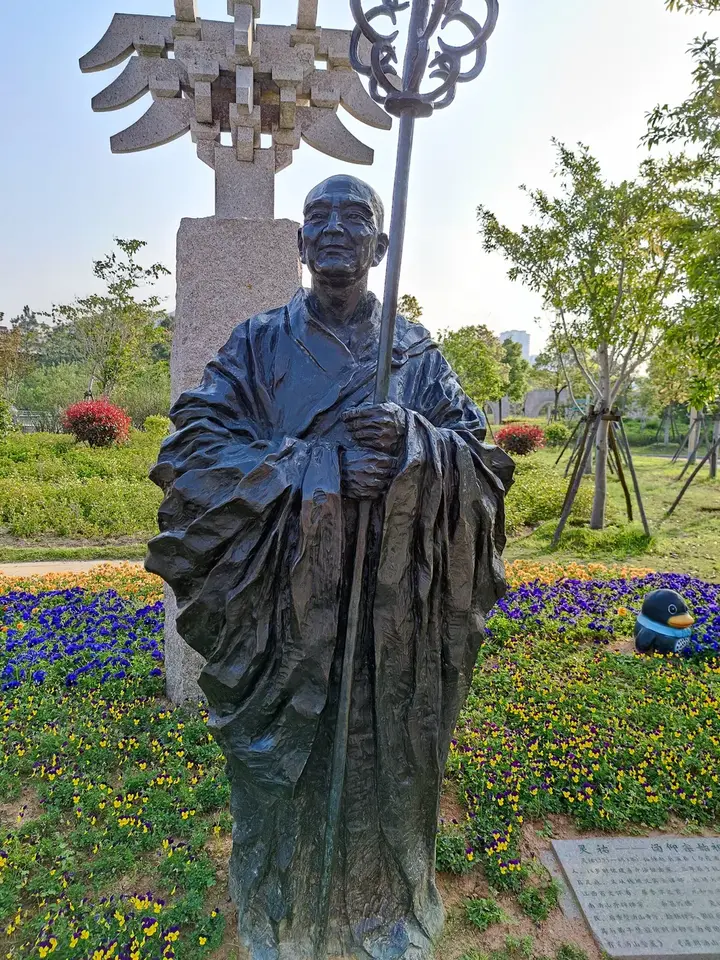
Life
Monastic Origins and Canonical Mastery
Lingyou was born in 771, the sixth year of Dali during Emperor Daizong's reign, into the Zhao clan of Changxi County (modern Xiapu, Fujian Province). Precociously mindful and physically imposing, he abstained from meat from boyhood and preferred quiet meditation over secular pursuits. In 785, at the age of fifteen, he renounced secular life, receiving tonsure at Jianshan Monastery under Vinaya Master Fachang to study Buddhist discipline and texts.
Lingyou threw himself into monastic study. In 793, he traveled to Longxing Monastery in Hangzhou, receiving full ordination according to monastic vinaya. During this period, he scrutinized Hinayana and Mahayana treatises, achieving total familiarity with scholastic terminology. However, recognizing that doctrinal scholasticism could not illuminate the mind or dissolve existential attachment, he resolved to travel throughout China seeking living masters who transmitted the direct mind-to-mind realization of Chan.
Enlightenment Under Baizhang Huaihai
Journeying into Jiangxi, Lingyou arrived at Mount Baizhang, entering the assembly of Baizhang Huaihai, the celebrated dharma heir of Mazu Daoyi. Baizhang immediately recognized Lingyou's spiritual maturity, appointing him tenzo (monastic head cook) to manage community provisions.
One winter evening, Baizhang called Lingyou to the hearth in his quarters, asking: "Is there any fire in the stove?" Lingyou took tongs, stirred the ash casually, and answered: "There is no fire." Baizhang stood up, took the tongs, reached deep into the hearth ash, and unearthed a glowing red ember, showing it to Lingyou: "You said there was no fire, but what is this?" At that instantaneous demonstration, Lingyou's conceptual obscurations collapsed completely, attaining sudden, unshakeable enlightenment. Lingyou bowed reverently to the floor, presenting his realization. Baizhang declared: "This is the moment of arrival! As the scripture says: 'To perceive Buddha-nature, one must observe temporal causes and conditions.' When the time arrives, realization is like sudden remembrance; then you know this treasure is not acquired from without." Lingyou was thereby confirmed as Baizhang's primary dharma heir.
Opening Mount Wei and Building Tongqing Monastery
During the Yuanhe era, the ascetic traveler Sima Toutuo returned from Hunan, reporting to Baizhang: "Mount Wei is a magnificent mountain peak surrounded by thousand summits, destined to support an assembly of fifteen hundred enlightened masters." Baizhang gathered his senior disciples to test their insight, pointing to a water pitcher: "You cannot call this a pitcher; what do you call it?" The chief monk answered: "It cannot be called a wooden tub." Baizhang turned to Lingyou, who kicked over the pitcher and walked out of the room. Baizhang laughed aloud: "The head monk has lost to Mount Wei!" Thereupon, he dispatched Lingyou to open the mountain.
Lingyou traveled south into the isolated crags of Mount Wei with only his staff. Mount Wei was a forbidding primeval forest inhabited by panthers, tigers, and poisonous vipers. Lingyou built a grass hermitage beneath ancient pines, subsisting on acorns and wild berries, enduring harsh winters on bare stones without wavering. His profound ascetic aura won the reverence of mountain hunters and regional farmers. Local villages pooled resources to clear forests and construct a sprawling monastery, christened Tongqing Monastery.
Lay Patronage of Pei Xiu and the Weiyang Tradition
During the reigns of Wenzong and Wuzong, Lingyou's fame spread across southern China. Chancellor Pei Xiu, serving as Governor of Tanzhou and Surveillance Commissioner of Hunan, climbed Mount Wei to receive spiritual instruction. Deeply illuminated by Lingyou's direct, unadorned teachings, Pei Xiu bowed as a formal disciple, writing commemorative steles and donating imperial stipends to expand the temple cloisters. Supported by the chancellor's prestige, the monastic assembly swelled to over fifteen hundred resident monks.
Among Lingyou's disciples, Yangshan Huiji was foremost. Huiji studied at Mount Wei for over a decade, engaging in profound dialectical exchanges with his master. While Lingyou excelled at direct verbal pointing, Huiji developed the symbolic "circular forms" (yuanxiang) to illuminate non-dual reality. Together, they established the Weiyang School, the earliest recognized lineage among the Five Houses of Chan.
Weathering the Huichang Purge and Final Nirvana
In 845, Emperor Wuzong launched the catastrophic Huichang persecution of Buddhism, destroying temples and forcing clergy into secular life. Lingyou accepted the hardship with tranquil detachment, donning peasant garb and retreating into remote ravines, continuing daily meditation without complaint. In 846, Emperor Xuanzong rescinded the persecution; Governor Pei Xiu immediately escorted Lingyou back to Tongqing Monastery to resume public teachings.
On the ninth day of the first lunar month in 853, knowing his worldly teaching was concluded, Lingyou bathed, washed his feet, assumed the full lotus posture on his couch, and peacefully passed into parinirvana at age eighty-three, with sixty-four monastic rains-retreats. Emperor Xuanzong bestowed upon him the posthumous title Great Perfected Chan Master, naming his pagoda the "Tower of Pristine Purity."
Major Achievements
Foundational Patriarch of the Weiyang School
In the history of Chinese Chan Buddhism, Lingyou and his disciple Yangshan Huiji co-founded the Weiyang School, the earliest of the "Five Houses and Seven Schools" of the late Tang and Five Dynasties. Lingyou championed the direct realization that "the mind itself is the Buddha," breaking away from dogmatic scholasticism to open an energetic, living stream of monastic practice.
Xiangyan's Bamboo Awakening and Transmission of the Lamp
At Mount Wei, Lingyou fostered an environment of profound awakening. When his disciple Xiangyan Zhixian was paralyzed by intellectual doubt, Lingyou challenged him to articulate his original face before birth. Later, while sweeping weeds, a discarded tile struck a bamboo stalk with a sharp crack, shattering Xiangyan's conceptual delusions in sudden enlightenment.
Dialogue Between Master and Disciple and Weiyang Dynamic Dialectic
The dynamic exchanges between Lingyou and Yangshan formed the core dialectic of the Weiyang School. Operating as two mirrors reflecting each other without dust, their mutual interrogations and non-verbal gestures—such as drawing circles and silent bows—became legendary paradigms of Chan pedagogical skill.
The Water Buffalo Gong'an and Immortal Paradigm
Among Lingyou's most celebrated koans was his declaration that after death he would reincarnate as a water buffalo at the foot of the mountain, bearing the inscription "Monk of Mount Wei." This startling paradox shattered his disciples' attachments to sacred holiness and enlightened status, demonstrating absolute non-duality and boundless compassionate action.
Formulating the Three Kinds of Arising to Instruct Disciples
Lingyou's major doctrinal innovation was the formulation of the "Three Kinds of Arising" (sansheng): Conceptual Arising (xiangsheng), Phenomenal Arising (xiangsheng), and Continuous Flux Arising (liuzhusheng). Through this rigorous taxonomy, he analyzed delusion and guided advanced practitioners from dualistic discernment to non-abiding wisdom.
Authoring the Monastic Classic Guishan Jingce
Confronting monastic laxity, Lingyou authored the celebrated Guishan Jingce (Admonitions of Mount Wei). Warning against complacency and the squandering of fleeting time, this austere text urged monks to observe discipline and pursue liberation, becoming one of the most widely recited ethical manuals across East Asian Buddhism.
Championing the Agricultural Chan Model of Monastic Labor
Inheriting Baizhang Huaihai's maxim of "a day without work is a day without food," Lingyou institutionalized agricultural labor (nongchan) on Mount Wei. Leading thousands of monks in clearing forests and farming valleys, he transformed physical labor into a direct expression of meditative mindfulness.
Flourishing of Tongqing Monastery and Renewal of Baizhang's Lineage
Under Lingyou's leadership, Tongqing Monastery on Mount Wei grew into an unprecedented monastic center. Monks from across the empire gathered by the thousands, with over 1,500 resident monastics continuously practicing together and reviving Baizhang's spiritual legacy following the Huichang persecution.
Cutting Through Extremes and the Doctrine of Sudden Awakening
Lingyou fully embodied the sudden enlightenment teachings of Huineng and Mazu Daoyi. He rejected intellectual hair-splitting and dry nihilism alike, insisting that ultimate truth must integrate noumenon and phenomenon in spontaneous, everyday responsiveness.
Compilation of Recorded Sayings and Enduring Influence
Following Lingyou's parinirvana, his dialogues and public sermons were compiled by Chancellor Pei Xiu and his disciples as the Recorded Sayings of Chan Master Guishan Lingyou. Highly praised by Qing Emperor Yongzheng as the pinnacle of the Chan vehicle, Lingyou's teachings remain an enduring source of inspiration in global Zen philosophy.