Birth
Lin Xu was born in Houguan, Fujian, orphaned of his father early in life, and raised under his uncle's care.
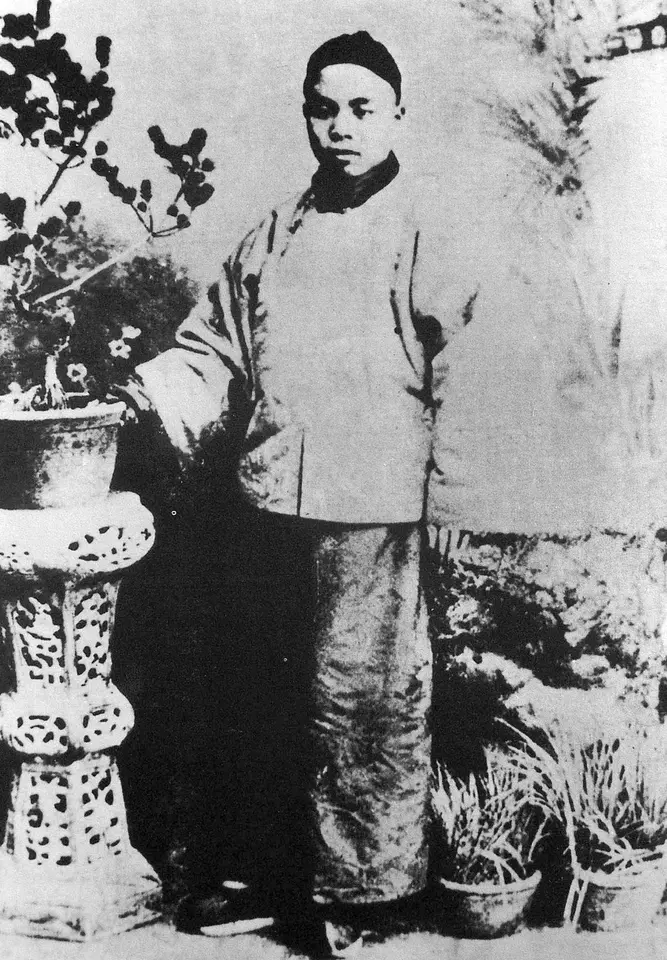
林旭
Lin Xu (林旭, 1875–1898), courtesy name Tungu and art name Wancui, was a native of Houguan (present-day Fuzhou), Fujian. He was an eminent reformist statesman, poet, and the youngest martyr among the celebrated "Six Gentlemen of the Wuxu Reform." An intellectual prodigy who was orphaned in childhood, he achieved regional acclaim by placing first (jieyuan) in the Fujian provincial civil examinations of 1893 at the age of…
Lin Xu (林旭, 1875–1898), courtesy name Tungu and art name Wancui, was a native of Houguan (present-day Fuzhou), Fujian. He was an eminent reformist statesman, poet, and the youngest martyr among the celebrated "Six Gentlemen of the Wuxu Reform." An intellectual prodigy who was orphaned in childhood, he achieved regional acclaim by placing first (jieyuan) in the Fujian provincial civil examinations of 1893 at the age of nineteen. Following China's humiliating defeat in the First Sino-Japanese War, he joined the "Public Vehicle Memorial" movement opposing the Treaty of Shimonoseki, purchased office as a Secretary of the Grand Secretariat, and entered the Tongyi Academy to study Western science and political philosophy. In early 1898, Lin mobilized fellow provincial literati in the capital to establish the Min Academy (Fujian Society) and served as a founding board member of Kang Youwei's National Protection Society. During the Hundred Days' Reform, recommended by Hanlin Academician Wang Xifan for his extraordinary grasp of statecraft and foreign affairs, he was granted the fourth-rank brevet and appointed Secretary in the Grand Council alongside Tan Sitong, Yang Rui, and Liu Guangdi. Over ten days in the inner cabinet, he submitted the largest number of reform proposals and drafted vital imperial decrees on institutional modernizations. Following Empress Dowager Cixi's coup, he was arrested and executed at Caishikou at age twenty-three; his talented wife, Shen Queying, died of grief soon after. A master of the "Tongguang Style" of classical verse, his poems were collected in Wancui Xuan Ji.
Lin Xu was born in Houguan, Fujian, orphaned of his father early in life, and raised under his uncle's care.
Placed first as jieyuan in the Fujian provincial civil examinations at age nineteen, astounding regional literati.
Married Shen Queying, daughter of Shen Yuqing and granddaughter of Shen Baozhen, forging an intellectual and poetic partnership.
Failed the metropolitan exam in Beijing and joined the nationwide protest against the Treaty of Shimonoseki, subsequently entering the Grand Secretariat.
Enrolled in the Tongyi Academy founded by Zhang Yuanji in Beijing, studying Western constitutional systems, commerce, and geography.
Established the Min Academy in Beijing to coordinate reformist Fujian literati and became a founding director of the National Protection Society.
Granted imperial fourth-rank brevet and appointed Secretary in the Grand Council to participate directly in reform deliberations.
Submitted numerous memorials and drafted crucial imperial edicts abolishing eight-legged essays and encouraging industrial development.
Captured by imperial troops at his residence in North Banjie Hutong following Cixi's coup, remaining composed in prison.
Executed alongside Tan Sitong and four other reform martyrs at the Caishikou execution ground at age twenty-three.
Lin Xu was born in 1875 in Houguan, Fujian. Endowed with exceptional natural gifts, he possessed a photographic memory and mastered classical prose, metric poetry, and historical analysis while still a child. His father died when he was young, leaving the household in modest circumstances, and he was raised by his uncle. He dedicated himself to rigorous classical studies, reading far beyond standard examination anthologies.
In 1893, at just nineteen, Lin took the special provincial civil examinations in Fuzhou and achieved first place (jieyuan) among thousands of competitors across the province. His brilliant examination papers caused a sensation throughout southeastern literati circles. Senior statesmen recognized his immense potential; Shen Yuqing, an eminent official and son of the famous modernization pioneer Shen Baozhen, arranged for his eldest daughter, Shen Queying, to marry Lin. Shen Queying was also the great-granddaughter of national hero Lin Zexu. Highly educated and a gifted poetess, she shared Lin's passion for classical verse; the couple studied poetry under the prominent mentor Chen Yan, their literary devotion celebrated widely in cultural circles.
In 1894 and 1895, Lin traveled to Beijing to sit for the metropolitan examinations. Although his innovative writing did not conform to the rigid preferences of imperial examiners, his time in the capital coincided with China's catastrophic defeat in the First Sino-Japanese War and the signing of the Treaty of Shimonoseki.
Enraged by the partition of the homeland and the cession of Taiwan and the Liaodong Peninsula, Lin joined hundreds of examination candidates in signing the "Public Vehicle Memorial" initiated by Kang Youwei, petitioning the throne to reject the treaty, move the capital inland, and launch sweeping institutional reforms. Remaining in Beijing as a Secretary of the Grand Secretariat, he gained direct access to central administrative processes. In 1897, eager to master modern statecraft, he enrolled in the Tongyi Academy established by Zhang Yuanji, studying foreign languages, international diplomacy, world geography, and political economy, rapidly becoming an ardent advocate of constitutional modernization.
In early 1898, as foreign powers scrambled for railway concessions and territorial leases, Lin mobilized Fujian gentry in the capital, formally founding the Min Academy on February 10, 1898. He established close communications with provincial reform societies from Guangdong, Sichuan, and Zhejiang, building an interconnected reform network. When Kang Youwei founded the National Protection Society in April to safeguard China's territorial integrity and cultural heritage, Lin served as one of its most dynamic founding directors, delivering impassioned speeches before conservative detractors.
On June 11, 1898, the Guangxu Emperor promulgated the decree establishing state policy, launching the Hundred Days' Reform. In response to an imperial decree commanding ministers to recommend extraordinary talents, Hanlin Academician Wang Xifan submitted a memorial praising Lin Xu's deep understanding of ancient and modern institutions, his mastery of Western political philosophy, and his expertise in foreign commerce. The emperor summoned Lin for an imperial audience, and, impressed by his incisive geopolitical analysis, immediately earmarked him for crucial responsibilities.
On September 5, 1898, the emperor took the unprecedented step of granting Lin Xu, Tan Sitong, Yang Rui, and Liu Guangdi the fourth-rank civil brevet, appointing them Secretaries in the Grand Council with orders to participate directly in reform affairs.
During the crucial ten days that followed, Lin was the most active of the four secretaries. He worked long hours drafting imperial decrees, including edicts reforming provincial education, establishing commercial bureaus, restructuring central administration, and abolishing hereditary sinecures. His drafts were characterized by structural clarity and uncompromising urgency, translating broad reformist concepts into concrete imperial legislation.
On September 21, 1898, Empress Dowager Cixi staged a palace coup, detaining the Guangxu Emperor at Yingtai Island and ordering the immediate arrest of reform leaders. On September 24, imperial guards surrounded Lin's residence. Refusing to flee, Lin calmly straightened his robes and surrendered. In the Ministry of Punishments prison, he maintained serene composure, writing his famous poem to Tan Sitong reflecting on imperial service and the tragedy of thwarted national salvation.
On September 28, 1898, without formal trial, the Qing court ordered the summary execution of the Six Gentlemen. Lin Xu was beheaded at Caishikou, facing death with unyielding fortitude at age twenty-three. In Jiangnan, his wife Shen Queying was overwhelmed by grief; writing a heartbreaking deathbed elegiac couplet, she refused food and passed away in the spring of 1900 at age twenty-four. The couple was buried together on Mount Mao'er in Fuzhou, their tragic devotion commemorated by posterity as an enduring symbol of youthful patriotism.
Lin Xu was the essential organizer who brought Fujian's gentry into the mainstream of the national reform movement. Through the Min Academy, he turned traditional provincial guild networks into active centers of political modernization and Western translation.
As a founding board member of the National Protection Society, he defended patriotic collective action against reactionary accusations of illicit factionalism, helping to mobilize civil society on the eve of the 1898 reforms.
During his tenure in the Grand Council, Lin functioned as one of the chief draftsmen of modern Chinese constitutional legislation. He synthesized radical reform proposals into formal imperial rescripts.
His contributions included drafting decrees to establish modern universities, streamline the civil service, foster domestic manufacturing, and eliminate feudal sinecures, leaving behind a crucial documentary legacy of late Qing institutional reform.
Beyond politics, Lin Xu was an extraordinarily gifted poet who occupied a unique position in late Qing literary history. Influenced by his mentor Chen Yan, he was a key figure of the Min branch of the "Tongguang Style," modeling his verse on Mid-Tang poet Li He and Northern Song master Wang Ling.
Literary critics in Jinchuanshi Lou Shihua praised his verse for its dense imagery, astringent musicality, and intense philosophical depth. His collected works, Wancui Xuan Ji, stand as an enduring monument of late Qing patriotic literature.
The tragic story of Lin Xu and his wife Shen Queying entered the cultural memory of modern China as a profound emblem of youthful sacrifice. Shen Queying's grief-stricken poems, included in Qian Zhonglian's Three Hundred Qing Ci Poems, reflect authentic historical tragedy untainted by literary posturing.
Their joint martyrdom in the cause of national renewal became celebrated in regional drama and historical literature, inspiring subsequent generations of young Chinese patriots.
FIGURES ASSOCIATED WITH THIS DYNASTY