Birth in Georgia
Born in Burke County, Georgia, orphaned in early childhood and raised by maternal relatives.
林乐知
Young John Allen (林乐知, 1836–1907), known in Chinese as Lin Lezhi and by his courtesy name Rongzhang, was a native of Burke County, Georgia, United States. He was an American missionary of the Methodist Episcopal Church, South, a pioneer journalist, educational reformer, and translator who served as a primary catalyst of late Qing intellectual modernization and the Reform Movement of 1898. In 1860 (the tenth year of the…
Young John Allen (林乐知, 1836–1907), known in Chinese as Lin Lezhi and by his courtesy name Rongzhang, was a native of Burke County, Georgia, United States. He was an American missionary of the Methodist Episcopal Church, South, a pioneer journalist, educational reformer, and translator who served as a primary catalyst of late Qing intellectual modernization and the Reform Movement of 1898. In 1860 (the tenth year of the Xianfeng reign), Allen arrived in Shanghai with his family. Over forty-seven years of continuous residency, he utilized journalistic and educational institutions to introduce modern Western civilization to Qing society. During the Tongzhi era, he taught at the Shanghai Guangfangyan Guan and translated Western works at the Jiangnan Arsenal Translation Bureau, earning a fifth-rank imperial civil title. In 1868, he established The Church News, later transforming it into the acclaimed Wanguo Gongbao (The Globe Magazine / The Review of the Times), which he edited for decades. In education, Allen founded the Anglo-Chinese College (Zhongxi Shuyuan) in Shanghai in 1881, establishing an eight-year progressive modern curriculum balancing Chinese and Western disciplines. He subsequently partnered with female educators to establish McTyeire School, pioneering modern female higher education in China. Following the Sino-Japanese War of 1894–1895, he authored Zhongdong Zhanji Benmo, an incisive historical analysis of Qing military defeat that became essential reading for reformers Kang Youwei and Liang Qichao. Passing away in Shanghai in 1907 at seventy-one, Allen left an enduring legacy as an intellectual bridge between China and the modern world.
Born in Burke County, Georgia, orphaned in early childhood and raised by maternal relatives.
Graduated with a Bachelor of Arts from Emory College and was ordained an overseas missionary for the Methodist Episcopal Church, South.
Arrived in Shanghai after a maritime voyage of 210 days, studying classical Chinese under the essayist Wang Tao.
Appointed English instructor at the imperial Shanghai Guangfangyan Guan, later translating works for the Jiangnan Arsenal.
Founded and edited The Church News in Shanghai, introducing modern geography and physical sciences alongside mission news.
Renamed the periodical Wanguo Gongbao (The Globe Magazine), expanding coverage to global statecraft and international political economy.
Established the Anglo-Chinese College in Shanghai, introducing an integrated modern curriculum balancing classical and Western sciences.
Revived Wanguo Gongbao as a monthly journal under the Society for the Diffusion of Christian and General Knowledge (SDK).
Published the landmark eight-volume treatise Zhongdong Zhanji Benmo, analyzing the causes of China's defeat in the First Sino-Japanese War.
Promoted the establishment of Soochow University in Suzhou, serving as the first Chairman of its Board of Trustees.
Passed away in Shanghai at the age of seventy-one, laid to rest in the Jing'an foreign cemetery, commemorated in 1922 with Moore Memorial Church.
Young John Allen was born on January 3, 1836 (the fifteenth day of the eleventh month in the fifteenth year of the Daoguang reign) in Burke County, Georgia. Orphaned in infancy when both parents died shortly after his birth, he was raised by his aunt and uncle under devout Methodist Christian disciplines that fostered lifelong resilience and scholastic diligence.
During his formative years, Allen attended Warren Academy before enrolling at Emory College in Oxford, Georgia. At Emory, he studied classical languages, rhetoric, history, and natural philosophy, graduating at the head of his class in 1858 with a Bachelor of Arts degree. Deeply moved by spiritual calling, he volunteered for foreign mission work in the Far East and was ordained an elder in the Methodist Episcopal Church, South.
In late 1859, Allen, accompanied by his wife and infant daughter, boarded a sailing vessel for China. Enduring seven months of treacherous ocean voyages around the Cape of Good Hope, the family arrived in Shanghai in June 1860 amid the turbulence of the late Taiping Rebellion, initiating nearly a half-century of missionary and pedagogical service.
Upon arriving in Shanghai, refugee flows from surrounding provinces created severe economic hardship, and the outbreak of the American Civil War severed financial remittances from the southern missionary board. Undeterred by poverty, Allen supported his family by tutoring and commercial translation while dedicating every spare moment to mastering classical Chinese language and literature.
Upon reaching Shanghai, Allen realized that intellectual communication with Chinese literati required mastery of Chinese language and literature. Choosing the Chinese name Lin Lezhi and courtesy name Rongzhang based on the classical maxim that ignorance is a scholar's shame, he engaged the noted essayist Wang Tao as his tutor, acquiring fluency in classical prose and Confucian canons.
In 1864, Allen was appointed English instructor at the Shanghai Guangfangyan Guan, an official language institute founded by Qing modernization officials. When the academy was merged into the Jiangnan Arsenal in 1867, Allen expanded his duties to serve as translator for the Arsenal's Translation Bureau. Over sixteen years, he collaborated with Chinese scholars to translate treatises on mechanics, international history, and fiscal administration.
His translated titles included introductory science texts, histories of the United States and Russia, and geographical surveys. In recognition of his contributions to official educational translation, the Qing imperial court conferred upon Allen the rank of civil official of the fifth grade, granting him elite standing among regional governors and scholar-officials.
Through his official translations, Allen engaged with reformist administrators and commercial compradores who sought practical Western expertise. Utilizing translation bureau resources, he disseminated knowledge on modern manufacturing, taxation methods, and international maritime law, providing crucial intellectual support to the early Self-Strengthening Movement.
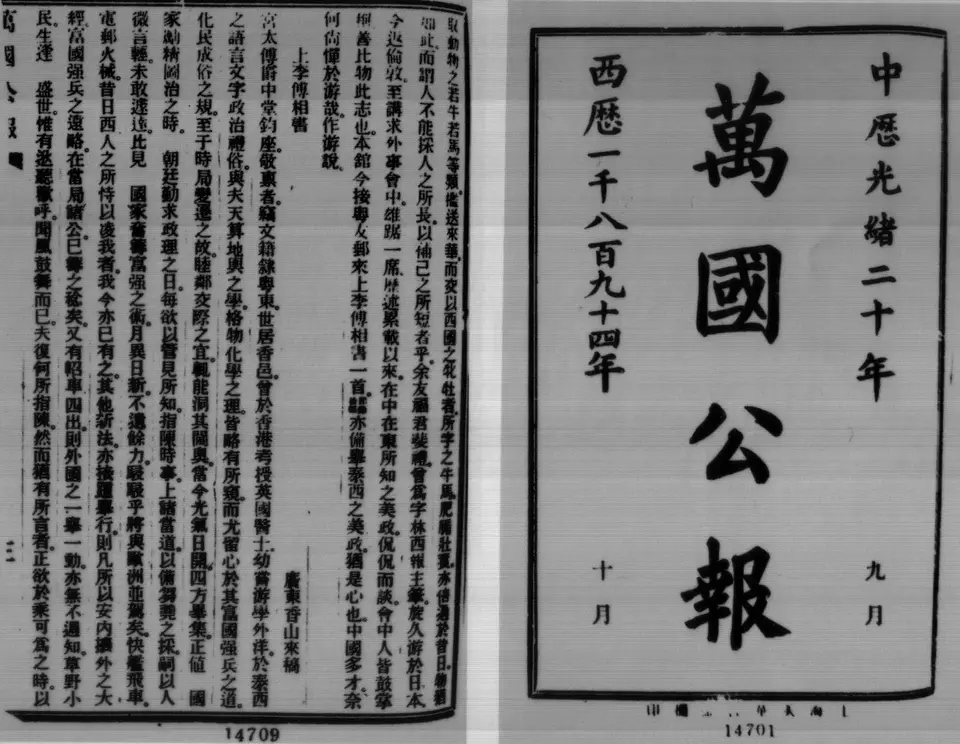
Recognizing that pulpit preaching reached few educated elites, Allen turned to journalism as a vehicle of cross-cultural communication. In September 1868 (the seventh year of the Tongzhi reign), he founded The Church News, a four-page weekly periodical in Chinese.
While initially intended for native Christian converts, Allen broadened the paper's scope to include international news, astronomical observations, and administrative edicts. In September 1874, he expanded the journal into Wanguo Gongbao (The Globe Magazine), dedicating it to advancing global enlightenment and introducing Western statecraft, international law, and industrial technology to Chinese readers.
In 1889, supported by the Society for the Diffusion of Christian and General Knowledge Among the Chinese (SDK), Wanguo Gongbao resumed publication as a monthly magazine with Allen continuing as Editor-in-Chief. Collaborating with Chinese editor Shen Yugui, Allen penned editorials analyzing international relations, domestic administrative reform, and technological modernization. Circulating across provincial academies and viceregal offices, Wanguo Gongbao became the premier journal shaping late Qing reformist thought.
Throughout his editorial tenure, Allen emphasized accessible classical prose. Working alongside Shen Yugui, he expressed modern concepts of representative assemblies, national balance sheets, and constitutional jurisprudence in refined prose that resonated with Chinese scholars, turning the publication into a primary window on world developments.
In 1881, seeking to build an educational system independent of the imperial examinations, Allen resigned from imperial posts to establish the Anglo-Chinese College in Shanghai. Fundraising across Europe and America, he purchased forty acres in Hongkou to build a modern campus, serving as the institution's first principal.
Allen introduced an eight-year progressive curriculum balancing classical Chinese humanities with Western natural sciences, algebra, calculus, physics, international law, and English. Unlike mission schools that mandated baptism, the Anglo-Chinese College welcomed non-Christian students without compulsory doctrinal requirements, attracting sons of merchants and reformist officials. Over three decades, the college graduated thousands of modern administrators, translators, and engineers before merging into Soochow University in 1911.
Simultaneously, Allen championed the emancipation and education of Chinese women. In 1892, in collaboration with Laura Haygood of the Methodist Women's Foreign Missionary Society, he co-founded McTyeire School for Girls in Shanghai. The institution offered rigorous academic training in modern languages, sciences, and music, dismantling ancient patriarchal prejudices and nurturing generations of prominent modern female leaders.
The success of the Anglo-Chinese College and McTyeire School transformed traditional academy pedagogy. Allen's focus on tiered instruction and modern sciences earned the trust of national entrepreneurs, sending graduates into late Qing diplomatic and industrial leadership.
The crushing defeat of the Qing Empire in the First Sino-Japanese War of 1894–1895 devastated Chinese intellectual complacency. Acting with journalistic urgency, Allen compiled domestic and foreign accounts to publish Zhongdong Zhanji Benmo (Complete Record of the Sino-Japanese War) in eight volumes in 1895.
In this seminal work, Allen presented a comprehensive chronicle of naval and land campaigns, incisively contrasting Japan's constitutional modernization with the administrative decay, military corruption, and educational stagnation of the Qing court. He urged the immediate adoption of nationwide public schooling, industrial development, and representative institutions. The treatise became a sensation, reprinted multiple times and serving as a political handbook for Kang Youwei and Liang Qichao during the Hundred Days' Reform of 1898.
In his final years, Allen participated in the founding of Soochow University, serving as Chairman of its Board of Trustees, and published works on international constitutional history. On May 30, 1907 (the nineteenth day of the fourth month in the thirty-third year of the Guangxu reign), Allen passed away at his Shanghai residence at seventy-one. Mourners from the diplomatic corps, imperial government, and student body attended his funeral at the Jing'an foreign cemetery, and in 1922, admirers erected Moore Memorial Church in his memory.
Allen's passing coincided with the late Qing constitutional reform era. Periodicals across the nation mourned the loss of a mentor who dedicated his career to Chinese enlightenment, leaving millions of published words that nourished the transition to a modern state.
Allen's foremost historical accomplishment was founding and directing Wanguo Gongbao, the longest-running and most influential foreign-edited Chinese periodical of the nineteenth century.
Over three decades, Allen guided the periodical under the editorial principle of using modern knowledge to reform Chinese society. Transcending sectarian theology, the journal published essays on international arbitration, constitutional governance, physical sciences, and global commerce. Working with Chinese stylist Shen Yugui, Allen produced accessible essays that reached provincial capitals, introducing generations of scholar-officials to modern world geography and political economy.
Moreover, the journal served as an intellectual compass during national crises. During the Sino-French War and First Sino-Japanese War, it analyzed military logistics and international treaties. Reform leaders including Kang Youwei and Liang Qichao read the publication systematically, drawing directly on its essays to articulate constitutional reform programs.
The founding of the Anglo-Chinese College in 1881 established a foundational model for modern collegiate education in China.
Allen designed a comprehensive eight-year curriculum combining classical Chinese literature with modern higher mathematics, chemistry, physics, and international law. Rejecting narrow vocational training, he sought to cultivate versatile intellectual leaders equipped for modern civil governance. The pedagogical methods and examination standards he established provided practical blueprints for the national educational reforms that abolished the civil service examinations in 1905.
In the classroom, Allen organized graded progressions from arithmetic and grammar up through calculus, analytical chemistry, and public international law. This multidisciplinary curriculum shattered the insularity of traditional academies and served as an institutional forerunner of modern university systems.
Challenging traditional patriarchal conventions that excluded women from academic life, Allen partnered with Laura Haygood to establish McTyeire School for Girls in Shanghai in 1892.
Allen advocated that national rejuvenation required the intellectual empowerment of women. McTyeire provided advanced collegiate instruction in English, natural sciences, history, and the arts, fostering civic responsibility and personal independence. The institution transformed societal perceptions of female capabilities, educating prominent twentieth-century figures including Soong Ching-ling and Soong Mei-ling.
Allen also introduced modern physical education for female students, building gymnasiums and tennis courts to discourage foot-binding and promote health. This holistic pedagogy stimulated late Qing gentry to establish anti-footbinding societies and modern women's academies.
Published immediately following the Treaty of Shimonoseki in 1895, Allen's Zhongdong Zhanji Benmo represented the most influential contemporary geopolitical analysis of China's defeat.
Allen demonstrated that Japan's triumph resulted from comprehensive constitutional government, universal public schooling, and administrative transparency, while China's collapse stemmed from bureaucratic stagnation and the superficiality of the Self-Strengthening Movement. His concrete recommendations for parliamentary governance, educational modernization, and judicial reform served as the intellectual framework for the Reform Movement of 1898.
Accompanied by precise battle maps and statistical comparisons, the work was purchased extensively by imperial ministries and provincial viceroys. Alongside Yan Fu's translation of Huxley's Evolution and Ethics, it awakened an entire generation of scholars to the urgency of constitutional reform.
As a senior director of the Christian Literature Society for China, Allen channeled Western political, legal, and educational philosophy into the Chinese intellectual mainstream.
He translated foundational treatises on Western higher education, public administration, and international treaties, including Educational Strategies for National Rejuvenation. His works were requested for imperial reading by the Guangxu Emperor and consulted by reform leaders drafting modernization edicts, leaving an indelible imprint on modern Chinese constitutional thought.
Furthermore, Allen's translations examined diverse political systems objectively, comparing British constitutional monarchy, American republicanism, and continental European administration. Through these voluminous works, he enriched the intellectual foundations of the late Qing constitutional movement and early Republican state building.
The Draft History of Qing (Qing Shi Gao, Volume 309, Biography 96) recorded concerning Western scholars: "From the Daoguang and Xianfeng eras onward, Western figures arrived through writing. Figures such as Young John Allen and Timothy Richard resided longest in Shanghai, establishing the Christian Literature Society, translating Western works on administration, agriculture, and science, and publishing Wanguo Gongbao. Through them, scholars first learned of the vastness of the five continents; their merit in opening modern consciousness cannot be erased."
Historian Xiong Yuezhi wrote in The Inflow of Western Learning and Late Qing Society: "Among the missionaries who came to China in the late Qing, Young John Allen engaged in literary and journalistic propagation for the longest duration and with the most profound influence. Directing Wanguo Gongbao for decades, founding the Anglo-Chinese College and McTyeire School, and authoring Zhongdong Zhanji Benmo, his writings penetrated deeply into the scholar-gentry class, playing an irreplaceable bridging role in breaking antiquated imperial complacency and fostering modern reformist thought."
FIGURES ASSOCIATED WITH THIS DYNASTY