Born in Qiantang
Born into an illustrious scholarly family in Hangzhou; showed precocious talent and established literary circles in Jiangnan.
梁诗正
Liang Shizheng (梁诗正; 1697–1763), courtesy name Yangzhong and art names Xianglin and Wenlian, was a native of Qiantang, Hangzhou Prefecture (present-day Hangzhou, Zhejiang Province). He was an illustrious grand secretary, literary scholar, and master calligrapher of the High Qing era. In 1730, he achieved first-class third rank (Tanhua / Tertius) in the palace examinations, receiving an appointment as Hanlin Compiler.…
Liang Shizheng (梁诗正; 1697–1763), courtesy name Yangzhong and art names Xianglin and Wenlian, was a native of Qiantang, Hangzhou Prefecture (present-day Hangzhou, Zhejiang Province). He was an illustrious grand secretary, literary scholar, and master calligrapher of the High Qing era. In 1730, he achieved first-class third rank (Tanhua / Tertius) in the palace examinations, receiving an appointment as Hanlin Compiler. Appointed imperial tutor in the Palace School for Princes (Shangshufang), he instructed the imperial sons and served as Diarist of the Imperial Court. Following the accession of the Qianlong Emperor, he was inducted into the Southern Study, subsequently advancing to Left Vice Minister of Revenue. Observing the economic decline of the Eight Banners, Liang submitted his farsighted Memorial on Eight Banners Reclamation, advocating the resettlement of surplus bannermen in Heilongjiang and Jilin to cultivate agricultural frontier lands. In 1745, Liang was elevated to Minister of Revenue, managing imperial finances before serving successively as Minister of War, Minister of Works, and Minister of Personnel, enforcing strict civil service reviews. In 1758, he ascended to Grand Secretary of the Eastern Cabinet supervising the Ministry of War, reaching the apex of civil administration. Renowned for his vast scholarship and artistic connoisseurship, Liang was commissioned by the Qianlong Emperor to lead the compilation of monumental royal art catalogues, including the 44-volume Precious Collection of the Stone Channel (Shiqu Baoji), the Pearl Forest of the Secret Hall (Midian Zhulin), and the imperial bronze catalogue Western Clear Antiquities (Xiqing Gujian). Liang was equally celebrated as the foremost exponent of High Qing court calligraphy, synthesizing the styles of Yan Zhenqing, Zhao Mengfu, Wen Zhengming, and Li Yong into an elegant, dignified script that defined the imperial court aesthetic. The Qianlong Emperor frequently ordered Liang to transcribe imperial poems and monumental stone inscriptions. Liang passed away in Beijing in 1763 at age sixty-six; the emperor personally poured wine at his funeral, granted the posthumous title of Grand Tutor, conferred the posthumous name "Wenzhuang," and enshrined him in the Temple of the Wise and Virtuous.
Born into an illustrious scholarly family in Hangzhou; showed precocious talent and established literary circles in Jiangnan.
Captured third place (Tanhua) in the imperial palace examination; appointed Hanlin Compiler and Imperial Tutor in the Shangshufang.
Summoned by the newly enthroned Qianlong Emperor to direct imperial compilations and attend the Southern Study.
Promoted to Vice Minister of Revenue; memorialized urging the agricultural settlement of Eight Banners households in Manchuria.
Appointed Minister of Revenue; commissioned to direct the compilation of the imperial art catalogue Shiqu Baoji.
Transferred to Minister of War, subsequently heading the Ministries of Works and Personnel to enforce bureaucratic discipline.
Elevated to Grand Secretary of the Eastern Cabinet and supervising minister of the War Ministry, directing state policy.
Honored with the title of Grand Guardian of the Heir Apparent in recognition of decades of meticulous imperial governance.
Passed away in office on December 8; honored by imperial visit, granted Grand Tutor rank, and canonized as Wenzhuang.
Liang Shizheng hailed from a prestigious scholarly family in Qiantang, Hangzhou. From infancy, he demonstrated extraordinary intellectual precocity, reciting classical verse upon speaking and memorizing historical annals with effortless mastery. In his youth, he established the monthly Yueke Poetry Society alongside prominent Hangzhou intellectuals including Hang Shijun and Chen Zhao, publishing their refined verse in the Zhiwei Collection. At twenty-seven, he studied under the distinguished scholar Wan Jing at the Fuwen Academy, developing deep expertise in classical philosophy and epigraphy.
In 1730, Liang passed the metropolitan examinations and earned third place (Tanhua / Tertius) in the palace examinations, receiving an appointment as Hanlin Compiler. In 1732, he presided as Chief Examiner over the Shandong provincial examinations, and in 1733, he served as associate examiner for the metropolitan examination. In recognition of his rectitude and classical erudition, the Yongzheng Emperor selected him as tutor in the Shangshufang to educate imperial princes, concurrently appointing him imperial diarist and Senior Academician in the Hanlin Academy.
Upon ascending the throne in 1736, the Qianlong Emperor displayed exceptional favor toward his former teacher, commanding Liang to direct imperial historiographical projects and serve in the Southern Study. In 1738, the emperor granted Liang an official residence in Beijing, promoting him to Senior Academician and imperial classics lecturer. Between 1739 and 1741, he served as Vice Minister of Punishments and Left Vice Minister of Revenue.
In 1741, while serving as Vice Minister of Revenue, Liang submitted his renowned Memorial on Eight Banners Reclamation. Addressing the chronic financial crisis caused by rapid population growth among the Eight Banners and their complete dependence on imperial stipends, Liang warned: "The banner population multiplies daily while state revenues remain fixed. Relying perpetually on public grain is unsustainable; only agricultural cultivation can secure their livelihood. Lands near the capital and provincial garrisons are fully occupied, but the vast territories of Jilin and Heilongjiang remain fertile and sparsely settled. We should resettle surplus banner households to the frontier, granting them land and draft cattle to establish self-sufficient farms. If we fail to act now, in several decades the population will increase tenfold, and treasury revenues will be exhausted!" This memorial displayed penetrating structural insight into Qing demographic and fiscal challenges.
In 1745, Liang was promoted to Minister of Revenue, commanding national fiscal administration. That same year, the Qianlong Emperor ordered an exhaustive audit of all ancient and modern calligraphy and paintings stored across imperial palaces. Liang was appointed Chief Compiler alongside Zhang Zhao to assemble the 44-volume Precious Collection of the Stone Channel (Shiqu Baoji) and the 24-volume Pearl Forest of the Secret Hall (Midian Zhulin). Employing meticulous connoisseurship, Liang catalogued thousands of masterpieces from the Jin and Tang dynasties onward, recording seals, colophons, and physical dimensions, creating a foundational monument for Chinese art history. He subsequently directed the compilation of the 40-volume imperial bronze catalogue Western Clear Antiquities (Xiqing Gujian).
From 1748 onward, Liang successively directed the Ministries of War, Works, and Personnel. In the Ministry of Personnel, he enforced strict performance evaluations, eradicated clerical corruption, and firmly prohibited aristocratic patronage, earning widespread admiration for his administrative impartiality.
In 1758, Liang was elevated to Grand Secretary of the Eastern Cabinet while supervising the Ministry of War, entering the core imperial grand secretariat. In 1759, he was honored with the rank of Grand Guardian of the Heir Apparent.
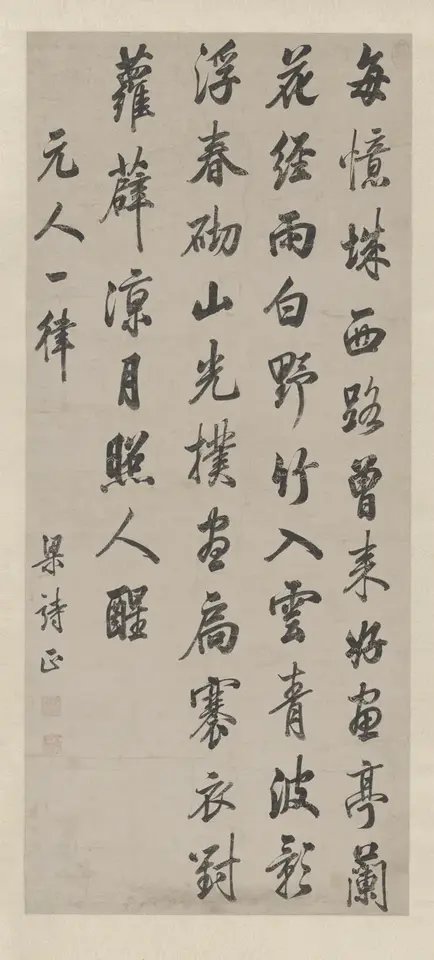
Liang Shizheng was universally celebrated as one of the preeminent calligraphers of the High Qing era. In his early years, he mastered the bone structure of Liu Gongquan; in mid-life, he incorporated the lyrical elegance of Wen Zhengming, Zhao Mengfu, and the Two Wangs; and in his mature period, he absorbed the dynamic vigour of Li Yong. His style was characterized by upright poise, exquisite balance, and aristocratic refinement, setting the supreme benchmark for the Qing "Court Style" (Guange Ti). The Qianlong Emperor admired his calligraphy immensely, ordering Liang to transcribe numerous imperial poems, stelae, and formal state proclamations.
On December 8, 1763, Liang passed away from illness in Beijing at age sixty-six. Upon receiving the news, the Qianlong Emperor grieved deeply, traveling personally to Liang’s residence to offer funeral libations. The emperor issued an edict granting the posthumous rank of Grand Tutor, bestowing state funeral honors, conferring the posthumous name "Wenzhuang," and commanding his enshrinement in the Temple of the Wise and Virtuous. His son Liang Tongshu later inherited his artistic mantle, becoming another renowned calligrapher of the dynasty.
In 1745, upon assuming leadership of the Ministry of Revenue, Liang Shizheng observed the growing financial pressures resulting from imperial construction and frontier military maneuvers. He submitted a cautionary memorial advising: "The annual revenues of the empire, after standard administrative disbursements, leave a surplus of merely two million taels. Statecraft requires farsighted frugality. We must refrain from launching frivolous palace construction projects and exercise profound caution against unprovoked foreign warfare, thereby preserving treasury reserves to ensure perpetual public tranquility." The Qianlong Emperor praised and adopted his counsel.
In 1747, Liang was appointed Chief Compiler of the Continuation of the Comprehensive Examination of Literature (Xu Wenxian Tongkao). In 1749, he advanced to Junior Preceptor to the Heir Apparent, Minister of Punishments, Assistant Grand Secretary, and Chancellor of the Hanlin Academy. In 1752, because his elderly father had reached nearly ninety years of age and required personal care, Liang submitted an imperial petition begging permission to resign from the central government to care for his father in Hangzhou. During his years of filial retirement in his hometown, he shut his doors to social callers, dedicating his days to classical study. When the Qianlong Emperor inspected the south in 1757, Liang welcomed the imperial entourage in Hangzhou, and the emperor granted him the privilege of receiving full official stipends while residing at home.
Following his father's passing in 1758 at age ninety-three and the completion of ritual mourning, Liang was recalled to Beijing, serving successively as acting Minister of Works and Minister of War. In 1759, he presided as Chief Examiner over the Shuntian provincial examinations, receiving the honorific title of Grand Guardian of the Heir Apparent. In 1763, he ascended to Grand Secretary of the Eastern Cabinet supervising the Ministry of Personnel, reaching the apex of civil ministerial rank with the rank of Grand Tutor to the Heir Apparent. During this period, all major imperial manifestos, dynastic inscriptions, and sacrificial stelae were drafted exclusively by Liang’s brush. He directed the National Historiography Bureau, the Imperial Prose Compendium Bureau, and the Xu Wenxian Tongkao Bureau, establishing the structural standards for Qing official historiography.
Decades after his death, when the Qianlong Emperor composed his nostalgic Poem on the Past recalling the illustrious ministers of his golden reign, he placed Liang Shizheng foremost among the celebrated "Five Literary Ministers" of the dynasty, eulogizing his pristine erudition and lifelong moral dignity. His eldest son Liang Tongshu achieved national acclaim as a master calligrapher, while his second son Liang Dunshu rose to Vice Minister of War, continuing an illustrious family tradition of statecraft and literature.
Ascending from Tanhua laureate to Grand Secretary, Liang Shizheng managed national revenues and military logistics for decades with exemplary discretion. His monumental art catalogues organized the imperial heritage, and his graceful calligraphy defined the golden age of court art, standing as an ideal model of High Qing civil statesmanship.
"Liang Shizheng served with meticulous reverence and fertile intellect. In his inner court attendance, he discharged every duty with consummate elegance. His prose was classical, his calligraphy immaculate, commanding the steadfast trust of Emperor Gaozong." — Zhao Erxun, Chief Editor, Draft History of Qing (Qing Shi Gao), Volume 303, Biographies 90
"Grand Secretary Xianglin’s calligraphy was consummate in grace and structural strength, combining the divine essence of the Two Wangs with Li Beihai, reigning as the undisputed master of court calligraphy." — Qing Literary Consensus
FIGURES ASSOCIATED WITH THIS DYNASTY