Born in Kuaiji
Born into an illustrious scholarly family in Shaoxing, Zhejiang; displayed moral seriousness and mastered the Confucian canons.
梁国治
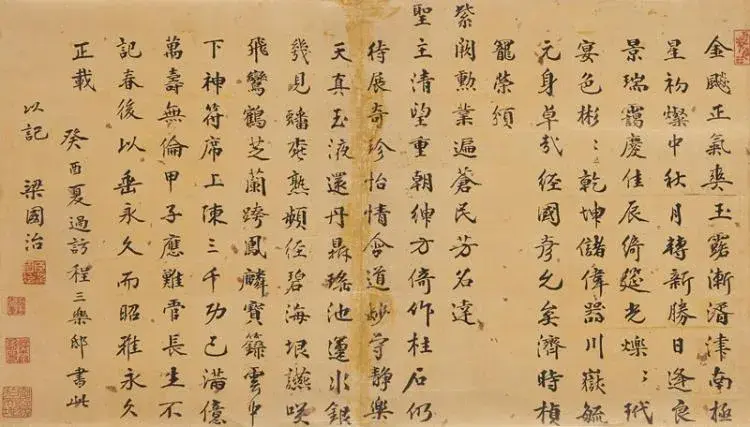
Liang Guozhi (梁国治; 1723–1786), courtesy name Jieping and art names Yaofeng and Jingsi, was a native of Kuaiji, Shaoxing Prefecture (present-day Shaoxing, Zhejiang Province). He was an illustrious grand secretary, scholar, and master calligrapher of the Qianlong era. In 1748, he captured first place (Zhuangyuan / Optimus) in the imperial palace examinations, entering the Hanlin Academy as a Senior Compiler and later…
Liang Guozhi (梁国治; 1723–1786), courtesy name Jieping and art names Yaofeng and Jingsi, was a native of Kuaiji, Shaoxing Prefecture (present-day Shaoxing, Zhejiang Province). He was an illustrious grand secretary, scholar, and master calligrapher of the Qianlong era. In 1748, he captured first place (Zhuangyuan / Optimus) in the imperial palace examinations, entering the Hanlin Academy as a Senior Compiler and later serving as Director of Studies in the Directorate of Education. Dispatched to Guangdong as Circuit Intendant, his administrative brilliance earned him rapid promotion to Vice Minister of Personnel. In 1769, he was appointed Governor of Hubei and Acting Governor-General of Huguang; confronting severe provincial granary deficits of over 480,000 shi, he devised a seasonal revolving fund using 200,000 taels of treasury silver, replenishing the imperial granaries without levying burdens on the populace. In 1771, Liang was transferred to Governor of Hunan during the expansion of the Second Jinchuan War. Facing acute fiscal shortages, he secured imperial permission to allocate over 100,000 taels from provincial reserves to manufacture firearms and ammunition, while successfully reforming military promotion regulations to reward frontline combatants. In 1773, he was summoned to Beijing to serve in the Grand Council and Southern Study, subsequently advancing to Minister of Revenue, Assistant Grand Secretary, and Grand Secretary of the Eastern Cabinet in 1785. He served as Associate Chief Compiler for the monumental Siku Quanshu and directed imperial editorial projects such as the Imperial Gazeteer of Rehe. Liang was distinguished by his serene composure, austere personal frugality, and vigilance regarding fiscal integrity, famously admonishing students that fiscal negligence harmed the people ten times more severely than judicial errors. He passed away in office in 1786 at age sixty-four. The Qianlong Emperor grieved his death, granting the posthumous rank of Grand Guardian of the Heir Apparent, conferring the posthumous name "Wending," and praising him as an exemplary "pure minister" (Chunchen) who feared troubling the populace even in his final hours. Renowned for his vigorous Tang-style calligraphy, he was celebrated alongside Liang Tongshu and Liang Yan as one of the "Three Liangs of Calligraphy."
Born into an illustrious scholarly family in Shaoxing, Zhejiang; displayed moral seriousness and mastered the Confucian canons.
Achieved first place (Zhuangyuan) in the palace examination; appointed Senior Compiler and Director of Studies.
Served as Chief Examiner in Guangdong; impressed the throne during imperial audience and received regional circuit appointments.
Appointed Governor of Hubei; instituted a treasury-backed grain purchasing cycle to replenish a 480,000-shi granary deficit.
Transferred to Governor of Hunan; mobilized 100,000 taels to supply Jinchuan munitions and reformed frontline battlefield promotion rules.
Recalled to the capital; appointed Grand Councilor, Attendant of the Southern Study, and Vice Minister of Revenue.
Elevated to Minister of Revenue; directed the Shuntian civil examination, recognizing and patronizing the pioneering historiographer Zhang Xuecheng.
Supervised imperial fiscal policy; elevated to Assistant Grand Secretary and Junior Preceptor to the Heir Apparent.
Promoted to Grand Secretary of the Eastern Cabinet and chief financial minister; directed the compilation of the Siku Quanshu.
Passed away in office in December at age sixty-four; praised as a "pure minister," granted Grand Guardian honors, and canonized as Wending.
Liang Guozhi was born into an eminent bureaucratic family in Kuaiji, Shaoxing. His father Liang Wenbiao had served as Prison Warden in the Ministry of Punishments, renowned for rectifying wrongful imprisonments and showing deep mercy to prisoners. Liang Guozhi was deeply devoted to his family; he was born as a twin, but his twin brother died young. Throughout his life, Liang mourned his brother by refusing to celebrate his own birthdays, while serving his widowed sister-in-law with filial piety, winning widespread respect in his native community.
In 1748, at the age of twenty-six, Liang participated in the palace examinations, drafting an immaculate policy response that earned him first place (Zhuangyuan / Optimus) from the Qianlong Emperor. In accordance with precedent, he was commissioned as a Senior Compiler in the Hanlin Academy, subsequently serving as imperial diarist and Director of Studies in the Directorate of Education. In 1756, he presided as Chief Examiner over the Guangdong provincial examinations. In his audience report, his articulate proposals earned high praise from the emperor, who appointed him to regional circuit posts including the Huijiachao Circuit and Grain Transport Circuit, where he established a formidable reputation for integrity before rising to Vice Minister of Personnel.
In 1769, Hubei Province suffered from chronic administrative stagnation and consecutive floods, accumulating severe granary deficits exceeding 480,000 shi. The Qianlong Emperor appointed Liang as Governor of Hubei, subsequently ordering him to act as Governor-General of Huguang and Jingzhou General, commanding central regional civil and military affairs.
Upon arrival, Liang discarded the abusive practice of forcing subordinate magistrates to repay granary shortfalls through predatory surcharges. Instead, he formulated an innovative financial plan: he requested 200,000 taels of silver from provincial treasury reserves to purchase surplus grain during autumn harvest gluts when prices fell; during spring and summer shortages, the granaries disbursed the grain at stabilized prices, adding merely one qian of silver per shi to offset transport overhead. Within several years, this revolving mechanism completely replenished the 480,000-shi deficit without extracting a single copper from the peasantry, while effectively capping regional grain price inflation.
In 1771, Liang was transferred to Governor of Hunan. At the time, the Qing court was waging the intensive Second Jinchuan Campaign in Sichuan, and logistics placed enormous strain on adjacent provinces. As the principal rear-guard supply base, Hunan was tasked with manufacturing firearms and ammunition, but military funding was exhausted. Liang boldly petitioned the throne to draw over 100,000 taels of silver from provincial emergency funds, advancing the money against future annual military deductions over three years, which solved the supply crisis.
Furthermore, observing that battlefield officers were disadvantaged in promotions because standard vacancies were filled by sedentary garrison personnel, Liang submitted an imperial memorial urging that frontline combatants receive equal access to home garrison vacancies. The Qianlong Emperor approved the reform, significantly boosting the morale of expeditionary troops fighting in the Jinchuan mountains.
In 1773, recognizing his administrative triumphs, the Qianlong Emperor summoned Liang to Beijing to serve in the Grand Council and Southern Study, promoting him to Vice Minister of Revenue. In 1777, he was elevated to Minister of Revenue, commanding imperial finances. In 1783, he was named Assistant Grand Secretary, and in 1785, he ascended to Grand Secretary of the Eastern Cabinet while continuing to supervise the Ministry of Revenue.
Liang served in the inner decision-making council for thirteen years, concurrently serving as Associate Chief Compiler of the Siku Quanshu and directing the compilation of royal works such as the Imperial Gazetteer of Rehe and Imperial Inkstone Catalogue of the Western Clear Collection. In 1777, he presided as Chief Examiner over the Shuntian provincial examinations. Disdaining rote memorization of examination bagu essays, he framed exam questions that integrated broad historical analyses to test candidates’ grasp of practical statecraft. When he read the profound submission of Zhang Xuecheng—a brilliant historiographer who had languished unrecognized in Beijing—Liang was deeply impressed and awarded him the degree. Upon learning that Zhang was a fellow Shaoxing native who had concealed his identity, Liang praised his integrity and subsequently invited Zhang to teach his sons, fostering one of the most celebrated intellectual patronages of the Qing Dynasty.
Throughout his decades as Grand Secretary, Liang maintained an atmosphere of dignified calm and personal austerity. In his private life, he spent his evenings studying classical calligraphy, completely free from bureaucratic vanity. The Qianlong Emperor deeply cherished his devotion, granting him a residence within the imperial city, the right to ride a horse in the Forbidden City, and imperial gifts of blue fox robes and first-rank insignia.
Liang was exceptionally vigilant regarding financial probity. When a student sought his recommendation to become a legal secretary in a provincial judicial yamen, Liang warned him sternly: "One’s inner moral purpose must never be compromised!" When the student offered to handle taxation and grain accounts instead, Liang admonished him with grave severity: "If a legal secretary acts without care, he harms at most one man, and the injustice is publicly known; but if a tax secretary acts with greed or negligence, he harms the people ten times more severely! The populace feels no immediate blow, but the systemic poison spreads for decades or centuries, draining the lifeblood of the realm! If you harbor such casual ambitions, you shall never touch finances!" He firmly refused the request.
In December 1786, Liang passed away in office from exhaustion at the age of sixty-four. In his final hours, he instructed his family to decline all imperial funeral donations and donate remaining funds to famine relief. Grieving his passing, the Qianlong Emperor granted the posthumous title of Grand Guardian of the Heir Apparent, bestowed the posthumous name "Wending," and dispatched the seventeenth imperial prince to offer sacrifices, extolling him as a "pure minister" (Chunchen) whose pristine modesty endured to the very end.
Ascending from Optimus laureate to the Grand Secretariat, Liang Guozhi served in the supreme councils for over a decade with flawless composure. In regional governorships, he brought enduring prosperity to the populace; in central administration, he safeguarded the imperial treasury with unblemished incorruptibility, standing as an elder statesman of the High Qing era.
"Even on his deathbed, Minister Liang feared imposing burdens on the populace; he was truly a pure minister! Pure in learning and meticulous in conduct, his integrity remained consistent from beginning to end." — Qianlong Emperor (Hongli), Veritable Records of the Qing Dynasty
"Liang Guozhi possessed profound filial piety and managed affairs with meticulous reverence. Throughout his life, he never displayed harshness in speech, yet remained impervious to private solicitation. Safeguarding the treasury and mitigating civilian suffering without seeking empty glory, he truly displayed the stature of an illustrious statesman." — Zhao Erxun, Chief Editor, Draft History of Qing (Qing Shi Gao), Volume 320, Biographies 107
FIGURES ASSOCIATED WITH THIS DYNASTY