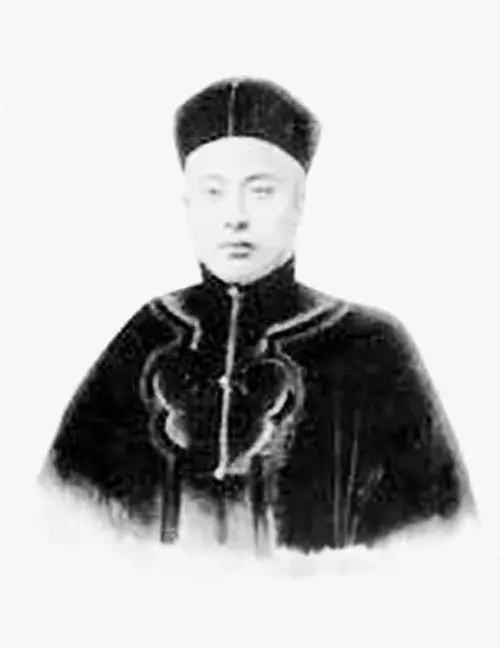
良弼
Historical portrait of Aisin-Gioro Liang-pi
Image creditsUnknown authorUnknown author · Public domainImage source

Historical figure

Liangbi (良弼)

良弼

Liangbi (良弼, 1877–1912), courtesy name Lechen, of the Aisin Gioro clan, was enrolled in the Manchu Bordered Yellow Banner and descended from Taksi, ancestor of the Qing imperial house. He was an outstanding military theorist, army reformer, and supreme leader of the Royalist Party (Zongshedang) during the final years of the Qing Dynasty. Sponsored by Hubei Governor Duanfang in 1899 to study in Japan, he graduated from Seijo…

Qing Dynasty

PROFILE

Liangbi (良弼, 1877–1912), courtesy name Lechen, of the Aisin Gioro clan, was enrolled in the Manchu Bordered Yellow Banner and descended from Taksi, ancestor of the Qing imperial house. He was an outstanding military theorist, army reformer, and supreme leader of the Royalist Party (Zongshedang) during the final years of the Qing Dynasty. Sponsored by Hubei Governor Duanfang in 1899 to study in Japan, he graduated from Seijo School and the Imperial Japanese Army Academy, acquiring deep proficiency in modern western infantry tactics and general staff administration. Upon returning to China, he served as Director of the Military Administration Bureau, Commander of the First Brigade of the Imperial Guard, and Senior Councilor of the General Staff, winning the trust of Prince Regent Zaifeng and emerging as the leader of the younger generation of Manchu officers. Following the outbreak of the 1911 Wuchang Uprising, the Qing court appointed Yuan Shikai as Prime Minister, who manipulated internal divisions to compel imperial abdication. Discerning Yuan autocratic ambitions, Liangbi fiercely opposed republican capitulation, founding the Constitutional Monarchist Association (popularly known as the Royalist Party) in January 1912 alongside Prince Puwei and Tieliang to defend the dynasty. On the night of January 26, 1912, revolutionary Peng Jiazhen detonated a bomb outside Liangbi residence, severing his leg. He succumbed to his wounds two days later at age thirty-five. Before dying, Liangbi lamented: "The one who bombed me was Peng Jiazhen, but the one who killed me was Yuan Shikai! With my death, the Great Qing is finished!" Within two weeks, Emperor Puyi formally abdicated, terminating imperial rule.

Courtesy Name
Lechen
Native Place
Manchu Bordered Yellow Banner (Modern Shenyang, Liaoning)
Dynasty
Qing Dynasty
Birth Date
1877 (Third Year of Guangxu)
Death Date
1912 (Twelfth Month of Third Year of Xuantong)
Age at Death
35
Highest Office
Brigade Commander of the Imperial Guard, Military Councilor of the General Staff
Major Offices
Director of the Bureau of Military Affairs, Regiment Commander of the Eighth Infantry, Imperial Guard Commander
Accurate Identity Positioning
Eminent Late Qing Manchu Military Strategist, Commander of the Imperial Guard, Leader of the Royalist Party (Zongshedang)

LIFE TIMELINE

Relationship graph

BIOGRAPHY

Chronology

  • 1877 (Third Year of the Guangxu Reign) | Birth in Capital | Born into an impoverished collateral branch of the imperial lineage; raised by his widowed mother.
  • 1899 (Twenty-Fifth Year of the Guangxu Reign) | Studies in Japan | Selected for state-sponsored military education in Japan, entering the Imperial Japanese Army Academy.
  • 1903 (Twenty-Ninth Year of the Guangxu Reign) | Military Modernization | Returned to China to join the Commission for Army Reorganization, drafting modern army codes and drill manuals.
  • 1908 (Thirty-Fourth Year of the Guangxu Reign) | Imperial Guard Command | Commissioned by Prince Regent Zaifeng as Commander of the First Brigade of the newly formed Imperial Guard.
  • 1911 (Third Year of the Xuantong Reign) | Resisting Abdication | Mobilized the Royalist Party to counter Yuan Shikai maneuvers and oppose the surrender of imperial sovereignty.
  • 1912 (Twelfth Month of Third Year of Xuantong) | Assassination and Death | Mortally wounded by a bomb thrown by Peng Jiazhen; his death catalyzed the final abdication of the dynasty.

Life and Career

Collateral Lineage and Military Studies in Japan

Liangbi was born in 1877 in Beijing, descending from Bayara, the fifth son of early Jurchen chieftain Taksi. Over generations, his branch had drifted from imperial power, and Liangbi lost his father in early childhood, enduring deep poverty alongside his mother. Despite material adversity, he applied himself diligently to classical Confucian scholarship and modern reform treatises, determined to restore dynastic vitality.

In 1899, amid the rising wave of institutional modernization following the Hundred Days of Reform, Governors Zhang Zhidong and Duanfang advocated sending elite candidates to Japan to master modern military science. Liangbi was selected by Duanfang on government scholarship. In Tokyo, he completed preparatory training at Seijo School before entering the infantry division of the Imperial Japanese Army Academy in its second cohort. Observing modern industrial and military power firsthand, Liangbi studied western tactics, permanent fortifications, topographic cartography, and logistical planning, graduating with academic distinction.

Directing Army Reorganization and the Imperial Guard

Upon his return in 1903, Liangbi was appointed to the Commission for Army Reorganization by Grand Coordinator Tieliang and Yuan Shikai. He served successively as inspector of military academies and Director of the Military Administration Department. Dedicated to dismantling the inefficient Green Standard system, he drafted organizational frameworks for the projected thirty-six national divisions and translated modern German and Japanese military drill regulations into Chinese. Known for unbending personal incorruptibility, he rejected bribery and nepotism.

In 1908, following the accession of Emperor Puyi and the appointment of Prince Regent Zaifeng, the Qing court established the Imperial Guard to counterbalance Yuan Shikai control over the Beiyang Army. Zaifeng appointed Liangbi as Commander of the First Brigade of the Imperial Guard and Senior Councilor in the General Staff. Liangbi instituted rigorous Prussian-style drilling, eliminated aristocratic sinecures, and upgraded weaponry, transforming the guard into the most disciplined military force in northern China and consolidating his position as the leader of the Manchu officer corps.

The Royalist Party and Tragic Demise

In October 1911, the Wuchang Uprising ignited the Chinese Revolution, causing multiple provinces to secede. Hard-pressed, the court recalled Yuan Shikai as Prime Minister with supreme command over northern forces. However, Yuan prolonged negotiations with southern revolutionaries, aiming to leverage the crisis to force the abdication of the Qing emperor in exchange for the presidency of the new republic.

Liangbi recognized Yuan Shikai treasonous intentions. He staunchly opposed abdication, advocating the deployment of the Imperial Guard to confront the revolutionaries. In January 1912, as Empress Dowager Longyu wavered under pressure, Liangbi united with Prince Puwei and Tieliang to found the Constitutional Monarchist Association (the Royalist Party). Unanimously elected its paramount leader, Liangbi petitioned to dismiss Yuan Shikai and fight to the end, temporarily halting the abdication process.

Viewing Liangbi as the primary obstacle to republican unification, the Beijing-Tianjin assassination division of the Tongmenghui resolved to eliminate him. On the night of January 26, 1912, revolutionary Peng Jiazhen disguised himself as a northern army officer and waited outside Liangbi residence in Xisi. When Liangbi carriage arrived, Peng detonated a bomb. Peng died instantly, while the blast shattered Liangbi left leg. Carried into his quarters, Liangbi lingered for two days before succumbing to blood loss on January 28 at age thirty-five. In his dying moments, he observed: "The one who bombed me was Peng Jiazhen, but the one who killed me was Yuan Shikai! With my death, the Great Qing is finished!" Following his demise, the Royalist Party collapsed in panic. On February 12, 1912, the Qing court issued the Imperial Edict of Abdication, closing over two and a half centuries of dynastic rule.
Interpersonal Connections

  • Sponsoring Patron: Duanfang (Late Qing Governor-General who selected Liangbi for study in Japan)
  • Imperial Patron: Zaifeng, Prince Chun (Prince Regent who appointed Liangbi commander of the Imperial Guard)
  • Royalist Party Ally: Puwei, Prince Gong (Imperial prince who co-founded the Royalist Party with Liangbi)
  • Political Arch-Rival: Yuan Shikai (Beiyang warlord leader whose bid for power Liangbi fiercely resisted)
  • Assassination Operative: Peng Jiazhen (Tongmenghui revolutionary who assassinated Liangbi)

Historical Evaluations

  • The Draft History of Qing (Qing Shi Gao), Biography of Liangbi, recorded: "Liangbi was resolute in character and incorruptible in conduct, skilled in military affairs and endowed with courage. During the crisis of 1911, while the court panicked, Liangbi alone argued against abdication. On the day he died, the fate of the dynasty was sealed."
  • Revolutionary statesman Hu Hanmin evaluated: "Among the Qing nobility, princes like Zaifeng and Yikuang were mediocre figures unworthy of note; Liangbi alone was versed in modern military science and endowed with courage, truly the most formidable adversary of our party."
  • Historian Jin Liang recorded: "Lechen loyalty was unmatched, and he commanded the Imperial Guard with brilliance. When he was assassinated, the Manchu nobility in Beijing lost their spirits, and Yuan Shikai triumph became inevitable."

Related Entries

  • Zaifeng
  • Duanfang
  • Yuan Shikai

FIGURES ASSOCIATED WITH THIS DYNASTY

Bibliography

  • Zhao Erxun et al., Draft History of Qing (Qing Shi Gao), Volume 470, Biographies 257: Biography of Liangbi.
  • Hu Hanmin, Autobiography of Hu Hanmin: Records of the Beijing-Tianjin Assassination Bureau.