Birth into Scholarship
Born into a prominent literary family, his father Li Shan being the author of the standard commentary on Wenxuan.
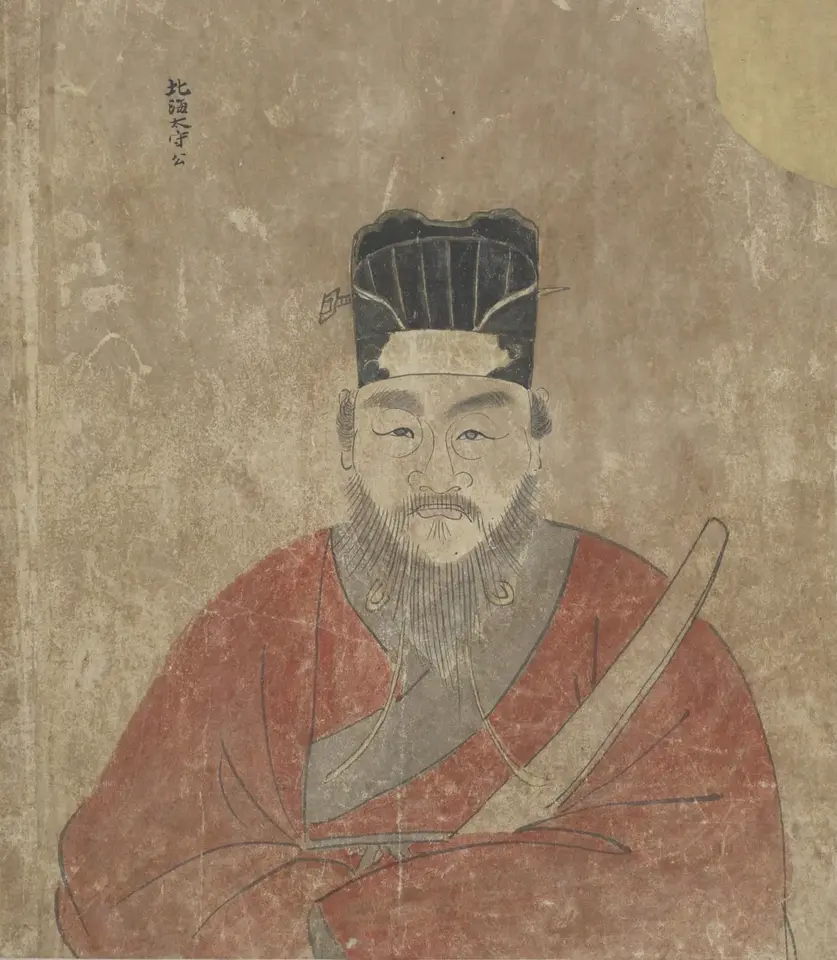
李邕
Li Yong (李邕, 678–747), courtesy name Taihe (泰和), widely revered by posterity as Li Beihai (李北海), was a monumental calligrapher, master essayist, and fearless remonstrator of the High Tang dynasty, originating from Jiangdu in Guangling. He was the son of Li Shan, the celebrated early Tang scholar renowned for his sixty-volume commentary on the Selections of Refined Literature (Wenxuan). Blessed with brilliant intellect and…
Li Yong (李邕, 678–747), courtesy name Taihe (泰和), widely revered by posterity as Li Beihai (李北海), was a monumental calligrapher, master essayist, and fearless remonstrator of the High Tang dynasty, originating from Jiangdu in Guangling. He was the son of Li Shan, the celebrated early Tang scholar renowned for his sixty-volume commentary on the Selections of Refined Literature (Wenxuan). Blessed with brilliant intellect and family scholarship, Li Yong achieved early literary renown. During the Chang'an era of Wu Zetian, he was recommended by Chancellor Li Qiao to serve as Left Reminder; in court audiences, he joined Censor Song Jing in boldly denouncing the imperial favorites Zhang Yizhi and Zhang Changzong, earning nationwide admiration. Throughout the reigns of Zhongzong, Ruizong, and Xuanzong, his uncompromising rectitude and refusal to flatter powerful ministers resulted in repeated political banishments to southern provinces, serving as Vice Director in the Ministry of Revenue, Sima of Kuozhou, Governor of Chenzhou, and Sima of Lizhou. During the Tianbao era, Li Yong governed Jijun and Beihai with exceptional administrative distinction. In Shandong, he was celebrated for patronizing literary talent and championing justice. In 745, he rode out to greet the young poet Du Fu, hosting the famous Lixia Pavilion banquet in Jinan, and warmly received the poet Li Bai in Beihai, forging historic cultural bonds. In 747, the despotic Chancellor Li Linfu fabricated charges of treason against him, dispatching the executioner Luo Xishi to beat the seventy-year-old statesman to death in his provincial office without trial. He was posthumously rehabilitated under Emperor Daizong as Director of the Palace Library. In Chinese cultural history, Li Yong revolutionized calligraphic art: following Emperor Taizong's Jinci Inscription, he championed the use of dynamic running script on monumental stone stelae, fusing the southern grace of Wang Xizhi with the rugged bone-strength of northern stele inscriptions. Honored by Dong Qichang with the adage "Wang Xizhi is like a dragon; Li Beihai is like an elephant," he authored over eight hundred monumental stelae, revered as an immortal master of brushwork.
Born into a prominent literary family, his father Li Shan being the author of the standard commentary on Wenxuan.
Recommended by Chancellor Li Qiao as Left Reminder, fearlessly impeaching the Zhang brothers alongside Song Jing in the imperial presence.
Promoted to Left Rectifier after the Shenlong coup; demoted to Nanbin for defying the powerful regent Wu Sansi.
Reassigned to the central government as Vice Director in the Ministry of Revenue under Emperor Xuanzong, later exiled as Sima of Kuozhou for forthright memorials.
Welcomed Emperor Xuanzong returning from the Mount Tai sacrifices, presenting elegant rhapsodies; incurred Chancellor Zhang Shuo's wrath for declaring his fitness for the premiership.
Sentenced to death on charges of fiscal irregularity, but saved by commoner Kong Zhang's courageous petition; commuted to exile as Defender of Zunhua in Qinzhou.
Transferred to Governor of Jijun and subsequently Governor of Beihai, administering with benevolence and dispensing generous patronage to visiting scholars.
Welcomed Du Fu at Jinan, hosting the historic banquet at the ancient Lixia Pavilion; hosted Li Bai at his Beihai yamen.
Falsely implicated by Chancellor Li Linfu; brutally beaten to death in his Beihai office by imperial agent Luo Xishi at age seventy.
Formally cleared of all false charges by Emperor Daizong, posthumously granted the rank of Director of the Palace Library.
Li Yong was born into an eminent family of scholars. His father, Li Shan, was an erudite master of classical literature who served as Scholar in the Institute of Refined Literature and Gentleman of the Imperial Library under Emperor Gaozong, authoring the monumental sixty-volume commentary on Xiao Tong's Selections of Refined Literature (Wenxuan), which became the premier textbook of classical Chinese prose. Raised within this rich scholastic tradition, Li Yong displayed formidable intellectual agility, committing the historical chronicles and classical canons to memory while still a boy and establishing an expansive reputation for oratorical eloquence. Unlike his scholarly father, Li Yong possessed a fierce, passionate temperament, driven by an unyielding desire to purify imperial politics and defend moral rectitude.
During the Chang'an era of Wu Zetian, Chancellor Li Qiao and Censor Zhang Tinggui jointly submitted a memorial praising Li Yong's unparalleled literary stature and uncompromising moral integrity, asserting that he was ideally suited for censorial responsibilities. Wu Zetian summoned the young scholar and appointed him Left Reminder. At that time, the empress's favored male courtiers, Zhang Yizhi and Zhang Changzong, monopolized access to the throne, manipulating imperial appointments while civil officials competed to flatter them. When Censor Song Jing formally impeached the brothers for treasonous corruption, Wu Zetian attempted to shield her favorites and intimidate the court. Amidst general ministerial silence, Li Yong stepped forward from the assembly and passionately supported Song Jing, delivering a scathing indictment of the favorites' abuses. Awed by his articulate fury, Wu Zetian relented and accepted the remonstrance. Li Yong became an instant national hero for his courage in confronting tyranny.
In 705, following the Shenlong Coup that forced Wu Zetian to abdicate and restored Emperor Zhongzong, Li Yong was promoted to Left Rectifier. However, Prince of Liang Wu Sansi exploited his ties to Empress Wei and Princess Anle to seize control of central administration, persecuting loyal officials. While many ministers compromised their principles to curry favor with the Wu clan, Li Yong remained steadfast, submitting multiple memorials warning against imperial in-laws undermining dynastic stability. Viewing him as an intolerable obstacle, Wu Sansi fabricated administrative pretexts to banish Li Yong from the capital, demoting him to Defender of Nanbin in the distant southern frontier.
Following the downfall of the Wei faction during the reign of Emperor Ruizong, Li Yong was recalled to court and appointed Vice Director in the Ministry of Revenue. In this post, he discharged his duties with fearless impartiality, refusing to grant improper tax dispensations to imperial princes and high aristocrats. His outspoken insistence on administrative legality alienated senior ministers, who united to engineer his removal, reassigning him as Sima of Kuozhou. Undaunted by provincial banishment, Li Yong immersed himself in the dramatic landscapes of the eastern seaboard, composing stelae for famous temples and mountain retreats that spread his reputation throughout Jiangnan.
Early in the Kaiyuan era of Emperor Xuanzong, Li Yong was recognized for his proven administrative competence and appointed Governor of Chenzhou. In Chenzhou, he suppressed corruption, excavated waterworks, and provided relief for displaced peasants, earning the warm devotion of the populace. In 725, Emperor Xuanzong conducted the grand Feng and Shan sacrifices at Mount Tai. As the imperial entourage progressed through Bianzhou on its return journey, Li Yong rode out to greet the sovereign, presenting a suite of exquisite rhapsodies celebrating the peace and prosperity of the empire. Emperor Xuanzong was delighted by his magnificent style, rewarding him with generous gifts and prolonged imperial audiences.
Buoyed by the emperor's visible favor, Li Yong openly declared at banquets that his administrative vision and literary stature fitted him to serve as chancellor. These remarks alarmed Chancellor Zhang Shuo, who resented Li Yong's rising influence. Capitalizing on Li Yong's lifelong habit of redirecting local treasury funds to feed impoverished scholars, Zhang Shuo ordered judicial auditors to scrutinize Chenzhou's fiscal records, charging him with embezzlement and recommending the death penalty.
At this critical juncture, Kong Zhang, a private scholar of Xuzhou, submitted a passionate memorial to Emperor Xuanzong, defending Li Yong's lifelong loyalty and demonstrating that the funds had been spent on public charity and intellectual patronage rather than private luxury. Emperor Xuanzong was moved by Kong Zhang's plea and commuted Li Yong's sentence, stripping him of office and exiling him to Qinzhou as Defender of Zunhua. Tragically, Kong Zhang was exiled to Guangdong by vindictive ministers and died in hardship; the two noble friends never met in person. Li Yong endured years of harsh exile before being pardoned and appointed Sima of Lizhou, later advancing to Governor of Kuozhou and Zizhou.
In the early Tianbao era, Li Yong was appointed Commandery Governor of Jijun and subsequently Governor of Beihai (modern Qingzhou and Yidu, Shandong), earning him the enduring historical title Li Beihai. Despite being in his sixties, his energetic passion remained undiminished. He handled litigation with profound compassion, famously intervening to secure an imperial pardon for a brave woman from Donghai who had personally slain her husband's unpunished murderer, a deed celebrated throughout the empire.
In 745, one of the most celebrated literary summits in Chinese history took place in Shandong. Hearing that the thirty-three-year-old poet Du Fu was traveling through Qizhou (modern Jinan), the sixty-eight-year-old Governor Li Yong rode over a hundred leagues to meet him. At the newly constructed Lixia Pavilion on Lake Daming, Li Yong hosted a magnificent feast in Du Fu's honor, conversing with the young poet as an equal and praising his literary brilliance. Deeply touched by the great master's generosity, Du Fu immortalized the occasion with the famous couplet: "Ancient is this pavilion on the right bank of the sea; abundant are the eminent scholars of Jinan." In the same year, Li Bai visited Li Yong's yamen in Beihai, where the two shared wine and camaraderie, prompting Li Bai to compose the narrative ballad A Valiant Woman of the Eastern Sea. The two greatest poets of the High Tang both acknowledged their profound debt to Li Yong's magnanimity.
By the mid-Tianbao era, the tyrannical Chancellor Li Linfu had established a reign of terror, employing secret police to eliminate any independent statesman who might challenge his supremacy. Li Yong's unyielding character, immense national prestige, and extensive network of scholar-admirers made him an intolerable threat to the chancellor. In 747, when military officer Liu Ji was accused of seditious intrigue involving his father-in-law Du Youlin, Li Linfu seized upon the discovery that Li Yong had once presented a riding horse to Liu Ji, fabricating charges that Li Yong had formed an illegal faction to plot rebellion.
Determined to eliminate him without delay, Li Linfu dispatched his ruthless henchmen, Luo Xishi and Qi Shunzhi, to Shandong with imperial execution decrees. Arriving at the Beihai government office, Luo Xishi bypassed formal judicial interrogations, ordered the seventy-year-old statesman to be pinned to the flagstones, and had him beaten to death with heavy wooden clubs. His close friend Pei Dunfu, Governor of Zichuan, was murdered on the same day. The death of the great master sent shockwaves through the empire. After the An Lushan Rebellion, Du Fu wept bitterly in his Eight Laments, recalling "the blood of Qingzhou spilled across the mound," while Li Bai lamented: "Do you not see Li of Beihai? Where now is his heroic spirit and grand vigor?" In 768, Emperor Daizong formally exonerated Li Yong, posthumously granting him the high rank of Director of the Palace Library.
Li Yong's supreme cultural legacy lies in his revolutionary transformation of Chinese epigraphy. Since the Han and Wei dynasties, imperial stelae had been written exclusively in formal clerical or regular script, conforming to rigid solemnity. While Emperor Taizong had experimented with running script on his Jinci Inscription, it was Li Yong who fully established and popularized the practice of carving large-scale running script onto monumental public monuments.
Drawing upon the fluid elegance of Wang Xizhi and Wang Xianzhi, Li Yong infused southern running-script forms with the monumental gravity, sharp angles, and structural density of northern stone inscriptions. His characters are distinguished by an asymmetric posture—slanted left-high and right-low—conveying dynamic energy while remaining anchored in stone-like stability. His masterpieces, including the Stele for General of the Cloud Banner Li Sixun (Li Sixun Bei) and the Stele for Lushan Temple (Lushan Si Bei), exhibit an unprecedented combination of rugged power and flowing ease.
In his critical reflections on calligraphy, Ming dynasty master Dong Qichang famously declared: "Wang Xizhi is like a dragon; Li Beihai is like an elephant," highlighting the colossal weight and unshakeable majesty of Li Yong's brushwork. Rejecting slavish imitation, Li Yong coined the famous warning: "Those who resemble me become vulgar; those who copy me die." His innovative style directly nourished the creative departures of Song dynasty titans Su Shi, Huang Tingjian, and Mi Fu, as well as Yuan dynasty master Zhao Mengfu.
Li Yong was renowned not only as a calligrapher but as one of the most prolific and celebrated epigraphic essayists of the Tang dynasty. During an era when stone monuments commemorated major historical figures and sacred temples, an inscription drafted and calligraphed by Li Yong was regarded by princes, generals, and monastic abbots as the supreme earthly honor.
According to historical records, Li Yong personally composed and calligraphed over eight hundred stelae throughout his life. The honoraria and gifts bestowed upon him by patrons amounted to tens of thousands of strings of cash, an unprecedented sum for literary labor. Du Fu described this cultural phenomenon in his poetry: "Petitioners thronged his gate, his stele texts illuminated the four horizons." He collaborated with master stone carvers such as Fu Lingzhi and Huang Xianhe, and some scholars argue he occasionally carved the inscriptions himself.
Remarkably, Li Yong accumulated none of this vast wealth for private luxury. Possessing the magnanimous spirit of an ancient patron, he spent his fortunes subsidizing struggling scholars, feeding impoverished literati, and building community infrastructure. His reputation for using literature to support scholars made him a beloved patron throughout the realm, and wherever he was assigned, regional scholars flocked to his administration.
Li Yong's generous patronage of younger poets represents one of the most radiant chapters in classical Chinese literature. During his governance of Beihai, he recognized the genius of the young Du Fu, traveling far out of his administrative territory to receive him at Lake Daming in Jinan. The resulting banquet at Lixia Pavilion not only validated Du Fu's artistic confidence during a period of obscurity, but also produced the famous phrase celebrating Jinan's heritage: "Ancient is this pavilion on the right bank of the sea; abundant are the eminent scholars of Jinan."
Similarly, his warm reception of Li Bai in Beihai inspired the composition of A Valiant Woman of the Eastern Sea, where Li Bai celebrated Li Yong's courage in rescuing a righteous widow from the executioner's blade. In the grief-stricken elegies written after Li Yong's murder, both Li Bai and Du Fu immortalized him not merely as a master of prose and calligraphy, but as a heroic martyr who championed moral truth against political tyranny.
Throughout his seven decades of public life, Li Yong stood as an unyielding exemplar of Confucian courage. Beginning with his youthful confrontation with the Zhang brothers in Wu Zetian's court, he consistently chose moral integrity over political convenience. He opposed the corrupt faction of Wu Sansi, resisted the arbitrary authority of Emperor Xuanzong's chancellors, and fearlessly presented the Classic of History to Emperor Yang to warn against dynastic decline.
Even during the darkest years of Li Linfu's administration, when ministers prostrated themselves in fear, Li Yong maintained an independent administrative posture in Beihai, providing sanctuary for dissidents and defending the oppressed. His tragic murder by the secret police cemented his reputation as one of the most heroic figures of the Tang dynasty, whose unbending bone-strength found expression in both his monumental calligraphy and his moral sacrifice.
FIGURES ASSOCIATED WITH THIS DYNASTY