Birth in Teng County
Born into an impoverished farming family in Xinwang Village, Teng County, Guangxi.
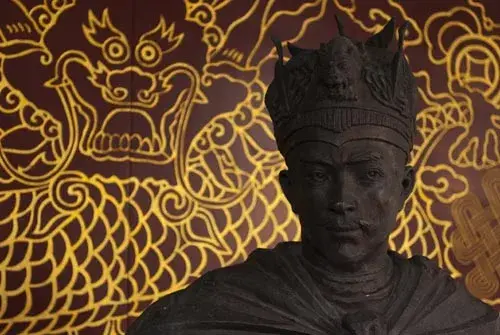
1823 CE–1864 CE
李秀成 (Li Xiucheng)
Li Xiucheng (李秀成, 1823–1864), originally named Li Yiwen (李以文) and later Li Shoucheng (李寿成) before receiving the name Xiucheng from Hong Xiuquan, was a native of Xinwang Village, Dali, Teng County, Xunzhou Prefecture, Guangxi. He was a prominent military commander and premier strategist during the late period of the Taiping Heavenly Kingdom, bearing the noble title "Loyal King" (Zhongwang) and serving as Deputy Chief of Staff…
Li Xiucheng (李秀成, 1823–1864), originally named Li Yiwen (李以文) and later Li Shoucheng (李寿成) before receiving the name Xiucheng from Hong Xiuquan, was a native of Xinwang Village, Dali, Teng County, Xunzhou Prefecture, Guangxi. He was a prominent military commander and premier strategist during the late period of the Taiping Heavenly Kingdom, bearing the noble title "Loyal King" (Zhongwang) and serving as Deputy Chief of Staff and Commander of the Rear Army. Born into grinding rural poverty, Li worked in his youth renting mountain land for farming, herding livestock, and doing odd jobs. In 1850, he joined the God Worshipping Society in Jintian, enlisting in the Taiping army and marching through Guangxi, Hunan, and Hubei before rising to prominence after the establishment of the Heavenly Capital at Tianjing (modern Nanjing). Following the catastrophic internal bloodbath of the Tianjing Incident in 1856, the Taiping leadership fractured, and Qing imperial armies tightened their siege around Tianjing. Partnering with Brave King Chen Yucheng, Li Xiucheng shouldered the monumental task of reviving the Taiping cause. In 1858, Li and Chen achieved the historic Sanhe Victory, completely annihilating the elite Xiang Army division under Li Xubin and relieving the siege of Anqing. In 1860, Li devised a brilliant strategy of "besieging Wei to rescue Zhao", launching a sudden raid on Hangzhou to draw off Qing besiegers before turning back to shatter the Qing Great Camp of Jiangnan for the second time, lifting the mortal threat to Tianjing. Immediately afterward, Li launched his Eastern Expedition into southern Jiangsu, capturing Changzhou, Wuxi, Suzhou, Jiaxing, and Hangzhou, establishing the prosperous Sufu Province. In Sufu, he implemented benevolent policies, fostered commerce, and protected cultural relics, winning immense local support. When advancing toward Shanghai, Li repeatedly routed the Western-led "Ever Victorious Army" under Frederick Townsend Ward and repelled joint Anglo-French intervention forces, mortally wounding Ward and killing French naval commander Albert Auguste Protetch. Beginning in 1862, Xiang Army forces under Zeng Guoquan laid siege to Tianjing. Recalled from the eastern front, Li Xiucheng led hundreds of thousands of troops in forty-six days of ferocious assaults at Yuhuatai but failed to dislodge the entrenched enemy. Despite severe starvation within the besieged capital, Li maintained an unyielding defense for more than two years. When Tianjing fell in July 1864, Li gave his own swift warhorse to the teenage Young Heavenly King Hong Tianguifu to facilitate his escape, riding a spent mount and falling into enemy hands at Fangshan. While imprisoned in Zeng Guofan's camp, Li composed his famous multi-thousand-word manuscript (Li Xiucheng's Self-Narration), detailing the entire history of the Taiping movement and analyzing its internal failures. On August 7, 1864, he was executed in Jiangning at age forty-two. Renowned for strategic brilliance, compassion for his soldiers, and unbending courage, Li Xiucheng was the most luminous military leader of the late Taiping Heavenly Kingdom.
Born into an impoverished farming family in Xinwang Village, Teng County, Guangxi.
Joined the God Worshipping Society with his mother and enlisted at Jintian.
Participated in the capture of Nanjing; appointed army commander under Shi Dakai and Hu Yihuang.
Appointed Point Inspector; stationed in Luzhou and Hexian to secure northern Anhui defenses.
Enfeoffed as Marquis of Hetian; rushed back to stabilize defenses after internal leadership purges.
Allied with Chen Yucheng to annihilate Li Xubin's elite Xiang Army force of over six thousand men.
Hong Xiuquan bestowed the title Loyal King (Zhongwang) and named him Deputy Chief of Staff.
Raided Hangzhou to distract Qing forces, crushed the Great Camp of Jiangnan, and founded Sufu Province.
Advanced on Shanghai; routed Ward's mercenaries and French intervention units, killing Admiral Protetch.
Recalled to relieve Tianjing; assaulted Zeng Guoquan's Xiang Army at Yuhuatai for forty-six days.
Subordinates assassinated Tan Shaoguang and surrendered Suzhou to Li Hongzhang; Sufu Province fell.
Xiang Army blew up Taiping Gate; Li gave his warhorse to the Young Heavenly King and was captured at Fangshan.
Finished his autobiographical manuscript in captivity; executed at Jiangning on August 7.
Li Xiucheng was born in Xinwang Village, Dali, Teng County, Xunzhou Prefecture, Guangxi. For generations, his ancestors had engaged in farming, leasing rocky mountain slopes from landlords to cultivate crops under crushing poverty. At age eight, his maternal uncle, who taught in a village school, took Li Xiucheng to study tuition-free for two years. During this brief period of formal education, Li demonstrated exceptional aptitude and read extensively in popular historical narratives such as the Romance of the Three Kingdoms.
By age ten, deteriorating household poverty forced Li Xiucheng to leave school and help his parents with hard agricultural labor. He herded cattle and sheep, took on odd jobs, and helped clear brushwood. Local villagers remarked that he possessed natural authority even in youth, herding large flocks of sheep using stones tied to ropes so effectively that hundreds of animals followed his commands. In adolescence, through his uncle's assistance, he found employment doing menial chores in village schools, using his spare hours to study classical histories and administrative texts, gradually forging a personality of quiet fortitude and razor-sharp perception.
Around 1844, Hong Xiuquan and Feng Yunshan entered Guangxi, proselytizing and establishing the God Worshipping Society across Guixian and the Thistle Mountain region of Guiping. Neighboring Teng County was deeply influenced by these egalitarian doctrines. Suffering under official extortion and landlord oppression, Li Xiucheng was powerfully drawn to the society's promises of social equality and deliverance. In 1850, when Hong Xiuquan issued the mobilization order for the Jintian Uprising, the twenty-seven-year-old Li Xiucheng brought his mother to Jintian, enlisting in the rear division of the vanguard and dedicating himself to the revolutionary movement.
Enlisting as a private soldier under Chun Official Chief Chancellor Hu Yihuang, Li Xiucheng took part in early campaigns, including the siege of Guilin, the assault on Quanzhou, the battle of Suoyidu, and the advance through Hunan. Hardened in continuous combat, Li distinguished himself by personal bravery, strategic composure, and genuine care for his soldiers and local civilians, earning promotion to brigade commander and later army commander.
In March 1853, the Taiping army captured the southern metropolis of Jiangning (Nanjing), and Hong Xiuquan proclaimed it the Heavenly Capital (Tianjing). Li Xiucheng was ordered to serve under Wing King Shi Dakai to pacify Anhui. Recognizing Li's foresight and iron discipline, Shi Dakai entrusted him with military-agricultural garrisons and northern Anhui defenses. In 1854, Li was stationed at Luzhou (modern Hefei) and Hexian, earning promotion to Palace Right 22nd Point Inspector and becoming the primary military commander in northern Anhui.
Facing repeated offensives by Qing Imperial Commissioner Shengbao and Jiangbei Camp Commander Dexing'a, Li Xiucheng employed flexible ambush tactics, coordinating closely with local Nian leader Zhang Lexing to repel imperial incursions. Stationed along Chaohu Lake and Hexian, he actively recruited boatmen to assemble a transport fleet, securing waterborne grain routes along the Changjiang and shipping rice to Tianjing. His logistical acumen and battlefield command matured rapidly, earning wide acclaim across the Taiping army.
In the autumn of 1856, immediately after the Taiping forces lifted the first siege of the Great Camp of Jiangnan, internal catastrophe struck the capital in the Tianjing Incident. Northern King Wei Changhui slaughtered Eastern King Yang Xiuqing and over twenty thousand followers; Wing King Shi Dakai raised troops in protest, prompting Hong Xiuquan to execute Wei Changhui. Soon afterward, alienated by Hong Xiuquan's suspicious brothers, Shi Dakai led more than one hundred thousand veteran troops away from Tianjing toward southwest China.
The internal purges decimated the Taiping leadership. Qing forces seized the opportunity to re-establish the Great Camps of Jiangnan and Jiangbei, encircling Tianjing again. Simultaneously, the Xiang Army under Zeng Guofan and Hu Linyi counterattacked fiercely in the west, recapturing Jiujiang and besieging Anqing. In this supreme crisis, Hong Xiuquan broke bureaucratic precedent to elevate talented younger generals, appointing Li Xiucheng as Earth Official Chief Chancellor and Marquis of Hetian, pairing him with Brave King Chen Yucheng to command the armed forces.
Li Xiucheng embraced his mission without hesitation. Displaying modest conciliation, he united disparate commanders, mobilized Nian cavalry in eastern Anhui, and coordinated operational movements with Chen Yucheng. To stabilize public confidence after Shi Dakai's departure, Li personally visited Tongcheng, Shucheng, and Qianshan, restoring civilian morale and securing vital communication routes between central Anhui and Tianjing.
In August 1858, Li Xiucheng and Chen Yucheng routed Dexing'a's Jiangbei Camp at Wuyi. In November, when elite Xiang Army general Li Xubin advanced to Shucheng and besieged Sanhe, Li and Chen executed a pincer maneuver, encircling and annihilating Li Xubin's six thousand veteran troops at the Battle of Sanhe. Li Xubin committed suicide. The Sanhe victory shattered the Xiang Army's western offensive, relieved Anqing, and marked the military resurgence of the late Taiping Heavenly Kingdom.
In 1859, to reward Li Xiucheng's decisive victories, Hong Xiuquan elevated him to the title of Loyal King (Zhongwang), praising him as "eternally loyal and righteous", and appointed him Deputy Chief of Staff and Commander of the Rear Army. By early 1860, Qing Imperial Commissioner Hechun and General Zhang Guoliang had constructed a formidable network of trenches and artillery redoubts outside Tianjing, cutting off external grain supplies and pushing the capital toward starvation.
To break the siege, Li Xiucheng proposed the brilliant strategy of "besieging Wei to rescue Zhao". In the spring of 1860, Li led seven thousand elite light troops on a rapid march through southern Anhui, bypassing Qing checkpoints and launching a surprise assault on Hangzhou, the capital of Zhejiang. Capturing the city on March 19, Li provoked immense panic in the Qing court. Hechun fell into the trap, dispatching General Zhang Guoliang with over thirteen thousand veteran troops south to relieve Hangzhou.
Having successfully diverted the besiegers, Li Xiucheng left a small rearguard to maintain the illusion of occupation and led his main force back toward Tianjing at double speed. Concentrating with Chen Yucheng and Li Shixian at Chunhua and Molingguan, Li launched a coordinated general offensive against the weakened Jiangnan Camp on May 2. Within days, the Taiping armies destroyed dozens of Qing fortifications, killing Zhang Guoliang at Danyang and driving Hechun to suicide at Zhenjiang, completely eradicating the Great Camp of Jiangnan.
Following the relief of Tianjing, Li Xiucheng launched his Eastern Expedition into southern Jiangsu to secure a rich economic base. Moving with lightning speed, he shattered Qing remnants at Danyang and captured Changzhou and Wuxi. On June 2, 1860, his forces reached Suzhou; Qing Governor Xu Youren fled, and the Taiping army took possession of the city, subsequently garrisoning Jiaxing and Huzhou to establish the prosperous Sufu Province.
Establishing Suzhou as the capital of Sufu Province, Li Xiucheng governed the rich Taihu basin. Recognizing that civilian welfare was the bedrock of lasting authority, he implemented benevolent administrative measures: reducing agricultural land taxes, inviting displaced landlords and gentry to return, and actively protecting private commerce. To revive silk and tea export routes interrupted by warfare, he established commercial transit bureaus, prohibiting troops from collecting illegal tolls and ensuring unimpeded water transport between Suzhou, Hangzhou, and Shanghai.
To assist impoverished artisans and small traders, Li established government credit programs, providing low-interest working capital that allowed merchants to keep thirty percent of profits while repaying seventy percent over time. He enforced strict military discipline with capital prohibitions against looting and rape, and appointed village elders to oversee household registers and canal dredging, restoring social order and commercial vibrancy across southern Jiangsu.
Li also prioritized cultural preservation. In Suzhou, he strictly forbade soldiers from vandalizing private libraries, established printing bureaus to republish classical texts, and protected ancient cultural landmarks such as Hanshan Temple, winning immense praise from Jiangnan scholars.
Between 1860 and 1862, Li Xiucheng launched three major campaigns toward Shanghai to break foreign control over maritime customs and arms imports. Western powers violated their neutrality pledges, financing the mercenary "Ever Victorious Army" under American adventurer Frederick Townsend Ward and deploying regular British and French forces alongside Qing troops. Undaunted by modern artillery, Li Xiucheng engaged the combined forces in brutal battles across Qingpu, Jiading, Baoshan, and Songjiang.
In the Battle of Qingpu, Li lured the Ever Victorious Army into an ambush, surrounding the mercenaries, capturing foreign commander Edward Forester, seriously wounding Ward, and seizing extensive modern artillery and rifles. In subsequent engagements, Taiping forces killed French Rear Admiral Albert Auguste Protetch at Gaoqiao and mortally wounded Ward at Cixi, delivering severe blows to Western interventionists and demonstrating Chinese national resolve against foreign aggression.
In the autumn of 1860, the Taiping leadership formulated a two-pronged Western Expedition to converge on Wuhan, with Chen Yucheng leading the northern route and Li Xiucheng the southern route. Chen Yucheng advanced swiftly to Huangzhou; however, reluctant to abandon his newly acquired base in southern Jiangsu, Li Xiucheng progressed sluggishly through Jiangxi and southern Hubei. The failure of the two wings to coordinate allowed the Xiang Army to concentrate against Anqing, which fell in September 1861. Chen Yucheng retreated to Luzhou, where he was betrayed by Miao Peilin and executed, causing the middle Changjiang defensive front to collapse.
In May 1862, Zeng Guoquan led the elite Xiang Army directly to the outskirts of Tianjing, establishing fortified camps at Yuhuatai. Hong Xiuquan issued urgent decrees commanding Li Xiucheng to return immediately. Though aware that Tianjing's internal provisions were depleted, Li was forced to break off his Shanghai offensive and march back. In October, Li coordinated hundreds of thousands of troops in an all-out assault against the Xiang Army positions at Yuhuatai, pounding Zeng Guoquan's camps with heavy artillery.
The Battle of Yuhuatai raged continuously for forty-six days. Taiping sappers excavated tunnels and exploded several enemy redoubts, engaging in fierce hand-to-hand fighting. However, the Xiang Army held fast behind deep trenches. Beset by torrential winter rains, epidemic disease, and freezing conditions without adequate winter clothing, the Taiping troops suffered catastrophic casualties. Li Xiucheng was forced to lift the assault, leaving Tianjing's outer defenses compromised.
In 1863, Li Xiucheng led an offensive north of the Changjiang to relieve pressure on the capital, but encountered severe famine in northern Anhui, causing his army to disintegrate from starvation. Simultaneously, Li Hongzhang's Huai Army and the Ever Victorious Army under Charles George Gordon launched a coordinated offensive in southern Jiangsu. In December 1863, eight subordinate commanders under Gao Yongkuan assassinated defender Tan Shaoguang and surrendered Suzhou. Hangzhou and Changzhou fell soon after, wiping out Sufu Province and leaving Tianjing completely surrounded.
By the spring of 1864, all outer strongholds surrounding Tianjing had been lost, and the city was gripped by devastating famine, with soldiers and civilians surviving on wild weeds. Effective fighting forces were reduced to a few thousand exhausted troops. Li Xiucheng repeatedly urged Hong Xiuquan to evacuate the city and seek mobility elsewhere, but the Heavenly King angrily rejected the proposal. In June 1864, Hong Xiuquan died, and his teenage son Hong Tianguifu succeeded him, leaving total military responsibility on Li Xiucheng's shoulders.
On July 19, 1864, Xiang Army sappers detonated tens of thousands of pounds of gunpowder in a mine beneath the Taiping Gate, opening a breach over one hundred feet wide. Xiang Army assault columns poured into the city. Li Xiucheng led his troops in savage street fighting, contesting every barricade from Taiping Gate to the Heavenly King's palace until nightfall.
That night, Li Xiucheng escorted the Young Heavenly King and a few hundred survivors in a breakout attempt. Amid the chaotic darkness, Li gave his own swift warhorse to the Young Heavenly King to ensure his escape, mounting a spent horse himself and becoming separated in the melee. Exhausted and starving, Li hid in the desolate hills of Fangshan, where he was captured by local militia and delivered to the Xiang Army camp.
Brought before Zeng Guoquan, Li was subjected to severe torture, but maintained absolute composure. Zeng Guofan interrogated Li personally and instructed him to write a detailed account of his career. Imprisoned in chains, Li wrote continuously for several days, producing a multi-thousand-word manuscript that provided an unsparing analysis of the Taiping movement, its internal divisions, and strategic failures, while warning future generations to defend China against foreign imperialist encroachment.
Fearing that transporting Li Xiucheng to Beijing would expose the Xiang Army's looting of Nanjing to imperial scrutiny, Zeng Guofan decided to execute him summarily. When notified of his impending death on the evening of August 7, 1864, Li Xiucheng showed no fear, calmly adjusting his robes and walking to the Jiangning execution ground, where he died heroically at age forty-two.
In the spring of 1860, the Qing Great Camp of Jiangnan had constructed extensive siegeworks east of Tianjing, aiming to starve the capital into submission. Faced with imminent collapse, Li Xiucheng conceived and executed the classic strategic maneuver of "besieging Wei to rescue Zhao".
Selecting seven thousand elite light cavalry and infantry from Wuhu, Li marched hundreds of miles across mountain paths, completely bypassing Qing garrisons and striking directly at Hangzhou, the provincial capital of Zhejiang. On March 19, his forces took Hangzhou by storm, killing Governor Luo Zundian. The loss threw the Qing court into panic; Imperial Commissioner Hechun fell into the trap, detaching General Zhang Guoliang with over thirteen thousand veteran troops south to recover Hangzhou.
Having successfully diverted the main Qing army, Li Xiucheng evacuated Hangzhou, leading his force back toward Tianjing at extreme speed. Joining Chen Yucheng and Li Shixian outside the capital, Li launched a coordinated assault against the depleted Jiangnan Camp on May 2. Taiping forces broke through five main divisions, completely annihilating the Great Camp of Jiangnan, killing Zhang Guoliang, and lifting the siege of Tianjing in one of the most celebrated operational masterpieces of modern Chinese warfare.
Following the destruction of the Jiangnan Camp, Li Xiucheng directed his armies eastward into the wealthy Taihu basin. During the summer of 1860, he conquered Changzhou, Wuxi, and Suzhou, formally establishing Sufu Province with Suzhou as its administrative capital and creating the primary economic lifeline for the late Taiping state.
In administering Sufu Province, Li demonstrated exceptional civil competence. He implemented equitable land taxation, curbed bureaucratic extortion, and enforced strict discipline to protect merchant caravans. To revitalize commercial life, his government provided state-backed credit to destitute traders, allowing merchants to retain thirty percent of net profits while repaying seventy percent over time.
Furthermore, Li gathered and preserved extensive private library collections across Jiangnan, established printing houses to republish classical texts, and protected ancient architectural treasures like Hanshan Temple from destruction. To relieve ongoing grain shortages in Tianjing, he organized waterborne grain transport networks, dispatching thousands of river craft loaded with rice and textiles to sustain the capital under siege. His enlightened administration won widespread popular admiration throughout Jiangnan.
Between 1860 and 1862, Western powers intervened militarily to protect their opium trade and treaty privileges, allying with Qing authorities to sponsor the mercenary Ever Victorious Army led by Western adventurers. Confronting modern gunboats and rifled artillery, Li Xiucheng demonstrated heroic anti-imperialist resolve.
Li personally commanded major counter-offensives around Shanghai. In April 1862 at Qingpu, he ambushed the Ever Victorious Army, surrounding the mercenaries, capturing second-in-command Edward Forester, severely wounding Ward, and capturing substantial modern ordnance. He followed up by clearing dozens of enemy camps around Songjiang and Baoshan.
In subsequent engagements, Taiping gunners at Gaoqiao killed French naval commander Rear Admiral Albert Auguste Protetch, while Taiping riflemen mortally wounded Ward during the assault on Cixi, forcing British Admiral Sir James Hope to withdraw wounded to his flagship. Li's victories shattered the myth of Western military invincibility, writing a heroic chapter in the history of modern Chinese anti-imperialist defense.
When Tianjing fell in July 1864, Li Xiucheng exemplified supreme loyalty and personal sacrifice. As Xiang Army troops broke through the defenses, Li surrendered his only robust warhorse to the Young Heavenly King Hong Tianguifu, mounting a spent horse himself to cover the retreat, resulting in his capture at Fangshan.
In captivity, enduring torture and facing execution, Li maintained dignified composure, writing thousands of words in his prison cell. In Li Xiucheng's Self-Narration, he provided an unvarnished account of the Taiping movement from the Jintian Uprising onward, analyzing internal factionalism, strategic blunders, and administrative shortcomings, while urging China to adopt modern Western military technology to defend national sovereignty against foreign partition.
As the sole surviving comprehensive primary memoir written by a top Taiping commander, Li Xiucheng's Self-Narration holds immense historical value, serving as an indispensable foundation for the study of the Taiping Heavenly Kingdom.
Zeng Guofan, Supreme Commander of the Xiang Army, recorded in his victory memorial to the Qing court: "Li Xiucheng was the foremost among the rebel leaders, operating across the Jiangnan region for over a decade with unmatched cunning. While other rebel kings indulged in arrogance and luxury, Li Xiucheng alone commanded his subordinates with benevolence and forbearance, earning their fanatical devotion. In governing Suzhou and Hangzhou, he pacified the common people and won widespread affection, making him by far the most formidable chieftain among the rebels."
Qing scholar Li Hongyi noted in his postscript to Li Xiucheng's Self-Narration: "The Loyal King was not tall of stature, but carried himself with majestic presence, speaking with fluent eloquence and a resonant voice. On the day of his execution, his demeanor was entirely serene; he recited ten lines of farewell verse and met death with composed laughter, without the slightest hint of sorrow—a true champion of his generation."
Dr. Sun Yat-sen, founding father of modern democratic China, remarked: "Among the leaders of the Taiping Heavenly Kingdom, Loyal King Li Xiucheng stood out; rising from the furrowed fields, he possessed supreme loyalty and courage, resisting foreign aggression and shedding his blood on the battlefield. Though he fell, his glory endures, marking him as a truly extraordinary hero of modern China."
Marxist historian Fan Wenlan wrote in Modern Chinese History: "Li Xiucheng was the most outstanding military commander of the late Taiping Heavenly Kingdom. In the extreme crisis following the Tianjing Incident, he preserved the regime, securing the Sanhe victory and relieving Tianjing. In resisting foreign armed intervention, he fought in the vanguard, delivering devastating blows to Western armies and mercenaries, embodying the indomitable courage and noble spirit of the Chinese people against foreign aggression."
FIGURES ASSOCIATED WITH THIS DYNASTY