Imperial Lineage
Born into the prominent imperial clan of the Tang dynasty, devoted to calligraphy and painting from youth.
李思训
Li Sixun (李思训) (?–718), courtesy name Jianxian (建睍), was a native of Didao in Longxi (present-day Lintao, Gansu). He was a prominent imperial clansman of the Tang dynasty, an epoch-making master in Chinese art history, and the founding father of both blue-and-green and gold-and-green landscape painting. His grandfather Li Shuliang was a paternal cousin of Emperor Gaozu of Tang and was ennobled as Prince of Changping; his…
Li Sixun (李思训) (?–718), courtesy name Jianxian (建睍), was a native of Didao in Longxi (present-day Lintao, Gansu). He was a prominent imperial clansman of the Tang dynasty, an epoch-making master in Chinese art history, and the founding father of both blue-and-green and gold-and-green landscape painting. His grandfather Li Shuliang was a paternal cousin of Emperor Gaozu of Tang and was ennobled as Prince of Changping; his father Li Xiaobin inherited the title of Duke of Huayang and served as Chief Administrator of the Yuanzhou Area Command. In his youth, Li Sixun entered bureaucratic service through hereditary privilege, beginning as Assistant Administrator in Changzhou and later serving as District Magistrate of Jiangdu. During the reign of Wu Zetian and the Wu Zhou dynasty, when members of the imperial clan faced brutal purges orchestrated by cruel officials, Li Sixun recognized the imminent danger and resigned his post, retreating into seclusion deep within forested mountains for over a decade, thus successfully preserving his life and integrity throughout the political upheaval. Following the Shenlong Coup of 705 and the restoration of the Tang dynasty, Li Sixun was recalled to the imperial court. He served consecutively as Chief Minister of the Court of the Imperial Clan and Aide to the Area Commander of Yizhou, being ennobled as Commandery Duke of Longxi. During the early Kaiyuan era under Emperor Xuanzong, he was held in high imperial esteem, rising to Senior General of the Left Martial Guard and Senior General of the Right Martial Guard, and was promoted to Duke of Peng, earning the popular designation Senior General Li. He passed away in 718 in Chang'an. Emperor Xuanzong issued an edict mourning his death, posthumously bestowing upon him the title Commander-in-chief of Qinzhou and the posthumous name Zhao, granting him the rare privilege of an imperial burial accompanying Emperor Ruizong at Qiaoling Mausoleum. Li Sixun was an accomplished calligrapher and an unparalleled painter, renowned for his mastery of landscapes, palace pavilions, flowers, trees, and animals. Inheriting and expanding upon the meticulous technique of Sui dynasty master Zhan Ziqian, he created a lavish style using mineral azurite and malachite pigments outlined with powdered gold leaf, giving rise to gold-and-green landscape painting. His art was acclaimed by contemporaries as the foremost landscape painting of the dynasty. His son Li Zhaodao inherited the family art, known together as Senior General Li and Junior General Li, while his invention of the axe-cut texture stroke became a defining hallmark of mature Chinese landscape painting. During the Ming dynasty, Dong Qichang formulated the theory of the Northern and Southern Schools, venerating Li Sixun as the supreme patriarch of the Northern School of Chinese landscape painting.
Born into the prominent imperial clan of the Tang dynasty, devoted to calligraphy and painting from youth.
Entered civil service through clan privilege, served as Assistant Administrator of Changzhou, promoted to District Magistrate of Jiangdu.
Relinquished official rank upon Wu Zetian's accession and purge of imperial clansmen, retiring to mountain wilderness.
Recalled following Tang restoration, appointed Chief Minister of the Court of the Imperial Clan and Aide in Yizhou.
Deeply favored by Emperor Xuanzong, appointed Senior General of the Left Martial Guard, ennobled as Duke of Peng.
Passed away in Chang'an, Emperor Xuanzong mourned, bestowed Commander-in-chief of Qinzhou and burial at Qiaoling.
Li Sixun descended from a distinguished branch of the Longxi Li imperial clan that founded the Tang dynasty. His grandfather Li Shuliang was a paternal first cousin of Emperor Gaozu Li Yuan, playing a pivotal role in the Taiyuan uprising and subsequent reunification wars, for which he was ennobled as Prince of Changping. His father Li Xiaobin inherited the title Duke of Huayang and served as Chief Administrator of the Yuanzhou Area Command. Raised within an aristocratic imperial household, Li Sixun absorbed the classical canon and history while demonstrating an innate passion for calligraphy and traditional painting. In the early decades of the Tang dynasty, court nobility cherished the artistic legacy of the Six Dynasties and Sui period, particularly the delicate, fine-lined landscape scrolls created by Sui master Zhan Ziqian, such as Spring Outing. Li Sixun studied Zhan's linear brushwork diligently while observing the natural topography of rivers and mountains, quickly gaining renown among imperial circles for his exquisite depictions of landscapes, trees, and rocks.
During the reign of Emperor Gaozong, Li Sixun entered officialdom through hereditary clan privilege, receiving his first appointment as Assistant Administrator of Changzhou. In this post, he discharged administrative and military logistical duties with diligence, while dedicating his leisure hours to exploring the picturesque landscapes of Jiangnan, observing the misty waters of Lake Tai and ancient Wu-Yue vistas. This direct communion with nature deepened his visual vocabulary and refined his technique. In recognition of his integrity and competence, the court promoted him to District Magistrate of Jiangdu in Yangzhou. Jiangdu had served as a vital Grand Canal hub and prosperous commercial metropolis since the Sui dynasty. Li Sixun governed Jiangdu with benevolent prudence, earning a sterling administrative reputation.
In 690, Wu Zetian proclaimed herself emperor, changing the dynastic title to Zhou and initiating the Wu Zhou interregnum. To extinguish any potential resistance from the Tang imperial house, Wu Zetian unleashed cruel inquisitors such as Zhou Xing and Lai Junchen to weave expansive webs of false accusations. Prominent Tang imperial princes—including Prince of Han Li Yuanjia, Prince of Lu Li Lingkui, and Prince of Yue Li Zhen—were systematically executed along with their clans. Members of the Li royal house lived in constant terror of arbitrary arrest and death.
As an imperial descendant of Emperor Gaozu, Li Sixun was exposed to grave danger from these political purges. Recognizing the peril of clinging to official rank, he chose survival over ambition and promptly resigned his magistrate office in Jiangdu. Escorting his immediate household, he vanished into remote mountains and secluded valleys. Adopting an unassuming lifestyle, he severed ties with court society and lived in hiding for more than a decade. During these protracted years of exile, Li Sixun found solace in forests, streams, steep precipices, and cascading waterfalls. He channeled his inner emotions into painting, integrating the structural grandeur of northern peaks with intricate brushwork and rich mineral colors, thus forging his unique landscape style.
In early 705, senior statesmen Jing Hui, Cui Xuanwei, and Zhang Jianzhi executed the Shenlong Coup, compelling Wu Zetian to abdicate and restoring Emperor Zhongzong to the throne. The restored emperor issued general pardons, cleared fabricated charges, and extended warm patronage to surviving members of the imperial family. Li Sixun was invited back to Chang'an and appointed Chief Minister of the Court of the Imperial Clan. The Court of the Imperial Clan was responsible for managing the genealogical rolls, hereditary titles, stipends, and ancestral sacrifices of the nine imperial clansmen branches. Entrusting this vital post to the loyal, respected Li Sixun reassured the recovered imperial family.
Subsequently, Li Sixun was appointed Aide to the Area Commander of Yizhou. Yizhou (modern Chengdu, Sichuan) was the preeminent military and economic citadel of southwest China, governing dense urban populations and securing vital frontier boundaries. In Yizhou, Li Sixun restored administrative discipline, comforted the populace, and maintained vigilant defenses, winning widespread acclaim from civilian and military leaders. In recognition of his dedicated governance, the court ennobled him as Commandery Duke of Longxi. Throughout the Jingyun and Taiji eras of Emperor Ruizong, he continued to serve as a venerated elder statesman in central policy deliberations.
In 712, Emperor Xuanzong ascended the throne and inaugurated the celebrated Kaiyuan era. Renowned for his discernment and personal affection for calligraphy, literature, and painting, Emperor Xuanzong held Li Sixun in exceptional reverence due to his twin distinctions as a steadfast imperial elder and a preeminent master of the brush. In the early Kaiyuan years, Xuanzong appointed him Senior General of the Left Martial Guard and subsequently Senior General of the Right Martial Guard, elevating his title to Duke of Peng with a lavish stipend. Henceforth, both court and society venerated him as Senior General Li.
In 718, Li Sixun passed away in the capital Chang'an. Emperor Xuanzong was deeply shaken by the loss, suspending court sessions and ordering an imperial lament. The emperor posthumously conferred upon him the title Commander-in-chief of Qinzhou and the posthumous name Zhao (Illustrious). Xuanzong decreed that Li Sixun be accorded the high honor of an imperial accompanying burial at Qiaoling, the grand mausoleum of Emperor Ruizong, sealing his legacy with supreme imperial respect.
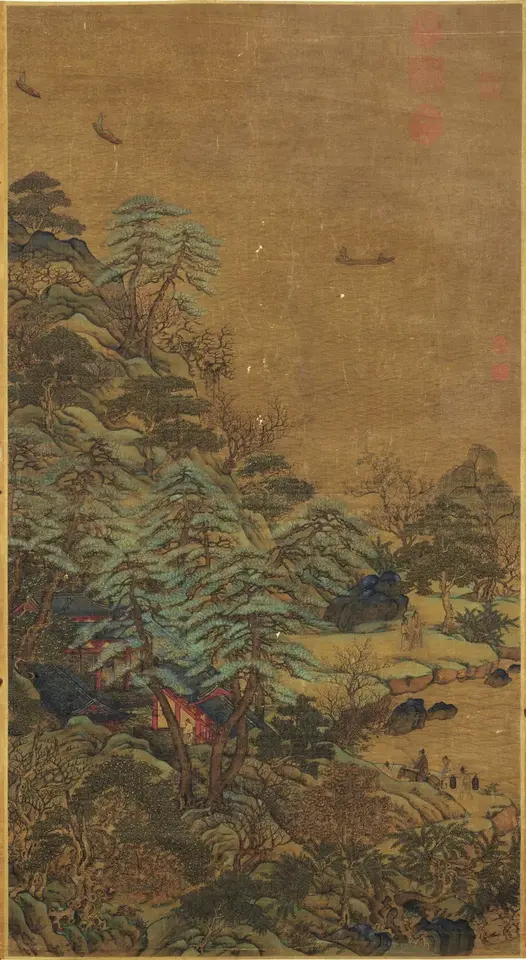
Li Sixun's crowning achievement in Chinese art history was his establishment of the blue-and-green and gold-and-green landscape painting traditions. Prior to the Tang dynasty, landscapes had primarily served as secondary decorative backdrops for narrative figure compositions. Although Sui painter Zhan Ziqian had initiated independent landscape rendering, techniques remained rudimentary. Li Sixun introduced the revolutionary technique of outlining mountains, ridges, and palace verandas with powdered gold pigment, layered over rich mineral applications of azurite blue and malachite green. His compositions attained an awe-inspiring grandeur, characterized by brilliant radiance and heroic scale. In Record of Famous Paintings of the Tang Dynasty, art critic Zhu Jingxuan classified his work in the divine category, lauding him as the foremost landscape painter of the dynasty whose brushwork captured nature's minutest details with breathtaking vigor.
In the technical evolution of Chinese brushwork, Li Sixun pioneered the transformative axe-cut texture stroke (Fupi Cun). Early landscape painters drew outlines without applying textural brushwork to convey surface volume. Li Sixun tilted his brush obliquely, applying forceful lateral sweeps reminiscent of an axe cleaving stone, precisely rendering the rugged, angular facets and dense geological heft of northern crags. This technical breakthrough transcended simple contour drawing, enhancing the tactile presence and spatial depth of classical painting. It is universally acknowledged by art historians as the definitive milestone marking the maturation of Chinese landscape art.
During the treacherous reign of Wu Zetian when imperial kin were systematically exterminated, Li Sixun displayed acute foresight and unyielding moral dignity. Rather than currying favor with usurping factions or awaiting inevitable destruction, he relinquished his bureaucratic commission and withdrew into deep wilderness. This deliberate retreat preserved his family lineage and political integrity, demonstrating the profound wisdom and moral rectitude expected of a noble Confucian gentleman.
Following the Shenlong restoration, Li Sixun served as Chief Minister of the Court of the Imperial Clan and Aide to the Area Commander of Yizhou. In the imperial clan bureau, he meticulously audited genealogical records, expunging distortions generated by the usurpation and restoring legitimate kinship hierarchies. In Yizhou, he fortified southwestern defenses and maintained civic harmony through benevolent administration, laying the regional foundation for the peace and prosperity of the early Kaiyuan era.
During the late Ming dynasty, artistic theorists Dong Qichang and Chen Jiru formulated the seminal theory of the Northern and Southern Schools of Chinese landscape painting. In his treatises Principles of Painting and Eye of Painting, Dong Qichang categorized precise, brightly colored, and majestic academic brushwork as the Northern School, designating Li Sixun as its supreme founding patriarch, in contrast to the monochrome ink-wash style pioneered by Wang Wei. From his son Li Zhaodao, through Song masters Zhao Boju and Zhao Boshu, down to Ming master Qiu Ying, the entire lineage of meticulous decorative landscapes traced its heritage directly to Li Sixun, establishing his immortal stature in art history.
Li Sixun not only attained the summit of landscape artistry himself, but also imparted his complete aesthetic methodology to his son, Li Zhaodao. Li Zhaodao built upon his father's foundational techniques, developing an even more delicate, intricate style that gained equal renown, leading contemporary connoisseurs to celebrate them collectively as Senior General Li and Junior General Li. Their joint aesthetic legacy dominated the landscape painting of the Mid-to-Late Tang and Five Dynasties periods. The famous surviving masterpiece Sailing Boats and Riverside Pavilions, attributed to this lineage, vividly reflects the radiant grandeur and royal elegance of their gold-and-green landscape style.
FIGURES ASSOCIATED WITH THIS DYNASTY