Court Appointment
Commissioned as seal clerk after imperial audience; promoted to Deputy Lieutenant-General of Rehe.
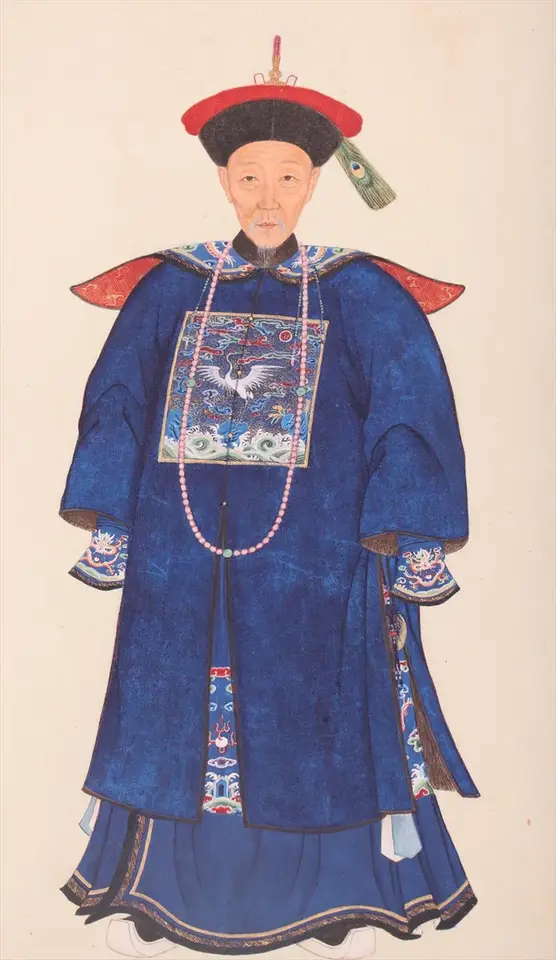
李侍尧
Li Shiyao (李侍尧, ? – November 24, 1788), courtesy name Qinzhai (钦斋), was a member of the Bordered Yellow Banner of the Han Military Banners, a fifth-generation descendant of Second-Class Earl Li Yongfang, and the son of Minister of Revenue Li Yuanliang. He was one of the most capable regional viceroys, military administrators, and frontier commanders of the Qianlong reign. Beginning his bureaucratic career as a junior clerk,…
Li Shiyao (李侍尧, ? – November 24, 1788), courtesy name Qinzhai (钦斋), was a member of the Bordered Yellow Banner of the Han Military Banners, a fifth-generation descendant of Second-Class Earl Li Yongfang, and the son of Minister of Revenue Li Yuanliang. He was one of the most capable regional viceroys, military administrators, and frontier commanders of the Qianlong reign. Beginning his bureaucratic career as a junior clerk, Li was acclaimed by the Qianlong Emperor upon their first audience as an "extraordinary genius of the empire," rising rapidly to Vice Minister of Works, Vice Minister of Revenue, and General of Guangzhou. In 1759, as Viceroy of Liangguang, he formulated the landmark Regulations for Restricting Foreigners (Fangfan Waiyi Guitiao), establishing the institutional foundation for the Canton Single-Port Trade System and the Cohong monopoly. Subsequently serving as Viceroy of Yun-Gui and Shaan-Gan, Li successfully reorganized southwestern defenses in the aftermath of the Sino-Burmese War. In 1780, an investigation spearheaded by Censor Qian Feng and Grand Councillor Heshen revealed widespread corruption and extortion across Yunnan, resulting in a death sentence for Li. However, recognizing his indispensable administrative talents, the Qianlong Emperor reprieved and reinstated him to resolve the Su Forty-Three rebellion in Gansu. In 1787, when the Lin Shuangwen uprising erupted in Taiwan, Li organized the cross-strait logistics network from Xiamen, enabling General Fuk'anggan to suppress the rebellion. For these achievements, he was enfeoffed as First-Class Earl Zhaoyong and his portrait was hung in the Purple Light Pavilion (Ziguangge). He passed away in office in 1788, posthumously honored as Grand Guardian of the Heir Apparent with the name "Gongyi".
Commissioned as seal clerk after imperial audience; promoted to Deputy Lieutenant-General of Rehe.
Promoted to Vice Minister of Works and Vice Minister of Revenue; praised for administrative efficiency.
Appointed General of Guangzhou and Acting Viceroy of Liangguang, auditing granary deficits across Guangdong.
Submitted the five-point Regulations for Restricting Foreigners, codifying the Canton System and Thirteen Factories supervision.
Formally appointed Viceroy of Liangguang and granted the rank of Grand Guardian of the Heir Apparent.
Transferred to Yunnan and Guizhou; fortified border checkpoints and neutralized Burmese diplomatic demands.
Convicted of massive bribery following an audit led by Qian Feng and Heshen; sentenced to death with reprieve.
Pardoned by imperial decree to manage military logistics and refugee relief during the Su Forty-Three uprising in Gansu.
Commissioned Viceroy of Min-Zhe and General of Fuzhou, strengthening naval forces and coastal garrison lines.
Directed maritime mobilization and provisions from Xiamen to support Fuk'anggan's suppression of the Lin Shuangwen uprising.
Enfeoffed as First-Class Earl Zhaoyong and painted among the twenty meritorious commanders in the Ziguangge; died in office on November 24.
Li Shiyao was born into one of the most prominent military houses in the Han Military Banners. His ancestor Li Yongfang had surrendered Fushun to Nurhaci in 1618, received imperial marriage to a Jurchen princess, and was created a hereditary second-class earl. Li Shiyao's father, Li Yuanliang, served as Minister of Revenue and grain transport commissioner, earning the posthumous name "Qingke." Under strict martial instruction, Li Shiyao mastered horseback archery alongside classical literatures, demonstrating exceptional intellectual agility, administrative precision, and tactical vision.
In the early Qianlong reign, Li entered the imperial bureaucracy through ancestral privilege as a junior clerk in the banner secretariat. When the Qianlong Emperor inspected imperial guards, Li's articulate presentation and encyclopedic grasp of frontier logistics astonished the sovereign, who remarked: "This man is truly an extraordinary genius of the empire!" In 1753, Li was promoted to Deputy Lieutenant-General of Rehe.
In 1755, Li was recalled to the capital and promoted to Junior Vice Minister of Works and later Senior Vice Minister of Revenue. Within the metropolitan ministries, he cleared longstanding accounting backlogs and audited treasury disbursements with ruthless efficiency, earning the emperor's lasting trust on complex fiscal affairs.
In 1756, Li was appointed General of Guangzhou and Acting Viceroy of Liangguang. Upon arriving in Guangdong, he audited provincial granary ledgers, discovering that county magistrates routinely purchased rotten grain while claiming reimbursement for top-tier prices. Li reported the fraud directly to the throne, dismissing corrupt magistrates and securing regional grain reserves.
In 1759, British East India Company interpreter James Flint sailed armed merchantmen into Tianjin, petitioning high authorities against custom extortion at Canton and demanding open access to Ningbo. Enraged by this breach of maritime protocol, the Qianlong Emperor ordered an immediate clampdown. As Viceroy of Liangguang, Li Shiyao took command, arresting corrupt brokers, interrogating Flint, and banishing foreign agitators.
More importantly, Li formulated the five-point Regulations for Restricting Foreigners (Fangfan Waiyi Guitiao), presenting them to the throne. The emperor ratified the memorial in full, codifying the Canton System that concentrated all Western maritime trade in Guangzhou under strict Cohong supervision for the next eight decades.
In 1777, following the conclusion of the Sino-Burmese War, the southwestern borderlands remained precarious, with Burmese forces frequently raiding frontier villages. The Qianlong Emperor transferred Li to the Viceroyalty of Yun-Gui to stabilize the frontier.
Li adopted a strategy combining strict defensive border closure with armed vigilance. He sealed cross-border passes at Tengyue and Pu'er, banning private trade in ironware, gunpowder, and silk to cut off Burmese military supplies. Simultaneously, he fortified frontier redoubts and organized local chieftain militias into continuous patrol networks. When Burmese emissaries presented extravagant credentials requesting open tribute trade, Li rejected their demands, requiring that Burmese authorities first return kidnapped border inhabitants and submit formal apologies, successfully stabilizing southwestern border security.
Despite his administrative brilliant and military competence, Li was arrogant and corrupt, demanding lavish gifts and monetary contributions from subordinate prefects and magistrates. In 1780, Yunnan Grain Intendant Hai Ning filed formal corruption complaints, which Censor Qian Feng brought before the throne.
The Qianlong Emperor ordered Grand Councillor Heshen and Censor Qian Feng to travel to Yunnan to conduct an exhaustive audit. Confronted by damning accounting ledgers, Li confessed to extorting tens of thousands of silver taels and priceless curiosities. The Nine Ministries sentenced him to execution with reprieve (zhanjianhou), confiscating his estate.
However, in 1781, the Su Forty-Three Muslim uprising broke out in Gansu. Regional imperial commanders suffered catastrophic defeats, throwing northwestern defense into turmoil. Recognizing that Li's logistical genius was indispensable in wartime, the Qianlong Emperor pardoned his death sentence, restored him to third-rank brevet, and dispatched him to Lanzhou as Acting Viceroy of Shaan-Gan. Li traveled day and night, overhauled the military supply lines, resettled refugees, and assisted Grand Secretary Agui in crushing the rebellion, regaining imperial confidence.
In 1785, Li was transferred to the Viceroyalty of Min-Zhe concurrently serving as General of Fuzhou. In late 1786, the Lin Shuangwen Heaven and Earth Society rebellion erupted in Taiwan, rapidly overrunning administrative centers and killing the regional brigade general.
Confronting this national maritime crisis, Li stationed himself at Xiamen, marshaling hundreds of naval war junks and organizing massive shipments of grain, gunpowder, cannons, and provincial reinforcements across the Taiwan Strait. He established emergency shipyards at Quanzhou, refitted shallow-draft landing craft, and secured coastal supply depots.
When Grand Secretary Fuk'anggan landed in Taiwan in the autumn of 1787, Li ensured that imperial troops received uninterrupted ammunition and food supplies, enabling Fuk'anggan to annihilate the rebel forces within months. In imperial commendations, Qianlong credited Li's logistics with half the victory, creating him First-Class Earl Zhaoyong, granting the two-eyed peacock feather, and ordering his portrait painted in the Purple Light Pavilion among the twenty meritorious heroes of the Taiwan campaign.
On November 24, 1788, Li passed away in office in Fuzhou from chronic overwork. The Qianlong Emperor mourned his passing, posthumously conferring the title Grand Guardian of the Heir Apparent and the posthumous name "Gongyi".
Li Shiyao's most influential historical legacy was the institutionalization of the Regulations for Restricting Foreigners in 1759. In response to European commercial and territorial expansion, Li designed an overarching regulatory framework governing foreign interactions:
First, foreign vessels were restricted exclusively to Huangpu Port in Guangzhou, requiring licensed pilots. Second, foreign merchants were required to reside exclusively in Thirteen Factories concessions, strictly prohibited from bringing foreign women, firearms, or military equipment into Guangzhou proper. Third, foreign traders were required to conduct all business, price negotiations, and tax payments through authorized Cohong merchant guilds, prohibiting direct transactions with domestic private merchants. Fourth, strict penalties were imposed on Chinese subjects secretly serving foreign interests or conducting illicit smuggling. Fifth, coastal artillery emplacements and naval patrols were placed at strategic bottlenecks along the Pearl River to conduct mandatory inspections. These regulations defined Sino-Western commercial and diplomatic interactions until the First Opium War.
As Viceroy of Yun-Gui, Li devised a sustainable, low-cost containment policy that preserved imperial frontier sovereignty without costly military overseas expeditions.
Recognizing Burma's dependence on Chinese iron and consumer products, Li closed border passes while maintaining defensive redoubts along the Yunnan borderlands. This economic and military quarantine preserved regional fiscal solvency and compelled the Konbaung dynasty to seek formal diplomatic accommodation in 1788, securing decades of peace in southwest China.
During the 1787–1788 campaign against the Lin Shuangwen rebellion, Li proved that logistical mastery was the cornerstone of cross-strait military victory. Organizing military supplies from Xiamen across the treacherous Taiwan Strait, Li invented moisture-sealed storage bins that prevented hundreds of thousands of bushels of rice from mildewing during maritime passage.
His supply operations ensured that Fuk'anggan's forty-thousand-strong expeditionary army advanced without supply interruption, leading directly to the pacification of the island and earning Li a permanent place of honor in the Purple Light Pavilion.
FIGURES ASSOCIATED WITH THIS DYNASTY