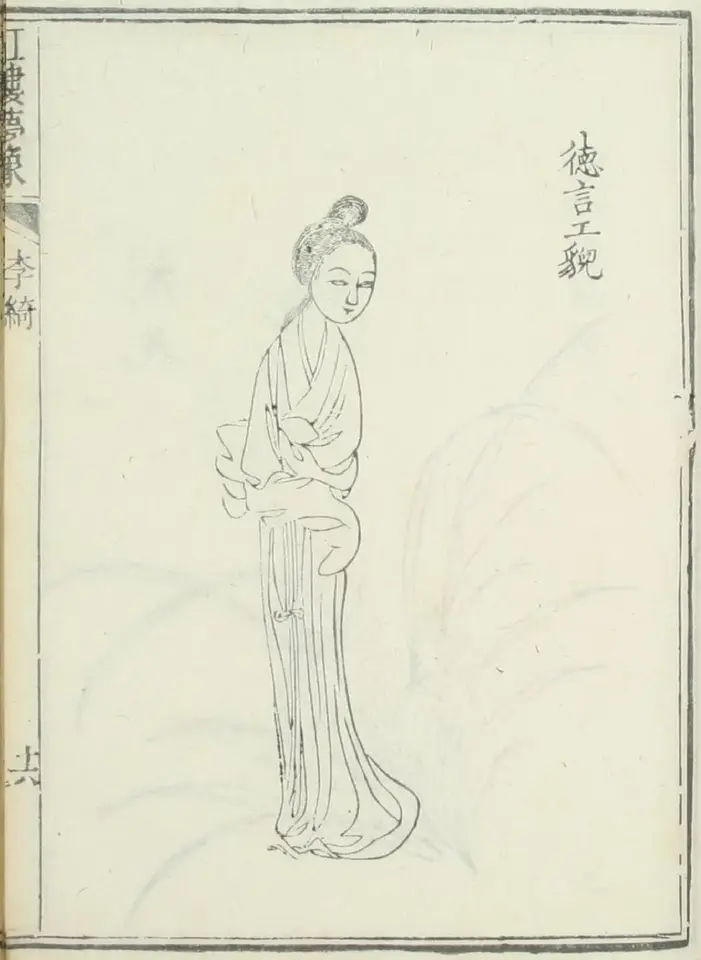
PROFILE
Li Qi (李颀), a native of Yinyang in Henan (present-day southwest of Dengfeng, Henan) with ancestral roots in Zhao Commandery (present-day Zhao County, Hebei), was a distinguished poet of the High Tang dynasty. In his youth, Li was born into affluent circumstances and possessed an untamed, generous disposition; indulging in lavish socializing with aristocratic youths, he squandered his ancestral fortune into bankruptcy. Reflecting deeply upon his ruin, he severed worldly ties and withdrew to his Dongchuan villa beneath Mount Shaoshi in Yinyang, dedicating a decade to relentless classical study. In the twenty-third year of the Kaiyuan era (735), Li passed the imperial examinations, earning the Jinshi degree, and entered government service as Sheriff of Xinxiang (Xinxiang Xianwei). Disdaining bureaucratic trivialities and possessing an aloof spirit, he remained in this junior post for years without promotion. In the Tianbao era, he resigned his office, returned to secluded life in Yinyang, practiced Daoist alchemy, and spent his remaining years among monks and recluses.
Li Qi was one of the leading figures in seven-character ancient ballads and frontier music bureau poetry during the High Tang era. His verse spanned a wide thematic range, characterized by solemn melancholy, generous pathos, and resonant diction. Li formed intimate friendships with leading cultural titans including Wang Wei, Gao Shi, Wang Changling, Cui Hao, Zhang Xu, and Cen Shen, engaging in reciprocal poetic exchanges. In terms of artistic attainment, his frontier poetry was distinguished by realism, exposing the immense suffering inflicted upon soldiers by imperial expansion; his musical poems, notably Listening to Dong Da Playing the Nomadic Flute and Listening to An Wanshan Playing the Tartar Pipe, are recognized as masterworks of classical music literature. Tang anthologist Yin Fan praised his verse in Heyue Yingling Ji as having "clarity of opening tones and elegance of rhetorical embroidery," while later critics ranked him alongside Gao Shi, Cen Shen, and Wang Wei as a supreme master of High Tang poetic forms.
- Ancestral Home
- Yinyang, Henan (present-day southwest of Dengfeng, Henan)
- Highest Office
- Sheriff of Xinxiang (Xinxiang Xianwei)
- Identity
- Renowned High Tang poet and Sheriff of Xinxiang
BIOGRAPHY
Chronology
- 720 (Tang Dynasty, 8th year of Kaiyuan) | Squandering and Seclusion | Having squandered his family fortune, reformed his ways and withdrew to Mount Shaoshi in Yinyang to study classics and poetry.
- 730 (Tang Dynasty, 18th year of Kaiyuan) | Diligent Hermitage | Immersed himself in Han-Wei music bureau ballads and Daoist philosophy at his Dongchuan villa, achieving profound scholarship.
- 735 (Tang Dynasty, 23rd year of Kaiyuan) | Earning the Jinshi Degree | Traveled to Chang'an and passed the imperial examinations, achieving the Jinshi degree and establishing fame in the capital.
- 737 (Tang Dynasty, 25th year of Kaiyuan) | Appointed Sheriff of Xinxiang | Appointed Sheriff of Xinxiang in Weizhou, managing county policing and taxes while observing common hardships firsthand.
- 742 (Tang Dynasty, 1st year of Tianbao) | Gatherings in the Two Capitals | Frequently visited Chang'an and Luoyang, engaging in poetic salons with Wang Wei, Gao Shi, and Wang Changling.
- 744 (Tang Dynasty, 3rd year of Tianbao) | Resignation and Return to Seclusion | Resigned from his post in Xinxiang, returning permanently to his Dongchuan estate in Yinyang.
- 748 (Tang Dynasty, 7th year of Tianbao) | Practicing Daoist Alchemy | Cultivated Daoist alchemy in Yinyang; poet Wang Wei wrote a poem praising his youthful complexion and tranquil demeanor.
- 751 (Tang Dynasty, 10th year of Tianbao) | Passing in Tranquility | Passed away peacefully at his Dongchuan estate, mourned by literary contemporaries across the empire.
Life Course
Squandering Fortune and Solitary Scholarly Devotion
Li Qi was born in Yinyang, Henan (present-day Yinyang Town, southwest of Dengfeng), tracing his paternal ancestry to Zhao Commandery (present-day Zhao County, Hebei). In his early years, Li grew up in an affluent household with substantial wealth. By temperament generous, unrestrained, and fond of adventure, he spent his youth mingling with wealthy youths and reckless horsemen across Luoyang and Chang'an, cockfighting and squandering gold with abandon. Within a few years, his inherited wealth was utterly exhausted, reducing him to severe poverty.
Confronting destitution and the indifference of former acquaintances, Li underwent a profound awakening. He severed ties with superficial social circles, packed his surviving books, and retreated to his Dongchuan estate beneath Mount Shaoshi in Yinyang. Over a decade of rigorous seclusion, Li rarely ventured beyond his gates, reading Confucian classics, dynastic histories, and philosophical treatises day and night while studying Han-Wei music bureau songs and Qi-Liang metrics. This arduous period forged his resolute character and laid an unshakeable foundation for his future literary prominence.
During this period of seclusion, Li not only investigated Confucian canons and poetic traditions, but also studied Daoist philosophy and cosmological theories. Cultivating fields beside his hermitage, he befriended pines and mountain streams, exploring the principles of the Book of Changes and the tranquility of Laozi. This integration of Confucian civic conscience and Daoist transcendence transformed his mindset from youth's restless extravagance into profound compassion and philosophical maturity.
Passing the Examinations and Serving in Xinxiang
In the twenty-third year of the Kaiyuan era (735), deeming his scholarship mature, Li journeyed west to Chang'an to sit for the imperial examinations. During that year's Jinshi examination, Li distinguished himself through penetrating policy treatises and elegant poetic compositions, earning the Jinshi degree in the first rank. The examination hall was filled with imperial talents, yet Li's success caused an immediate sensation across the capital.
However, under Tang administrative conventions, examination graduates were required to undergo separate civil evaluations by the Ministry of Personnel before appointment. Possessing an aloof pride and refusing to curry favor with powerful ministers, Li's placement faced protracted delays. In the twenty-fifth year of Kaiyuan (737), Li was finally appointed Sheriff of Xinxiang County in Weizhou (present-day Xinxiang, Henan). Ranked at the lowest bureaucratic grade of lower ninth rank, the sheriff was tasked with arresting criminals, patrolling rural villages, collecting taxes, and supervising forced corvee labor. For an ambitious intellectual, being submerged in clerical paperwork and petty administrative drudgery felt stifling.
Nevertheless, during his tenure, Li consistently sympathized with common struggles, witnessing the burdens borne by tenant farmers and conscript soldiers, which provided the ideological bedrock for his later socially critical verse. He observed the relentless enforcement of tax quotas and the poignant parting of conscripted youths, experiences that etched indelible impressions upon his creative consciousness.
Poetic Salons and Fame in the Two Capitals
Serving in Xinxiang for several years without advancement due to his uncompromising temperament, Li frequently traveled to Chang'an and Luoyang to engage with the literary luminaries of the High Tang. Li found kindred spirits in Wang Wei, Gao Shi, Wang Changling, Cui Hao, Zhang Xu, and Cen Shen, forging bonds of deep companionship. Gathering in riverside taverns and Wang Wei's estate at Wangchuan, they exchanged poems that became enduring classics.
In his poems to friends, Li demonstrated supreme artistic versatility. In his farewell verse to Wang Changling upon the latter's exile, his lines overflowed with profound sincerity and sorrowful power. In his poem presented to cursive calligraphy titan Zhang Xu, he captured Zhang's ecstatic brushwork and unrestrained creative energy after intoxication, producing an iconic literary portrait in Chinese art history. Li's seven-character ballads circulated widely through the two capitals, earning him equal renown alongside Gao Shi and Wang Wei.
Resignation and Daoist Reclusion in Yinyang
Observing court politics degenerate into luxury, imperial minister Li Linfu monopolize power, and regional military commissioners amass autonomous armies, Li became disillusioned with officialdom. In the third year of the Tianbao era (744), Li submitted his formal resignation, renounced his sheriff's green robe and seal of office, and returned to his ancestral home in Yinyang. Intellectuals across the capital admired his uncompromising integrity and penned parting verses praising his departure.
Retiring to his Dongchuan villa, Li found solace in the streams and peaks of Mount Shaoshi, immersing himself in Daoist meditation and longevity techniques. He refined cinnabar, cultivated internal tranquility, and consorted with mountain monks and local woodcutters. In the seventh year of Tianbao (748), literary statesman Wang Wei learned of his reclusive life and composed a poem praising his radiant complexion and serene contentment.
Around the tenth year of the Tianbao era (751), Li passed away peacefully at his Dongchuan estate. He left an indelible mark upon High Tang literature, his noble poetic style and transcendent character commanding lasting reverence across subsequent generations.
Major Achievements
Frontier Ballads and Anti-War Realism
Within the renowned High Tang frontier poetry school, Li Qi's music bureau ballads occupied a preeminent position through their penetrating social criticism and tragic epic resonance. Although he did not serve as a military staffer on distant frontiers, his firsthand observation of nationwide conscription and grueling corvee levies during Emperor Xuanzong's military campaigns against Tubo, Nanzhao, and the Turks gave him lucid insight into the devastating realities of warfare.
His music bureau masterpiece Ancient Campaign Ballad stands as a philosophical monument in frontier literature. Opening with the sweeping border panorama: "By day ascending the mountain to watch the beacon fires, at dusk watering horses beside the border river. Travel flags flutter as sandstorms darken the sky; the princess's pipa overflows with sorrowful longing," he plunged directly into the desolate frontier environment. He then portrayed the boundless plains without walls, snow sweeping across the desert, wild geese crying through the night, and barbarian youths weeping bitterly, transcending conventional ethnic prejudices to empathize with the shared tragedy of all conscripted soldiers.
At the climax of the poem, Li voiced a searing indictment: "Word has arrived that the Yumen Pass remains barred, yet soldiers must pursue swift chariots with their lives. Year after year battle bones are buried in the wild wastes, only to see grapevines introduced into Han palaces." Alluding to Emperor Wu of Han closing the Yumen Pass to force his generals forward, Li sharply satirized the vanity of contemporary military expansion, pointing out that countless common soldiers died in foreign sands merely to procure exotic delicacies and luxuries for imperial palaces.
In related works such as Song of the Frontier and Farewell to Liang Song, Li maintained this unyielding anti-war conviction. Rejecting triumphalist celebrations of conquest, he consistently directed attention toward the blood shed by ordinary youths and the desolation left in frontier homes, establishing a vital benchmark in Chinese anti-war literature.
Music Ballads and the Pinnacle of Acoustic Poetry
Li Qi's most dazzling artistic achievement in Chinese literature was his pioneering mastery of seven-character ballads depicting auditory musical experience. The High Tang era witnessed unprecedented musical cross-pollination between Central Asian melodies and court compositions. However, translating transient acoustic sensations into vivid visual and emotional metaphors represented one of the most formidable hurdles in classical poetics. Li conquered this challenge with astonishing genius.
In his celebrated masterpiece Listening to Dong Da Playing the Nomadic Flute and Sending Word to Supervising Secretary Fang, Li depicted master musician Dong Tinglan performing on the nomad flute: "Lady Cai in ancient times created the nomadic melody, playing all eighteen stanzas in succession. Nomad warriors wept, moistening border grasses; Han envoys stood brokenhearted facing departing guests. Across the desert in late autumn border grasses wither; before solitary walls in the setting sun combatants dwindle. Bamboo shoots splitting apart I cannot see, suspecting dark pines overturning in a mountain gorge. Stifled streams flow beneath rapids, then burst forth like thunder shattering bamboo." By deploying vast, shifting metaphors of mountain forests, flowing streams, and roaring thunder, he captured the tempo shifts of the flute from plaintive melancholy to surging triumph.
In another monumental music rhapsody, Listening to An Wanshan Playing the Tartar Pipe, he portrayed the Kucha master musician An Wanshan performing on the tartar pipe, describing the sound as withered mulberries enduring frost winds, nine fledglings of the phoenix chirping together, and dragons roaring as tigers howl. Li's musical poems, alongside Bai Juyi's Song of the Pipa and Li He's Li Ping's Konghou Song, are venerated as the Three Monumental Masterpieces of Chinese music literature.
Through these works, Li documented the aesthetic sensation created when Central Asian music penetrated Tang literary circles, preserving historical details of modal modulations and performance techniques, transforming sound into timeless philosophical reflection.
Character Portraits and Epochal Figures
Beyond frontier and music verse, Li displayed remarkable mastery in character sketch and farewell poetry. He excelled at using succinct brushwork in seven-character ballads to capture lifelike portraits of individuals across various social strata of the High Tang. His subjects included eccentric calligraphers, unrewarded commoner talents, high court dignitaries, and reclusive hermits.
In his celebrated work Presented to Zhang Xu, Li seized upon cursive master Zhang Xu's habit of writing while intoxicated, penning the lines: "Master Zhang by nature loves wine, openhearted without worldly pretension... Removing his cap to bare his head before princes and dukes, his brush sweeping across paper like flying clouds and mist." This immortalized an artistic genius who defied court authority and communicated with the cosmos through ink. In Seeing off Kang Qia Entering the Capital to Present Music Bureau Songs, he portrayed a folk musician carrying unique talents to Chang'an with boundless vitality.
Li's portrait poetry avoided pedantic physical detail, focusing instead on capturing the essential spirit and moral integrity of his subjects. His portraits reflected the expansive, boundary-breaking spirit of the High Tang era, enriching the human gallery of classical literature.
Seven-Character Regulated Verse and High Tang Models
Li was equally celebrated for his mastery of the strictly governed seven-character regulated verse (qiyan lushi). The Kaiyuan-Tianbao era was the decisive period when seven-character regulated verse achieved structural maturity. Li composed numerous regulated poems characterized by balanced prosody, immaculate parallelism, and magnificent resonance, jointly establishing standard models for the genre alongside Wang Wei and Gao Shi.
His celebrated regulated poem Seeing off Wei Wan to the Capital opened with the departure song and morning frost, weaving imagery of migrating wild geese and cloud-shrouded peaks with the traveler's sorrow, before concluding with earnest counsel urging the younger scholar not to squander his youth amid the frivolous entertainments of Chang'an. The middle couplets achieved effortless parallelism and flowing musicality, combining dignified gravitas with warm intimacy.
Ming-dynasty critic Wang Shizhen summarized High Tang poetry in Yiyuan Zhiyan by identifying Li Qi, Gao Shi, Cen Shen, and Wang Wei as the four definitive masters of seven-character regulated verse, praising their works for muscular vigor and elevated tonal resonance. Qing-dynasty anthologist Shen Deqian lauded Li's regulated verse as possessing lofty structural elegance and profound resonance, unrivaled during the Kaiyuan and Tianbao eras.
Transmission of Manuscripts and Literary Legacy
Li Qi's poetic output was widely celebrated during his lifetime and selected into contemporary anthologies. Tang critic Yin Fan included twelve of Li's poems in Heyue Yingling Ji, placing him in a prominent position and praising his clarity of tone and rhetorical beauty, which established the foundational assessment of his artistry.
Although some manuscripts were scattered during the Five Dynasties conflicts, his poems were preserved intact in private and imperial collections due to their melodic memorability. Song-dynasty bibliographies such as the Chongwen Zongmu and Chao Gongwu's Junzhai Dushuzhi recorded a five-volume edition of Li Qi's Collected Poems. During the Jiajing and Wanli eras of the Ming dynasty, scholars of the Archaist movement reprinted several editions of his collection.
When the Qing dynasty compiled the Complete Tang Poetry, it gathered over one hundred and twenty of Li's poems into volumes one hundred thirty-three through one hundred thirty-five. Modern literary scholars continue to hold Li in high esteem, recognizing him alongside Li Bai, Wang Wei, and Gao Shi as a fiercely original and socially conscious master whose frontier critiques and musical rhapsodies remain enduring treasures of world literature.
Related Figures
- Wang Wei: Eminent High Tang poet and hermit of Wangchuan. A lifelong literary companion of Li, he composed Presented to Li Qi praising Li's peaceful life of Daoist cultivation in Yinyang.
- Gao Shi: Renowned master of frontier poetry. He sat for the imperial exams in the same period as Li, sharing mutual poetic discussions on frontier affairs.
- Wang Changling: Celebrated High Tang master of seven-character quatrains. A close friend of Li, who composed a long ballad bidding him farewell upon his exile.
- Zhang Xu: Master of cursive calligraphy. Frequently socialized with Li over wine; Li composed Presented to Zhang Xu capturing his intoxicated calligraphic creation.
- Dong Tinglan: Celebrated Tang musician and zither master. Famed for performing nomadic flute tunes; Li composed Listening to Dong Da Playing the Nomadic Flute in his honor.
Historical Evaluations
- Yin Fan: "Li Qi's poetry has a clear opening tone and refined rhetoric. In diverse meters none can equal his standard; in varied lengths none can measure his vigor. Across the Kaiyuan and Tianbao eras, he was truly exceptional." (Heyue Yingling Ji)
- Wang Shizhen: "In the seven-character regulated verse of the High Tang, Gao Shi, Cen Shen, Wang Wei, and Li Qi were preeminent, excelling in robust style and elevated musicality." (Yiyuan Zhiyan)
- Hu Yinglin: "In High Tang seven-character ballads, Li Bai triumphed through ethereal ease, while Gao Shi, Cen Shen, and Li Qi triumphed through solemn and tragic grandeur; viewed together, they exhausted the possibilities of art." (Shisou)
- Shen Deqian: "Li Qi's poetic structure is lofty and refined, his tone profound and vigorous; his music bureau ballads shift like celestial steeds galloping across the void, a true marvel of Kaiyuan genius." (Tangshi Bieji)
- Ji Yun: "Li Qi's musical poetry translates sound directly into feeling, utilizing synesthesia with peerless mastery; unmatched in the entire Tang corpus, it represents true acoustic perfection." (Annotated Catalog of the Siku Quanshu)
Related Entries
- Ancient Campaign Ballad
- Listening to Dong Da Playing the Nomadic Flute
- Listening to An Wanshan Playing the Tartar Pipe
- Seeing off Wei Wan to the Capital
- Heyue Yingling Ji
- High Tang Poetry