Birth in Jiading
Born into an eminent gentry family in Jiading; father Li Xuedao was Assistant Surveillance Commissioner of Yunnan.
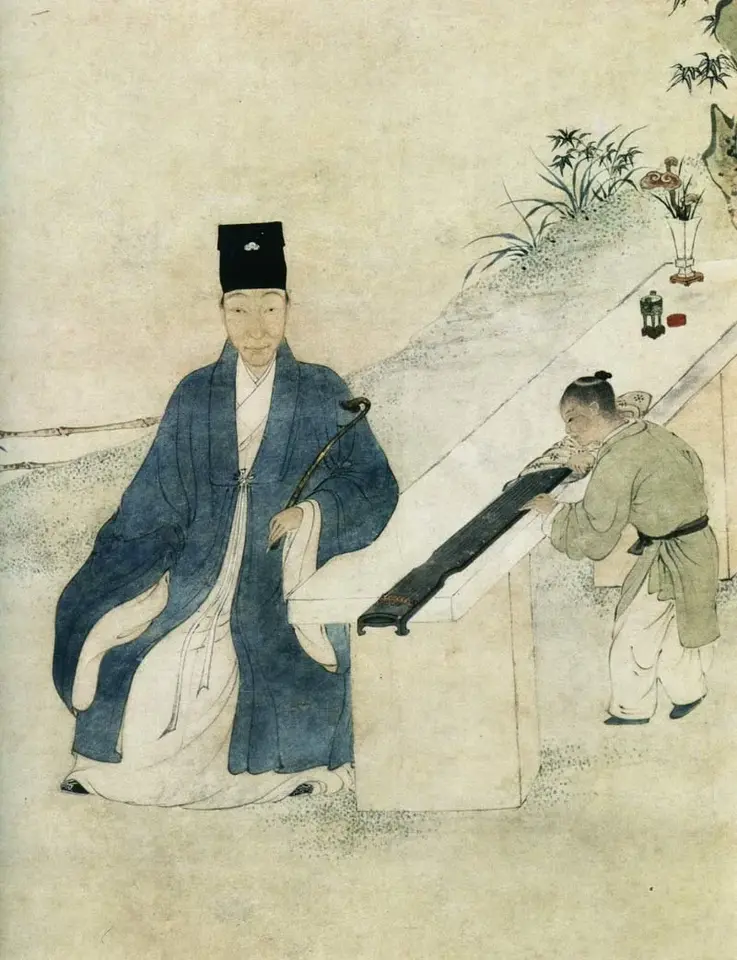
李流芳
Li Liufang (李流芳, 1575–1629), courtesy names Maozai and Changheng, art names Tanyuan, Xianghai, and Pao'an, was a native of Jiading, Suzhou Prefecture, South Zhili (modern Jiading District, Shanghai), with ancestral roots in She County, Huizhou. He was an eminent late Ming literatus, celebrated poet, essayist, calligrapher, and landscape painter, standing as a pivotal figure among both the "Nine Friends of Painting" (*Huazhong…
Li Liufang (李流芳, 1575–1629), courtesy names Maozai and Changheng, art names Tanyuan, Xianghai, and Pao'an, was a native of Jiading, Suzhou Prefecture, South Zhili (modern Jiading District, Shanghai), with ancestral roots in She County, Huizhou. He was an eminent late Ming literatus, celebrated poet, essayist, calligrapher, and landscape painter, standing as a pivotal figure among both the "Nine Friends of Painting" (Huazhong Jiuyou) and the "Four Masters of Jiading" (Jiading Si Xiansheng). In 1606 (34th year of Wanli), Li Liufang earned the juren degree in the Yingtian provincial examination. Over the following two decades, he traveled to the capital nine times to sit for the metropolitan examinations, failing on each occasion. During the Tianqi reign, the powerful eunuch Wei Zhongxian usurped state authority, prompting sycophantic provincial governors to construct living shrines in his honor. Traveling through Dongchang, Shandong on his way to Beijing, Li Liufang witnessed authorities demolishing civilian homes to build a lavish shrine for Wei Zhongxian. Indignant at such depravity, he threw down his brush, composed verses condemning eunuch tyranny, ordered his boat to turn back south, and swore never to set foot in Beijing again. Returning to Jiading, he constructed the "Sandalwood Garden" (Tanyuan), dedicating his time to poetry societies and ink painting. Along with Tang Shisheng, Lou Jian, and Cheng Jiasui, he was revered across Jiangnan as one of the "Four Masters of Jiading." In visual arts, his ethereal landscapes blended the moist brushwork of Huang Gongwang, Wu Zhen, and Dong Qichang; poet Wu Weiye immortalized him in his Song of the Nine Friends of Painting alongside Dong Qichang, Wang Shimin, and Wang Jian. In 1629, he died of illness at fifty-five.
Born into an eminent gentry family in Jiading; father Li Xuedao was Assistant Surveillance Commissioner of Yunnan.
Studied under Jiangnan scholars, mastering Confucian canons, classical poetry, calligraphy, and landscape painting.
Passed the Yingtian provincial examinations as a juren, earning widespread fame among scholars of eastern Wu.
Purchased land south of Jiading to build Sandalwood Garden (Tanyuan), planting bamboo and hosting scholars.
Exchanged painterly insights with Dong Qichang, Cheng Jiasui, and Wang Shimin, counted among the Nine Friends of Painting.
Witnessed Wei Zhongxian's living shrine in Shandong, denounced eunuch corruption, and abandoned metropolitan exams to return south.
Following the purge of Wei's faction, Emperor Chongzhen sought secluded talents; Li Liufang declined all official appointments.
Passed away from illness in his Jiading residence at age fifty-five; Qian Qianyi composed his funerary epitaph.
Li Liufang was born in 1575 in Nanxiang Town, Jiading County, South Zhili. His family originated in She County, Huizhou, relocating to Jiading in the mid-Ming dynasty, producing generations of scholar-officials. His father, Li Xuedao, served as Director in the Court of Judicial Review and Assistant Surveillance Commissioner of Yunnan, known for judicial leniency; his elder brother Li Xianfang earned his jinshi degree in 1589 and served as Vice Director in the Ministry of Revenue. This cultivated scholarly pedigree provided rich intellectual nourishment and artistic resources for Li Liufang's youth.
In his youth, Li Liufang possessed a gallant, uninhibited temperament and remarkable memory. Beyond formal training in classical Confucian texts under father and brother, he harbored a passionate affinity for poetry, classical prose, and painting. Generous and indifferent to wealth, he routinely distributed personal funds to support impoverished local scholars, winning immense affection and prestige among the educated youth of Jiangnan.
In 1606, at thirty-two years of age, Li Liufang took part in the Yingtian provincial examinations, attaining the juren degree with brilliant essays. Filled with aspirations for practical governance, he traveled north to the capital multiple times to sit for the metropolitan examinations. However, the late-Ming examination system was heavily corrupted by formulaic conventions, while Li Liufang's prose was unyielding, insightful, and direct, resulting in nine consecutive failures in the metropolitan trials.
Repeated examination rejections led Li Liufang to perceive the vanity of bureaucratic office. In 1612, he purchased land south of Jiading's walled center to construct an estate, naming it "Sandalwood Garden" (Tanyuan) after the fragrance of sandalwood trees. Within Tanyuan, winding streams, jagged rockeries, and groves of bamboo surrounded open pavilions. Li Liufang made this retreat his private sanctuary for creative work. In Jiading and Suzhou, he forged intimate artistic bonds with senior scholars Tang Shisheng, Lou Jian, and his soulmate Cheng Jiasui. The four gathered regularly in Tanyuan to exchange poems, compose paintings, and study classical prose, forcefully challenging the superficial mannerisms of the Gongan and Jingling literary schools, celebrated universally by Jiangnan literati as the "Four Masters of Jiading."
During the Tianqi reign, Emperor Xizong neglected state affairs, allowing Senior Eunuch Wei Zhongxian to seize control of the central administration. Proclaiming himself "Nine Thousand Years," Wei initiated vicious purges of the Donglin Academy, executing loyal ministers like Yang Lian and Zuo Guangdou. To flatter the eunuch dictator, provincial governors and opportunistic bureaucrats built lavish living shrines dedicated to Wei Zhongxian nationwide, compelling local officials and literati to perform kowtows before his statues.
In the spring of 1625, fifty-year-old Li Liufang was traveling north by boat toward Beijing for another metropolitan examination. Reaching Dongchang Prefecture in Shandong, he saw that local authorities had forcibly demolished thousands of civilian dwellings and riverside schools, driving starving laborers into freezing blizzards to haul timber and stones for a decadent living shrine honoring Wei Zhongxian, while commoners wept bitterly by the roadside.
Witnessing this monstrous political corruption, Li Liufang burned with fury. When fellow travelers urged him to keep silent to avert catastrophe, Li Liufang pulled out his brush, wrote poems denouncing the tyrant, and exclaimed: "As educated scholars who understand ritual propriety, how can we bend our knees to a eunuch rogue? If I were to hold office under such an administration, with what countenance could I face the scholars of the realm!" With that, he tore his examination entry permits to shreds and commanded the boatman to turn south immediately. He swore an iron oath: "In this lifetime, my feet shall never step into Beijing again!"
Returning to Jiangnan, Li Liufang abandoned all thoughts of official career, spending his remaining years amidst the gardens of Tanyuan and the scenery of Lake Tai. He established intimate intellectual friendships with cultural leaders Qian Qianyi and Dong Qichang. Inspecting Li Liufang's landscapes, Dong Qichang marveled at the airy lucidity of his brushwork, praising them as "divine works of art." During this period, Li wandered around West Lake in Hangzhou, boating between Mount Gushan and Lengquan, authoring picturesque travel essays and poems.
In 1628, the Chongzhen Emperor ascended the throne, executing Wei Zhongxian, rehabilitating Donglin martyrs, and summoning upright scholars living in retirement into public service. Local magistrates visited Tanyuan repeatedly to offer official appointments, but Li Liufang declined on grounds of illness, content to remain an independent hermit of the Ming realm.
In 1629, Li Liufang passed away from illness in his Tanyuan residence at the age of fifty-five. His close friend Qian Qianyi penned his biographical epitaph, mourning that "his moral integrity was as austere as autumn frost, while his poetry and painting soared far above the mundane world."
Li Liufang occupies a prominent position in the history of late-Ming painting. Early Qing poet Wu Weiye composed the celebrated poem Song of the Nine Friends of Painting, commemorating the nine paramount painters of the late Ming and early Qing, with Li Liufang ranking prominently alongside Dong Qichang, Yang Wencong, Cheng Jiasui, Zhang Xuezeng, Bian Wenyu, Shao Mi, Wang Shimin, and Wang Jian.
In landscape painting, Li drew inspiration from Five Dynasties masters Dong Yuan and Juran, Southern Song masters Ma Yuan and Xia Gui, and especially Yuan masters Huang Gongwang and Wu Zhen. His brushwork was robust, mature, and saturated, excelling in combining dry textured rubbing with pale ink washes to create expansive, austere, and untrammeled atmospheres free of affected mannerisms. He advanced the "Three Dissemblances" theory, asserting that true painting should merge nature, ancient models, and poetic insight, capturing "true likeness through apparent unlikeness." In flower-and-plant painting, he displayed dynamic freehand sweeps, winning Dong Qichang's praise for capturing the vital spirit of bamboo and rocks. His extant scrolls, such as Ten Views of Wuzhong, Autumn Pavilion, Secluded Dwelling in Streams and Mountains, and Landscape in the Manner of Huang Gongwang, are preserved in premier museums.
In late-Ming literary history, the "Four Masters of Jiading"—comprising Li Liufang, Tang Shisheng, Lou Jian, and Cheng Jiasui—formed one of the most intellectually influential literary groups in Jiangnan.
Countering the superficial verbal acrobatics of the late-Ming literary scene, Li Liufang championed Tang and Song classical prose traditions, insisting that "literature must stem from genuine human emotion, and subject matter must engage with the moral welfare of society." His poetry was heavily influenced by Tao Yuanming and Bai Juyi, marked by antique simplicity and sincere feeling. His travelogues and colophons, such as Record of Traveling West Lake and Colophon on Bamboo Scroll by Monk Deng, captured the atmospheric mist of Jiangnan water towns in spare, evocative prose, standing as masterpieces of Ming personal essays. His writings were compiled into the twelve-volume Tanyuan Collection, later selected into the Complete Imperial Library (Siku Quanshu).
Li Liufang was an accomplished calligrapher excelling in running and cursive scripts. His style originated from Northern Song master Su Shi, while absorbing the pure, archaic detachment championed by Dong Qichang.
Adopting the broad, horizontal structure of Su Shi's calligraphy, Li stripped away excessive plumpness, transforming the strokes into slender, taut, and bone-rich lines brimming with inner tension. In his colophons on paintings, he favored running script, displaying airy spacing and understated brush modulation. In cursive script, he incorporated the discipline of Tang master Huaisu while avoiding wild abandon, producing compositions that were dynamically flying yet grounded. Extant pieces like his hanging scroll Li Bai's Poem on Lake Dongting are treasured as exemplary models of late-Ming adaptations of Su Shi's calligraphy.
Beyond literature, calligraphy, and painting, Li Liufang was an influential master in late-Ming seal engraving. Following Wen Peng and tracing back to Qin and Han bronze seals, he achieved equal renown alongside Wan School master He Zhen, actively promoting literati seal carving.
Li Liufang advocated that seal carving should transcend sterile imitation of antiquity, stressing that "seal art is not prized solely for copying ancients, but for creative transformation in harmony with the Dao," reflecting late-Ming quests for individual creative liberation. His seal carving featured rugged, forceful cuts and archaic, weathered lines devoid of mechanical polishing. He composed numerous prefaces and colophons for contemporary seal manuals, making lasting contributions to Ming seal theory.
Li Liufang was not only an elegant cultural master but a heroic exemplar of traditional Confucian moral courage.
At a dark hour when Wei Zhongxian's terror silenced the imperial court, Li Liufang, holding merely a provincial juren degree, dared to turn his boat around at Dongchang, write scathing poems denouncing the tyrant, and renounce his official career to defend scholar-official dignity. When the Chongzhen court subsequently summoned him to office, he remained in serene retirement, content with virtuous poverty. His unyielding moral character won him lasting veneration among Jiangnan literati as an enduring model of late-Ming integrity.
History of Ming (Ming Shi, Volume 288, Biographies of Literary Figures, Biography of Li Liufang) states: "Li Liufang, courtesy name Changheng, native of Jiading. Passed the provincial examination in the thirty-fourth year of Wanli. Filial and fraternal by nature, skilled in poetry and painting. In the Tianqi reign, passing through Dongchang, he saw the living shrine of the treacherous eunuch and sighed: 'What kind of era is this, that one would still seek office!' He turned his boat back that very day, never again taking the metropolitan exams. Returning, he built Sandalwood Garden, exchanging verses with Cheng Jiasui, Lou Jian, and Tang Shisheng, titled the 'Four Masters of Jiading.' He died in the second year of Chongzhen."
Wu Weiye praised him in Song of the Nine Friends of Painting: "Hermit Changheng possessed a body pure as jade, wandering through forests and mountains like a banishment recluse. Disdaining carriage attendants, on sturdy feet he walked, sharing secluded stone caverns with poetic companions."
Qing compilers observed in Annotated Catalog of the Complete Imperial Library (Siku Quanshu Zongmu Tiyao): "Liufang achieved fame in poetry and painting during the late Ming. His poetry is clear, firm, and graceful, his prose elegant and vigorous, entirely free of late-Ming superficiality. His departure from Dongchang upon seeing the eunuch's shrine won universal veneration from literati; his reputation matched his reality, marking him truly as a noble gentleman."
FIGURES ASSOCIATED WITH THIS DYNASTY