Birth in Shuzhou
Born into a prominent scholar-official lineage in Shucheng, immersing himself in family art collections from infancy.
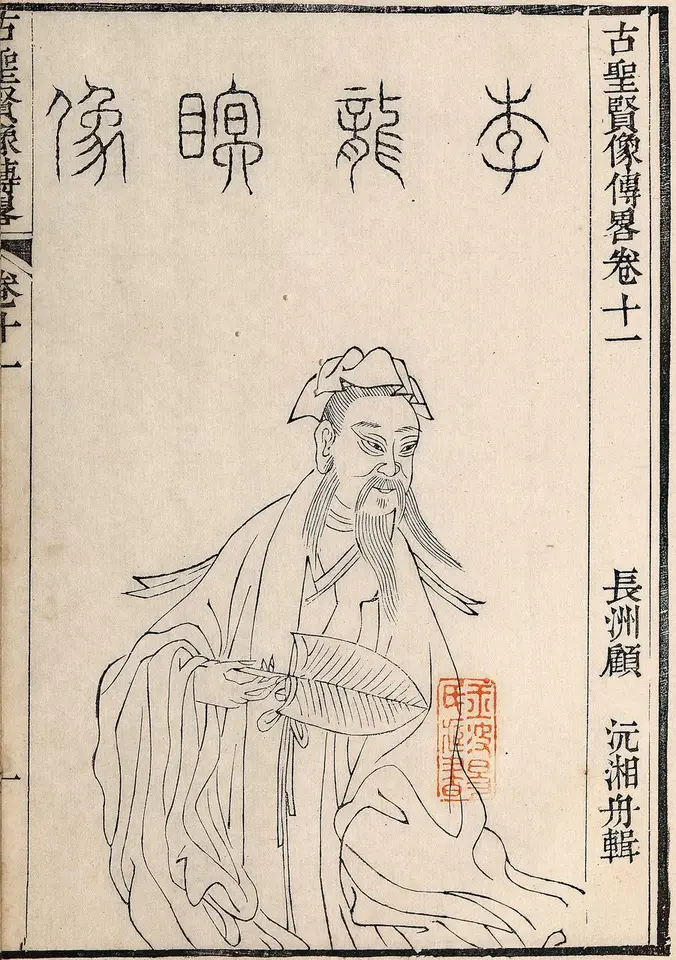
李公麟
Li Gonglin (李公麟, 1049–1106), courtesy name Boshi (伯时) and pseudonym Master of Longmian (龙眠居士), was a native of Shucheng in Shuzhou (present-day Shucheng, Anhui Province). He was an illustrious Northern Song literati painter, antiquarian epigrapher, and founding master of the baimiao fine-line painting school, universally celebrated in Chinese art history as the "foremost painter of the Song Dynasty." Born into an esteemed…
Li Gonglin (李公麟, 1049–1106), courtesy name Boshi (伯时) and pseudonym Master of Longmian (龙眠居士), was a native of Shucheng in Shuzhou (present-day Shucheng, Anhui Province). He was an illustrious Northern Song literati painter, antiquarian epigrapher, and founding master of the baimiao fine-line painting school, universally celebrated in Chinese art history as the "foremost painter of the Song Dynasty." Born into an esteemed scholar-official family whose patriarch Li Xuyi served as Assistant in the Court of Judicial Review and possessed a celebrated art collection, Li Gonglin absorbed classical connoisseurship from early childhood. He passed the highest civil service examination in 1070 during the Xining reign, serving in regional magistracies before entering the central bureaucracy as Sub-editor in the Secretariat-Chancellery, Legal Officer of the Censorate, and eventually Gentleman for Court Service. Renowned for his vast erudition across calligraphy, classical literature, and archaic bronzes, Li Gonglin transformed traditional contour draughtsmanship into an independent aesthetic genre. Elevating fine-line painting (baimiao) beyond mere draftsmanship into an autonomous artistic school alongside mineral polychrome and monochrome ink-wash, his masterpieces—including Five Horses and After Wei Yan's Pasturing of Horses—represent the summit of classical Chinese line drawing. In his later years, afflicted by debilitating rheumatism, he retired to his mountain estate in Longmian, sketching imaginary brushstrokes on his bedclothes until his passing at age fifty-eight.
Born into a prominent scholar-official lineage in Shucheng, immersing himself in family art collections from infancy.
Passed the highest imperial civil service examination in Kaifeng alongside his brother, embarking upon an administrative career.
Commenced regional service as Sheriff of Nankang and Changyuan counties, praised for administrative integrity and judicial fairness.
Served as Administrative Assistant in Sizhou, investigating regional antiquities and copying ancient master scrolls in his leisure hours.
Recalled to the capital Kaifeng as Sub-editor in the Secretariat-Chancellery, participating in statutory code revisions.
Joined the fabled Western Garden Gathering hosted by Prince Consort Wang Shen, immortalizing the assembly in his iconic painting Western Garden Gathering.
Appointed Legal Officer of the Censorate and Gentleman for Court Service, appraising imperial court collections of archaic bronzes.
Painted imperial tribute steeds from life using fine-line painting, producing the supreme masterwork Five Horses with calligraphic colophons by Huang Tingjian.
Retired due to severe rheumatism, establishing his hermitage in Mount Longmian and adopting the title "Master of Longmian."
Practiced virtual brushwork on his quilts while bedridden until passing away peacefully at his mountain estate at age fifty-eight.
Li Gonglin hailed from a prominent clan in the Huai River basin, historically linked to ancient southern nobility and regarded in genealogical traditions as distant descendants of the Southern Tang royal house. His father, Li Xuyi, served as Assistant in the Court of Judicial Review and was celebrated throughout the empire as an astute connoisseur, amassing an extraordinary private collection of ancient calligraphy, master paintings, and archaic bronze vessels. Raised amid this rich artistic environment, Li Gonglin displayed precocious genius in both literary scholarship and pictorial art.
Gifted with an encyclopedic intellect, he not only mastered the Confucian classics and ancient historiography, but also demonstrated exceptional talent in prose composition. His running and standard script calligraphy closely channeled the balanced elegance of Jin Dynasty masters Wang Xizhi and Wang Xianzhi. Day and night, he meticulously copied ancestral masterworks, absorbing the fundamental brush dynamics of Gu Kaizhi, Lu Tanwei, and Wu Daozi, rapidly surpassing contemporary painters in technical refinement.
In 1070, the twenty-two-year-old Li Gonglin journeyed to the imperial capital Kaifeng, passing the imperial examinations alongside his brother. Commencing his bureaucratic career, he received regional appointments as Sheriff of Nankang and Changyuan, and subsequently as Administrative Assistant in Sizhou. Throughout his local postings, he carried out his duties with upright moderation, refusing to flatter regional grandees and earning the profound affection of local populations.
During his regional assignments, Li Gonglin never allowed official burdens to derail his artistic investigations. Instead, he immersed himself in everyday life across villages and frontier outposts, closely observing the posture, physiognomy, and social expressions of court dignitaries, rustic recluses, common laborers, and servant classes. These keen observations furnished him with an inexhaustible reservoir of realistic artistic material.
In 1086, following the accession of Emperor Zhezong and the ascendancy of the Yuanyou conservative leadership, Li Gonglin was summoned to the metropolitan capital to serve as Sub-editor in the Secretariat-Chancellery. Within this prestigious editorial bureau, he applied his rigorous legal training to revise complex imperial statutes and ceremonial ordinances. He was subsequently promoted to Legal Officer of the Censorate and Gentleman for Court Service.
Li Gonglin possessed a lofty, unworldly character. Although stationed in the bustling imperial capital, he shunned factional maneuvering and never sought patronage at the gates of influential grandees. His associations with prominent statesmen were grounded purely in intellectual integrity and artistic devotion. Even after Wang Anshi lost political power and retreated to Jinling, Li Gonglin traveled to Mount Zhongshan to visit the former chancellor, rambling through scenic valleys and composing poetry together, capturing the retired statesman in his celebrated scrolls Wandering at Dinglin and Chancellor Wang Riding a Donkey.
The Yuanyou era represented the golden twilight of Northern Song literati culture. Endowed with extraordinary creative gifts, Li Gonglin maintained intimate friendships with Su Shi, Su Zhe, Huang Tingjian, Mi Fu, Chao Buzhi, Qin Guan, and Zhang Lei, frequently visiting the elegant mansion of Prince Consort Wang Shen.
In 1087, Wang Shen hosted an immortal assembly of cultural luminaries at his Western Garden estate in Kaifeng. Sixteen supreme figures of Song civilization—statesmen, poets, painters, calligraphers, Daoist hermits, and Chan Buddhist monks—gathered to share wine, poetry, and art. In this idyllic setting, Su Shi wielded his brush while Wang Shen reclined beside a rockery; Huang Tingjian and Li Gonglin debated ancient texts, Mi Fu inscribed calligraphy upon stone slabs, and Chen Jingyuan played the zither beneath ancient pines. Li Gonglin immortalized this iconic summit in his magnificent scroll Western Garden Gathering, for which Mi Fu composed a celebrated textual record praising its spiritual transcendence.
Li Gonglin's friendship with Su Shi was particularly intimate. He repeatedly painted Su Shi's portrait and collaborated with him on Resting in Stillness. Su Shi held his artistic brilliance in boundless esteem, and the two masters championed the literati theory of art, asserting that painting must prioritize internal poetic resonance over literal surface resemblance, fundamentally elevating Chinese painting into an autonomous expressive medium for the scholar-official elite.
In 1100, just as Li Gonglin's artistic mastery reached its peak, decades of intense official duties and prolonged painting sessions brought on severe chronic rheumatism. Afflicted with muscular spasms and joint pain that impeded his physical mobility, Li Gonglin recognized the shifting tides of court politics and submitted his resignation to the throne.
Granted retirement, he journeyed back to his ancestral home in Shuzhou, building a secluded mountain retreat amid the verdant valleys of Mount Longmian and adopting the hermit name "Master of Longmian." Surrounded by rushing torrents and towering bamboo groves, his mind attained crystalline serenity. Based upon sixteen scenic vistas surrounding his estate, he executed the celebrated Longmian Mountain Villa Painting. Su Zhe composed twenty accompanying poems, and Su Shi contributed an extensive colophon, praising the work as a worthy successor to Tang master Wang Wei's legendary Wangchuan Villa.
In his final years, his rheumatism intensified, confining him permanently to bed. Yet his passion for pictorial creation never waned. Even when acute physical suffering made it nearly impossible for his fingers to clasp a brush, he would raise his hand toward the ceiling, tracing invisible strokes and practicing brush movements upon his bedclothes with luminous concentration. When relatives gently urged him to rest, Li Gonglin smiled, replying that art was his innate calling and that brushwork remained his purest joy in this life.
In 1106, the great master passed away serenely at his Longmian Mountain Villa at the age of fifty-eight. His demise was deeply mourned throughout the Northern Song cultural sphere, marking the end of a golden era in Chinese literati painting.
Following his death, imperial court authorities and scholarly society paid solemn tribute to his achievements. The imperial painting catalogue Xuanhe Huapu, compiled under the direction of Emperor Huizong, documented one hundred and seven of his paintings in the imperial collection, extolling him as a versatile genius whose brushwork penetrated beyond the visible world into metaphysical essence.
Li Gonglin not only commanded universal admiration for his personal moral integrity, but the fine-line painting technique he developed established an enduring canon for Chinese art. His aesthetic principles inspired successive generations of masters, including Ma Hezhi in the Southern Song, Zhao Mengfu in the Yuan, Chen Hongshou in the Ming, and Ren Bonian in the Qing, securing his status as a titan of global art history.
Li Gonglin's foremost achievement in the history of Chinese art was his transformation of fine-line painting (baimiao) from an auxiliary drafting technique into an autonomous fine-art discipline, establishing linear draughtsmanship as a supreme aesthetic vehicle for the scholar-official elite.
Prior to the Song Dynasty, monochromatic ink-line drawing was utilized almost exclusively as preliminary sketches or cartoon drafts (fenben) for large-scale murals and heavy polychrome compositions. Leveraging his consummate calligraphic discipline and brush control, Li Gonglin pioneered an innovative aesthetic language defined by "dispensing with cosmetics and relying solely on subtle ink and clear brushwork." Completely casting aside heavy mineral pigments, he relied exclusively on the modulated pressure, pauses, hooks, and varying ink tones of the brush to convey anatomical mass, textile drapery, and spatial rhythm.
His fine-line painting achieved a transcendent grace celebrated as "radiating luminous splendor without employing mineral pigments." By infusing calligraphic energy directly into figurative outlining, he endowed line drawing with independent spiritual vitality. Fine-line painting (baimiao) subsequently took its place alongside fine-brush polychrome (gongbi) and freehand ink-wash (xieyi) as one of the three core pillars of traditional Chinese painting.
Li Gonglin's artistic range spanned virtually every traditional genre, including horses, Daoist and Buddhist deities, historical narratives, landscapes, and flora and fauna, achieving his greatest renown in equine and figurative painting. Literary master Su Shi paid homage to his genius in the immortal couplet: "Within the breast of the Master of Longmian dwell ten thousand steeds; he portrays not merely their flesh but paints their very bones."
His surviving masterpiece Five Horses is an ink-on-paper handscroll measuring 29.3 cm by 225 cm. It depicts five magnificent western frontier steeds presented as imperial tribute during the Yuanyou era: Fengtoucong, Jinbocong, Haotouchi, Zhaoyebai, and Manchuanhua. Each magnificent horse is guided by a stable attendant (xiguan). The first three attendants wear foreign western nomadic costumes with deep-set eyes, while the latter two are Han Chinese grooms. Executed entirely in delicate fine-line painting, the horses possess majestic bone structures and supple musculature, while their handlers display distinct demeanors ranging from haughty pride to respectful caution.
Each steed is accompanied by an authentic colophon inscribed by calligraphic titan Huang Tingjian, detailing the horse's age, tribute date, and imperial stable name. Formerly preserved in the Qing imperial collection, the scroll surfaced in 2019 at the Tokyo National Museum, recognized worldwide as an authentic, irreplaceable masterpiece of Northern Song art.
Li Gonglin possessed profound scholarly authority in analyzing and preserving ancient artistic lineages. By imperial command of Emperor Zhezong, he faithfully executed a monumental replica of a lost masterpiece by Tang Dynasty equine master Wei Yan, creating the celebrated handscroll After Wei Yan's Pasturing of Horses.
Preserved today in the Palace Museum in Beijing, this monochrome and light-wash silk handscroll spans over 420 cm in length. The composition presents an expansive panorama featuring over 1,200 horses and more than 140 grooms and herdsmen. The compositional dynamic alternates brilliantly between dense cavalry charges in the opening section and open rolling meadows in the finale, exhibiting a rhythmic musical cadence.
Employing robust iron-wire line drawing and delicate ochre washes, Li Gonglin revitalized the imperial majesty of Tang Dynasty royal pasturing grounds. The work not only preserved the lost genius of Wei Yan, but also testified to Li Gonglin's supreme capacity for orchestrating complex multi-figure panoramic narratives.
Beyond his pictorial triumphs, Li Gonglin was a vital pioneer of Chinese antiquarian scholarship (kaoguxue) and paleography. During his years in Kaifeng, he actively collected pre-Qin and Han Dynasty artifacts, dedicating himself to the study of archaic ritual bronzes (zhongding zunyi).
Possessing deep knowledge of archaic seal scripts and bronze inscriptions, Li Gonglin systematically recorded the dimensions, casting alloys, and decorative motifs of every ancient vessel he obtained. Tracing stylistic evolutions from the Xia, Shang, and Zhou eras, he clarified chronological sequences and corrected numerous errors in transmitted classical texts concerning ancient bureaucratic and ritual systems. He played a key role in categorizing the imperial bronze collection and drafted illustrated records of ancient artifacts.
Modern scholars emphasize that Li Gonglin's pioneer illustrated documentation of ancient ritual bronzes established the empirical methodology for Chinese epigraphy, directly inspiring Lu Dalin's Illustrated Archaeology (Kaogu Tu) and the Northern Song imperial catalogue Xuanhe Bogu Tu.
FIGURES ASSOCIATED WITH THIS DYNASTY