Birth in Qiantang
Born on June 16 into an impoverished physician-scholar family in Hangzhou, fragile in health yet extraordinarily gifted.
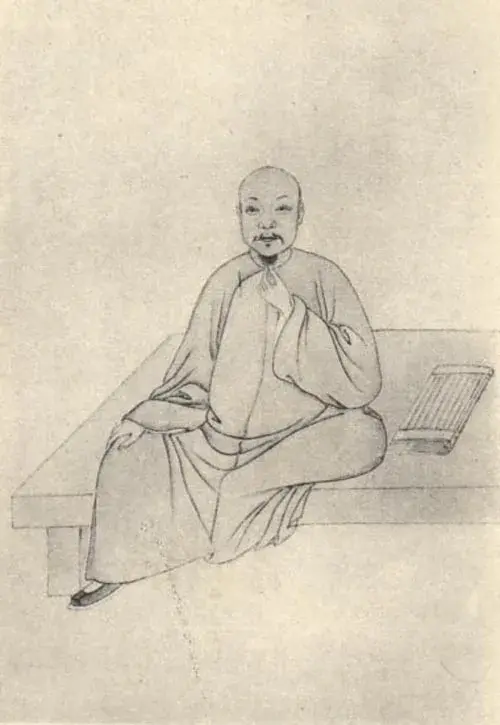
厉鹗
Li E (厉鹗, June 16, 1692 – October 17, 1752), courtesy name Taihong (太鸿) and art name Fanxie (樊榭), was a preeminent literary master, poet, ci lyricist, bibliophile, and textual critic from Qiantang (Hangzhou), Zhejiang, celebrated as the pivotal leader and culminating figure of the Western Zhejiang Ci School after Zhu Yizun. Born into an impoverished scholar's home and narrowly escaping boyhood dedication to a Buddhist…
Li E (厉鹗, June 16, 1692 – October 17, 1752), courtesy name Taihong (太鸿) and art name Fanxie (樊榭), was a preeminent literary master, poet, ci lyricist, bibliophile, and textual critic from Qiantang (Hangzhou), Zhejiang, celebrated as the pivotal leader and culminating figure of the Western Zhejiang Ci School after Zhu Yizun. Born into an impoverished scholar's home and narrowly escaping boyhood dedication to a Buddhist monastery, he pursued relentless classical studies, earning his juren degree in 1720 before repeatedly facing failure in metropolitan examinations. Summoned to compete in the prestigious Boxue Hongci special examination in 1736, he was passed over due to his idiosyncratic, austere prose style, thereafter renouncing official ambition to live as an independent commoner scholar. Residing in celebrated private library estates throughout his adult life, he collaborated with Zha Weiren at Shuixizhuang in Tianjin to author the seven-volume Annotations to Incomparable Fine Lyrics (Jue Miao Hao Ci Jian), establishing the aesthetic models of Southern Song masters Jiang Kui and Zhang Yan as the orthodoxy of Chinese lyric poetry. During his twelve-year stay at the Ma brothers' Xiaolinglong Mountain Studio in Yangzhou, he examined hundreds of thousands of rare volumes, spending a decade compiling the monumental one-hundred-volume Song Shi Ji Shi (Chronicle of Song Poetry), which recovered works by over 3,800 Song poets and single-handedly dismantled centuries of Ming prejudices against Song verse. His twenty-four-volume Liao Shi Shi Yi (Gleanings from the History of Liao) remains a gold standard in Qing dynastic textual criticism. Renowned for his transcendent, desolate "Fanxie poetic style," his works include Fanxie Shanfang Ji, Nan Song Yuan Hua Lu, and Dongcheng Zaji, establishing him as an immortal titan of Qing classical scholarship and lyric poetry.
Born on June 16 into an impoverished physician-scholar family in Hangzhou, fragile in health yet extraordinarily gifted.
Overcomes severe household poverty to master classics and histories, exploring cliff inscriptions across West Lake.
Rambles through remote peaks and caverns around West Lake, composing Visiting Wumen Cavern and winning regional acclaim.
Passes the Zhejiang provincial examination at age twenty-nine, acclaimed as a literary prodigy.
Fails the metropolitan examination in Beijing, returning south to sustain his household as a private tutor.
Travels to Tianjin to lodge at the grand Shuixizhuang garden estate, forming a lifelong friendship with Zha Weiren.
Completes the seven-volume Jue Miao Hao Ci Jian, establishing Southern Song elegance as the orthodox standard for ci poetry.
Recommended for the Boxue Hongci examination in Beijing; rejected by court examiners, he resolves never to seek office again.
Moves to Yangzhou to reside at the Ma brothers' Xiaolinglong Studio, gaining access to 120,000 rare library volumes.
Completes the one-hundred-volume Song Shi Ji Shi, reconstructing the vast corpus of Song dynasty literature.
Finishes the twenty-four-volume Liao Shi Shi Yi, meticulously rectifying errors and gaps in the official Yuan dynasty History of Liao.
Passes away in an unheated Hangzhou inn on October 17 at age sixty-one; buried at Mount Fahua in West Lake.
Li E was born on June 16, 1692 (the second day of the fifth month of the thirty-first year of Kangxi) into an impoverished scholar's household in Qiantang County, Hangzhou Prefecture, Zhejiang. His ancestral lineage originated in Cixi, Shandong, before migrating south to Qiantang, where generations practiced medicine and classical scholarship. His father Li Wenguang was a learned scholar who repeatedly failed the civil service examinations, supporting the family through modest medical earnings. Tradition recounts that on the eve of his birth, his father dreamt of an ancient, majestic osprey (e) swooping down from celestial clouds onto an ancient garden cypress, crying out toward the heavens; his father subsequently named him E (Osprey), styling him Taihong and later taking the art name Fanxie after his cottage beneath Mount Fanxie by West Lake.
In childhood, Li E was frail, emaciated, and physically delicate, but exhibited phenomenal poetic precocity and scholarly determination. Because of extreme household destitution, his father was briefly unable to feed him and nearly sent the young boy to an ancient Buddhist monastery to be raised as a novice monk, only to be dissuaded by his mother and relatives. This agonizing childhood brush with monastic abandonment left an indelible trauma upon Li E's sensitive soul, fostering a reclusive, detached, and solitary disposition devoid of worldly greed.
Beginning formal schooling at age seven, he became an insatiable reader, poring over books by the reflection of snow or moonlight through harsh winters and blistering summers. By age ten, he had mastered the Four Books and Five Classics, composing poems imbued with pre-Qin and Han vigor. Recognizing his lofty ambition, his father spent scarce medical earnings to buy him poetry anthologies. Fulfilling his family's hopes, twelve-year-old Li entered the prefectural academy, astonishing Jiangnan literati with his crystalline, unearthly literary talent.
Throughout his life, Li E was nurtured by the landscape of West Lake, frequently describing himself as a "lifelong neighbor of lakes and mountains." The scenic peaks, ancient monasteries, and secluded gorges of Lingyin, Tianzhu, Qixia, and Gushan served as his primary academy and emotional sanctuary. From his youth, Li detested the mechanical conventions of the imperial eight-legged essay, channeling his vital energy into nature's wonders and the epigraphic remains of the fallen Song dynasty. Wearing straw sandals and leaning on an old rattan cane, he regularly wandered alone through the steep defiles of South and North High Peaks.
Wherever he encountered abandoned monasteries or overgrown tombs, he cleared thorny brush with his hands, tracing weathered stone characters on ancient steles for hours without food or rest. At age twenty-three, he composed Visiting Wumen Cavern, capturing the majestic grandeur of soaring precipices; later he explored Huawu Valley, emulating Mid-Tang poet Meng Jiao's eccentric contemplation beside the Toujin Rapids. In his preface to the Shuliao Collection, he wrote: "Whenever I encounter an extraordinary landscape, I must row my boat to ascend it; what my feet traverse, my eyes observe; what my eyes witness, my heart records." This lifelong devotion to the natural world established the bedrock of his desolate, crystalline poetic style.
In 1720, at age twenty-nine, Li E sat for the Zhejiang provincial examinations in Hangzhou, successfully passing the Gengzi triennial as a provincial juren scholar, earning widespread acclaim across southeastern literary circles. However, this academic triumph did not lead to a secure official career; instead, it inaugurated decades of bureaucratic frustration and itinerant lodging. In 1724, at age thirty-three, Li journeyed north to Beijing to sit for the metropolitan examination, but his unvarnished, austere prose was dismissed by examiners who favored ornate courtly essays.
Returning to Zhejiang, confronted by household poverty and the urgent need to support his aged mother and young family, Li was forced to set aside high literary aspirations to serve as an itinerant family tutor across Haining, Shaoxing, and Ningbo. In his spare hours away from teaching, he examined rare Song and Yuan block-printed volumes preserved in private collections, expanding his intellectual focus from pure poetic composition to rigorous, exhaustive historical and philological collation.
Between 1729 and 1734, Li E traveled north to northern Zhili to serve as a secretarial guest. In Tianjin, he was invited to reside at Shuixizhuang, the legendary private garden estate owned by wealthy salt merchants and celebrated bibliophiles Zha Riqian and his son Zha Weiren. Shuixizhuang was the premier garden of North China, renowned for its pavilions, winding waters, and a library collection exceeding tens of thousands of volumes. Zha Weiren was an accomplished lyricist of generous temperament who recognized Li E's transcendent genius, welcoming him as a preeminent state scholar and becoming his closest intellectual soulmate.
The years spent at Shuixizhuang represented the most financially stable and creatively fertile period of Li E's mature life. The Zha family provided luxurious research quarters and granted him unrestricted access to their rare Song-Yuan lyric collections. Li spent his days immersed in rare books, drinking wine, composing lyrics, and debating poetics with intellectual luminaries such as Zha Weiren, Hang Shijun, and Quan Zuwang. These intellectual gatherings at Shuixizhuang catalyzed a decisive turn in northern Chinese poetry toward the orthodox musical refinement of the Southern Song tradition.
While residing at Shuixizhuang, Li E and Zha Weiren joined forces to undertake an epoch-making scholarly project: annotating Jue Miao Hao Ci (Incomparable Fine Lyrics), a seminal anthology compiled by Southern Song scholar Zhou Mi. Zhou's anthology stood as the supreme treasury of Southern Song elegant lyrics, preserving masterworks by Jiang Kui, Zhang Yan, and Shi Dazu; however, centuries of transmission had obscured its historical allusions and corrupted musical notations. Armed with encyclopedic erudition and incisive textual critical skills, Li scoured Song histories, gazetteers, and rare literati anthologies to annotate every verse.
In 1734, the seven-volume Jue Miao Hao Ci Jian was completed and printed. Celebrated for its rigorous scholarship and precise attribution of obscure historical allusions, the work not only revived the spiritual essence of Southern Song lyricism, but also established Jiang Kui and Zhang Yan's aesthetic of "pure emptiness, classical grace, and metrical precision" as the orthodox model for Chinese ci poetry. The publication marked the zenith of the Western Zhejiang Ci School in theoretical authority and philological practice, serving as an authoritative manual for generations of poets.
In 1736, the Qianlong Emperor ascended the throne and decreed a Boxue Hongci special examination, ordering provincial governors to recommend the realm's most eminent scholars for imperial service. Zhejiang Governor Ji Zengyun and Vice Minister Shen Deqian enthusiastically recommended Li E as Zhejiang's foremost candidate. At age forty-five, carrying his final hope of serving the nation, Li traveled to Beijing alongside Quan Zuwang and Hang Shijun to sit for the imperial palace examination in the Baohe Hall.
During the grading, however, high-ranking conservative examiners favored flattering, ornate rhetoric; Li E's profound, rugged, and antique verses were cast aside, resulting in another bitter failure. This devastating blow completely extinguished his remaining illusions regarding imperial officialdom. Declining invitations from capital dignitaries, he boarded a southward vessel, weeping beside the gunwale and swearing never to enter an examination hall again. He returned to Jiangnan as an independent commoner, resolving to dedicate his remaining days entirely to literary scholarship.
In 1738, at age forty-seven and without personal property, Li E moved his household to Yangzhou, accepting an invitation from prominent Huizhou merchant-patrons Ma Yuguan and Ma Yulu to reside at their celebrated garden estate, Xiaolinglong Mountain Studio. The Ma brothers were among Yangzhou's most enlightened cultural patrons, accumulating a library of 120,000 rare volumes in their Congshu Tower, turning their estate into Southeast China's premier intellectual hub. Holding Li E in profound reverence, they designated Qiuxueji and Jienan Study as his permanent scholarly retreats, treating him as an honored elder master.
During his twelve-year stay at Xiaolinglong Studio, Li E was granted complete access to the Ma brothers' library treasures. The Ma family financed his massive scholarly compilations, hired copyists, sponsored the carving of printing blocks, and sustained his entire household. Collaborating with scholars like Quan Zuwang, Yuan Mei, and Chen Zhang, Li turned Xiaolinglong Studio into the central powerhouse of Jiangnan literary collation and poetic innovation during the Qianlong era.
Supported by the library collections at Xiaolinglong Studio, Li E devoted a decade of unremitting labor to a monumental historical and literary compilation: the one-hundred-volume Song Shi Ji Shi (Chronicle of Song Poetry). From the Yuan and Ming dynasties onward, the Early and Latter Seven Masters' dogmatic disdain for Song verse had led to the widespread destruction of Song individual collections, giving rise to the arrogant fallacy that "the Song dynasty produced no poetry." Infuriated by this historical distortion, Li resolved to reconstruct the glory of Song poetry through incontrovertible textual evidence.
Working tirelessly, Li examined over 3,800 ancient titles, extracting lost poems, fragments, and epigraphic records. In total, the compilation assembled works by 3,812 Song poets, spanning founding emperors, prime ministers, recluses, Buddhist monks, Daoist masters, and female writers. For each author, Li provided a verified biographical sketch and recorded critical commentaries across the centuries. Completed in 1742, this monumental work reversed centuries of prejudice against Song verse, establishing an enduring foundation for the study of Song civilization.
Simultaneously, Li E directed his critical faculties toward the notoriously flawed History of Liao (Liao Shi), compiled during the Yuan dynasty by Chancellor Toghto. Because of hasty compilation and sparse sources, the official History of Liao was riddled with chronological errors, missing biographies, and corrupted geographical entries. Drawing upon three hundred Song and Jin historical documents, diplomatic travelogues, and stone steles preserved in the Ma collection, Li authored the twenty-four-volume Liao Shi Shi Yi (Gleanings from the History of Liao).
Characterized by rigorous methodology, the work supplied hundreds of missing biographies of Liao generals and statesmen, rectified distorted dates, and clarified administrative and tribal structures. Leading Qing historians Qian Daxin and Zhao Yi acclaimed the work as the supreme model of historical rectification in Qing scholarship; it was later incorporated into the imperial Siku Quanshu, which praised it as vastly surpassing the efforts of Ming scholars. In addition, Li compiled the eight-volume Nan Song Yuan Hua Lu and the two-volume Dongcheng Zaji, both celebrated as masterpieces of art history and regional literature.
Around 1750, following the death of his beloved patron Ma Yuguan, the aging Li E fell once more into loneliness and dire poverty. Leaving Yangzhou with a trunk of manuscripts, he returned to Hangzhou, lodging in a dilapidated attic beside the eastern canal. Decades of reading by dim oil lamps and chronic malnutrition had ruined his health; suffering from severe vision loss, chronic pulmonary illness, and debilitating rheumatism, he could scarcely hold a brush in his final months.
On October 17, 1752, Li E passed away in an unheated Hangzhou inn amid cold autumn winds at age sixty-one. At his death, his home was completely bare, containing only stacks of uncollated poetry drafts and worn reference books, leaving his family unable to afford a coffin. Shattered by his passing, his close friends Hang Shijun and Quan Zuwang raised funds to provide a proper funeral, laying the master to rest at Mount Fahua in West Lake. Though he died in poverty, his unyielding integrity and monumental scholarship continue to shine across Chinese intellectual history.
Li E occupies a towering position in Qing lyric poetry, acclaimed alongside Zhu Yizun as the quintessential leader and culminating giant of the Western Zhejiang Ci School. While Zhu founded the school, later imitators fell into superficial verbosity. Li injected profound historical erudition and austere emotional gravity into the genre, championing Southern Song masters Jiang Kui and Zhang Yan to elevate ci poetry to an aesthetic peak of "pure emptiness, classical grace, and icy nobility."
His lyrics eliminated the vulgar, sentimental tropes of late Ming verse, pursuing metrical perfection and profound allegorical resonance without artificial strain. His collection Fanxie Shanfang Ci in two volumes focuses on the landscapes of West Lake, ancient monuments, and melancholic wanderings, capturing loyalist grief and literati loneliness. Master Wang Guowei, despite his reservations regarding late Western Zhejiang School imitators, marveled in Poetic Remarks on the Human World that "Li Fanxie possessed extraordinary conceptual subtlety and a lean, rugged bone-structure, standing as an isolated peak among our dynasty's lyricists."
Li E's compilation of the one-hundred-volume Song Shi Ji Shi was an unprecedented milestone in Chinese literary history. Under the Ming dynasty's archaist dogma that "prose must follow the Qin and Han, and poetry must follow the High Tang," Song poetry had suffered centuries of neglect and destruction. Li undertook the heroic task of single-handedly scouring nearly four thousand rare volumes, deploying incontrovertible textual evidence to restore the dignity of Song verse.
The work's architectural breadth and philological precision not only preserved the works of major figures like Su Shi, Huang Tingjian, and Lu You, but also rescued thousands of obscure and lost poems. Its publication dismantled the fallacy that the Song dynasty lacked poetic brilliance, fueling the major nineteenth-century revival of Song poetry that influenced modern masters such as Mo Youzhi and Qian Zhongshu. It remains an irreplaceable foundational monument in Chinese classical literary studies.
In shi poetry, Li E forged a distinctive personal style that established the renowned "Fanxie Style" across the Qing empire. His verse assimilated the eerie, jagged lines of Mid-Tang poets Li He and Meng Jiao, alongside the lean, muscular bone-structure of Song masters Su Shi and Chen Shidao, creating a singular aesthetic characterized by crystalline purity, archaic diction, and icy desolation.
He possessed an unmatched genius for capturing remote, rugged wilderness—overgrown crags, dark mossy caves, and cold mountain springs. Scholar Quan Zuwang praised his poetry: "He excelled above all in mountain excursions, exploring the essence of natural forms and lingering amid scenic light; his crystalline elegance stood completely above the multitude." Leading poet Shen Deqian noted in Qing Shi Bie Cai Ji that "his thoughts were deep and distant, every syllable flowing from his vital soul, incised into bone without vulgar clamor." The Fanxie style broke the superficial fluency of early Qing poetry, dominating southeastern literary circles for half a century.
In rigorous historical criticism, Li E's twenty-four-volume Liao Shi Shi Yi ranks among the most celebrated achievements of the Qianlong-Jiaqing evidential research school. The official Yuan dynasty History of Liao had long been criticized as the most defective of the Twenty-Four Dynastic Histories. Utilizing hundreds of Song diaries, embassy travel records, and Khitan stone inscriptions, Li rigorously reconstructed the political, institutional, and geographical framework of the Liao empire.
His textual corrections restored hundreds of missing biographies of Liao generals and ministers, rectifying severe errors in reign titles, personal names, and battle chronology. Historian Qian Daxin praised the work enthusiastically: "Li Fanxie probed hidden depths, rendering immense service to the history of the Liao; future scholars of Liao history can never step beyond his scope." The imperial compilers of the Siku Quanshu designated it as an essential classical manual for historical research.
Li E made foundational contributions to Chinese art history. Confronting the scattered and incomplete records of Southern Song court painting, he harvested centuries of colophons, poetry inscriptions, and private connoisseurship catalogs to compile the eight-volume Nan Song Yuan Hua Lu (Record of Southern Song Academy Painting). The work documented the institutional organization of the imperial painting academy, painters' ranks, masterworks, and transmission lineages, illuminating the artistic contributions of giants such as Li Tang, Liu Songnian, Ma Yuan, and Xia Gui.
Furthermore, Li compiled the five-volume Yu Tai Shu Shi (History of Female Calligraphers), systematically gathering historical records and surviving inscriptions of women calligraphers spanning from the pre-Qin era to the Ming dynasty. By meticulously reconstructing their artistic training and biographical lineages, he filled a major void in traditional art history, displaying forward-looking historical vision and profound humanist empathy.
Li E's life embodies the tragic nobility of the traditional independent scholar persevering amid poverty. Devoid of personal wealth, land, or high patrons, he drew spiritual sustenance from classical literature, circulating among the great private libraries of West Lake, Shuixizhuang in Tianjin, and Xiaolinglong Studio in Yangzhou to transcribe, collate, and author monumental works.
His twenty-volume Fanxie Shanfang Ji, its eight-volume supplement, and his numerous monographs continue to shine across global Sinology. His refusal to compromise his scholarly standards for courtly favor, his meticulous passion for empirical truth, and his desolate aesthetic vision established an enduring cultural beacon that honors the scholarly conscience of imperial China.
FIGURES ASSOCIATED WITH THIS DYNASTY