Birth in Capital
Born on the western shore of Xuanwu Lake in Beijing.
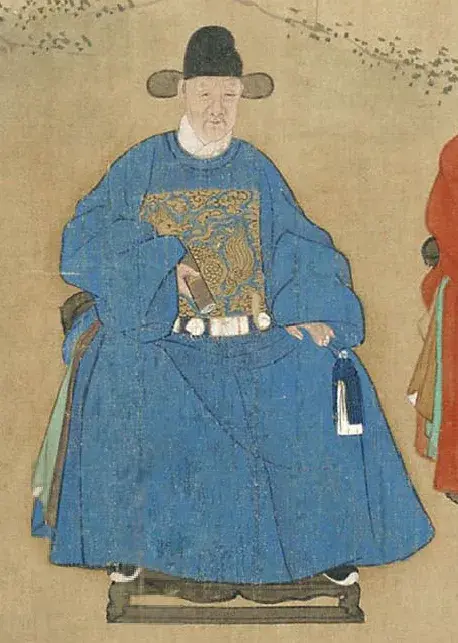
李东阳
Li Dongyang (李东阳, July 21, 1447 – August 17, 1516), courtesy name Binzhi, art name Xiya, posthumous name Wenzheng, was an eminent statesman, Grand Secretary, literary scholar, and calligrapher of the middle Ming dynasty. Born in the imperial capital of Beijing to a family originating from Chaling, Huguang, he was renowned as a child prodigy who could write large calligraphic characters at age four. Summoned to court by the…
Li Dongyang (李东阳, July 21, 1447 – August 17, 1516), courtesy name Binzhi, art name Xiya, posthumous name Wenzheng, was an eminent statesman, Grand Secretary, literary scholar, and calligrapher of the middle Ming dynasty. Born in the imperial capital of Beijing to a family originating from Chaling, Huguang, he was renowned as a child prodigy who could write large calligraphic characters at age four. Summoned to court by the Jingtai Emperor to lecture on the Book of Documents, he later placed first in the second class of the metropolitan examination in 1464 and entered the Hanlin Academy as a bachelor. Serving in the Hanlin Academy for more than three decades, he rose steadily through prestigious secretarial posts, including compiler, reader, and vice minister of rites. In 1495, Li Dongyang entered the Grand Secretariat, collaborating closely with Senior Grand Secretary Xu Pu, Liu Jian, and Xie Qian to govern the empire and establish the peace and administrative stability of the Hongzhi reign, while also presiding over the compilation of the Collected Statutes of the Ming Dynasty. Following the ascension of the Zhengde Emperor, when eunuch tyrant Liu Jin seized supreme power and senior colleagues Liu Jian and Xie Qian were forced into retirement, Li Dongyang remained alone in office. Enduring immense political opprobrium, he tactfully maneuvered within the hostile bureaucracy, softening harsh imperial decrees, shielding upright scholars from execution, and secretly orchestrating the eunuch dictator's downfall. As a towering literary arbiter, he pioneered the Chaling Poetry School, steering Ming literature away from the stale Cabinet Style toward dynamic archaism.
Born on the western shore of Xuanwu Lake in Beijing.
Summoned to the imperial palace to demonstrate calligraphy before the Jingtai Emperor.
Lectured on classical canons before the emperor and enrolled in the Shuntian Prefectural School.
Passed the metropolitan examination with second class honors and appointed Hanlin bachelor.
Accompanied his father to Chaling to pay respects at ancestral graves and composed Southward Journey Draft.
Promoted to Hanlin Reader-in-Waiting and served as lecturer in the Eastern Palace.
Appointed Vice Minister of Rites and Grand Secretary of the Wenyuan Hall to assist in state affairs.
Appointed Chief Director to oversee the compilation of the Collected Statutes of the Ming Dynasty.
Received the deathbed testament of the Hongzhi Emperor alongside Liu Jian and Xie Qian.
Remained alone in the Grand Secretariat after Liu Jian and Xie Qian were ousted by eunuch factions.
Coordinated the imperial court to crush the Anhua Prince rebellion and purge the eunuch tyrant Liu Jin.
Granted honorable retirement with imperial honors and awarded a monthly grain stipend.
Died in his Beijing residence, posthumously honored as Grand Preceptor and granted the title Wenzheng.
Li Dongyang was born on July 21, 1447, on the western shore of Xuanwu Lake in Shuntian Prefecture. His ancestors were registered under the military rolls and transferred from Chaling in Huguang to serve in the capital garrison during the early Ming dynasty. Growing up in a modest household where his father operated a small neighborhood private school, Li Dongyang displayed extraordinary intellectual brilliance from infancy. By the age of four, he could wield large writing brushes to execute substantial characters measuring a foot wide, a feat that astounded the scholar-officials of Beijing and earned him the reputation of a divine prodigy.
In 1450, the Jingtai Emperor learned of the extraordinary young talent and issued a special decree commanding court eunuchs to bring four-year-old Li Dongyang into the palace. In an imperial pavilion, the sovereign personally tested his character writing and questioned him on poetic principles. Young Li Dongyang answered with poise, clarity, and impeccable grace. Delighted by his composure, the emperor placed the child on his lap, stroked his head with admiration, and bestowed sweets, paper currency, and gifts. In 1452, the sovereign summoned him again to expound upon the core moral themes of the Book of Documents. In 1453, Li Dongyang formally began studying classics under scholar Zhan Yu, whom he revered throughout his life as his primary external mentor.
In 1454, eight-year-old Li Dongyang was invited to deliver another palace lecture on canonical governance. Deeply impressed by the young scholar's mastery of ancient texts, the emperor ordered the Ministry of Rites to admit him immediately as a stipend student in the Shuntian Prefectural School. In 1456, his biological mother died, and he observed deep filial mourning. In 1461, following the restoration of the Tianshun Emperor, Li Dongyang continued his advanced training under Hanlin compiler Li Chun, studying alongside lifelong comrades Liu Daxia and Yang Yiqing. In 1462, he passed the Shuntian provincial examination. In 1464, he achieved first place in the second class of the metropolitan examination, entering the prestigious Hanlin Academy as a bachelor under the tutelage of prominent scholars Liu Dingzhi and Ke Qian.
In August 1465, upon concluding his Hanlin apprenticeship, Li Dongyang was formally appointed Hanlin Compiler and assigned to draft the Veritable Records of Emperor Yingzong. Upon the successful completion of the historical chronicle in 1467, Emperor Xianzong rewarded him with silver and silk textiles, elevating his rank to the lower sixth grade. Tragedy struck his domestic life in 1471 when his first wife died of illness. In February 1472, Li Dongyang escorted his aging father back to their ancestral soil in Chaling, Huguang, to sweep the ancestral graves. The seven-month journey traversed thousands of miles across central waterways, during which he closely observed provincial customs and wrote Southward Journey Draft.
In 1474, Li Dongyang completed his nine-year tenure as compiler and was promoted to Hanlin Lecturer. Two years later, he was appointed companion lecturer at the Imperial Diets, responsible for composing canonical lectures for the emperor. In 1483, after serving another nine-year evaluation cycle with distinction, he was promoted to Hanlin Reader-in-Waiting. In 1484, he served as a reader for the palace examinations and accompanied the Crown Prince in the Eastern Palace to instruct him in Confucian orthodoxy. When his father died in late 1486, he dutifully retired from official post to observe the mandatory three-year mourning rituals.
In early 1488, the newly enthroned Hongzhi Emperor recalled Li Dongyang to the capital to compile the Veritable Records of Emperor Xianzong. After completing his mourning period in 1489, he was made Left Mentor of the Household of the Heir Apparent while retaining his academy titles. Following the completion of the records in 1491, he was promoted to Junior Minister of the Court of Imperial Sacrifices. The emperor held his pedagogical clarity in high esteem, making him daily tutor at the imperial seminars. In 1493, he presided as chief examiner of the metropolitan examination.
In February 1495, on the recommendation of Senior Grand Secretary Xu Pu, the Hongzhi Emperor appointed Li Dongyang Right Vice Minister of Rites and Grand Secretary of the Wenyuan Hall, bringing him into the inner sanctum of the Grand Secretariat alongside colleagues Liu Jian and Xie Qian. The three statesmen formed an exceptionally harmonious ministerial triumvirate. Li Dongyang focused on civil ordinances, archival reviews, and edict drafting, while consistently advising the throne to reduce agricultural taxes, eliminate redundant government expenses, and restrain the excesses of court favorites. Their combined stewardship ushered in the celebrated Hongzhi Restoration, recognized as a golden age of administrative stability and Confucian governance.
In March 1497, Li Dongyang was designated Chief Director for the monumental state compilation of the Collected Statutes of the Ming Dynasty. In 1498, when the crown prince commenced regular classical studies, the emperor conferred upon Li Dongyang the rank of Junior Guardian of the Heir Apparent and Minister of Rites. In 1499, when allegations of examination leakages erupted regarding candidates Xu Jing and Tang Yin, the emperor appointed Li Dongyang to conduct a confidential review. He meticulously reexamined the answer sheets, verified that neither candidate had been admitted to the passing roster, and dispelled widespread public cynicism. In December 1502, the one-hundred-and-eighty-volume Collected Statutes of the Ming Dynasty was formally presented to the throne, for which Li Dongyang received a jade belt and gold-embroidered robes. In May 1505, when the Hongzhi Emperor lay dying, he summoned Li Dongyang, Liu Jian, and Xie Qian to the Qianqing Palace to entrust them with the supreme care of the youthful heir.
With the ascension of the Zhengde Emperor, Li Dongyang was promoted to Junior Preceptor and Grand Preceptor to the Crown Prince. However, the teenage sovereign quickly abandoned rigorous governance to pursue extravagant amusements, allowing court eunuch Liu Jin and his faction to seize de facto control over state affairs. In October 1506, Senior Grand Secretaries Liu Jian and Xie Qian rallied the ministerial bureaucracy to demand the immediate execution of the corrupt eunuchs. Betrayed by imperial leaks, the petition failed, prompting Liu Jian and Xie Qian to submit their resignations in protest. The young emperor accepted their departure but adamantly refused to let Li Dongyang step down, appointing him Senior Grand Secretary and Minister of Personnel.
The withdrawal of his venerable colleagues subjected Li Dongyang to bitter censure from idealistic scholars, who accused him of cowardly appeasement and clinging to power. Yet Li Dongyang foresaw that if the entire civilian cabinet resigned, imperial governance would collapse entirely into the unchecked hands of Liu Jin and his sycophantic allies. Enduring public humiliation and debilitating chronic pulmonary hemorrhages, he chose to remain at the helm, deploying subtle procedural obstruction to mitigate tyranny. Whenever Liu Jin drew up execution lists targeting political opponents, Li Dongyang intervened tenaciously during edict drafting, arguing canonical precedents to commute capital sentences into dismissals or fines. Through his quiet maneuvering, towering intellectual luminaries including Wang Shouren, Yang Yiqing, and Lin Jun were preserved from summary execution.
In 1510, Prince Anhua rebelled in Ningxia. Li Dongyang coordinated civil administration and logistics in the capital, providing essential backing to pacification commander Yang Yiqing and supervisory eunuch Zhang Yong. After the frontier mutiny was crushed, Yang Yiqing arrived in Beijing and consulted secretly with Li Dongyang. Exploiting the growing enmity between Zhang Yong and Liu Jin, they encouraged Zhang Yong to present an indictment charging Liu Jin with seventeen counts of treason. The shocked emperor ordered the dictator arrested, and Liu Jin was subsequently executed by dismemberment.
Only after Liu Jin was destroyed did the empire recognize the profound wisdom and selfless perseverance of Li Dongyang, whose quiet patience had prevented catastrophic bloodbaths. The throne awarded him the title Left Pillar of State in recognition of his service. In 1512, after peasant uprisings in the capital metropolitan region were brought to an end, Li Dongyang submitted dozens of memorials begging for retirement on grounds of advanced age and chronic sickness. The emperor granted his honorable retirement, providing him an official monthly grain stipend and periodic imperial greetings. Retiring to his Xiya cottage, he spent his remaining years teaching and writing poetry. He passed away peacefully on August 17, 1516, at age seventy. The Zhengde Emperor suspended court audiences, posthumously elevated him to Grand Preceptor, and granted the honored posthumous name Wenzheng.
Li Dongyang served in the Grand Secretariat across eighteen turbulent years and two imperial reigns, acting as a structural cornerstone in the maturation of the Ming cabinet system. During the Hongzhi era, his seamless cooperation with Xu Pu, Liu Jian, and Xie Qian established a benchmark of ministerial cohesion. Drawing upon deep mastery of historical jurisprudence, he scrutinized all major administrative codes, taxation policies, and defense logistics. He advocated for agricultural tax relief across frontier provinces, curtailed military inspections conducted by court eunuchs, and streamlined redundant personnel, laying the groundwork for the enduring administrative stability of the mid-Ming dynasty.
In civil examinations and educational policy, Li Dongyang upheld absolute fairness. In 1499, during the infamous examination scandal involving charges of bribery against examiner Cheng Minzheng and candidate Tang Yin, Li Dongyang performed a meticulous reevaluation of candidate examination papers. His impartial verification shielded the reputation of the civil service examinations from factional hysterics. Throughout his chancellorship, he steadfastly prohibited nepotism and favoritism, training a whole generation of principled officials.
The reign of terror unleashed by Liu Jin during the early Zhengde period represented one of the gravest existential threats encountered by Ming Confucian scholar-officials. While Liu Jian and Xie Qian chose principled martyrdom by resigning to preserve moral integrity, Li Dongyang embraced the far heavier burden of staying behind in government. Recognizing that open defiance would merely lead to his immediate elimination and leave the court defenseless, he utilized his secretarial drafting authority to blunt tyrannical edicts.
When Liu Jin compiled formal proscription rosters designed to eliminate dozens of leading scholars across the empire, Li Dongyang repeatedly protested at ministerial audiences, pleading on his knees to avert catastrophe. Through his subtle interventions, death sentences for prominent figures including Wang Shouren and Yang Yiqing were downgraded to provincial banishments, preserving the intellectual and political future of the Ming dynasty. His covert alliance with Yang Yiqing ultimately catalyzed the downfall of the eunuch clique, stabilizing the imperial court at a moment of acute constitutional vulnerability.
Beyond statecraft, Li Dongyang reigned as the foremost literary figure of his generation, founding the Chaling Poetry School. During the early Ming period, the rigid and celebratory Cabinet Style dominated classical verse, degenerating by the late fifteenth century into hollow flattery and lifeless formalism. Li Dongyang launched an energetic campaign of aesthetic renewal, advocating a return to Han, Wei, and High Tang poetic vitality.
His literary doctrine rested upon three fundamental pillars: first, learning from ancient models without succumbing to mechanical imitation; second, insisting that poetry must arise from authentic inner emotions rather than rhetorical vanity; and third, cultivating moral energy and breadth of spirit as the primary source of poetic resonance. Surrounding himself with talented disciples such as Xie Duo and He Mengchun, Li Dongyang created an influential literary circle that decisively dismantled the hegemony of the Cabinet Style and paved the way for the Archaist Movement led by the Former Seven Masters.
With encyclopedic learning and refined administrative expertise, Li Dongyang spearheaded the production of the foundational administrative code of the dynasty, the Collected Statutes of the Ming Dynasty. Commissioned in 1497 by the Hongzhi Emperor, the project involved systematic indexing and structural integration of imperial edicts, legal precedents, tax schedules, and bureaucratic duties since the founding of the dynasty. Completed across one hundred and eighty volumes, the compendium served as the standard reference work for Ming statecraft.
In addition to state codes, Li Dongyang directed the compilation of imperial veritables for three emperors and edited the Comprehensive Mirror of History Summarized. In private scholarship, his voluminous writings were collected into the Huailutang Collection, exceeding one hundred volumes. His Huailutang Poetry Talks stands as an enduring masterpiece in Chinese literary criticism, offering incisive commentary on meter, tone, and classical aesthetics. His published works, including Southward Journey Draft and Archival Records of Imperial Consultations, remain vital historical sources for modern Ming historiography.
Li Dongyang was recognized as one of the greatest calligraphers of his century, mastering seal, clerical, standard, running, and cursive scripts, with exceptional renown in seal script and wild cursive. At a time when the early Ming calligraphic world was stifled by the rigid and ornamental court style popularized by the Shen brothers, Li Dongyang broke free from conventional constraints through rigorous study of pre-Qin bronze inscriptions and Tang cursive models.
His seal script drew direct inspiration from Li Si and Li Yangbing, characterized by taut bone structure, circular brush movements, and archaic dignity. His running and wild cursive scripts were celebrated for untamed fluidity, balance, and pure elegance, completely devoid of ostentatious violence. Ming art connoisseur Wang Shizhen praised his large cursive writing as an unrivaled marvel of medieval art. Li Dongyang calligraphic innovations liberated the artistic atmosphere, serving as the immediate catalyst for the blossoming of the celebrated Wu School led by Zhu Yunming and Wen Zhengming.
FIGURES ASSOCIATED WITH THIS DYNASTY