Birth in Huaizhou
Born into a commoner silversmith family, growing up quick-witted and fond of networking.
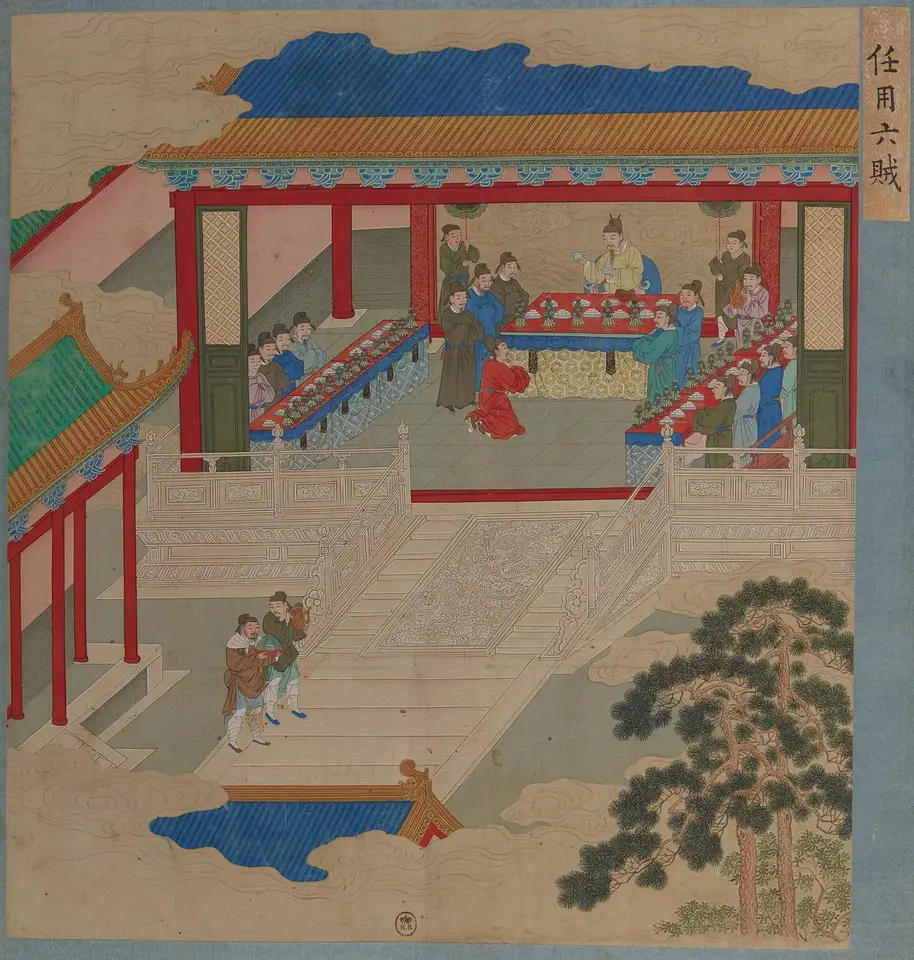
李邦彦
Li Bangyan (李邦彦, ?–1129), courtesy name Shimei (士美), a native of Huaizhou, was a prominent chancellor of the late Northern Song dynasty, a central figure in the capitulationist faction during the Jingkang Incident, and widely known by the moniker the Prodigal Chancellor. Born into an artisan silversmith household, he possessed an attractive physical presence and rapid literary wit. Granted a jinshi degree by Emperor Huizong…
Li Bangyan (李邦彦, ?–1129), courtesy name Shimei (士美), a native of Huaizhou, was a prominent chancellor of the late Northern Song dynasty, a central figure in the capitulationist faction during the Jingkang Incident, and widely known by the moniker the Prodigal Chancellor. Born into an artisan silversmith household, he possessed an attractive physical presence and rapid literary wit. Granted a jinshi degree by Emperor Huizong in 1108, he attached himself to the faction of powerful courtier Wang Fu, leveraging his skill in street theater, jesting, and soccer (cuju) to entertain the monarch and achieve rapid bureaucratic elevation, rising to Junior Chancellor by 1123. In high executive office, he indulged in frivolous pleasures, prompting contemporaries to condemn him as the Prodigal Chancellor. In 1126, when Jurchen Jin armies invaded the south and besieged Kaifeng, Emperor Qinzong elevated Li Bangyan to Senior Chancellor. Facing national crisis, Li Bangyan completely lost his resolve, obstinately advocating total capitulation and urging Emperor Qinzong to cede the strategic northern commanderies of Taiyuan, Zhongshan, and Hejian while pledging astronomical war indemnities and imperial hostages. To eliminate resistance, he slandered and removed the staunch defense leader Li Gang, which triggered a massive civil uprising where tens of thousands of Imperial University students led by Chen Dong and angry citizens stormed the palace gates. Li Bangyan fled in disguise, while the furious crowd smashed his carriage and killed several of his retainers. Following the temporary withdrawal of Jin forces, he was impeached by censors for disastrous treason and banished to the far south, dying in Guizhou in 1129.
Born into a commoner silversmith family, growing up quick-witted and fond of networking.
Entered the Imperial University and received a bestowed jinshi degree from Emperor Huizong; appointed Collator in the Palace Library.
Famed for popular songs and court jesting under the nickname Li the Prodigal; aligned with Wang Fu for rapid advancement.
Appointed Imperial Diarist, Secretariat Drafter, and Hanlin Academician, enjoying Emperor Huizong's personal favor.
Elevated to Right Assistant of the Department of State Affairs, transferring soon after to Left Assistant.
Appointed Junior Chancellor and Vice Minister of the Secretariat; indulged in street entertainment, termed the Prodigal Chancellor.
Jin armies led by Wanyan Zongwang crossed the Yellow River; Li Bangyan opposed military resistance and urged retreat.
Elevated to Senior Chancellor; demanded the cession of the Three Commanderies and engineered the removal of Li Gang, sparking a massive popular riot.
Following massive scholar protests led by Chen Dong, removed from the chancellorship and demoted to local provincial posts.
Following the fall of Northern Song, condemned by Emperor Gaozu as a principal traitor of the dynasty; banished to Xunzhou.
Transferred under armed custody to Guizhou, where he died of illness to widespread public satisfaction.
Li Bangyan was born in the late eleventh century in Huaizhou. His father, Li Pu, was a skilled local silversmith. Endowed with an elegant appearance, a charming bearing, and a quick tongue, Li Bangyan showed an early talent for making literary connections. When candidates from Hedong journeyed through Huaizhou on their way to the imperial examinations in Kaifeng, Li Bangyan and his father routinely halted work at the silver shop to host banquets and provide travel funds for the travelers, thereby establishing Li Bangyan's early reputation among northern examination candidates.
Upon entering the Imperial University in Kaifeng, Li Bangyan was granted a jinshi degree by Emperor Huizong in 1108, receiving initial appointment as Collator in the Palace Library. Li Bangyan possessed a rapid writing hand and could draft elegant rhetoric on demand. However, having matured among urban commoners, he was deeply versed in vulgar theatrical entertainments, street jokes, and athletic soccer (cuju). He frequently adapted coarse marketplace idioms into catchy song lyrics that circulated widely through Kaifeng's taverns, adopting for himself the moniker Li the Prodigal. Although censors impeached him for licentious misconduct, Emperor Huizong, who loved artistic amusement, was enchanted by his clownish antics. Supported by powerful eunuchs and Chancellor Wang Fu, Li Bangyan climbed the civil bureaucracy with astonishing speed, serving as Vice Director in Personnel, Imperial Diarist, and Secretariat Drafter.
In 1121, Li Bangyan was appointed Right Assistant of the Department of State Affairs, advancing to Left Assistant shortly thereafter. In 1123, Emperor Huizong formally promoted him to Junior Chancellor and Vice Minister of the Secretariat, seating him at the summit of executive power. Within Huizong's decadent court, Li Bangyan carried himself not as a dignified minister of state, but as an imperial jester. At private palace banquets, he routinely shed his official ceremonial robes, smeared cosmetics on his face, and performed comedic skits, recounting ribald humor to amuse the sovereign.
During his years in the chancellorship, Li Bangyan remained utterly indifferent to the mounting national crises, the depletion of the imperial treasury, and the shifting balance of power in the north. He made no preparations for border defense, tailoring all administrative decisions to flatter Huizong's whims. The citizens of Kaifeng viewed his elevation with disgust, coining the contemptuous label the Prodigal Chancellor and chanting satirical street ditties: "Li the Prodigal becomes prime minister; the sovereign is pleased, but the people suffer."
In the winter of 1125, following their total destruction of the Liao Empire, the Jurchen Jin Empire launched a coordinated invasion of the Northern Song. The eastern invasion army under Wanyan Zongwang crossed the Yellow River with alarming speed, closing in on Kaifeng. Paralyzed by panic, Emperor Huizong abdicated in haste to Crown Prince Zhao Huan (Emperor Qinzong) and fled south to Zhenjiang. Upon taking the throne, Emperor Qinzong purged Wang Fu's faction, but the opportunistic Li Bangyan adroitly shifted allegiances, escaping punishment and securing promotion to Senior Chancellor in early 1126.
As Jurchen siege engines battered Kaifeng's outer ramparts with flaming projectiles and stones, Li Bangyan was overwhelmed by cowardice. In military councils, he vehemently opposed armed resistance, insisting that survival lay solely in total capitulation. The Jurchen commanders presented exorbitant demands: the surrender of the three vital northern strategic bastions—Taiyuan, Zhongshan, and Hejian—alongside five million ounces of gold, fifty million ounces of silver, millions of bolts of silk, herds of livestock, and the dispatch of an imperial prince and chancellor as hostages. Disregarding national sovereignty and the sacrifice of northern garrison troops, Li Bangyan urged Emperor Qinzong to concede every demand, counseling that purchasing peace at any territorial cost was paramount.
While Li Bangyan urged surrender, Vice Minister of War Li Gang organized a ferocious defense atop the city battlements, employing heavy artillery and repeating crossbows to inflict severe casualties on the besiegers. Observing the city's formidable defenses and the approach of provincial relief armies, the Jurchen invaders hesitated. However, Li Bangyan harbored deep resentment toward Li Gang, fearing that the success of the defense would destroy his own appeasement agenda.
When a nocturnal commando raid led by general Yao Pingzhong met with a tactical reverse, Li Bangyan capitalized on the setback, falsely accusing Li Gang before the emperor of reckless provocation that endangered peace. Swayed by his deceit, Emperor Qinzong abruptly dismissed Li Gang from his command. News of Li Gang's ouster triggered explosive outrage across Kaifeng. In February 1126, Imperial University scholar Chen Dong mobilized hundreds of students alongside tens of thousands of angry soldiers and citizens, massing outside the Xuande Gate to petition the throne, shouting that Li Gang was an indispensable patriot while Li Bangyan was a traitor who deserved death.
Emerging from the palace in his grand ministerial carriage, Li Bangyan was confronted by the furious mob. Recognizing his conveyance, the crowd surged forward with stones and clubs, smashing his carriage to splinters. Terror-stricken, Li Bangyan scrambled over palace walls to save his life, while several of his personal retainers were beaten to death on the spot. Weeping before the emperor, Li Bangyan pleaded for imperial guards to fire upon the protestors. Fearing an outright revolution, Emperor Qinzong was compelled to publicly restore Li Gang to command, temporarily quelling the civil rebellion.
Following the temporary withdrawal of the Jurchen army laden with extortionate spoils, the Northern Song court was engulfed by an unstoppable wave of popular fury against the capitulationist faction. Censors and ministers repeatedly impeached Li Bangyan for treasonous surrender, personal cowardice, and destroying national defenses by ceding the northern commanderies. Bowing to overwhelming public condemnation, Emperor Qinzong dismissed him from the chancellorship, stripping him of high ranks and exiling him to provincial administration.
In 1127, Jurchen armies returned in force, breaching the undefended northern frontiers, sacking Kaifeng, and capturing both Emperors Huizong and Qinzong, bringing the Northern Song to an ignominious end. When Emperor Gaozong established the Southern Song in Yingtian, imperial decrees formally classified Li Bangyan as a foremost traitor responsible for the fall of the empire. He was demoted to assistant military commissioner of Jianwu Army and banished under armed guard to remote Xunzhou. In 1129, transferred to Guizhou in deep disgrace, Li Bangyan died of illness in exile, with the empire's populace openly celebrating his demise.
Li Bangyan's career represents the nadir of civil administration during the late Northern Song dynasty. By utilizing urban clowning, street tunes, and athletic tricks to charm Emperor Huizong, he transformed the solemn state chancellorship into a comedic playground for personal ambition.
During a historic turning point when the geopolitical landscape of East Asia was being violently reconfigured by the rise of the Jurchen Jin Empire, Li Bangyan completely neglected defensive readiness and strategic foresight. His tenure hollowed out bureaucratic competence and destroyed administrative integrity, serving as a primary internal catalyst for the catastrophic vulnerability of the Song state.
During the initial Jurchen siege of Kaifeng in 1126, northern bastions like Taiyuan still tied down substantial hostile forces. Rather than coordinating a strategic counter-offensive with approaching relief columns, Senior Chancellor Li Bangyan chose absolute defeatism.
By railroading the imperial decision to surrender the northern defensive ramparts of Taiyuan, Zhongshan, and Hejian, he dismantled the geographical buffer protecting the Yellow River basin. This catastrophic capitulation abandoned loyal frontier armies and directly paved the way for the second Jurchen invasion that extinguished the Northern Song dynasty.
At the height of the Kaifeng defense, Li Bangyan placed factional self-preservation above the survival of the empire, engineering the dismissal of the heroic commander Li Gang to satisfy invading enemies.
This shameless betrayal provoked the famous student uprising led by Chen Dong, in which tens of thousands of citizens assaulted the chancellor's entourage outside the palace gates. Li Bangyan's willingness to sacrifice patriotic commanders and appease foreign invaders solidified his permanent historical infamy as a paramount traitor in Chinese memory.
FIGURES ASSOCIATED WITH THIS DYNASTY