Birth in Anping
Born into the aristocratic Li clan of Zhaojun, named Baiyao due to infant frailties.
李百药
Li Baiyao (李百药, 565–648), courtesy name Zhonggui, was a native of Anping, Dingzhou (modern Anping, Hebei), and an eminent historian, political essayist, and man of letters during the Sui and early Tang dynasties. He is celebrated as the independent compiler of the official dynastic history Book of Northern Qi (Bei Qi Shu). Born into the illustrious Anping branch of the aristocratic Li clan of Zhaojun, he was the son of…
Li Baiyao (李百药, 565–648), courtesy name Zhonggui, was a native of Anping, Dingzhou (modern Anping, Hebei), and an eminent historian, political essayist, and man of letters during the Sui and early Tang dynasties. He is celebrated as the independent compiler of the official dynastic history Book of Northern Qi (Bei Qi Shu). Born into the illustrious Anping branch of the aristocratic Li clan of Zhaojun, he was the son of premier chancellor and literary master Li Delin. Weak and prone to illnesses in childhood, he was named "Baiyao" ("Hundred Medicines") by his grandmother in hopes of longevity. Endowed with astonishing intellectual gifts, he composed prose at seven and mastered the Confucian Five Classics and dynastic histories by thirteen. During the Kaihuang era, he won boundless praise from Grand Chancellor Yang Su and Prince Yang Guang, serving as Attendant to the Crown Prince and Supernumerary Vice Director in the Ministry of Rites. However, his unyielding integrity repeatedly provoked bureaucratic jealousy and political exile to the south. During the late-Sui dynastic disintegration, Li was involuntarily detained by regional warlords Shen Faxing and Li Zitong; he steadfastly maintained his moral principles, refusing to draft decrees for their imperial usurpations while covertly aligning with the rising Tang house. In 621, after Tang forces pacified the Yangtze region, he returned to Chang'an and was appointed Secretariat Drafter by Emperor Gaozu. Under Emperor Taizong's Zhenguan reign, he was elevated to Vice Minister of Rites, Chamberlain for the Imperial Clan, and Right Mentor to the Heir Apparent, enfeoffed as Baron of Anping and subsequently promoted to Viscount. In the monumental court debate over re-establishing the ancient feudal system, Li authored the acclaimed treatise On the Feudal System (Fengjian Lun), demolishing arguments for aristocratic enclaves and proving the supremacy of centralized commanderies. Fulfilling his father's unfinished legacy, Li independently authored the fifty volumes of the Book of Northern Qi in 636. He passed away in 648 at the age of eighty-four and was posthumously honored with the posthumous title Kang ("The Moderate and Upright").
Born into the aristocratic Li clan of Zhaojun, named Baiyao due to infant frailties.
Acclaimed across the realm at age thirteen for composing refined rhapsodies and classical poetry.
Appointed Attendant to Crown Prince Yang Yong; later served as Supernumerary Vice Director of Rites after mourning.
Exiled to serve as Marshal of Guizhou and magistrate of Jian'an following friction with court grandees.
Captured by warlords Shen Faxing and Li Zitong in the lower Yangtze; refused to support imperial usurpations.
Entered Chang'an upon the pacification of the south, appointed Secretariat Drafter by Emperor Gaozu.
Promoted to Vice Minister of Rites and created Baron of Anping by Emperor Taizong.
Completed the monumental fifty-volume Book of Northern Qi, officially promulgated by imperial decree.
Died in his Chang'an residence at eighty-four; posthumously honored as Chamberlain for the Palace of Law, with the posthumous name Kang.
Li Baiyao was born in 565 into the illustrious Anping branch of the Li clan of Zhaojun. His father Li Delin was a premier scholar-statesman and founding pillar of the Sui dynasty, serving as President of the Chancellery and directing the drafting of imperial statutes and official histories. Afflicted with chronic diseases in his infancy, Li's grandmother bestowed upon him the name Baiyao, praying that diverse medicines would grant him long life. Despite physical frailties, Li demonstrated astonishing intellectual acumen, memorizing texts on a single reading and composing mature poetic expositions at age seven. By age thirteen, his writings were widely shared among northern literati, who marveled at his classical elegance and hailed him as an extraordinary prodigy.
During the early Kaihuang reign, before reaching twenty, the Sui court appointed him Attendant to Crown Prince Yang Yong in recognition of his family's meritorious services. Grand Chancellor Yang Su read his literary works and openly expressed deep admiration, while Prince of Jin Yang Guang sought his acquaintance. However, Li Baiyao maintained strict moral detachment, refusing to fawn on powerful figures. Following his father's death, Li fulfilled three years of filial mourning. Upon his resumption of duties as Supernumerary Vice Director of Rites, corrupt ministers aligned with Yang Su fabricated charges against his independence, exiling him in 599 to Guizhou as Commandery Marshal, and later dispatching him to govern remote Jian'an County.
During the Daye reign under Emperor Yang, Li Baiyao was once again stripped of his titles due to factional entanglements in southern princely administrations, forcing him into prolonged private retreat in the Jiangnan region. In 618, Emperor Yang was murdered during the Jiangdu mutiny, plunging the realm into catastrophic warfare. Regional warlord Shen Faxing seized the southern territories, declaring himself King of Liang; coveting Li's immense intellectual stature, Shen coerced him into accepting the office of Secretariat Director. Discerning Shen's cruel instability, Li feigned illness and avoided participating in rebel administration. Shortly thereafter, rival warlord Li Zitong routed Shen and occupied Jiangdu, appointing Li as county magistrate. When Li Zitong prepared to assume the imperial mantle and demanded congratulatory memorials, Li Baiyao boldly protested against premature usurpation, winning broad acclaim for his unyielding moral backbone amidst military terror.
In 621, Tang forces pacified Jiangnan. Recognizing the distinguished historiographical lineage of the Li family, Emperor Gaozu of Tang summoned Li Baiyao to Chang'an, appointing him Secretariat Drafter to draft major imperial edicts. With the accession of Emperor Taizong in 626, Li's profound erudition received highest honors. Taizong elevated him to Vice Minister of Rites, enfeoffed him as Baron of Anping, and frequently solicited his counsel on institutional matters.
During the early Zhenguan era, a critical constitutional debate erupted over whether the Tang should revive the Western Zhou feudal system by enfeoffing imperial princes and merit ministers as hereditary autonomous vassals. Conservative grandees led by Xiao Yu passionately championed feudalization. In response, Li Baiyao submitted his historic memorial On the Feudal System (Fengjian Lun). Drawing upon two millennia of dynastic history from the Three Dynasties through the Qin and Han, Li proved that hereditary feudalism inexorably provoked civil warfare, regional fragmentation, and dynastic collapse. Conversely, the centralized commandery system administered by appointed bureaucratic magistrates provided the institutional cornerstone for enduring peace. Deeply impressed by his penetrating arguments, Emperor Taizong abolished all plans for hereditary enfeoffment, cementing the Tang dynasty's centralized imperial state.
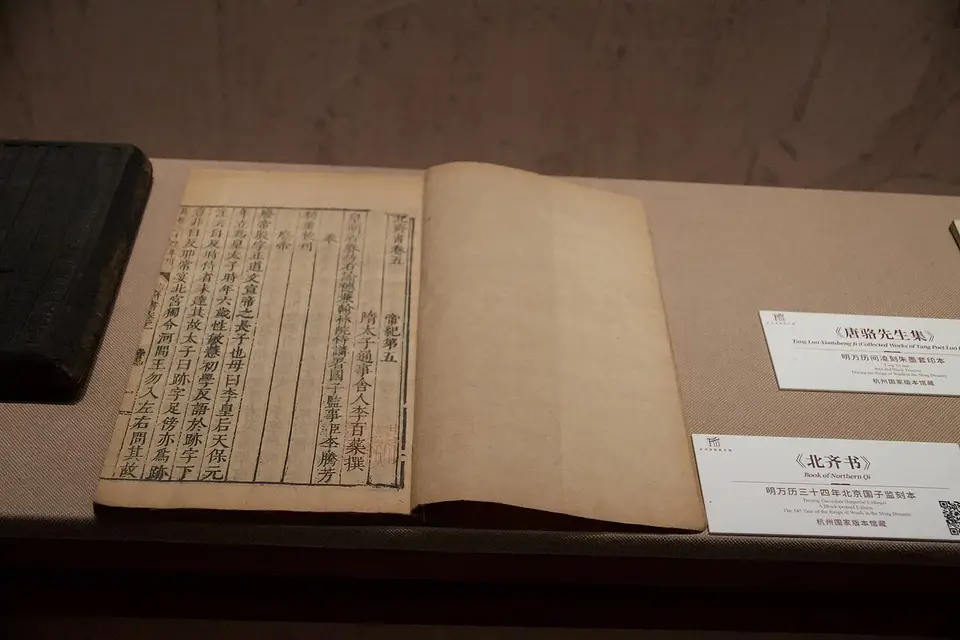
Li Baiyao's lifelong scholarly aspiration was the completion of the dynastic history of Northern Qi begun by his father. During the Sui dynasty, Li Delin had drafted twenty-seven volumes of annals and biographies, but political turmoil and his death left the work unfinished. In 629, Emperor Taizong commissioned the compilation of the official histories of previous dynasties, assigning the Northern Qi history exclusively to Li Baiyao. Working in isolation, Li examined private memoirs, cross-referenced imperial archives from the former capital Ye, and adhered strictly to unbiased historiography. In 636, he completed the fifty-volume Book of Northern Qi, comprising eight volumes of imperial annals and forty-two volumes of biographies. The work won immediate acclaim for its lucid narrative, psychological portraits, and rigorous historical truth.
In his final years, Li Baiyao was revered as an elder statesman of the empire, serving as Chamberlain for the Imperial Clan, Right Mentor to the Heir Apparent, and Cavalier Regular Attendant. Approaching old age, he remained gentle, unassuming, and completely free of factional ambition. In 648, Li passed away peacefully in his Chang'an residence at the age of eighty-four. Emperor Taizong expressed profound sorrow, posthumously elevating him to Chamberlain for the Palace of Law and conferring the honorable posthumous name Kang.
Li Baiyao's premier scholarly achievement was the compilation of the standard dynastic history Book of Northern Qi. Chronicling the turbulent twenty-eight-year reign of the Northern Qi dynasty, the work brought order to chaotic Six Dynasties archives. Li constructed vivid biographical portraits of foundational figures such as Gao Huan, Gao Yang, and Yang Yin, capturing both their military brilliance and despotic excess. His balanced moral evaluations, rigorous source criticism, and elegant prose established the Book of Northern Qi as an indispensable masterpiece within China's Twenty-Four Histories.
Li Baiyao's On the Feudal System is widely regarded as a watershed landmark in Chinese political philosophy. At a moment when early Tang leaders were tempted by archaizing nostalgia to partition the realm into hereditary fiefdoms, Li demonstrated that the autonomous decentralization of the Zhou dynasty was the primary cause of fraternal bloodshed. His compelling defense of meritocratic, non-hereditary administrative governance safeguarded imperial stability and served as the direct intellectual forerunner for Liu Zongyuan's later classic treatise of the same title.
In the institutional establishment of official historiography during the Zhenguan reign, Li Baiyao acted as an indispensable intellectual guide. When Emperor Taizong established the History Bureau to compile the histories of the Six Dynasties, Li Baiyao not only authored the Book of Northern Qi, but met frequently with chancellors Fang Xuanling and Wei Zheng to formulate historiographical criteria. He insisted that dynastic histories must record unvarnished facts and illuminate overarching moral principles, eradicating the decadent eulogistic style inherited from the Six Dynasties. His mastery of medieval administrative offices, commandery geography, and legal codes provided authoritative guidance for the entire Zhenguan historiographical enterprise.
Revered across the metropolitan administration, Li Baiyao welcomed younger scholars to his residence with gracious humility, patiently guiding them through classical exegesis and historical interpretation without aristocratic arrogance. He consistently urged disciples to illuminate ancient canonical wisdom while addressing contemporary statecraft. Chancellors Fang Xuanling and Du Ruhui regularly consulted Li when selecting academicians for the History Bureau and Court of State Ceremonial. His broad erudition and serene moral bearing deeply shaped the early Tang scholarly community, establishing a luminous standard of Confucian literati conduct.
In On the Feudal System, Li Baiyao articulated enduring governance principles that resonated far beyond the early Tang court. He illuminated the fundamental reason for the longevity of commanderies and counties: magistrates and prefects were evaluated and rotated by the central bureaucracy, allowing corrupt officials to be dismissed swiftly. Conversely, hereditary fiefs inevitably nurtured regional defiance and military insubordination across generations as kinship diluted. Demonstrating that imperial stability relied upon merit-based administrative mobility and uniform central statutes, Li's insights provided a timeless theoretical foundation for Chinese bureaucratic governance.
Beyond his monumental historical achievements, Li Baiyao stood as a paramount literary arbiter who bridged northern classical vigor with southern lyrical refinement. In the historical transition from Six Dynasties ornate parallelism toward the classical prose revival, Li functioned as a pivotal cultural bridge. Emperor Taizong composed poems in dialogue with him, praising his prose as the work of a consummate scholar and imperial treasure. His thirty volumes of collected works, excerpted in the Wenyuan Yinghua and Complete Tang Poems, enriched early Tang literary expression and profoundly inspired subsequent High Tang poetry.
FIGURES ASSOCIATED WITH THIS DYNASTY