Birth in Milan
Born on July 19 in Milan, Italy; trained systematically in Western perspective and realistic drawing from youth.
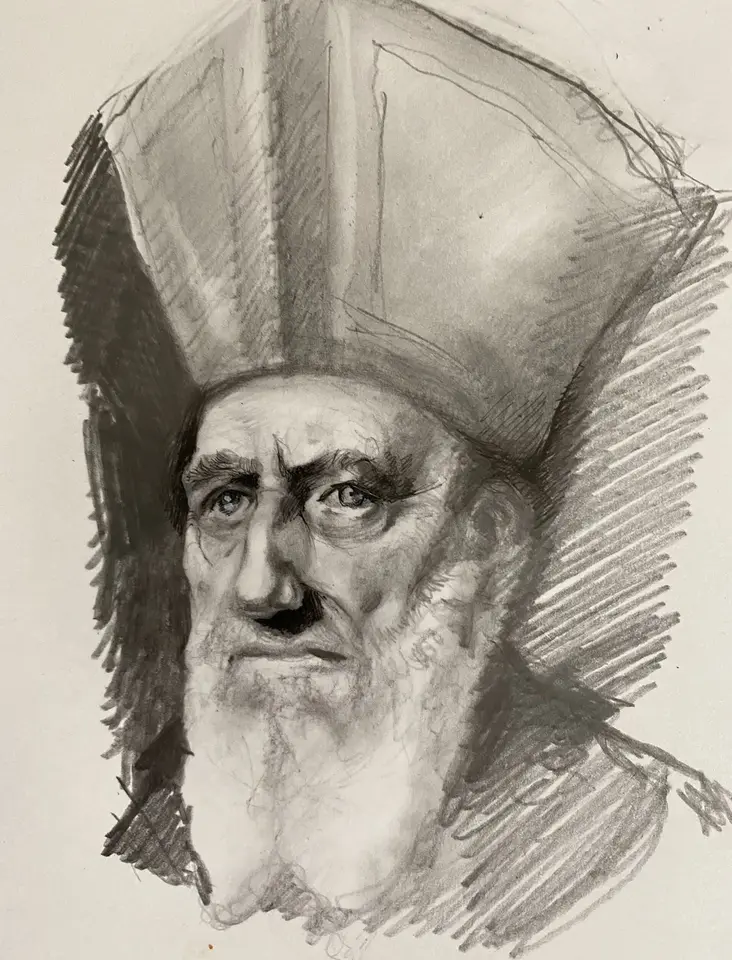
郎世宁
Lang Shining (Giuseppe Castiglione, July 19, 1688 – July 16, 1766), a native of Milan, Italy, was a Jesuit brother, a preeminent court painter and architectural designer in the Qing Dynasty, and a historic pioneer of cultural exchange between China and the West. In 1715 (the fifty-fourth year of the Kangxi Emperor's reign), Castiglione crossed the oceans and arrived in China. Due to his specialized artistic craftsmanship, he…
Lang Shining (Giuseppe Castiglione, July 19, 1688 – July 16, 1766), a native of Milan, Italy, was a Jesuit brother, a preeminent court painter and architectural designer in the Qing Dynasty, and a historic pioneer of cultural exchange between China and the West. In 1715 (the fifty-fourth year of the Kangxi Emperor's reign), Castiglione crossed the oceans and arrived in China. Due to his specialized artistic craftsmanship, he was summoned to the imperial palace, serving successively in the Imperial Workshops of the Hall of Mental Cultivation and the Ruyi Pavilion. His court service spanned the three glorious reigns of Kangxi, Yongzheng, and Qianlong, lasting more than fifty years in the Qing imperial painting academy. Throughout his half-century court artistic career, Lang Shining diligently studied traditional Chinese brush-and-ink painting techniques. He creatively synthesized European Renaissance focal perspective, chiaroscuro shading, and anatomical precision with traditional Chinese xuan paper, silk scrolls, and outline-and-wash brushwork, establishing an iconic new court painting style known as the Sino-Western synthesis. His works were characterized by rigorous realistic modeling, rich and refined coloration, and deep stereoscopic dimension. Highly appreciated and treasured by successive Qing emperors, his art profoundly reshaped the landscape of mid-Qing court painting and imperial aesthetic taste. Celebrated as one of the Ten Great Court Painters of the Qing Dynasty, Lang Shining produced a monumental oeuvre covering official court portraits of emperors and empresses, pictorial records of major military campaigns, spirited steeds, rare birds and auspicious animals, as well as tributary audiences of frontier tribal leaders. His masterpieces include One Hundred Horses, Auspicious Objects Offered in Longevity, The Qianlong Emperor in Ceremonial Armor on Horseback, Imperial Banquet in the Garden of Ten Thousand Trees, and Ayusi Sweeping the Rebels with a Spear. During the Qianlong era, he was commissioned to direct the design and planning of the European-style palaces (Xiyang Lou) in the Changchun Garden of the Old Summer Palace, presiding over the creation of the Hall of Calming Seas and the bronze twelve zodiac water-clock fountain. Furthermore, he directed the drafting of the copperplate prints for the Campaigns against the Dzungars and Muslims, and assisted Nian Xiyao in publishing Shixue, China's first treatise on perspective geometry, leaving an indelible legacy in the history of global art and architecture.
Born on July 19 in Milan, Italy; trained systematically in Western perspective and realistic drawing from youth.
Formally entered the Society of Jesus in Genoa, executing sacred murals and altarpieces for local basilicas.
Instructed by the Jesuit Superior General to embark for the China mission, painting murals in Coimbra, Portugal en route.
Reached Macao, adopted the Chinese name Lang Shining, and entered the Imperial Workshops of the Hall of Mental Cultivation in Beijing by year's end.
Yongzheng ascended the throne; commissioned to paint Assembled Auspiciousness and taught European oil painting to court disciples in the Ruyi Pavilion.
Commissioned to paint the monumental handscroll One Hundred Horses; completed Auspicious Objects Offered in Longevity and resided in the Old Summer Palace.
Completed One Hundred Horses after five years; assisted Nian Xiyao in printing Shixue, China's first treatise on linear perspective.
Qianlong ascended the throne, visiting the atelier daily and commissioning major imperial portraits and grand ceremonial scrolls.
Appointed chief designer of the Western Palaces complex in the Old Summer Palace, designing the Hall of Calming Seas and zodiac fountain.
Traveled to the Mountain Resort in Chengde to paint portraits of submitted Mongol princes, then composed Imperial Banquet in the Garden of Ten Thousand Trees.
Headed the drafting of sixteen drawings for the Campaigns against the Dzungars and Muslims, which were sent to Paris for copperplate engraving.
Died in Beijing on July 16 at age 78; honored by the Qianlong Emperor with the posthumous rank of Attendant Gentleman and imperial burial funds.
On July 19, 1688 (the twenty-seventh year of the Kangxi Emperor's reign), Lang Shining was born in the San Marcellino quarter of the Duchy of Milan, Italy, and given the baptismal name Giuseppe Castiglione. Exhibiting extraordinary visual arts talent in his youth, he entered the workshop of a reputable painter to receive comprehensive and rigorous training in high Baroque visual arts. During his apprentice years, he thoroughly mastered European Renaissance linear perspective, chiaroscuro shading, human and animal comparative anatomy, as well as the techniques of large-scale fresco and easel oil painting.
In 1707 (the forty-sixth year of the Kangxi Emperor's reign), at the age of nineteen, Castiglione formally entered the Society of Jesus in Genoa, devoting himself as a temporal coadjutor brother to the religious apostolate. During his residence in Genoa, he painted a grand altarpiece depicting Saint Ignatius of Loyola meditating in the cave of Manresa for the local cathedral, and created eight biblical murals for the Jesuit novitiate. These compositions displayed balanced structures, harmonious chromatic handling, and profound draftsmanship, earning warm praise from the ecclesiastical hierarchy.
In 1713 (the fifty-second year of the Kangxi Emperor's reign), recognizing the urgent requirement for specialized talent in the overseas missions, Jesuit Superior General Michelangelo Tamburini selected Castiglione for the mission to the Far East. He traveled through Spain to Lisbon to await passage. While staying at the Jesuit college in Coimbra, the college rector, captivated by his exceptional artistic mastery, engaged him to paint magnificent frescoes for the college chapel and an expressive portrait of the Portuguese crown prince. In April of the following year, under direct orders from Rome, Castiglione boarded a Portuguese caravel bound for the Orient, commencing his perilous cross-ocean voyage.
In 1715 (the fifty-fourth year of the Kangxi Emperor's reign), after surviving more than a year of stormy voyages across multiple oceans, the twenty-seven-year-old Castiglione arrived in Macao, the principal southern gateway to the Qing Empire. In accordance with the established practice among foreign missionaries entering China, he adopted the Chinese name Lang Shining, taking the courtesy style Gongjin. At that time, the Qing imperial government enforced strict regulatory restrictions on Western missionaries: only those possessing specialized scientific, mechanical, astronomical, or artistic skills were permitted to proceed to the capital to serve the court, while others were confined to Macao or Guangzhou and forbidden from entering the inland provinces.
Recognizing his consummate mastery of painting, Guangdong provincial authorities officially recommended Lang Shining to the imperial throne as a specialist artisan. In December of that year, Lang Shining arrived in Beijing and was immediately assigned to the Imperial Workshops of the Hall of Mental Cultivation under the Imperial Household Department. The Kangxi Emperor, then in his sixties, possessed a lively curiosity regarding Western science and plastic arts. Although Kangxi maintained reservations toward Catholic theology and strictly forbade preaching among commoners, he held Lang Shining's painting virtuosity in high esteem, treating the young Italian painter with great cordiality and instructing him to assimilate the techniques of Chinese brush, ink, silk, and traditional aesthetic motifs.
During his tenure at the workshops, Lang Shining spent his days moving between his studio and the inner palace precincts. In addition to mastering the subtleties of Chinese water-ink washes and natural mineral pigments, he surmounted formidable linguistic hurdles, acquiring fluency in both Manchu and Chinese and familiarizing himself with intricate court etiquette. In 1721 (the sixtieth year of the Kangxi Emperor's reign), Lang Shining was invited to attend the imperial New Year banquet and the Lantern Festival fireworks celebrations in the Forbidden City, receiving silk bolts and silver awards. He was subsequently transferred to the Ruyi Pavilion, inaugurating his legendary era as the primary imperial court painter.
In 1722 (the sixty-first year of the Kangxi Emperor's reign), the Kangxi Emperor passed away, and his fourth son, Yinzhen, succeeded to the throne as the Yongzheng Emperor. Following his accession, Yongzheng adopted even more stringent measures toward Christian proselytizing across the empire, banishing numerous missionaries to Guangzhou. However, technical specialists serving in the imperial palace ateliers were shielded from persecution due to their irreplaceable practical talents. The Yongzheng Emperor had refined, meticulous artistic tastes, demanding pristine precision and auspicious balance, and he particularly valued Lang Shining's unparalleled realism and life drawing.
In April 1723 (the first year of the Yongzheng era), Lang Shining was commissioned by Prince Yi, Yinxiang, the emperor's trusted thirteenth brother, to paint an exquisite silk hanging scroll titled Osmanthus, Jade Hare, and Moonlight. In September of that year, Yongzheng ordered him to compose Assembled Auspiciousness, celebrating imperial peace and prosperity. In this celebrated masterpiece, Lang Shining depicted double-headed lotuses and ears of auspicious grain arranged within an archaic bronze vase, ingeniously blending Western chiaroscuro with the crisp line work of Song Dynasty academy bird-and-flower paintings. Delighted by the outcome, the emperor assigned thirteen court apprentices to study under Lang Shining in the Ruyi Pavilion, ordering him to teach European oil painting and linear perspective to Chinese court artists, including Bandalisha, Sun Weifeng, Wang Jie, Ge Shu, and Yongtai.
In 1724 (the second year of the Yongzheng era), when the emperor launched large-scale expansion projects at the Old Summer Palace, Lang Shining was instructed to reside on-site for extended periods, executing scenic illusionistic murals (tongjinghua) and screen paintings for the newly constructed halls. In March of that year, he began working on his monumental masterpiece, One Hundred Horses. Spanning nearly eight meters in length and one meter in height, this handscroll portrayed one hundred steeds in diverse postures—grazing, bathing, galloping, and resting across meadows, forests, and winding streams. Lang Shining applied Chinese ink and mineral colors on silk, rendering exact anatomical proportions, lustrous fur coats, and expansive spatial depth. Completed in 1728 (the sixth year of the Yongzheng era) after five years of painstaking labor, it stands as an immortal treasure of Qing court painting.
During the Yongzheng reign, Lang Shining completed extensive illusionistic murals for the Gengzhi Xuan, Baihu Dian, and Hanyun Zhai at the Old Summer Palace, alongside acclaimed works such as Auspicious Objects Offered in Longevity, Auspicious Grain, Hami Melons, Mid-Summer Auspiciousness, and the album Immortal Blossoms in an Everlasting Spring. Outside palace walls, his genial disposition and unrivaled artistry earned him close friendships with imperial princes such as Yinxiang (Prince Yi), Yinli (Prince Guo), and Yunxi (Prince Shen), for whom he created formal portraits, horse albums, and ceremonial scrolls.
In August 1735 (the thirteenth year of the Yongzheng era), the Yongzheng Emperor passed away, and Prince Bao, Hongli, ascended the throne as the Qianlong Emperor. The twenty-four-year-old monarch was an enthusiastic connoisseur of painting and poetry, holding Lang Shining in the highest admiration. In the early years of his reign, Qianlong visited the Ruyi Pavilion studio almost daily to watch the master paint. The emperor commissioned Lang Shining to produce official state portraits of himself, the empress, and imperial consorts, as well as informal leisure paintings, granting him unparalleled prominence in the academy. In 1738 (the third year of the Qianlong era), when Lang Shining fell severely ill, Qianlong granted one hundred ounces of silver from the imperial privy purse for his medical care, and graciously permitted him to paint at his residence without making the dawn trek to the palace.
During the early Qianlong period, Lang Shining collaborated closely with eminent Chinese court painters such as Tang Dai, Shen Yuan, Chen Mei, and Ding Guanpeng, inaugurating a collaborative painting system in the imperial academy. Typically, Lang Shining executed the primary realistic portraits of imperial figures, noble steeds, or rare birds, while Chinese masters supplied traditional misty mountains, running streams, pine trees, and garden pavilions. This joint effort yielded timeless masterpieces such as The Qianlong Emperor's New Year Festivities, Lantern Festival Celebration, Hongli Inspecting Paintings, Spring's Peaceful Message, and the colossal silk scroll The Qianlong Emperor in Ceremonial Armor on Horseback, which captured the martial grandeur of the Eight Banners.
In 1754 (the nineteenth year of the Qianlong era), the Qing empire achieved crucial diplomatic and military breakthroughs in Central Asia. The Dorbet Mongol leaders (the Three Cherings) and the Khoit leader Amursana submitted to the Qing throne. Qianlong staged lavish banquets and ceremonial receptions at the Mountain Resort in Chengde. The sixty-six-year-old Lang Shining was dispatched alongside missionary painters Jean-Denis Attiret and Ignaz Sichelbart to Chengde, sketching oil portraits of the Mongol chieftains from life inside the grand yurts of the Garden of Ten Thousand Trees.
Subsequently, Lang Shining executed the colossal historical compositions Imperial Banquet in the Garden of Ten Thousand Trees and Equestrian Feats, which were mounted in the Juan'a Shengjing Hall of the Mountain Resort, recording the court's integration of frontier tributaries. During the ensuing Dzungar and Muslim pacification campaigns, Lang Shining painted Ayusi Sweeping the Rebels with a Spear and Machang Sashing through Enemy Lines, capturing the heroic valor of frontier officers with dynamic brushwork and dramatic light.
Beyond his prodigious output as an easel and scroll painter, Lang Shining played an indispensable role in Qianlong's architectural engineering and technical design. In 1747 (the twelfth year of the Qianlong era), Qianlong resolved to erect a complex of European-style palaces—popularly known as the Western Palaces (Xiyang Lou)—in the northern sector of the Changchun Garden at the Old Summer Palace. The emperor appointed Lang Shining chief designer and architectural planner for the entire monumental undertaking.
Drawing upon the architectural and mechanical draftsmanship principles he had studied in Europe, Lang Shining collaborated with French Jesuit engineer Michel Benoist to design Xieqiqu (Harmonious Delight), Haiyantang (Hall of Calming Seas), Dashuifa (Grand Fountains), Yuanyingguan (View of Distant Seas), and Guanshuifa (Observatory of Fountains). At the Hall of Calming Seas, Lang Shining brilliantly combined Western Baroque sculptural forms with traditional Chinese cyclical astrology, personally designing the world-famous fountain of the Twelve Bronze Zodiac Animal Heads. Replacing the Greco-Roman deities typical of Western fountains with the twelve Chinese zodiac animals, these copper-cast figures functioned as a hydraulic clock, each head spouting water sequentially during its designated two-hour period, with all twelve spouting together at noon. For his extraordinary administrative and design contributions, Lang Shining was conferred the official rank of Director of the Imperial Parks Administration (third-rank insignia).
In 1762 (the twenty-seventh year of the Qianlong era), with the comprehensive pacification of the northwestern frontiers, the Qianlong Emperor ordered Lang Shining to lead a team comprising Attiret, Sichelbart, and Giuseppe Panzi in drafting sixteen grand battle compositions for the Campaigns against the Dzungars and Muslims. Lang Shining supervised the drafting of the preparatory drawings and wrote comprehensive technical instructions in French and Latin. The drawings were dispatched through Guangdong customs to Paris, where seven master engravers under the Royal Academy of Painting and Sculpture spent seven years carving the copperplates. In 1773, two hundred sets of impressions alongside the original copperplates were delivered to Beijing. This monumental project, the first imperial copperplate series in Chinese history, stimulated great European fascination with China and laid the foundation for modern metal plate printmaking in China.
By early 1766 (the thirty-first year of the Qianlong era), approaching the age of eighty, Lang Shining experienced declining health and vigor, yet continued to provide sketches and decorative models for the palace. In March of that year, in recognition of the elderly artist's lifelong devotion, the Qianlong Emperor presented him with an imperial banquet of delicate vegetarian dishes and pastries, which marked his final recorded official activity in the Imperial Household archives.
On July 16, 1766 (the tenth day of the sixth month of the thirty-first year of Qianlong), Lang Shining passed away peacefully in Beijing at seventy-eight years of age, having served the Qing court for fifty-one years. Deeply grieved upon receiving the news, the Qianlong Emperor issued an imperial decree commending his lifelong loyalty and talent: "The Westerner Lang Shining entered into inner court service during the Kangxi reign, demonstrating great diligence and prudence, and was previously granted the third-rank insignia. Now that he has succumbed to illness and passed away, considering his many decades of service and age nearing eighty, let him be granted, in accordance with the precedent of Dai Jinxian (Ignaz Kögler), the posthumous rank of Attendant Gentleman, along with three hundred ounces of silver from the Imperial Household Department for his funeral arrangements, in manifestation of imperial favor."
Following the honors befitting a senior imperial dignitary, Lang Shining was buried in the European missionary cemetery outside Fuchengmen in western Beijing (the Zhalan Cemetery). The center of his tombstone bears the regular script inscription "Tomb of Jesuit Father Lang," accompanied by a Latin epitaph on the left and capped with the Qianlong Emperor's imperial eulogy, commemorating the Italian master's lifelong service and artistic triumph.
Lang Shining's foremost contribution to art history lay in dismantling the stylistic divide between traditional Chinese painting and Western classical oil painting, forging a path of creative synthesis that established an unprecedented new court painting genre. Following Matteo Ricci's introduction of Western devotional engravings during the late Ming dynasty, Western painting techniques had long been regarded by traditional literati painters as mere craft, lacking poetic resonance. Lang Shining transformed this imperial consensus through peerless realistic draftsmanship and respectful integration.
Technically, Lang Shining eliminated the heavy, murky shadow passages characteristic of European oil painting, adapting to imperial Chinese preferences for luminous, clear, and auspicious surfaces. He utilized fine double-ply Chinese silk scrolls and prepared xuan paper as supports, drawing crisp, delicate contours with soft goat-hair and wolf-hair Chinese brushes, then applying the fine linear hatching and multi-layered transparent washes of Renaissance art with natural mineral pigments. This approach preserved the calligraphic grace and brilliant pigmentation of Chinese gongbi painting while infusing the subjects with volumetric weight, muscular tension, and authentic optical highlights.
In masterpieces such as Auspicious Objects Offered in Longevity and White Falcon in the Palace Museum in Beijing, as well as One Hundred Horses and Peacock Spreading Its Tail in the National Palace Museum in Taipei, Lang Shining's eagles reveal distinct plumage textures, his steeds exhibit lustrous hides, and his ancient pines and rugged rocks possess tactile mass. Lauded across the empire as the Lang School of painting, his style became the supreme visual emblem of the High Qing era.
Throughout his tenure in the Qing capital, Lang Shining not only painted extensively but also served as a pioneer and instructor of Western scientific perspective. While traditional Chinese landscape and flower painting relied on atmospheric or multi-point perspective (the three distances: high, deep, and level) to evoke spiritual expansiveness, it lacked mathematical geometry for rendering complex architectural interiors and spatial foreshortening.
Lang Shining introduced classical European linear perspective (known in Chinese as xianfa or line-method) to the Forbidden City. Utilizing geometry, optics, and projection theory, he demonstrated principles of horizons, vanishing points, and foreshortening to Manchu and Han painters in the workshops. Backed by the Yongzheng Emperor, he trained ten prominent disciples in the Ruyi Pavilion—including Bandalisha, Sun Weifeng, Wang Jie, Ge Shu, Yongtai, Wang Youxue, and Zhang Weibang—equipping an entire generation of indigenous court painters with skills essential for imperial palace murals and architectural rendering.
Furthermore, Lang Shining established a close intellectual partnership with Nian Xiyao, the Superintendent of the Imperial Household Department and an accomplished mathematician. With Lang Shining's systematic instruction, diagrams, and geometrical demonstrations, Nian Xiyao compiled and published Shixue (The Science of Vision) in 1728 (the sixth year of Yongzheng), China's very first comprehensive treatise on Western linear perspective. In his preface, Nian acknowledged that his understanding of European perspective derived directly from extensive discussions with "Academician Lang" in the academy. The publication of Shixue filled a critical void in Chinese technical drafting theory and remains a landmark in Sino-Western scientific and cultural interaction.
In 1747 (the twelfth year of the Qianlong era), the Qianlong Emperor commissioned a suite of European-style palaces and mechanical fountains in the Changchun Garden of the Old Summer Palace. Lang Shining was selected as head designer and aesthetic coordinator for the entire complex.
In designing the Western Palaces (Xiyang Lou), Lang Shining demonstrated extraordinary cross-cultural architectural imagination. He introduced grand Baroque and Rococo architectural forms, featuring imposing marble Roman columns, ornate Ionic and Corinthian capitals, and elaborate acanthus leaf reliefs. Concurrently, he respected traditional Chinese imperial architectural grammar, replacing European slate roofs with radiant polychrome glazed tiles and adorning curved eaves with Chinese auspicious mythical zoomorphic ridge ornaments.
In hydraulic engineering and sculptural design, Lang Shining collaborated closely with French Jesuit mathematician Michel Benoist, constructing spectacular fountains at Xieqiqu, Haiyantang, and Dashuifa. His most celebrated design was the Twelve Bronze Zodiac Fountain at the Hall of Calming Seas. Lang Shining substituted the naked mythological figures of Western fountains with the twelve animal signs of the Chinese earthly branches (Rat, Ox, Tiger, Rabbit, Dragon, Snake, Horse, Goat, Monkey, Rooster, Dog, and Boar). Cast in refined red bronze by the Imperial Workshops, these animal-headed human statues sprayed water sequentially every two hours, culminating in a joint noon spout, achieving a harmonious balance between Chinese cyclical cosmology and Western hydraulic engineering.
During the Qing pacification of the northwestern frontiers, Lang Shining documented historical moments with documentary precision, pioneering panoramic military paintings and hero portraits in the Qing court. For decades, he accompanied imperial expeditions and official receptions, serving as an imperial visual historiographer.
In 1754 (the nineteenth year of the Qianlong era), upon the submission of the Three Cherings of the Dorbet Mongols, Lang Shining traveled to the Rehe Mountain Resort, sketching life studies of tribal chieftains inside yurts in the Garden of Ten Thousand Trees. This resulted in monumental handscrolls such as Imperial Banquet in the Garden of Ten Thousand Trees and Equestrian Feats, recording the multi-ethnic unification of the empire. He subsequently painted battle scenes such as Ayusi Sweeping the Rebels with a Spear and Machang Slashing through Enemy Lines, capturing the heroic intensity of military commanders in combat.
In 1762 (the twenty-seventh year of the Qianlong era), Lang Shining was commissioned to lead the creation of the Campaigns against the Dzungars and Muslims (also known as the Qianlong Conquest of the Western Regions). This series of sixteen grand compositions depicted decisive battles and victory celebrations, including "The Storming of Mount Gadan" and "Lifting the Siege of the Black Water River." Lang Shining directed the drafting of all sixteen compositions, preparing detailed instructions for French royal engravers in Paris. The return of the two hundred sets of finished copperplate impressions along with the copperplates in 1773 spurred the creation of an imperial engraving department in Beijing and broadcast the martial power and artistic splendor of the High Qing across Europe.
FIGURES ASSOCIATED WITH THIS DYNASTY