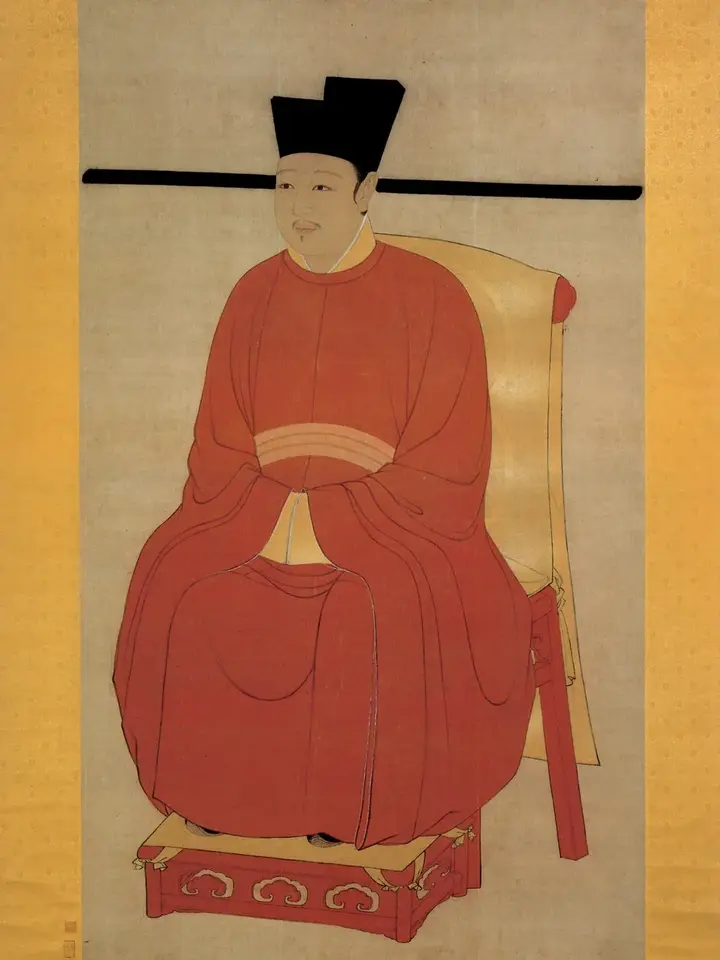
Biography
Wuling Gentry Lineage and Monastic Renunciation
On April 8, 1612 (the 8th day of the 3rd lunar month in the 40th year of the Wanli reign), Kuncan was born in Wuling County, Changde Prefecture, Huguang Province. His secular surname was Liu, tracing roots to an established gentry lineage in the region. Highly gifted from childhood with an impressive memory, young Kuncan studied the Confucian curriculum for the imperial civil service examinations, receiving a thorough grounding in classical literature.
However, Kuncan possessed an aloof, unyielding spirit. Confronted with the venality of late Ming society and bureaucratic corruption, he felt an urge to withdraw from the secular world. He visited ancient monasteries near his home, drawn to Buddhist monastic contemplation. When he reached age twenty, his parents arranged a marriage and pressured him to pursue examination honors. Refusing to submit, Kuncan severed his hair, renounced secular life at Sanjia Nunnery on Mount Longshan, took the monastic name Kuncan and courtesy name Jieqiu, and styled himself Shixi.
After entering the Buddhist monastic order, Kuncan adhered strictly to Vinaya monastic regulations, performing manual labor by day and studying the Avatamsaka and Surangama Sutras by night. Subsequently, he traveled across Hunan visiting prominent monasteries and studying under Chan masters, cultivating an independent spiritual presence like a solitary lion that walks alone without need of companions.
Wartime Resistance and Seclusion in Taoyuan
In 1644, Qing armies breached the northern pass, Beijing fell, and the Ming central dynasty was extinguished. When Qing forces pushed southward, Central China and the Jiangnan region were plunged into warfare. Upholding moral loyalty to his native dynasty, Kuncan joined the anti-Qing resistance under Southern Ming Grand Coordinator He Tengjiao, assisting in defense organization.
Between 1647 and 1648, the Southern Ming defense collapsed, He Tengjiao died a martyr, and Qing troops combed the Changde region to capture loyalist remnants. Kuncan fled into the deep wilderness of Taoyuan. This harsh period of exile was recorded by his close friend Cheng Zhengkui in the Brief Biography of Shixi. Living outdoors among jagged precipices, twisted ancient trees, and wild beasts, Kuncan slept in caves alongside tigers and serpents, foraging for roots and drinking river water, warming his feet with his own urine during freezing winters.
Although this prolonged survival in the wild ruined his health, inflicting chronic rheumatic ailments, the sublime grandeur of nature transformed his spirit. The untamed shapes of bizarre boulders, gnarled pines, and thundering waterfalls left impressions upon his mind, providing authentic living material for his rugged, monumental landscape style.
Residing in Jinling and Seclusion on Mount Niushou
In 1654, at age forty-three, Kuncan departed Huguang and sailed east to Nanjing. As the former capital of the Ming Empire, Nanjing preserved palaces and gathered prominent loyalist scholars. Upon arrival, Kuncan resided at the imperial Da Bao'en Temple outside the Jubaomen Gate. There, he met fellow provincial Cheng Zhengkui (styled Qingxi). Discovering a deep spiritual kinship, they spent nights debating Chan doctrine and painting, forging a lifelong bond.
In 1658, finding the Da Bao'en Temple crowded by urban noise, Kuncan relocated to the Youqi Temple on Mount Niushou, southwest of Nanjing. With its twin peaks and dense forests, Mount Niushou was the historic cradle of the Niutou Chan tradition. Kuncan built a modest hut, living in quiet seclusion and styling himself Dianzhu Daoren (Lightning-Dwelling Daoist).
During his fifteen years on Mount Niushou, Kuncan combined meditation with artistic creation. Holding a worn, blunt brush, he painted amidst the shifting seasons and mists of the mountain. Prominent Ming loyalists including Gu Yanwu, Gong Xian, Zhou Lianggong, and Fang Yizhi made pilgrimages to visit him, spreading his renown across Jiangnan.
Uncompromising Integrity and Reclusive Twilight Years
Kuncan possessed an uncompromising temperament, confronting injustice without hesitation. Devastated by the fall of his dynasty, he refused contact with Qing officials. When provincial governors and high officials came seeking paintings, Kuncan kept his doors closed, preferring poverty to currying favor with imperial authorities.
Kuncan expressed humility through his "Three Regrets": "I regret that these feet have not traversed all the famous mountains under heaven; I regret that these dull eyes could not read ten thousand volumes of books; and I regret that these ears failed to remember the instruction of enlightened masters." This sincere self-examination revealed his lofty moral character.
In his late years, Kuncan suffered from rheumatism that impaired his movement. In 1668, near sixty, he returned to Wuling despite illness to bury his deceased parents in their ancestral cemetery, fulfilling filial obligations. In the winter of 1673, at age sixty-two, sensing his approaching end, he distributed his art collections to fellow monks, commissioned a painter to execute the Arhat Emerging from the Mountain, inscribed his final poetic colophon, and laid down his brush. On his deathbed, he instructed his disciples: "Cast my ashes into the river, and leave no mound behind." He then passed away peacefully on his meditation mat at Youqi Temple.
Major Achievements
Fusing Chan Enlightenment into Dense Landscape Painting
In the evolution of Chinese landscape painting, Kuncan erected a towering monument through his revolutionary brushwork.
During the early Qing period, the Orthodox School represented by the Four Wangs emphasized stylistic imitation of ancient masters, producing rigid, formulaic landscapes. Approaching painting as an enlightened Chan master, Kuncan shattered conventional literati formulas, asserting that Chan awakening and artistic insight share a common source.
Kuncan's landscapes became celebrated for their dense, textured brushwork, often characterized as "coarse attire and unkempt hair" (cufu luantou). He favored worn, blunt brushes, using extremely dry, parched ink to execute layers of dry-brush scrubbing and shading across raw xuan or mulberry paper. Applying thin washes of burnt ochre and mineral blue beneath layered ink tones, he produced an effect that appeared rough and wild, yet remained structurally monumental. His compositions combined high-distance and deep-distance perspectives, achieving a natural synthesis of visual weight and Zen spontaneity.
Pioneering Realistic Landscape Sketching in the Early Qing
Unlike artists who relied on copying ancient manuals within their studios, Kuncan championed direct observation of nature, rooting his art in actual topography.
His exile in the mountains of Taoyuan and travels along the Yangtze instilled in him an appreciation of natural landscapes. During his years on Mount Niushou, he sketched the scenery of Niushou, Qixia Mountain, Da Bao'en Temple, and the Yangtze River. His surviving masterpiece Bao'en Temple re-created the glazed porcelain pagoda of the Ming imperial temple soaring into the clouds, conveying deep remembrance of fallen dynastic grandeur.
Masterpieces such as Layered Cliffs and Cascading Ravines and Mountain Stream Flowing from Clouds (both preserved in the Palace Museum in Beijing) exemplify the integration of outdoor observation and inner vision. Portraying craggy peaks, cascading torrents, and dense forests, these works exude wild vitality, celebrated as summits of early Qing landscape art.
Renown as One of the Four Monk Masters and Two Shi
During the artistic transition of the seventeenth century, Kuncan achieved historical prominence, recognized alongside Zhu Da (Bada Shanren), Hongren (Jianjiang), and Shitao (Yuanji) as the immortal "Four Monk Masters of the Early Qing." Literati also celebrated him with Shitao as the "Two Shi," and paired him with Cheng Zhengkui as the "Two Streams of Jinling."
Each of the Four Monks renounced secular society following the fall of the Ming, expressing personal grief through painting. While Bada Shanren was celebrated for cold aloofness, Hongren for crystalline purity, and Shitao for spontaneous brilliance, Kuncan stood out for dense monumental gravity and rugged power. Modern master Huang Binhong revered Kuncan's methods throughout his career, praising his art as the highest standard of Chinese painting. Modern luminaries including Zhang Daqian, Huang Qiuyuan, and Qian Songyan drew inspiration from his brushwork.
Moral Fortitude and Poetic Expression of Loyalist Grief
Kuncan was not only an exceptional painter-monk but also a Ming loyalist who maintained uncompromised moral integrity until death.
From his service in He Tengjiao's anti-Qing army to his secluded life on Mount Niushou, his existence was shaded by national loss. Under Qing literary inquisitions, he could not openly express anti-Qing defiance in political forums, channeling his loyalist anguish into his paintings and poetic colophons.
His inscriptions utilized Buddhist verses and the cadence of Qu Yuan's Songs of Chu to lament the fall of the empire and civilian suffering. In one celebrated colophon, he wrote: "Wild dragons and serpents roam the plains, while autumn winds wither mountain woods; a solitary monk has no dwelling, standing alone to gaze upon the Central Plains." These sentiments gave his landscapes moral weight, making his works enduring symbols of literati fortitude and patriotic devotion.