Aristocratic Birth
Born in Chang'an into the illustrious Yuchi military lineage, the son of General of the Left Militant Guard Yuchi Zong.
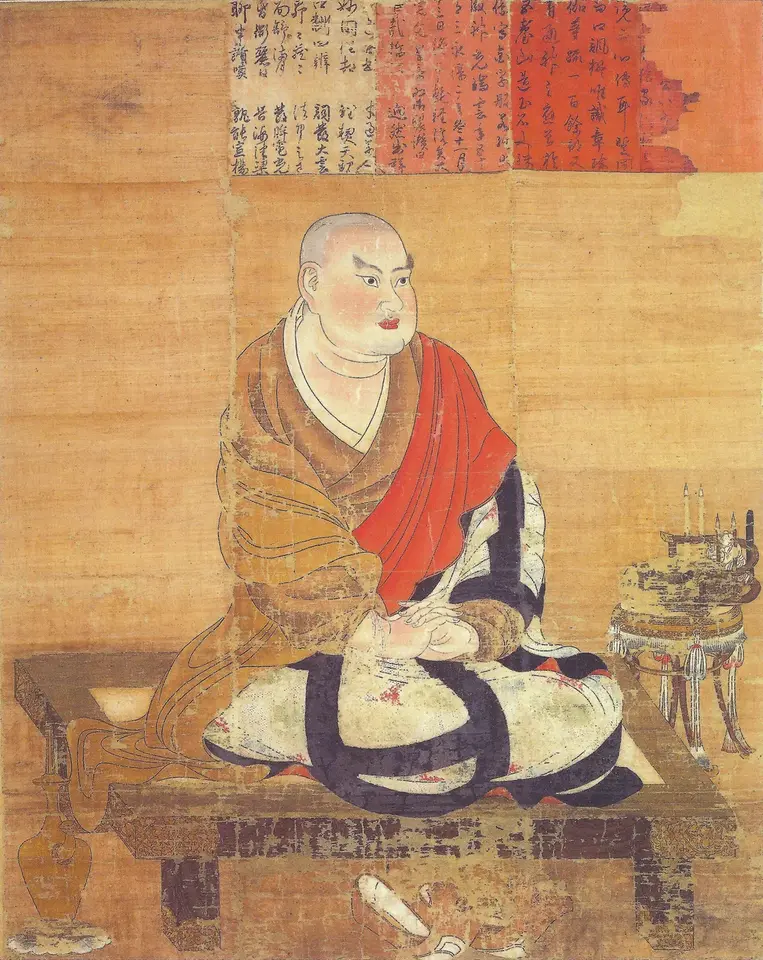
窥基
Kuiji (窥基, 632–682), courtesy name Hongdao (洪道), secular surname Yuchi, was an eminent Tang dynasty Buddhist prelate and the de facto founder of the Faxiang Weishi School (also renowned as the Ci'en School) of East Asian Buddhism. Born into a premier aristocratic military clan as the nephew of Duke of E Yuchi Jingde and the son of General of the Left Militant Guard Yuchi Zong, he entered the monastic order at age seventeen…
Kuiji (窥基, 632–682), courtesy name Hongdao (洪道), secular surname Yuchi, was an eminent Tang dynasty Buddhist prelate and the de facto founder of the Faxiang Weishi School (also renowned as the Ci'en School) of East Asian Buddhism. Born into a premier aristocratic military clan as the nephew of Duke of E Yuchi Jingde and the son of General of the Left Militant Guard Yuchi Zong, he entered the monastic order at age seventeen under imperial decree as the foremost disciple of Master Xuanzang. Residing successively at Hongfu Monastery and the Great Ci'en Monastery, he mastered Sanskrit, Indian linguistic treatises, and Buddhist pramāṇa logic, earning widespread acclaim as the leading luminary among Xuanzang's disciples and the revered Master of a Hundred Commentaries. In 659, during the pivotal translation of Indian commentaries on the Thirty Verses on Consciousness-Only, Kuiji boldly proposed abandoning the cumbersome tradition of translating each master's commentary separately. Instead, he pioneered a synthesized translation method, organizing the doctrines of ten Indian masters around the orthodox exegesis of Dharmapāla to produce the monumental ten-volume Cheng Weishi Lun (Treatise on the Establishment of Consciousness-Only). Following Xuanzang's demise, Kuiji directed the Translation Cloister at Great Ci'en Monastery, composing over forty comprehensive commentaries and formulating seminal doctrines such as the Fourfold Two Truths, the Fivefold Consciousness-Only, and the Fivefold Consciousness-Only Contemplation. His philosophical innovations profoundly shaped East Asian Buddhist thought, transmitting the Faxiang lineage to the Korean peninsula and Japan.
Born in Chang'an into the illustrious Yuchi military lineage, the son of General of the Left Militant Guard Yuchi Zong.
Lost his mother at age nine, withdrawing into deep reflection and mastering Confucian classics and historical treatises.
Encounted by Master Xuanzang upon the streets of Chang'an, who recognized his extraordinary capacity and persuaded his family to allow his ordination.
Formally ordained by imperial decree as Xuanzang's disciple, initially residing at Hongfu Monastery before moving to Great Ci'en Monastery.
Received full monastic vows (bhikṣu) under imperial mandate, selected to specialize in Sanskrit, linguistics, and Indian Buddhist logic.
Appointed by imperial edict to Xuanzang's translation academy, serving as chief recording scribe and textual editor.
Spearheaded the synthesis of ten Indian commentaries, assisting Xuanzang in completing the ten-volume Cheng Weishi Lun.
Returned to Great Ci'en Monastery after Xuanzang's death at Yuhua Palace, dedicating himself to voluminous scriptural commentaries.
Lectured throughout the Taihang Mountains and Mount Wutai, commissioning a jade statue of Mañjuśrī and transcribing the Prajñāpāramitā Sūtra in gold script.
Passed away peacefully at the Great Ci'en Monastery Translation Cloister on the thirteenth day of the eleventh month at age fifty-one.
Kuiji traced his ancestry to the Xianbei nobility of Dai Commandery in the Northern Wei dynasty, whose descendants accompanied the imperial court during the relocation to Luoyang and eventually settled in the imperial capital of Chang'an under the Sui and Tang dynasties. His family was among the preeminent military clans of northern China: his high great-grandfather Yuchi Benzhen served as Northern Wei Champion General and Founding Duke of Yuyang; his great-grandfather Yuchi Mengdu held office in Northern Qi and Northern Zhou as Regional Inspector of Jizhou; his grandfather Yuchi Shuo served as General Pacifying the East under the Sui; his father Yuchi Zong inherited ancestral honours to become General of the Left Militant Guard and Duke of Jiangguo; and his uncle was Yuchi Jingde, Duke of E, one of the founding heroes honored in the Lingyan Pavilion. Raised in such magnificent aristocratic splendor, Kuiji enjoyed exceptional educational and material privileges from early childhood.
According to Buddhist biographical annals, his mother Lady Pei conceived him following an auspicious dream in which she swallowed the lunar disc, and he was born with remarkable physical presence. However, when he was nine years old, his mother passed away prematurely. This traumatic childhood loss exerted a profound spiritual impact upon the young boy, awakening an acute awareness of the transience of mortal existence. Throughout his subsequent youth, Kuiji shunned ostentatious social gatherings, immersing himself in intensive study. He demonstrated photographic memory and acute analytical brilliance across the Confucian Five Classics, the philosophical masters, and dynastic annals, earning high acclaim among elite young scholars in Chang'an.
In the first month of 645, Master Xuanzang returned triumphant to Chang'an following seventeen arduous years of pilgrimage across Central Asia and India, received with immense honor by Emperor Taizong and hundreds of thousands of monastics and laypeople. Xuanzang brought back 520 bundles containing more than 600 Sanskrit texts, resolving to translate them into Chinese and establish a rigorous school of Consciousness-Only philosophy. Recognizing that the intricate pramāṇa logic and abstruse metaphysics of Indian Yogācāra required minds of the highest intellectual caliber to carry forward, Xuanzang actively sought promising young scholars throughout the realm.
While walking through the avenues of Chang'an, Xuanzang encountered the young Kuiji. Struck by his tall posture, clear features, and poised, scholarly demeanor, Xuanzang engaged him in conversation and was astonished by his extraordinary insight into causality and metaphysics. Xuanzang immediately recognized him as a rare vessel destined to transmit the ultimate truths of the Weishi school. Xuanzang paid a personal visit to the residence of Duke Yuchi Zong, expounding upon the profound merits of the Dharma and urging the general to permit his son to renounce secular life. Yuchi Zong was initially reluctant to yield his aristocratic heir to the monastery, but moved by Xuanzang's persistent sincerity, he eventually gave his consent. Because Kuiji belonged to the imperial aristocracy, his ordination required official imperial sanction. In 648, upon reaching age seventeen, Kuiji was formally tonsured under imperial decree as Xuanzang's foremost personal disciple, initially entering the Hongfu Monastery Translation Bureau before relocating to the newly constructed Great Ci'en Monastery in the twelfth month of that year.
Following his entry into the sangha, Kuiji received rigorous direct instruction from Xuanzang in Mahāyāna doctrine, Sanskrit grammar, and Indian pramāṇa logic. In 654, at age twenty-three, Kuiji was ordained as a full bhikṣu under imperial mandate at Zhuangyan Monastery in Chang'an. In the same year, Emperor Gaozong issued an edict selecting elite young monks to master the languages and dialects of the five regions of India. Displaying prodigious intellectual acumen, Kuiji quickly mastered Sanskrit phonology, morphology, syntax, and classical Indian regional vernaculars, acquiring the rare ability to read and collate original palm-leaf manuscripts directly.
In 656, an imperial edict formally inducted Kuiji into Xuanzang's imperial translation academy, appointing him to the vital office of recording scribe (bishou) and textual editor. In this capacity, the scribe was responsible for recording the Master's oral translations in precise, elegant Chinese prose while refining its logical continuity. Over the following years, as Xuanzang moved between translation bureaus at Ci'en Monastery, Ximing Monastery, and Yuhua Palace, Kuiji served continuously at his side. He recorded and edited landmark works including the six-hundred-volume Mahāprajñāpāramitā Sūtra, the three-volume Madhyānta-vibhāga-bhāṣya, the Viṃśatikā-vijñaptimātratā-siddhi, the Samayabhedoparacanacakra, and the Abhidharma-dhātukāya-pāda-śāstra. Kuiji's remarkable speed and flawless doctrinal accuracy earned him renown as the preeminent intellectual pillar of Xuanzang's academy.
In 659, Xuanzang's translation bureau embarked upon a monumental undertaking: translating the commentaries on Vasubandhu's foundational treatise, the Thirty Verses on Consciousness-Only. Vasubandhu had composed the thirty verses but passed away before producing a prose commentary. In subsequent generations, ten celebrated Indian masters—including Dharmapāla, Guṇamati, Sthiramati, Bandhuprabha, and Citrabhāṇa—authored separate commentaries reflecting divergent doctrinal perspectives. Xuanzang had painstakingly collected all ten commentaries during his studies at Nālandā and transported them to Chang'an. Initially, Xuanzang intended to translate all ten works separately, assigning four senior disciples—Shenfang, Jiashang, Puguang, and Kuiji—to divide the texts.
However, during early translation sessions, the four disciples disputed fiercely over conflicting interpretations, resulting in disjointed prose and doctrinal contradictions. Kuiji recognized that translating ten divergent treatises would overwhelm Chinese scholars with confusing technical disputes. He boldly presented a visionary proposal to Xuanzang: rather than producing ten separate translations, they should synthesize the ten commentaries into a single, comprehensive master text, adopting the authoritative interpretations of Dharmapāla as the central doctrinal backbone while integrating the finest insights of the other nine masters. Xuanzang enthusiastically approved this strategy, dismissed the other three assistants, and secluded himself with Kuiji. Xuanzang orally rendered the Sanskrit manuscripts while Kuiji meticulously organized, reconciled, and recorded the text. Their collaborative triumph was the ten-volume Cheng Weishi Lun, which established the undisputed doctrinal foundation of the Weishi school in East Asia.
In the second month of 664, Master Xuanzang passed away at Yuhua Palace in Yijun, leaving the Tang court and Buddhist world in profound mourning. At age thirty-three, Kuiji shouldered the immense historical responsibility of preserving and advancing Xuanzang's philosophical legacy. He returned from Yuhua Palace to Chang'an, taking up residence at the Translation Cloister of Great Ci'en Monastery. Recognizing that Indian Buddhist terminology was exceedingly intricate and prone to misinterpretation among Chinese scholars, Kuiji dedicated the remainder of his life to producing exhaustive exegetical commentaries.
During this period, Kuiji traveled beyond Chang'an to propagate the Dharma across Shanxi, the Taihang Mountains, Mount Wutai, and Xihe. Wherever he went, he established lecture halls to explicate the Cheng Weishi Lun, the Lotus Sūtra, and the Diamond Sūtra, drawing thousands of monastic and lay scholars. During his pilgrimage to Mount Wutai, inspired by the wisdom of Mañjuśrī, he personally funded the sculpting of a white jade Mañjuśrī statue and transcribed the entire six-hundred-volume Mahāprajñāpāramitā Sūtra in gold script. Throughout his career, Kuiji authored over forty major commentaries spanning more than a hundred fascicles across the Buddhist canon, earning the universally acknowledged title of Master of a Hundred Commentaries.
Kuiji's profound scholarship and rigorous pedagogy transformed Great Ci'en Monastery into the intellectual epicenter of East Asian Buddhism for over two decades. Scholars from throughout China and abroad flocked to his lecture halls. During this era, Master Daoxuan, the founder of the Vinaya School in the Zhongnan Mountains, maintained close relations with Kuiji. According to legend, Daoxuan, whose strict asceticism was believed to move celestial deities to offer divine meals, initially harbored reservations regarding Kuiji's aristocratic background. When Kuiji visited Daoxuan's hermitage, however, the celestial offering failed to appear because the deities were awed by the celestial protectors surrounding Kuiji, leading Daoxuan to revere him as a great bodhisattva incarnate.
In 682, worn by decades of relentless writing and teaching, Kuiji's physical health declined. Yet he continued lecturing upon the subtle points of the Cheng Weishi Lun and Buddhist logic. On the thirteenth day of the eleventh month in 682, Kuiji passed away peacefully in the lotus posture at the Translation Cloister at age fifty-one. In the twelfth month, more than a thousand mourners escorted his funeral procession to the Northern Canal of Fancun, interring him beside Xuanzang's stupa. In 829, during the reign of Emperor Wenzong, his disciples cremated his remains and relocated them to a new stupa on the plains. Through his eminent disciples Huizhao and Zhizhou, and foreign scholars such as Dōshō and Genbō of Japan and Woncheuk of Silla, Kuiji's teachings became the bedrock of the Hossō school in Nara, Japan, and the Weishi tradition throughout East Asia.
In the history of Chinese Buddhist translation, translators had traditionally adhered strictly to literal or idiomatic renderings of individual texts, rarely attempting systematic structural synthesis across competing traditions. Kuiji's innovation of the synthesized translation (rouyi) under Xuanzang's guidance represented a revolutionary milestone in world translation history. When confronted with the divergent commentaries on Vasubandhu's Thirty Verses, Kuiji recognized that disparate scholastic perspectives would foster factional chaos unless integrated into a coherent philosophical whole.
In compiling the ten-volume Cheng Weishi Lun, Kuiji established the guiding principle: "To deliberate between Chinese and Sanskrit, evaluate the weight of varying doctrines, reconcile differences among perspectives, and harmonize them within a single master's system." Adopting Dharmapāla's orthodoxy as the overarching framework, he carefully integrated the commentaries of Guṇamati, Sthiramati, Bandhuprabha, Citrabhāṇa, Nanda, Śuddhacandra, Jinaputra, and others. Complementary arguments were harmonized into unified assertions, while dissenting views were preserved and evaluated against Dharmapāla's standard. This unprecedented methodological synthesis created an exhaustive, logically rigorous philosophical masterpiece, resolving centuries of debate between the Dilun and Shelun schools and establishing the doctrinal sovereignty of the Tang Ci'en School.
The doctrine of the Two Truths—conventional truth (saṃvṛti-satya) and ultimate truth (paramārtha-satya)—serves as the foundational cornerstone for understanding reality across Indian Mahāyāna Buddhism. In his Notes on the Essence of the Cheng Weishi Lun and the Verses on the Forest of Meanings in the Mahāyāna Dharma, Kuiji achieved an extraordinary philosophical breakthrough by expanding the traditional dualistic framework into the sophisticated Fourfold Two Truths (sichong erdi). Kuiji posited that truth is not a static binary opposition, but rather a dynamic continuum of four progressively deeper epistemological tiers reflecting the knower's level of awakening.
Kuiji integrated scriptural definitions from the Yogācārabhūmi-śāstra, the Prakaraṇāryavācā-śāstra, and the Cheng Weishi Lun to construct his fourfold matrix: First, Nominal-Actual Two Truths, contrasting worldly conventional truth (deluded conceptual projections such as cups and wagons) with worldly ultimate truth (the five aggregates revealed through phenomenological analysis); Second, Event-Principle Two Truths, contrasting rational conventional truth (causally conditioned aggregates and spheres) with rational ultimate truth (the profound Four Noble Truths); Third, Realization Two Truths, contrasting realized conventional truth (the provisional states attained by noble disciples) with realized ultimate truth (the realization of twofold emptiness attained through eradicating ego and dharmic grasping); Fourth, Expression-Purport Two Truths, contrasting ultimate conventional truth (the ultimate reality provisionally expressed in language) with the ineffable ultimate truth (the transcendent, unconditioned tathatā beyond all conceptualization and speech).
In his Notes on the Essence of the Cheng Weishi Lun, Kuiji further elaborated upon the dialectics of concealment and manifestation. He explained conventional truth as concealing ultimate emptiness while manifesting provisional forms, just as a bound cloth conceals its fabric to appear as a rabbit. Ultimate truth encompasses both cognitive realms and transcendent principles, with the first three tiers existing as conceptually established states, while the fourth tier represents the purely ineffable reality known only through non-conceptual wisdom. Kuiji derived thirty-nine propositions of Consciousness-Only nature through combinatorial permutations of these tiers. Within this structured hierarchy, what is ultimate relative to a lower level becomes conventional relative to a higher level. This multi-dimensional dialectic elevated East Asian Buddhist epistemology to unprecedented heights of analytical rigor.
In analyzing the ultimate nature of reality (tathatā), Kuiji systematically formulated the doctrine of the Sevenfold Suchness (qi zhenru) in the Verses on the Forest of Meanings in the Mahāyāna Dharma, providing an incisive analysis of the relationship between ultimate ontology and phenomenal appearances. The seven aspects include: Flowing Suchness (the true nature of conditioned arising and ceasing); Characteristic Suchness (the reality revealed through the twofold selflessness); Consciousness-Only Suchness (the reality that all defiled and pure dharmas are mere consciousness); Established Suchness (the fundamental nature of the Truth of Suffering); Pernicious Suchness (the fundamental nature of karmic accumulation in the Truth of Origination); Pure Suchness (the unconditioned peace of Nirvana in the Truth of Cessation); and Correct Practice Suchness (the fundamental reality of the Noble Path).
Applying the doctrine of the Three Natures (imagined nature, dependent nature, and perfected nature), Kuiji scrutinized the metaphysical status of each suchness. He demonstrated that in their fundamental essence (shixing), all seven suchnesses belong to the perfected nature (pariniṣpanna), representing the cognitive realm of the fundamental and subsequent wisdom of Buddhas and Bodhisattvas. However, in their phenomenological aspects (xingxiang), due to the deluded grasping of sentient beings, Flowing, Established, and Pernicious Suchness pertain to the imagined (parikalpita) and dependent (paratantra) natures, whereas Characteristic, Consciousness-Only, Pure, and Correct Practice Suchness pertain to the dependent and perfected natures. Through this elegant framework, Kuiji maintained the absolute purity of ultimate suchness while fully explaining the realistic causes of worldly suffering and karmic transmigration.
To synthesize the sprawling Consciousness-Only doctrines scattered throughout the Mahāyāna canon, Kuiji creatively established the comprehensive categorization of the Fivefold Consciousness-Only (wu weishi) in the Verses on the Forest of Meanings in the Mahāyāna Dharma: Consciousness-Only of Objects (jing), Consciousness-Only of Teaching (jiao), Consciousness-Only of Principle (li), Consciousness-Only of Practice (xing), and Consciousness-Only of Fruit (guo). He declared that despite the infinite variety of canonical terminology, all Weishi doctrines are encompassed within these five categories, providing students with an indispensable conceptual blueprint.
Focusing upon the Consciousness-Only of Objects—the epistemological cornerstone of the school—Kuiji cited the classical analogy from the Abhidharma Sūtra wherein celestial beings see jewels, humans see water, and hungry ghosts see pus in the exact same river. He analyzed the cognition of external objects across six distinct dimensions: First, Discerning Consciousness-Only Based on Attachment, showing that external objects exist purely through deluded mental grasping; Second, Discerning Consciousness-Only Based on Defilement, uncovering how impure mental impulses project the three realms of cyclic existence; Third, Discerning Consciousness-Only Based on Freedom from Hindrance, demonstrating the direct realization of non-duality upon severing cognitive and affective obscurations; Fourth, Discerning Consciousness-Only Based on Inclusiveness, gathering all conditioned and unconditioned phenomena within the eight consciousnesses and their mental associates; Fifth, Discerning Consciousness-Only Based on Differentiation, explicating the specialized operational functions of each individual consciousness; and Sixth, Discerning Consciousness-Only Based on Profound Subtlety, revealing how the ālayavijñāna stores karmic seeds to generate all phenomenal reality.
Recognizing that Yogācāra philosophy was designed not merely for scholastic speculation but as an experiential path of meditative cultivation, Kuiji formulated the Fivefold Contemplation of Consciousness-Only (wuchong weishi guan) in the Verses on the Forest of Meanings in the Mahāyāna Dharma, providing practitioners with an ascending five-stage ladder of meditative realization.
The stages proceed systematically: First, Dismissing the False and Retaining the Real (qianxu cunshi), utilizing rational discernment to discard the fictitious projections of the imagined nature while retaining the genuine existence of the dependent and perfected natures; Second, Relinquishing the Extraneous and Preserving the Pure (shelan liuchun), recognizing that while mental associates are numerous and prone to defilement, one must release fixation upon secondary mental factors to focus purely upon the primary consciousness; Third, Gathering the Branches to Return to the Root (shemo guiben), realizing that both the subject of cognition (the seeing division) and the object of cognition (the image division) are merely secondary manifestations projected by the self-authenticating division of consciousness, thereby gathering secondary functions back into the fundamental source of mind; Fourth, Concealing the Inferior and Revealing the Superior (yinlie xiansheng), subordinating auxiliary mental factors to illuminate the sovereign, luminous awareness of the primary consciousness; Fifth, Dispensing with Forms to Realize the True Nature (qianxiang zhengxing), transcending the transient phenomenal operations of the eight consciousnesses to directly realize the unconditioned, tranquil reality of tathatā. This fivefold contemplative method translated complex psychology into a direct contemplative practice, serving as an enduring meditation manual for East Asian Buddhist monks.
Kuiji summarized the entire soteriological journey of the Weishi school within the overarching framework of the Three Positions: Object, Practice, and Fruit (jing xing guo). The Object of Consciousness-Only establishes an accurate metaphysical understanding of reality through the eight consciousnesses, Two Truths, Three Natures, and Seven Suchnesses; the Practice of Consciousness-Only delineates the gradual progress through the Five Stages of cultivation (Accumulation, Application, Insight, Cultivation, and Ultimate Realization); and the Fruit of Consciousness-Only outlines the ultimate attainment of supreme enlightenment, wherein defiled consciousness is transformed into the Fourfold Wisdom (the Great Mirror Wisdom, Wisdom of Equality, Wisdom of Wondrous Observation, and Wisdom of Accomplishing Actions) and non-abiding Nirvana.
To explicate this expansive philosophy, Kuiji authored over forty works, earning his renown as Master of a Hundred Commentaries. His masterworks include the twenty-volume Commentary on the Cheng Weishi Lun, the four-volume Notes on the Essence of the Cheng Weishi Lun, the two-volume Commentary on the Twenty Verses, and the six-volume Commentary on the Nyāyapraveśa. In addition, he applied Weishi principles to canonical sūtras, composing the ten-volume Profound Praise of the Lotus Sūtra, the two-volume Praise of the Diamond Sūtra, and commentaries on the Amitābha Sūtra and Maitreya Sūtra. In his Lotus Sūtra commentary, demonstrating consummate philological scholarship, he composed a dedicated chapter analyzing the grammatical usage and semantic meanings of particles, identifying nine distinct semantic readings for the character in the level tone and three readings in the departing tone, reflecting unmatched linguistic erudition.
In the history of Buddhist transmission, translations produced by Xuanzang were designated as the New Translations (xinyi), whereas those executed by earlier translators such as Kumārajīva, Guṇabhadra, and Paramārtha were designated as the Old Translations (jiuyi). As Xuanzang's premier editorial collaborator, Kuiji systematically evaluated the theoretical and philological discrepancies between these two eras, cementing the academic supremacy of Xuanzang's new corpus.
In his preface to the Commentary on the Twenty Verses, Kuiji examined earlier Chinese versions produced by Prajñāruci of Northern Wei and Paramārtha of the Chen dynasty, noting that earlier translators frequently lacked comprehensive familiarity with the subtle nuances of Indian pramāṇa logic and Yogācāra philosophy. Consequently, their translations had frequently borrowed native Chinese Daoist and metaphysical terminology, obscuring Vasubandhu's original intentions. Kuiji emphasized that Xuanzang had painstakingly compared multiple Sanskrit manuscripts, rectifying corrupt readings and clarifying abstruse syllogisms to restore the authentic logical progression of Vasubandhu's thought. Kuiji's rigorous textual criticism established new standards of philological precision in Chinese intellectual history.
During the Sui and Tang dynasties, the universalist doctrine that all sentient beings possess Buddha-nature and are destined for enlightenment gained widespread ascendancy among Chinese Buddhist schools. However, the orthodox Yogācāra tradition preserved by Xuanzang and Kuiji maintained the doctrine of the Five Distinct Spiritual Lineages (wuxing gebie), provoking one of the most intense theological controversies in Chinese intellectual history. In his Verses on the Forest of Meanings in the Mahāyāna Dharma and Commentary on the Cheng Weishi Lun, Kuiji mounted an uncompromising philosophical defense of this doctrine.
Kuiji systematically categorized sentient beings into five innate lineages based on the presence of untainted seeds within their ālayavijñāna: First, the Śrāvaka Lineage, naturally possessing seeds to attain the fruit of Arhat; Second, the Pratyekabuddha Lineage, possessing seeds to achieve solitary awakening; Third, the Bodhisattva Lineage, possessing seeds to attain supreme Buddhahood; Fourth, the Indeterminate Lineage, possessing seeds for multiple vehicles and capable of progressing to Mahāyāna through external conditions; and Fifth, the Icchantika Lineage (those lacking untainted seeds), who possess only worldly wholesome and unwholesome seeds and are structurally incapable of achieving transcendent liberation. Kuiji argued that just as vegetation in nature exhibits diverse biological capacities, the spiritual dispositions of beings differ inherently by natural law (fa'er). Although this uncompromising doctrine was fiercely attacked by universalist scholars of the Huayan and Tiantai schools, Kuiji defended Xuanzang's Indian heritage with unyielding logical vigor, demonstrating exemplary fidelity to scriptural orthodoxy.
Beyond Buddhist metaphysics, Kuiji was one of the greatest logicians in Chinese history. When Xuanzang introduced Śaṅkarasvāmin's Nyāyapraveśa and Diṅnāga's Nyāyamukha to Chang'an, Chinese intellectuals found the intricate Indian three-part syllogism (thesis, reason, and example) extraordinarily difficult to comprehend due to fundamental differences in logical syntax. Kuiji personally recorded Xuanzang's oral teachings and synthesized them with his own analytical insights to author the six-volume Commentary on the Nyāyapraveśa (celebrated across East Asia as the Great Logic Commentary).
In this masterwork, Kuiji systematically elucidated the formal rules of Indian logic, analyzing the Three Characteristics of the Reason (hetutri-rūpa), the nine conditions of valid reasoning, and thirty-three distinct logical fallacies spanning thesis, reason, and example. He rigorously delineated the boundaries between self-directed inference (svārthānumāna), other-directed inference (parārthānumāna), and mutually acknowledged inference. During numerous public debates against Daoist masters and rival Buddhist scholars in Chang'an, Kuiji employed these syllogistic methods with devastating precision, routing intellectual adversaries through impeccable formal proofs. Because many original Indian Sanskrit treatises on Buddhist logic were subsequently lost to history, Kuiji's commentary became the foremost foundational source preserved in the world for the study of classical Indian Buddhist logic.
FIGURES ASSOCIATED WITH THIS DYNASTY