Eastern Bureau Appointment
Recruited by General-in-Chief He Jin; urged the purge of eunuchs and took leave as Magistrate of Ruyang to avoid catastrophe.
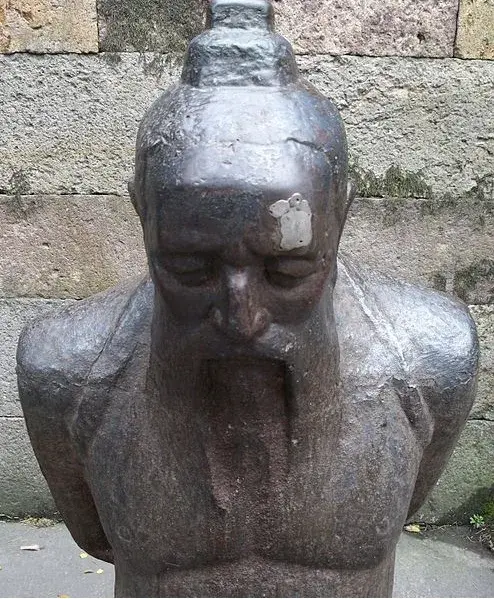
蒯越
Kuai Yue (蒯越, ?–214 CE), courtesy name Yidu, was a native of Zhonglu in Xiangyang Commandery (modern southwest Xiangcheng District, Xiangyang City, Hubei Province). He was a distinguished strategist, political counselor, and high minister spanning the late Eastern Han dynasty and the Cao Wei state of the Three Kingdoms period. A descendant of the renowned early Han strategist Kuai Tong, Kuai Yue rose to the eminent rank of…
Kuai Yue (蒯越, ?–214 CE), courtesy name Yidu, was a native of Zhonglu in Xiangyang Commandery (modern southwest Xiangcheng District, Xiangyang City, Hubei Province). He was a distinguished strategist, political counselor, and high minister spanning the late Eastern Han dynasty and the Cao Wei state of the Three Kingdoms period. A descendant of the renowned early Han strategist Kuai Tong, Kuai Yue rose to the eminent rank of Minister of the Household (Guangluxun), one of the Nine Ministers, and was enfeoffed as a Marquis of the Realm. Born into a prominent elite family of the Jingxiang region, he was widely celebrated for his acute political foresight, strategic adaptability, and deep grasp of statecraft. In his early career, Kuai Yue traveled to the capital Luoyang and was recruited by General-in-Chief He Jin as Senior Clerk of the Eastern Bureau. Discerning the irreconcilable factional conflict between the imperial consorts and the palace eunuchs, Kuai Yue urged He Jin to execute all corrupt eunuchs immediately in a decisive strike. Perceiving He Jin's indecision and fatal hesitation, Kuai Yue anticipated his imminent downfall and requested a provincial post as Magistrate of Ruyang, thereby escaping the bloody coup in Luoyang. In 190 CE, when Liu Biao was commissioned as Inspector of Jingzhou and arrived alone on horseback amid widespread uprisings by regional bandit clans, he consulted Kuai Yue and his brother Kuai Liang at Yicheng. Kuai Yue formulated the governing doctrine that "benevolence and righteousness govern peaceful times, while stratagem and authority resolve turbulent times." He engineered a trap that executed fifty-five bandit chieftains during a banquet and incorporated their forces, enabling Liu Biao to pacify the entire region and establish control over thousands of li in Jingzhou. In 208 CE, following Liu Biao's death and Cao Cao's southern military advance, Kuai Yue assessed the overall balance of power. Alongside Han Song and Fu Xun, he successfully persuaded Liu Biao's young heir, Liu Cong, to surrender Jingzhou peacefully to Cao Cao, sparing the province from devastating warfare. Upon taking possession of Jingzhou, Cao Cao was overjoyed, famously writing to Xun Yu: "I do not rejoice in acquiring Jingzhou; I rejoice in acquiring Yidu!" Cao Cao appointed Kuai Yue Minister of the Household, granted him a marquisate, and treated him with paramount honor. In 214 CE, when Kuai Yue fell gravely ill on campaign, he sent a farewell letter entrusting his family to Cao Cao. Cao Cao wept upon reading it and issued an imperial decree generously providing for his descendants. Historian Chen Shou praised Kuai Yue for his profound foresight, strategic acumen, and dignified bearing, marking him as one of the preeminent statesmen of the Han-Wei transition.
Recruited by General-in-Chief He Jin; urged the purge of eunuchs and took leave as Magistrate of Ruyang to avoid catastrophe.
Counseled the newly arrived Liu Biao, orchestrating the ambush of fifty-five bandit chiefs to secure Xiangyang.
Formulated the tactical ambush at Mount Xian against invading forces, resulting in the death of general Sun Jian.
Discouraged Liu Biao from allying with Yuan Shao before Guandu, strongly advising allegiance to the imperial court under Cao Cao.
Persuaded Liu Cong to surrender the province peacefully to Cao Cao following Liu Biao's demise.
Celebrated by Cao Cao as more valuable than the province itself; appointed Minister of the Household and enfeoffed as a Marquis.
Passed away from illness on campaign after entrusting his family to Cao Cao in a touching final letter.
Kuai Yue, styled Yidu, was born into a prominent aristocratic clan in Zhonglu County of Xiangyang Commandery in Jingzhou. His distant ancestor was Kuai Tong, the legendary political strategist who operated during the Qin-Han transition. From his youth, Kuai Yue demonstrated exceptional aptitude for military strategy and geopolitical analysis. In the final years of the Zhongping era under Emperor Ling, imperial politics deteriorated drastically. General-in-Chief He Jin, who controlled military affairs as the empress's brother, heard of Kuai Yue's strategic talents and formally summoned him to serve as Senior Clerk of the Eastern Bureau, an influential post managing administrative appointments and confidential dossiers.
At that time, the powerful palace eunuchs, known as the Ten Attendants, monopolized palace administration. He Jin contemplated eliminating the eunuchs but vacillated continuously under pressure from the Empress Dowager. Kuai Yue clearly analyzed the impending crisis, advising He Jin in person: "The corruption of the eunuchs has poisoned the dynasty for decades. Since Your Excellency wields supreme military authority, you must act with decisive lightning speed to eradicate the evil and fulfill the expectations of the realm. If you procrastinate and hesitate out of sentiment, you will surely suffer catastrophic retaliation!" Seeing that He Jin remained indecisive and timorous, Kuai Yue foresaw that He Jin would inevitably perish and that Luoyang would fall into catastrophe. Consequently, he submitted a petition requesting transfer to an external post as Magistrate of Ruyang. Shortly thereafter, He Jin was lured into the palace and murdered by eunuchs, unleashing the catastrophic tyranny of Dong Zhuo, while Kuai Yue remained entirely safe in his regional magistracy.
In the first year of Chuping (190 CE), after Sun Jian killed Inspector Wang Rui of Jingzhou, Dong Zhuo appointed the respected imperial clansman Liu Biao as Inspector of Jingzhou in Emperor Xian's name. At that juncture, regional communication was severed, bandit coalitions occupied commanderies, and regional magnates held autonomous military garrisons. Liu Biao arrived alone on horseback in Yicheng without troops or administrative machinery. Recognizing his vulnerable position, Liu Biao quickly summoned local Xiangyang luminaries, including Kuai Yue, his brother Kuai Liang, and Pang Ji, to convene a secret council in Yicheng to deliberate on stabilizing the province.
Liu Biao expressed profound anxiety: "The local armed clans are ruthless and aggressive, Yuan Shu garrisons Nanyang menacing us from the north, the local populace is volatile, and we have gathered no armed forces. How can we possibly establish order?" Kuai Yue immediately presented his grand design: "In peaceful times one prioritizes benevolence and righteousness, but in times of disorder one must employ stratagem and authority. Military success depends on elite quality rather than raw numbers, and supplies require frugal conservation rather than abundance. The chieftains of the local armed clans across the Jianghan region are mostly greedy, brutal, and suspicious of one another; they can easily be lured by material gain. My Lord should prepare lavish gifts and rich wine, proclaim the imperial court's benevolence and your own authority, and invite their leaders to a grand banquet. Once they arrive, enumerate their past crimes and execute them all at once. Immediately afterward, appease their subordinate troops, enlist their capable warriors, and establish proper administrative governance. Seeing that you have eradicated ruthless tyrants, the people of Jingzhou will flock to your banner carrying their infant children on their backs!" Delighted by this advice, Liu Biao carried out the plan in every detail. Kuai Yue coordinated the operation, ambushing and executing fifty-five bandit chieftains from Nan Commandery and Jiangxia during the banquet, incorporating tens of thousands of their followers. With this decisive masterstroke, Liu Biao pacified regional unrest, transferred his provincial seat to Xiangyang, and established his rule over Jingzhou.
In the second year of Chuping (191 CE), warlord Yuan Shu dispatched the fierce general Sun Jian to lead a full-scale invasion of Jingzhou. Sun Jian was renowned across the empire for his martial ferocity, repeatedly defeating Liu Biao's commanders around Fancheng and Deng County, crossing the Han River and laying siege to Xiangyang. Liu Biao closed the city gates in defense and dispatched General Huang Zu to muster regional reinforcements. Huang Zu engaged Sun Jian but was defeated once more, retreating into the rugged defiles of Mount Xian outside Xiangyang.
With Sun Jian's forces pressing aggressively, Liu Biao and his officials fell into panic. Kuai Yue maintained complete composure. Inspecting the precipitous terrain of Mount Xian, he analyzed Sun Jian's habit of leading reckless cavalry charges without adequate scouts. Collaborating with Huang Zu, Kuai Yue arranged a tactical trap in the densely forested ravines of Mount Xian. That night, Sun Jian pursued retreating troops into the woods with minimal guard. Huang Zu's subordinate officer Lu Gong, acting strictly under Kuai Yue's plan, triggered a coordinated ambush: hidden archers unleashed volleys of arrows and rolled down boulders from the ridges. Sun Jian was struck by fatal arrows and died instantly beneath his mount. The invading Jiangdong army collapsed in disarray and withdrew, immediately lifting the siege of Xiangyang. Kuai Yue's tactical brilliance once again preserved Jingzhou from conquest.
From 199 to 200 CE, the decisive confrontation between Cao Cao and Yuan Shao erupted at the Battle of Guandu. Yuan Shao dispatched envoys to Xiangyang, offering high imperial titles and lavish alliances to induce Liu Biao to launch a coordinated attack against Cao Cao's rear. Possessing a massive army of a hundred thousand soldiers and fertile grain reserves, Liu Biao vacillated, attempting to sit atop the mountain and observe the tiger fight.
Kuai Yue looked far into the future, discerning that while Yuan Shao had numerous troops, his command hierarchy was chaotic and his generals arrogant, whereas Cao Cao possessed superior strategic genius and commanded the authority of the imperial court. Kuai Yue and colleague Han Song remonstrated forcefully with Liu Biao: "Heroic commanders are contesting the empire. Lord Cao commands the imperial court, executes orders in the name of the Son of Heaven, and uses troops with supernatural skill. Yuan Shao is certainly no match for him. If General Liu wishes to preserve his domain and people, you must discern the balance of power. Instead of watching passively and losing favor with both sides, it is far better to resolve quickly and submit Jingzhou to Lord Cao. The Son of Heaven will lavish honors upon you, and you will not only preserve your territory but secure lasting prosperity!" However, Liu Biao was indecisive and suspicious, failing to adopt Kuai Yue's recommendation and squandering a pivotal opportunity to influence the central plains.
In the thirteenth year of Jian'an (208 CE), Liu Biao passed away from illness, and his younger son Liu Cong assumed the governorship. At that exact juncture, Cao Cao, having crushed the northern remnants of Yuan Shao's clan, led a formidable expeditionary force south toward Jingzhou, his vanguard reaching Wan. Liu Cong was young and timorous, while the Jingzhou civil and military officials fell into extreme anxiety.
Kuai Yue assessed the situation with clarity, recognizing that Jingzhou's troops had known peace for too long and were incapable of resisting Cao Cao's battle-hardened veterans, while internal factions undermined unity. Kuai Yue, Han Song, and Fu Xun urged Liu Cong to submit. Kuai Yue delivered a rigorous analysis: "Legitimacy and rebellion have fundamental distinctions, and strength and weakness have fixed proportions. Resisting the Son of Heaven as a regional subject is rebellion; confronting an overwhelmingly superior force with newly inherited authority is peril; relying on Liu Bei's displaced forces to repel Lord Cao is inadequacy. With these three fatal shortcomings, how can we withstand Lord Cao's sharp spearhead? If you safeguard the land and people by submitting to the Son of Heaven, Lord Cao will bestow boundless favor upon you. If you hesitate and offer resistance, destruction is inevitable!" Liu Cong accepted the advice and dispatched formal documents of surrender. Cao Cao occupied Jiangling and Xiangyang without shedding a drop of blood, bringing the entire province under imperial control.
Having long revered Kuai Yue's reputation for administrative and strategic brilliance, Cao Cao received Kuai Yue with the honors reserved for an esteemed guest upon entering Xiangyang. In a personal letter to Prefect of the Masters of Writing Xun Yu, Cao Cao expressed his excitement: "I do not rejoice in acquiring Jingzhou; I rejoice in acquiring Yidu!" Under imperial authorization, Cao Cao appointed Kuai Yue Minister of the Household, one of the Nine Ministers supervising palace security and imperial counselors, and enfeoffed him as a Marquis of the Realm.
During his tenure at court, Kuai Yue performed his duties with vigilance, participating in supreme military and political deliberations and enjoying Cao Cao's complete trust. In 214 CE, while accompanying the imperial army on campaign, Kuai Yue fell gravely ill. Aware that his end was near, he exerted his remaining strength to pen a farewell letter to Cao Cao. The letter sought no honors for himself, requesting only that Cao Cao extend protection to his elderly relatives and young descendants. Reading Kuai Yue's final letter at the front lines, Cao Cao was moved to tears. He immediately wrote back promising personal guardianship over the family, issuing imperial decrees granting generous provisions and ensuring the hereditary succession of Kuai Yue's noble rank.
During He Jin's crisis regarding the purge of palace eunuchs, Kuai Yue urged swift and decisive action. Accurately anticipating that He Jin's vacillation would trigger violent retribution, he requested reassignment as Magistrate of Ruyang, displaying extraordinary political foresight to escape the ensuing massacre in Luoyang.
When Liu Biao arrived alone in Jingzhou in 190 CE, Kuai Yue formulated the strategy that "stratagem and authority resolve turbulent times." By ambushing fifty-five regional bandit leaders at an official banquet, he eliminated regional resistance, enabling Liu Biao to take control of Nan Commandery and Jiangxia and lay the foundations of his regional lordship.
Confronted with Sun Jian's aggressive assault on Xiangyang, Kuai Yue exploited Sun Jian's overconfidence and lack of reconnaissance. By organizing a hidden archer ambush in the ravines of Mount Xian, he engineered Sun Jian's defeat and death, instantly relieving the siege and preserving Jingzhou from devastation.
Amid Cao Cao's southern military advance in 208 CE, Kuai Yue persuaded young heir Liu Cong to surrender the province, saving the civilian populace from warfare. His strategic submission earned Cao Cao's historic praise: "I do not rejoice in acquiring Jingzhou; I rejoice in acquiring Yidu."
FIGURES ASSOCIATED WITH THIS DYNASTY