Birth in Xianju
Born in Kesiao Village, Xianju; displayed brilliant intellect and artistic talent from early youth.
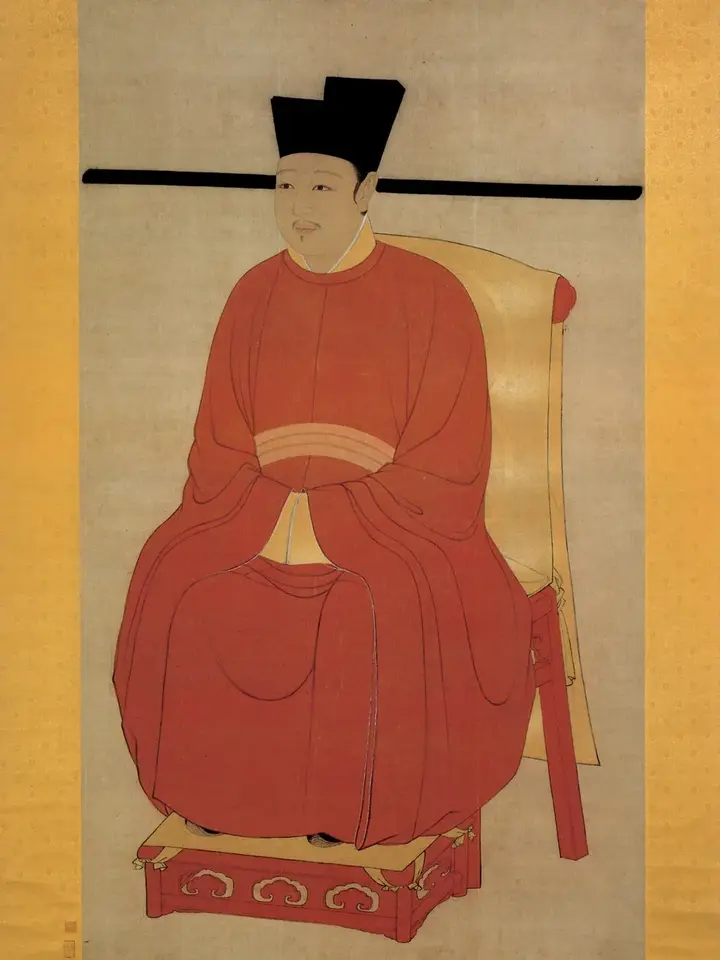
柯九思
Ke Jiusi (柯九思) was a celebrated painter, calligrapher, epigraphic connoisseur, poet, and court official of the Yuan Dynasty, hailing from Xianju in Taizhou (modern Zhejiang Province). He came from an illustrious scholarly lineage; his father Ke Qian served as an inspector in the Hanlin National History Academy. Endowed with extraordinary precocity, Ke was hailed as a child prodigy. In his youth, he traveled to the…
Ke Jiusi (柯九思) was a celebrated painter, calligrapher, epigraphic connoisseur, poet, and court official of the Yuan Dynasty, hailing from Xianju in Taizhou (modern Zhejiang Province). He came from an illustrious scholarly lineage; his father Ke Qian served as an inspector in the Hanlin National History Academy. Endowed with extraordinary precocity, Ke was hailed as a child prodigy. In his youth, he traveled to the imperial capital Dadu, where he received personal instruction in calligraphy and painting from the grand master Zhao Mengfu. Before ascending the imperial throne, Prince Tug Temur (later Emperor Wenzong) resided in Jiangnan and developed an immense admiration for Ke Jiusi's connoisseurship. Following his coronation in 1228, Emperor Wenzong summoned Ke to court and in 1229 established the Kuizhang Pavilion Academy, specially appointing Ke as the inaugural Doctor of Connoisseurship (Jianshu Boshi), a rank of the fifth grade. Granted privileged access to the inner palace library, Ke was entrusted with inspecting, authenticating, and cataloging the imperial collection of ancient calligraphy, paintings, and bronzes. Due to court intrigues and censorate envy, he resigned in 1332 and retired to Suzhou and Songjiang. Celebrated for his "Three Perfections" in poetry, calligraphy, and painting, Ke Jiusi was the premier master of ink bamboo after Zhao Mengfu, pioneering the method of "applying calligraphic scripts to painting." His extant masterpieces Twin Bamboos and Ink Bamboo in Qingbi Pavilion remain priceless national treasures of Chinese art history.
Born in Kesiao Village, Xianju; displayed brilliant intellect and artistic talent from early youth.
Accompanied his father on official postings across Jiangnan, studying Jin and Tang calligraphic models.
Visited Dadu and received direct mentorship from Zhao Mengfu, refining his ink bamboo and calligraphy.
Formed a close bond with Prince Tug Temur in Jiankang, who deeply revered Ke's connoisseurship.
Immediately summoned to Dadu following Emperor Wenzong's accession, receiving abundant imperial gifts.
Appointed inaugural Doctor of Connoisseurship in the Kuizhang Pavilion, authenticating national treasures.
Resigned office due to censorate factional attacks after Wenzong's death, retiring to the south.
Associated with Ni Zan, Huang Gongwang, and Gu Aying in Kunshan, engaging in poetic and artistic pursuits.
Passed away peacefully in his Jiangnan residence at age fifty-four.
Ke Jiusi was born in 1290 in Kesiao Village in Xianju, Zhejiang. His father Ke Qian was a distinguished scholar who served as inspector in the Hanlin Academy, possessing an extensive collection of ancient rubbings and manuscripts. Under strict familial tutelage, Ke Jiusi read voraciously from age five, mastering the classics and exhibiting astounding precocity in painting and calligraphy.
During the Yanyou era, Ke journeyed to Dadu. At literati gatherings, the cultural master Zhao Mengfu was astonished by Ke's dynamic brushwork, taking him under his wing to impart the secrets of Wei-Jin calligraphy and classical bamboo painting. Ke absorbed Zhao's philosophy of applying seal script to bamboo stems and cursive script to bamboo leaves, quickly rising to national artistic prominence.
During the Taiding era, Prince Tug Temur lived in exile in Jiankang. A passionate lover of art, the prince frequently consulted Ke Jiusi on ancient scrolls and bronze inscriptions, developing an unbounded admiration for Ke's connoisseurship.
Upon taking the imperial throne in Dadu in 1228, Emperor Wenzong summoned Ke to the capital. In spring 1229, Wenzong founded the Kuizhang Pavilion Academy and created the unique office of Doctor of Connoisseurship (Jianshu Boshi) specifically for Ke Jiusi. Permitted to enter the imperial inner apartments daily, Ke authenticated the imperial treasury's vast holdings of Jin, Tang, and Song masterpieces. Whenever new artifacts arrived, Emperor Wenzong had Ke evaluate them before applying the imperial seal Kuizhangge Bao, with Ke adding his personal authentication seals Ke Jiusi Yin and Danqiu Ke Jiusi Zhang.
Ke's meteoric rise without having passed the civil examinations aroused deep jealousy among conservative Mongol nobles and court censors. From 1330 onwards, imperial censors repeatedly memorialized against Ke, accusing him of overstepping ceremonial etiquette.
Following Emperor Wenzong's death in 1332, Ke lost his principal imperial protector. Facing intensifying factional hostility, he promptly submitted his resignation and departed Dadu for the south. Settling in Suzhou and Songjiang, he severed ties with officialdom, dedicating himself to landscape painting, zither playing, and literati gatherings.
In his later years, Ke lived around the scenic waterways of Songjiang and Kunshan, becoming an intimate associate of celebrated literati including Ni Zan, Huang Gongwang, Wu Zhen, and Gu Aying. At Gu Aying's Yushan Thatched Cottage, Ke joined lively poetry gatherings and painted alongside fellow masters, emerging as an intellectual leader of the late Yuan literati painting movement.
He passed away in 1343 at age fifty-four. His poetry was collected in the Collected Works of Danqiusheng, while his authenticated scrolls and ink bamboo paintings became treasured heirlooms for future generations of collectors.
Ke Jiusi occupies a monumental position in Chinese painting as the preeminent master of ink bamboo after Zhao Mengfu and Li Kan. He carried Zhao's principle of the "shared origin of calligraphy and painting" to its highest maturity.
Ke formulated the famous aesthetic rule: "Paint bamboo stems using the rounded strength of seal script; articulate nodes with the angular firmness of clerical script; and flick bamboo leaves with the flying agility of cursive and running script." His bamboos were celebrated for their pristine composure, resilient bone structure, and rhythmic fluidity. Extant works such as Twin Bamboos and Ink Bamboo in Qingbi Pavilion established a new aesthetic pinnacle for scholar-amateur ink painting.
As the inaugural Doctor of Connoisseurship in the Yuan imperial court, Ke Jiusi made indelible contributions to Chinese art history. Under Emperor Wenzong's patronage, he carried out the most rigorous, systematic connoisseurial cataloging of ancient paintings and calligraphy in Yuan history.
Invaluable national treasures, including Wang Xizhi's Cao'e Stele manuscript, the Dingwu stone rubbing of the Lanting Preface, and scrolls by Huaisu, Mi Fu, and Su Shi, were authenticated by Ke Jiusi. His precise textual colophons and connoisseurial seals remain universally recognized gold standards for identifying genuine pre-modern masterworks.
Ke Jiusi was an accomplished master across all major calligraphic scripts. Synthesizing the rigorous structure of Ouyang Xun with the fluid elegance of the Two Wangs, he infused classical gravitas into Yuan calligraphy.
Qing connoisseur Wang Wenzhi observed: "Danqiu's calligraphy followed Ouyang Xun and his son, pursuing vigorous precision; it is immediately recognizable as the finest Yuan style." His regular and running script colophons are renowned for their clean bone structure, balanced proportions, and scholarly composure.
FIGURES ASSOCIATED WITH THIS DYNASTY