Aristocratic Birth
Born into a distinguished Kangly noble house in Dadu; received rigorous instruction in Confucian classics and calligraphy from early youth.
康里巎巎
Kangli Naonao (康里巎巎, 1295–1345), courtesy name Zishan and art names Zhengzhai and Shusou, hailed from the Turkic Kangly tribe and was an exceptional statesman, scholar, and calligrapher during the Yuan dynasty. Descending from a prominent Semu aristocratic family, his father Buhumu served as a chancellor under Emperor Shizu (Kublai Khan). Educated in classic Confucian orthodoxy under the Neo-Confucian master Xu Heng, Kangli…
Kangli Naonao (康里巎巎, 1295–1345), courtesy name Zishan and art names Zhengzhai and Shusou, hailed from the Turkic Kangly tribe and was an exceptional statesman, scholar, and calligrapher during the Yuan dynasty. Descending from a prominent Semu aristocratic family, his father Buhumu served as a chancellor under Emperor Shizu (Kublai Khan). Educated in classic Confucian orthodoxy under the Neo-Confucian master Xu Heng, Kangli Naonao mastered ancient histories and statecraft. He held senior imperial positions including Vice Director of the Palace Library, Minister of Rites, Academician Expositor of the Kuizhang Pavilion, Chief Academician of the Hanlin Academy, and Manager of Governmental Affairs of the Jiangzhe Branch Secretariat. Known for his upright counsel and financial incorruptibility, Kangli Naonao served as an imperial lecturer, persistently guiding the young emperors toward disciplined governance, the patronization of scholars, the revival of the imperial civil examinations, and the compilation of the official histories of the Liao, Jin, and Song dynasties. In calligraphy, he stood out for his rapid, vigorous, and free-flowing cursive script, matching Zhao Mengfu in renown as the dual pinnacles of northern and southern calligraphy. He passed away in 1345 and was bestowed the posthumous title Wenzhong.
Born into a distinguished Kangly noble house in Dadu; received rigorous instruction in Confucian classics and calligraphy from early youth.
Appointed Vice Director of the Palace Library, embarking on an official path within the central court.
Following the Nanpo Incident where Emperor Yingzong was assassinated, he courageously co-petitioned to condemn the conspirators.
Promoted to Director of the Palace Library and subsequently Minister of Rites, overseeing civil rituals and state protocol.
Designated Administrative Censor of the Jiangnan Regional Surveillance Office to inspect provincial administrative discipline.
Appointed Academician Expositor in the Kuizhang Pavilion and Director of the Imperial Library, lecturing the throne on classic texts.
Elevated to Chief Academician of the Hanlin Academy; successfully advocated for reviving the imperial examination system and compiling the Liao, Jin, and Song dynastic histories.
Dispatched as Manager of Governmental Affairs of the Jiangzhe Branch Secretariat, promoting civil welfare and stabilizing public finances.
Recalled to Dadu to assume premier executive duties; suddenly fell ill with a fever and passed away seven days after arrival at age fifty-one; awarded the posthumous name Wenzhong.
Kangli Naonao, courtesy name Zishan and art names Zhengzhai and Shusou, was a native of the Kangly tribe, descendants of the ancient Gaoju nomadic groups originally affiliated with the Kereit confederation. His great-grandfather Hailanbo was a Kangly noble. Following the fall of Toghrul Khan (Wang Khan), Hailanbo's son Yanzhen became an attendant of Tolui and subsequently served Kublai Khan with distinction in military campaigns, founding an eminent aristocratic Semu clan under the Yuan dynasty.
His father Buhumu attained the rank of Manager of Governmental Affairs and was a renowned statesman under Kublai Khan and Temur Khan, deeply versed in Han culture and venerated for governing according to Confucian ethics. Kangli Naonao's mother, Lady Wang, was the second wife of Buhumu and the daughter of Wang Shou, who served as Left Vice Chancellor, Censor-in-Chief, and Grand Academician of the Jixian Academy. Raised in this scholarly and aristocratic household, Kangli Naonao studied Confucian classics under the Neo-Confucian master Xu Heng, receiving a rigorous classical training.
In July 1320, Kangli Naonao was appointed Vice Director of the Palace Library, overseeing court archives and imperial manuscripts. In August 1323, Emperor Yingzong was murdered by Grand Censor Tieshi during the Nanpo Incident. Kangli Naonao, then serving as an investigating censor, joined Xu Youren and Ding Habashi in submitting an uncompromising memorial that exposed the treason of Tieshi and demanded strict justice.
In August 1325, he rose to Director of the Palace Library and Minister of Rites, overseeing state ritual reforms. In November 1333, he was commissioned as Administrative Censor of the Jiangnan Regional Surveillance Office. Traveling across southern circuits, he investigated corrupt officials, cleared judicial backlogs, and reformed administrative discipline across Jiangnan.
In November 1335, Kangli Naonao was appointed Academician Expositor of the Kuizhang Pavilion and Director of the Imperial Library. He also served as imperial lecturer to Emperor Huizong (Toghun Temur). He often asserted that while chancellors were responsible for guiding state affairs, censors should speak if chancellors failed, and imperial tutors must speak if censors remained silent. Believing it his primary duty as lecturer to voice unpleasant truths before the monarch, he fearlessly submitted advice promoting state welfare and popular relief.
When expounding the Four Books and Five Classics, Naonao patiently explained historical rise and fall until the monarch comprehended their significance. He particularly favored lecturing on Liu Zongyuan's Master Carpenter and Zhang Shangying's Seven Ministers, employing the metaphor of timber framing to illustrate ministerial functions and contrasting virtuous counselors with selfish flatterers. His frank discourse alarmed opportunistic courtiers, who dared not openly contest his orthodox logic.
Noticing the young emperor's passion for painting, Naonao presented Guo Zhongshu's Painting of Bigan, reminding the monarch of how King Zhou of Shang caused dynastic ruin by ignoring Bigan's counsel. When the emperor praised the refined brushwork of Song Huizong, Naonao directly remonstrated, arguing that although Huizong was talented in artistic pursuits, he was utterly incompetent in ruling, leading to the fall of the Northern Song and his own capture. He stressed that a ruler's primary obligation was statecraft, while painting was purely secondary.
Toward the close of the Zhiyuan era, certain high officials proposed abolishing the Kuizhang Pavilion and the Literary Academy to trim expenses. Kangli Naonao argued vigorously that even private households of modest wealth maintained family academies to educate their children, and an empire spanning four seas should never dismantle its central academy. Emperor Shun commended his vision, reorganizing the institution into the Xuanwen Pavilion and the Literary Academy into the Chongwen Academy under Naonao's direct superintendence, while adding sixteen lecturing collators.
Kangli Naonao was instrumental in persuading the court to restore the imperial civil examination system, reopening civil service advancement for literati across China. He also urged the compilation of the official dynastic histories of the Song, Liao, and Jin, the revival of the traditional village drinking ceremony at the National Academy, and the imperial enshrinement of Song scholars including Shao Yong, aligning imperial policy with classical Confucian tradition.
In July 1342, Kangli Naonao became Chief Academician of the Hanlin Academy, serving concurrently as Drafter of Imperial Edicts, Compiler of National History, and Imperial Lecturer. He was subsequently appointed Manager of Governmental Affairs of the Jiangzhe Branch Secretariat, governing a wealthy southern province. Recognizing his administrative integrity, the throne summoned him to Dadu in 1345 to serve as chancellor in the central Secretariat. However, seven days after arriving in the capital, he fell critically ill with a fever and passed away at age fifty-one.
Despite holding premier ministerial posts, Kangli Naonao lived frugally and distributed his stipends to needy scholars. Upon his death, his household lacked funds for a burial. Astonished and grieved, Emperor Shun granted five ingots of silver for funeral expenses, ordered commercial penalties to settle his official debts, and conferred the posthumous title Wenzhong.
Kangli Naonao stood as a leading figure among Sinicized Semu nobility in the middle and late Yuan dynasty. Holding top administrative positions, he advocated Confucian statecraft and patronized scholar-officials throughout the empire. Literati from northern and southern regions gathered at his residence in fellowship. In response to conservative nobles who looked down upon Han scholars, Naonao asserted that Kublai Khan had consolidated the empire through classical rites, laws, and Confucian advice, warning that governance could never succeed without moral education.
He played an active part in shaping Yuan cultural policies: restoring civil examinations, supervising lectures at the Chongwen Academy, promoting the compilation of the three dynastic histories, and reviving ancestral rites. His efforts provided a crucial bridge between Mongol-Semu rulers and traditional Han scholarly culture.
Kangli Naonao gained enduring fame for his calligraphy. In standard script he followed Yu Shinan and Zhong Yao, while in running and cursive script he drew from Wang Xizhi, Wang Xianzhi, Huaisu, and Zhang Xu, incorporating the energetic momentum of Mi Fu. While the gentle and fluid style of Zhao Mengfu dominated contemporary tastes, Kangli Naonao developed a dynamic, bold, and elongated brush technique, particularly evident from his Li Bai Archaic Poems onward.
He wrote with a suspended wrist, moving the brush rapidly like lightning, producing rounded, forceful, and expressive strokes. His lines flowed smoothly with elongated proportions, maintaining centered brush tip control without superficial slickness. Tao Zongyi noted in his Notes Written After Ceasing Agriculture that Naonao practiced with exceptional diligence, writing up to thirty thousand characters daily—three times the daily output of Zhao Mengfu—without succumbing to exhaustion. He was celebrated alongside Zhao Mengfu as Northern Naonao and Southern Zhao, and ranked with Xianyu Shu and Deng Wenyuan among the Four Great Yuan Calligraphers.
His surviving works are treasured across major museums. The Palace Museum in Beijing holds his Cursive Treatise on Calligraphy and Treatise on Brushwork, dated to 1333, reflecting the vigorous rhythm of Zhang Xu and Huaisu. The Palace Museum also holds his thirty-line letter Fengji Tie and Dragon of Exile. The National Palace Museum in Taipei preserves Letter to Yanzhong; the Princeton University Library holds his 1331 scroll Master Carpenter by Liu Zongyuan; and the Tokyo National Museum houses his Li Bai Archaic Poems and Six Tang Quatrains. Ming scholar Xie Jin praised his calligraphy as a celestial sword leaning on the heavens and a rainbow spanning the seas; Qing connoisseur Kang Youwei singled out his running script for its striking structural grandeur; and Luo Zhenyu regarded him alongside Yang Weizhen, Rao Jie, and Song Ke as masters who broke through Zhao Mengfu's mold.
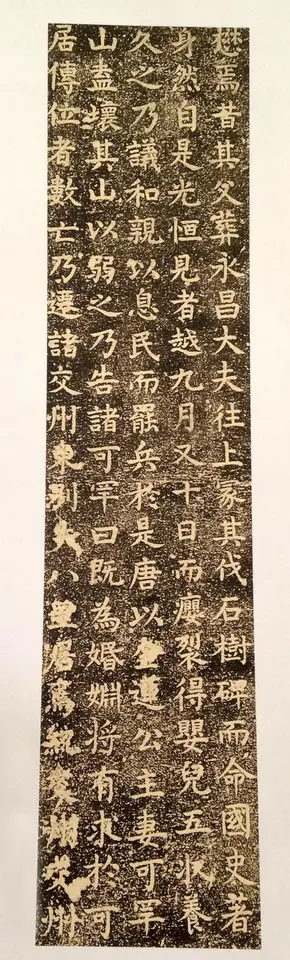
In September 2007, archaeologists discovered two funerary steles inscribed by Kangli Naonao in 1335 at the Zhang family cemetery in Guogongfu Village, Ongniud Banner, Chifeng, Inner Mongolia. The principal stele stands 563 cm tall, 135 cm wide, and 37 cm thick, with its front cap bearing seal script in Chinese and its rear bearing Phags-pa script translating Chinese into Old Uyghur.
The stele face contains thirty-nine columns of standard script penned by Kangli Naonao, with one hundred characters per full column. The brushwork is vigorous and structured, displaying his rare mastery of standard script and providing an exceptional stone monument of Yuan epigraphy. The reverse bears Old Uyghur inscriptions, and the stone side records mining at Stone Sutra Mountain. The accompanying stone sculptures of civil officials and warriors illustrate the high level of northern stone carving, offering important evidence of Yuan administrative institutions and multi-ethnic integration.
FIGURES ASSOCIATED WITH THIS DYNASTY