Birth
Kang Guangren was born into a prominent scholar-gentry lineage in Yintang, Nanhai, Guangdong.
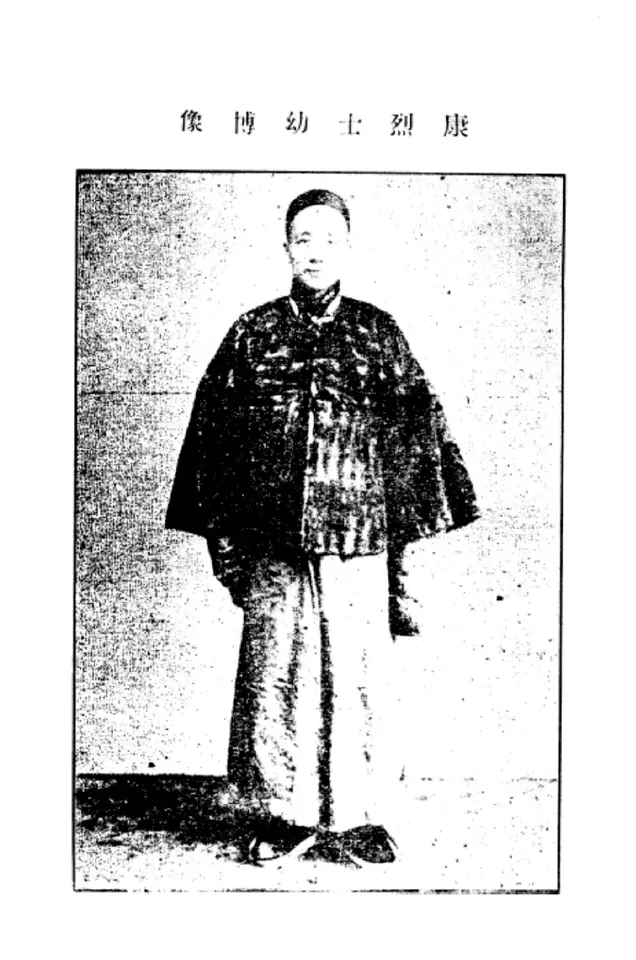
康广仁
Kang Guangren (康广仁, 1867–1898), originally named Youpu, courtesy name Guangren, and art names Youbo and Daguang, was a native of Nanhai, Guangdong. He was an eminent reformist thinker, social reformer, and celebrated martyr of the Hundred Days' Reform, remembered as one of the "Six Gentlemen of the Wuxu Reform" and the younger brother of reform leader Kang Youwei. Endowed with exceptional intellect, decisiveness, and…
Kang Guangren (康广仁, 1867–1898), originally named Youpu, courtesy name Guangren, and art names Youbo and Daguang, was a native of Nanhai, Guangdong. He was an eminent reformist thinker, social reformer, and celebrated martyr of the Hundred Days' Reform, remembered as one of the "Six Gentlemen of the Wuxu Reform" and the younger brother of reform leader Kang Youwei. Endowed with exceptional intellect, decisiveness, and pragmatic insight, he rejected the traditional eight-legged examination system from youth, declaring that rigid civil service examinations stifled national talent and impoverished the realm. During his early adulthood, Kang studied Western medicine under American missionary physician John Glasgow Kerr in Guangzhou for three years, becoming highly proficient in clinical medicine and advocating modern medical colleges. He took the lead in organizing the Anti-Foot-Binding Society across Guangdong and Shanghai, founded schools for women to advance female emancipation, established the Zhixin Bao (New Knowledge Newspaper) in Macao, and launched the Datong Translation Bureau in Shanghai to disseminate global sciences. During the Hundred Days' Reform in 1898, he accompanied Liang Qichao to Beijing, providing crucial strategic counsel to his brother, advocating the immediate abolition of eight-legged exams, and presciently urging reformists to withdraw from the capital before conservative retaliation materialized. Following the Empress Dowager's coup, he remained to coordinate defense, was arrested, and died heroically at Caishikou alongside Tan Sitong at age thirty-one.
Kang Guangren was born into a prominent scholar-gentry lineage in Yintang, Nanhai, Guangdong.
Disgusted by the rote dogma of the eight-legged essays, he burned generations of ancestral examination texts, swearing off imperial exams.
Sent to Zhejiang to serve as a low-ranking yamen clerk; disgusted by bureaucratic hypocrisy and extortion, he resigned in indignation.
Studied Western surgery and internal medicine under Dr. John Glasgow Kerr at the Canton Pok Tsai Hospital for three years.
Co-founded Zhixin Bao in Macao, established the Datong Translation Bureau in Shanghai, and mobilized national anti-foot-binding congresses.
Accompanied the ailing Liang Qichao to the imperial capital, administering medicine and taking residence in the Nanhai Guild Hall.
Successfully lobbied for the complete elimination of eight-legged essays across all exam levels, while urging Kang Youwei to retreat from the capital.
After the Guangxu Emperor issued secret edicts ordering Kang Youwei to flee, Guangren insisted his brother depart while he stayed behind to coordinate rescue operations.
As Empress Dowager Cixi launched her palace coup, government troops surrounded the guild hall; Guangren was captured, remaining defiant and cheerful in prison.
Executed at the Caishikou execution ground alongside Tan Sitong and four other reform martyrs at age thirty-one.
Kang Guangren was born in 1867 in Nanhai County, Guangdong. As the younger brother of Kang Youwei, he showed great mental sharpness and resolute courage from early childhood. He possessed an innate ability to discern truth from falsehood and demonstrated exceptional organizational discipline.
Unlike contemporaries who spent their lives memorizing examination stereotyping, Guangren vehemently despised the eight-legged essay, viewing it as the primary cause of China's intellectual stagnation and military weakness. At sixteen, he refused to recite examination manuals, and when rebuked by his father and brother, he offered to teach younger clan children instead. The elders accepted his proposal, assigning eight pupils to his care; Guangren established strict classroom codes and conducted lessons with solemn dignity, instantly subduing undisciplined youngsters. On one occasion, when Kang Youwei asked him to organize ancestral texts stored in the attic, Guangren took hundreds of inherited examination anthologies and burned them to ashes, coolly explaining that keeping such useless trash only disturbed the peace of the household. When sharing a chamber with his brother, he uprooted a decaying plantain tree in the courtyard, brushing off his brother's complaints by noting that useless clutter merely distracted the mind.
Guangren was exceptionally filial toward his mother. Whenever she felt troubled, a few comforting words from him immediately restored her spirits. In her presence, he displayed childlike tenderness, contrasting sharply with his unbending sternness in public affairs.
Aware of Guangren's fierce temper and impatient idealism, Kang Youwei arranged for him to enter provincial administrative service in Zhejiang. His brother hoped that experiencing the corrupt realities of local governance would teach him emotional restraint and broaden his pragmatic political judgment.
During more than a year as a junior clerk managing local security and examination logistics in Zhejiang, Guangren observed firsthand the endemic bribery, bureaucratic sycophancy, and clerical manipulation of late Qing administration. Repulsed by this moral degradation, he abandoned his post and returned home. The ordeal, however, tempered his personality. Back in Guangdong, he assumed control over family management and tenant rent collection, enforcing orders with military precision. He became Kang Youwei's most valuable strategic adviser, analyzing political developments with uncanny accuracy.
Following China's humiliating defeat in the First Sino-Japanese War, Guangren recognized that traditional scholarship offered no defense against foreign encroachment. Distressed by the primitive state of Chinese medicine, he studied Western surgery, pathology, and therapy under the prominent American missionary physician Dr. John Glasgow Kerr at the Canton Pok Tsai Hospital for three years. He later drafted institutional blueprints to establish modern medical schools in Shanghai.
Simultaneously, Guangren emerged as a dynamic reform organizer. In 1897, he helped launch Zhixin Bao in Macao to popularize principles of constitutional governance and international law. In Shanghai, he established the Datong Translation Bureau to publish Chinese translations of Japanese institutional treatises. Addressing the plight of women, he revitalized the Anti-Foot-Binding Society in Guangdong, turning it into a widespread social movement. He and Liang Qichao subsequently expanded the initiative to Shanghai, convening national assemblies against foot-binding, while his wife, Huang Jinyu, joined the directorship of the Chinese Women's Society to pioneer female education.
In the spring of 1898, Liang Qichao fell severely ill in Hunan and traveled to Shanghai. Knowing Western medicine, Guangren accompanied Liang north to Beijing to oversee his diet and medical treatment, settling in the Nanhai Guild Hall just as the Guangxu Emperor issued his reform decrees.
Throughout the hundred days of reform, Guangren maintained exceptional political lucidity. In private correspondence, he presciently warned that his brother had overextended his political reach, lacked institutional power, and faced entrenched bureaucratic enemies backed by the Empress Dowager. He argued that nationwide reform was impossible without first educating the populace, urging that effort be concentrated strictly on abolishing the eight-legged essay.
Through Censor Song Bolu, Guangren successfully persuaded the throne to eliminate eight-legged essays not only from provincial and metropolitan examinations, but from basic civil tests as well. Once this objective was achieved, he urgently pressed Kang Youwei to decline frequent audiences and leave Beijing to avoid conservative vengeance, advising him to build grass-roots educational strength in the south. Blinded by imperial favor, Kang Youwei failed to heed his brother's warnings.
On the second day of the eighth lunar month in 1898, the emperor issued urgent secret decrees commanding Kang Youwei to flee. Guangren insisted that his brother leave immediately, while he chose to remain in the capital alongside Tan Sitong and Liang Qichao to coordinate last-minute resistance.
On the eighth day of the eighth month, Empress Dowager Cixi executed her coup d'etat, placing the emperor under house arrest and dispatching forces to hunt down reformers. Manchu troops besieged the Nanhai Guild Hall, arresting Guangren. In the Ministry of Punishments prison, Guangren remained completely calm, singing martial songs that echoed through the stone cells. When his fellow captives Cheng Shigu and Qian Weiji wept over their impending deaths, Guangren rebuked them fiercely, asserting that dying in one's thirties for the cause of reform was far nobler than withering away in bed. He declared that with eight-legged essays gone, talented patriots would rise in countless numbers, and their deaths would awaken China to self-strengthening.
On September 28, 1898, without formal trial, the Qing court ordered Guangren and five fellow reformers executed at Caishikou. Guangren marched to the scaffold with serene dignity, gazing up at the heavens and facing death with unyielding fortitude at age thirty-one.
Kang Guangren was the most resolute and strategic advocate for examination reform during the 1898 movement. Recognizing that traditional civil exams produced incompetent bureaucrats blind to global realities, he insisted that dismantling this system was the prerequisite for any enduring modernization.
He directed the reformists' legislative priorities, demonstrating that reforming provincial and metropolitan exams alone would leave the vast majority of lower-degree candidates untouched. By securing the abolition of eight-legged essays across all levels of testing, he cleared the way for the institutionalization of modern schools and scientific education throughout the late Qing empire.
Guangren was an energetic pioneer of modern Chinese journalism and translation. By establishing Zhixin Bao in Macao, he provided southern China with an influential platform advocating constitutional reform, civic rights, and scientific inquiry.
Through the Datong Translation Bureau in Shanghai, he oversaw the systematic translation of Japanese educational, legal, and economic texts produced during the Meiji era. This initiative created an indispensable intellectual bridge that introduced modern statecraft paradigms to Chinese literati.
Possessing deep humanitarian conviction, Guangren spearheaded the anti-foot-binding movement, transforming it from a theoretical ideal into an organized nationwide campaign. He drafted operational regulations in Guangzhou and coordinated the first national congress in Shanghai.
Together with his wife, Huang Jinyu, he supported the founding of independent schools for women, directly challenging centuries of patriarchal subjugation and laying the foundations for modern female emancipation in China.
Unlike standard Confucian intellectuals who possessed no practical scientific training, Guangren acquired thorough clinical expertise under Dr. John Kerr. He advocated the replacement of unscientific medical practices with modern anatomy and pathology.
His blueprints for professional medical colleges in Shanghai represented one of the earliest indigenous initiatives by Chinese reformers to integrate Western public health into national development plans.
Among the martyrs of the 1898 reform, Guangren stood out for his cold-eyed appraisal of court politics. He recognized the fatal vulnerability of the Guangxu Emperor's position, the unyielding power of Empress Dowager Cixi, and the folly of attempting sweeping reforms without military authority or mass support.
His counsel urging a tactical retreat to southern China to build educational and civic institutions remains celebrated by modern historians as the most politically sound strategic blueprint formulated within the reformist camp.
FIGURES ASSOCIATED WITH THIS DYNASTY