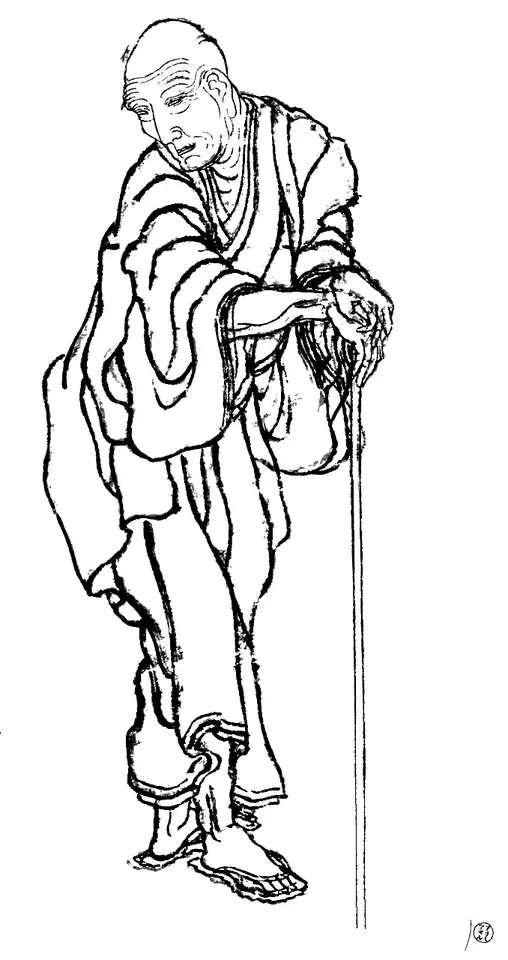
PROFILE
Tachibana no Hayanari (橘逸势, c. 782–842) was an eminent Japanese noble, calligrapher, and student envoy of the early Heian period. Born into the prestigious Tachibana clan, he was the son of Tachibana no Irikkyo and the great-grandson of Minister of the Left Tachibana no Moroe. In the twenty-third year of the Enryaku era (804, corresponding to the twentieth year of the Zhenyuan era in the Tang dynasty), Hayanari was appointed associate judge and student envoy in the twelfth Japanese mission to Tang China, crossing the sea alongside Buddhist masters Kukai and Saicho. Upon arriving in the imperial capital of Chang'an, Hayanari enrolled in the National University (Guozijian), dedicating himself to classical Confucian statecraft, literature, and calligraphic arts. Tang literati held his scholarship and brushwork in high esteem, affectionately referring to him as the "Tachibana Scholar."
Having absorbed the vital essence of Tang clerical, running, and cursive scripts over several years, Hayanari returned to Japan in 806 alongside Kukai, carrying extensive collections of classical texts and rubbings. Back in Japan, he attained the court rank of Junior Fifth Rank Lower Grade and held offices including Assistant Director of the Bureau of Medicine and Provisional Governor of Tajima, actively participating in the cultural Renaissance of Emperor Saga's Konin court. In Japanese calligraphic history, Hayanari is venerated alongside Emperor Saga and Grand Master Kukai as the "Three Brushes" (Sanpitsu), representing the absolute zenith of classical Japanese calligraphy. His brushwork drew deeply upon the Jin and Tang traditions, excelling particularly in archaic clerical and dynamic running scripts. His masterpiece Vow of Imperial Princess Ito displayed monumental vigor and rhythmic power, designated as a National Treasure of Japan. In the ninth year of the Jowa era (842), Hayanari was implicated in the Jowa Incident, stripped of his noble surname, and sentenced to exile in Izu Province, succumbing to illness at the Itaba relay station in Totomi Province; the court posthumously restored his rank and granted him Senior Fifth Rank.
- Ancestral Home
- Yamato Province, Japan (present-day Nara Prefecture, Japan)
- Highest Office
- Provisional Governor of Tajima (Tajima no Gon no Kami)
- Identity
- Master calligrapher of the Heian period, student envoy to Tang China, and one of the Three Brushes
BIOGRAPHY
Chronology
- 782 (Japan, 1st year of Enryaku) | Aristocratic Birth | Born into the prestigious Tachibana clan in the Heian capital, studying Confucian texts and Chinese calligraphy from early youth.
- 804 (Japan, 23rd year of Enryaku) | Voyage to Tang China | Traveled as a student envoy aboard the first vessel of the twelfth mission to Tang China, reaching Chang'an after perilous voyages.
- 805 (Tang Dynasty, 21st year of Zhenyuan) | Studies in Chang'an | Studied classics at the National University in Chang'an, exploring stone inscriptions and mastering clerical and cursive calligraphy.
- 806 (Tang Dynasty, 1st year of Yuanhe) | Return to Japan | Returned to Japan aboard an envoy vessel alongside master Kukai, bringing back extensive Tang calligraphic manuals and sutras.
- 821 (Japan, 12th year of Konin) | Court Appointments | Served in inner palace offices including Assistant Director of the Bureau of Medicine, earning deep respect from Emperor Saga.
- 840 (Japan, 7th year of Jowa) | Governor of Tajima | Appointed Provisional Governor of Tajima at the Junior Fifth Rank Lower Grade, overseeing regional governance and culture.
- 842 (Japan, 9th year of Jowa) | Jowa Incident | Implicated in the succession dispute surrounding Imperial Prince Tsunesada, stripped of nobility and exiled to Izu, dying en route.
- 853 (Japan, 3rd year of Ninju) | Posthumous Vindication | Following Emperor Montoku's accession, the imperial court vindicated Hayanari, restoring his clan registry and granting Senior Fifth Rank.
Life Course
Aristocratic Heritage and Early Chinese Studies
Tachibana no Hayanari was born in the early Heian period into the Tachibana clan, one of ancient Japan's most prominent political and cultural families. His great-grandfather Tachibana no Moroe had served as Minister of the Left, playing a pivotal role in the Nara court; his father Tachibana no Irikkyo served as Minister of Civil Affairs. Growing up in a household renowned for scholarly traditions, Hayanari received rigorous instruction in Chinese literature and calligraphy, reading classical canons including the Analects and Book of Han, while diligently copying the models of Wang Xizhi, Wang Xianzhi, Ouyang Xun, and Chu Suiliang.
Following the relocation of the capital to Heian-kyo, the Japanese court embraced Tang culture with immense enthusiasm. Emperor Saga and the ruling elite actively promoted continental literature and Tang-style calligraphy. As an outstanding young talent of the Tachibana lineage, Hayanari was celebrated for his lofty character, elegant compositions, and mastery of clerical and cursive scripts, making him the natural candidate for official overseas study.
Voyage to Tang China and Scholarship in Chang'an
In the twenty-third year of the Enryaku era (804), the Japanese court dispatched the twelfth official mission to Tang China, headed by Fujiwara no Kadonomaro. Hayanari was appointed as associate judge and student envoy, embarking aboard the flagship alongside Kukai, the founder of Shingon Buddhism, and Saicho, the founder of Tendai Buddhism. Departing from Matsuura in Hizen Province, the fleet encountered severe typhoons and drifted for months before landing in Chian Town, Fuzhou. Traveling overland, they reached the imperial capital of Chang'an in the first month of 805.
Within Chang'an, Hayanari entered the National University (Guozijian) to pursue advanced studies in statecraft and historical chronicles. Over nearly two years, he visited celebrated temples, inspected monumental stone steles, and studied with leading calligraphers across the metropolis. He absorbed the balanced architecture and fluid vitality of High Tang clerical script, alongside the dynamic brushwork of Zhang Xu and Huai Su. Tang scholars admired his deep classical erudition and refined brush technique, respectfully honoring him as the "Tachibana Scholar," a celebrated chapter in Sino-Japanese cultural exchange.
Return to Japan and Cultural Prominence
In the first year of the Yuanhe era (806, corresponding to the first year of the Daido era in Japan), having concluded his studies, Hayanari sailed back to Japan alongside Kukai, bringing a rich repository of Tang administrative codes, Buddhist scriptures, rubbings, and model calligraphy. Upon his return, he integrated the advanced Tang calligraphic principles he had acquired into Japanese court culture, elevating Japanese calligraphy from conservative insularity into expansive continental grandeur.
During the reign of Emperor Saga (Konin era, 810–823), the Japanese court experienced a golden age of Tang-style culture. Emperor Saga, himself a connoisseur of literature and calligraphy, deeply admired Hayanari's artistry, frequently inviting him to the palace to debate calligraphic techniques. Holding the court rank of Junior Fifth Rank Lower Grade, Hayanari served as Assistant Director of the Palace Storehouse, Assistant Director of the Bureau of Medicine, and Provisional Governor of Tajima. Whenever imperial palace plaques, temple inscriptions, or state documents required inscription, Hayanari was summoned to wield the brush, his clerical script venerated as a divine art.
Political Purge and Passing in Exile
In the ninth year of the Jowa era (842), Emperor Ninmyo fell gravely ill, sparking a fierce succession struggle centered on Crown Prince Tsunesada, an event known as the Jowa Incident. Seeking to monopolize political power and purge competing aristocratic houses, the Fujiwara clan fabricated conspiracy charges, accusing the crown prince's retainers of plotting an eastern uprising. Possessing an upright and forthright character, Hayanari had maintained close personal ties with Prince Tsunesada, rendering him a prime target for political elimination.
Hayanari was arrested and subjected to harsh interrogation. Despite his refusal to plead guilty, the dominant faction issued an imperial decree stripping him of his Tachibana clan registry, renaming him "Hinin" (outcaste), and exiling him to distant Izu Province. Traumatized physically and emotionally by the grueling overland journey, the sixty-year-old scholar fell critically ill upon reaching the Itaba relay station in Totomi Province (present-day Hamamatsu, Shizuoka Prefecture), dying in a modest travel lodge. In the third year of the Ninju era (853), under Emperor Montoku, the court fully vindicated Hayanari, posthumously restoring his clan surname and conferring the noble rank of Senior Fifth Rank.
Major Achievements
Cultural Bridge and the Tachibana Scholar Renown
Tachibana no Hayanari was among the most significant cultural ambassadors in early ninth-century Sino-Japanese relations. As a core member of the Japanese diplomatic mission, he pursued rigorous scholarly study in Tang Chang'an during a transformative era. In the Tang metropolis, he approached Chinese civilization with humility and devotion, establishing close intellectual ties with Tang scholars.
Tang literati and imperial officials extended high honors to Hayanari for his classical prose and calligraphic refinement. Within the National University and cultural salons of Chang'an, contemporaries acclaimed him as the "Tachibana Scholar." This title was recorded in the official Japanese chronicle Veritable Records of Emperor Montoku of Japan, standing as an enduring symbol of ancient cultural amity. Beyond calligraphy, Hayanari brought back essential continental administrative principles and literati ideals, providing substantial impetus to the cultural flourishing of the early Heian court.
Pillar of Japanese Calligraphy and the Three Brushes
In the history of Japanese calligraphy, Tachibana no Hayanari occupies an unshakeable position as a founding master. Alongside Emperor Saga and Grand Master Kukai, he is universally venerated as one of the "Three Brushes" (Sanpitsu), representing the absolute pinnacle of classical Japanese calligraphy.
Among the Three Brushes, Emperor Saga's brushwork was majestic, imperial, and orthodox; Kukai's style was dynamic, metaphysical, and infused with esoteric depth; while Hayanari distinguished himself through archaic clerical script and daring running-cursive brushwork. Hayanari creatively adapted the rounded, vigorous clerical brush techniques of High Tang masters such as Han Zemu and Shi Weize into Japanese writing, breaking the exclusive reliance upon Wang Xizhi's running script and enriching the structural vocabulary of Japanese calligraphy.
Hayanari's calligraphic lines were robust and unyielding, his characters expansive yet containing dramatic tension. The classical Japanese treatise On Calligraphy of Our Realm praised his brushwork as resembling "solitary peaks rising abruptly and rainbows drinking from mountain gorges," achieving transcendence in clerical and cursive forms. The Tang-inspired calligraphic standard he established remained an essential copybook throughout the Heian period and subsequent samurai eras.
Vow of Imperial Princess Ito and National Treasure Legacy
Hayanari's most celebrated surviving masterpiece is the Vow of Imperial Princess Ito, written in the tenth year of the Tencho era (833). This commemorative vow was composed on behalf of Imperial Princess Ito, daughter of Emperor Kammu, who dedicated estates and incense to Kongobuji Temple on Mount Koya to pray for the posthumous salvation of her mother Fujiwara no Heishi. The original manuscript survives in pristine condition, designated by the Japanese government as a National Treasure.
The Vow of Imperial Princess Ito was composed in dynamic running script interspersed with regular-running and cursive forms, characterized by profound structural gravitas, restrained energy, and undulating bone vigor. In composition, characters shift organically between dense and open arrangements, maintaining a continuous rhythmic momentum; in linear texture, it fused the monumental muscularity of Tang master Yan Zhenqing with the wild vitality of Huai Su, while preserving the characteristic "silkworm head and swallow tail" strokes of Han clerical script.
This masterpiece is universally acclaimed by epigraphers as the most authoritative surviving primary manuscript for studying ninth-century East Asian Chinese calligraphy. Modern scholars regard the work not only as a crowning achievement of Heian-period calligraphic art, but also as a magnificent testament to the transmission and creative localization of Tang calligraphic systems within the East Asian cultural sphere.
Related Figures
- Kukai: Founder of the Shingon school of Japanese Buddhism; sailed aboard the same vessel to Tang China in 804, maintaining lifelong friendship with Hayanari as fellow members of the Three Brushes.
- Emperor Saga: Emperor of Japan during the Heian period; an ardent promoter of Tang culture who deeply admired Hayanari's calligraphy, joining him in the Three Brushes.
- Saicho: Founder of the Tendai school of Japanese Buddhism; sailed in the same envoy fleet to Tang China as a core scholar-monk alongside Hayanari.
- Tachibana no Moroe: Great-grandfather of Hayanari; celebrated statesman of the Nara period who served as Minister of the Left, founding the Tachibana lineage's prominence.
- Imperial Prince Tsunesada: Crown Prince to Emperor Ninmyo; Hayanari remained loyal to him during the political crises of the Jowa Incident.
Historical Evaluations
- Veritable Records of Emperor Montoku of Japan: "Hayanari was by nature untrammeled and unconventional, mastering clerical script and excelling particularly in cursive-clerical forms. Traveling to Tang China, Tang scholars marveled at his genius and honored him as the Tachibana Scholar."
- On Calligraphy of Our Realm: "Among the Three Brushes of the Heian era, Saga was imperial, Kukai was divine, and Hayanari was extraordinary. Hayanari's clerical script moved like coiling dragons and crouching tigers, attaining miraculous transformation."
- Kukai: "Master Tachibana possesses pure literary genius and muscular brushwork; crossing the sea to explore profound mysteries, his fame crowned Chang'an, a true unicorn horn of the eastern seas." (Collected Works of Kukai)
- Motohiko Izawa: "Tachibana no Hayanari was the first master to transplant the authentic essence of High Tang clerical and running scripts into Japan, establishing the aesthetic foundation for three centuries of Heian classical culture." (General History of Japanese Calligraphy)
Related Entries
- Kentoshi
- Kukai
- Emperor Saga
- Three Brushes
- Vow of Imperial Princess Ito
- Jowa Incident
FIGURES ASSOCIATED WITH THIS DYNASTY