Birth in Panyu
Born into a scholar household in Geshan Village, Panyu, Guangdong.
居廉
Ju Lian (居廉, 1828–1904), courtesy name Shigang (士刚), art name Guquan (古泉), also styled Geshan Qiaoji (隔山樵子) and later Geshan Laoren (隔山老人), was a native of Geshan Village, Panyu County, Guangdong Province (modern-day Haizhu District, Guangzhou), with ancestral roots in Baoying, Jiangsu. He was an eminent master of Chinese painting in the late Qing Dynasty, celebrated alongside his elder cousin Ju Chao as the "Two Jus."…
Ju Lian (居廉, 1828–1904), courtesy name Shigang (士刚), art name Guquan (古泉), also styled Geshan Qiaoji (隔山樵子) and later Geshan Laoren (隔山老人), was a native of Geshan Village, Panyu County, Guangdong Province (modern-day Haizhu District, Guangzhou), with ancestral roots in Baoying, Jiangsu. He was an eminent master of Chinese painting in the late Qing Dynasty, celebrated alongside his elder cousin Ju Chao as the "Two Jus." Tutored early by Ju Chao and influenced by Jiangsu masters Song Guangbao and Meng Jinyi in Guangxi, Ju Lian spent a decade painting and observing nature at Keyuan Garden in Dongguan. In 1864, Ju returned to Geshan to establish the Ten Fragrances Garden (Shixiang Yuan), where he constructed the Moon-Whistling Zither Studio (Xiaoyue Qin Guan) as his studio and academy. Building upon Yun Shouping's boneless (mogu) floral painting technique, Ju synthesized Song-Yuan realistic precision with Ming-Qing expressive inkwork, systematically developing the innovative "water-infusion" (zhuangshui) and "powder-infusion" (zhuangfen) methods. By capturing the luminous textures and humid atmosphere of subtropical Lingnan nature, he founded the distinct Geshan School (Ju School). Dedicated to naturalistic sketching, he depicted traditional auspicious flora alongside southern regional fruits, vegetables, and everyday delicacies. Teaching at the Ten Fragrances Garden for nearly four decades, he nurtured founding masters of the Lingnan School including Gao Jianfu and Chen Shu-ren, rendering his garden the acknowledged cradle of modern Lingnan painting.
Born into a scholar household in Geshan Village, Panyu, Guangdong.
Studied traditional painting under elder cousin Ju Chao, roaming countryside fields to sketch wild flora and insects.
Accompanied Ju Chao to Guilin, absorbing boneless floral techniques from visiting Jiangsu masters Song Guangbao and Meng Jinyi.
Invited by patron Zhang Jingxiu to lodge at Keyuan Garden in Dongguan, spending a decade painting in scenic garden environments.
Returned to Geshan with Ju Chao to construct the Ten Fragrances Garden and established the Moon-Whistling Zither Studio.
Continued the artistic mission following Ju Chao's death, establishing an influential private painting academy.
Commissioned by Guangxi Governor Wang Zhichun to paint the Hundred Flowers Screen for Empress Dowager Cixi's 60th birthday, winning nationwide fame.
Admitted impoverished youths Gao Jianfu and Chen Shu-ren into his studio, waiving tuition and providing living support.
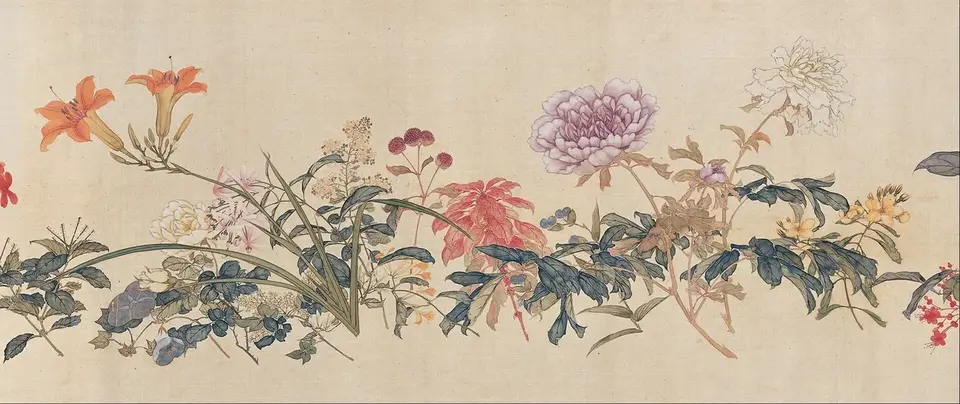
Completed his late monumental handscroll All Twelve Parts of Spring Radiance, showcasing mature technical mastery.
Died peacefully at the Moon-Whistling Zither Studio in the Ten Fragrances Garden at age seventy-seven.
Ju Lian was born into a cultured family in Geshan Village, Panyu County, Guangdong, whose ancestors migrated from Baoying, Jiangsu. Showing a natural gift for drawing from childhood, he studied classical literature, poetry, and painting under his talented elder cousin Ju Chao (art name Meisheng). Rejecting slavish imitation of popular printed manuals, the cousins frequently strolled through rural landscapes with ink and brushes, closely scrutinizing living blossoms, birds, and insects to replicate their natural spirit.
Around 1848, Ju Lian followed Ju Chao to Guangxi. While residing in Guilin, he became acquainted with two eminent painters from Changzhou, Jiangsu—Song Guangbao and Meng Jinyi—who had relocated to the south. Both were consummate masters of Yun Shouping's boneless floral technique, renowned for delicate coloring and tranquil washes. Ju studied their brushwork and ink handling diligently, incorporating the strengths of diverse lineages. In his later years, Ju often stamped his paintings with the seal "Between Song and Meng," reflecting his debt to these mentors while announcing his personal departure toward stylistic innovation.
The escalation of the Taiping Rebellion disrupted southern China in the 1850s. Renowned military commander and avid art collector Zhang Jingxiu retired to his ancestral estate in Dongguan, constructing Keyuan Garden, which became a haven for literati alongside Daosheng Garden built by his cousin Zhang Jiamo. In 1856, Ju Lian and Ju Chao accepted Zhang's invitation to take up extended residency at Keyuan, where they stayed for nearly a decade.
Keyuan Garden abounded in subtropical flora, ponds, and aviary fauna, creating an ideal laboratory for observational painting. Ju immersed himself in direct nature studies regardless of seasonal weather. He spent countless hours amidst flowerbeds, trellises, and melon patches, recording the subtle structural shifts of plants under morning dew and evening mist. To capture the precise movements of praying mantises, grasshoppers, and cicadas, Ju conducted nighttime excursions with lanterns to trap live specimens in glass containers, sketching their dynamic poses before mounting them as anatomical specimens for continued anatomical study.
In 1864, the cousins returned to Geshan Village. Adjacent to their ancestral residence, they created a garden planted with ten varieties of fragrant blossoms—including night-blooming jasmine, sweet osmanthus, and white champaca—naming the sanctuary the Ten Fragrances Garden. Ju Lian constructed the Moon-Whistling Zither Studio as his personal atelier. Following Ju Chao's death in 1865, Ju Lian led the school independently, supporting his family through art sales and formal instruction.
Ju devised a rigorous three-tiered curriculum for his students: the first year was devoted to "tracing contours" (goutao) to master foundational brush lines and skeletal structures; the second year focused on "copying masterworks" (linhua) to internalize wash layering, water infusion, and pigment balancing; and the third year required "independent life sketching" (tuogao xiesheng) before live plants and insects in the courtyard. During daily lessons, Ju had students surround his desk, explaining his brush manipulations and fluid interactions in vivid detail. Recognizing the genius of the impoverished youth Gao Jianfu, Ju waived his lodging and tuition fees, providing compassionate personal patronage.
During the Guangxu era, Ju Lian's artistic fame reached its peak, with patrons waiting in long lines for his scrolls. In 1894, on the occasion of Empress Dowager Cixi's sixtieth birthday, Guangxi Governor Wang Zhichun specially commissioned Ju to execute an elaborate "Hundred Flowers Screen" as an official birthday tribute, winning him high acclaim among metropolitan officials. His delicate insect paintings became so prized that contemporary markets priced his honeybees at "one tael of silver per bee."
On the Flower Festival of 1899, the septuagenarian master completed his celebrated handscroll All Twelve Parts of Spring Radiance, a tour de force synthesizing decades of observational mastery and technical brilliance. In 1904, Ju Lian passed away peacefully in his Moon-Whistling Zither Studio at the age of seventy-seven, leaving behind an artistic tradition that would redefine modern Chinese art.
Ju Lian's most celebrated technical breakthrough was the systematic codification of the "water-infusion" (zhuangshui) and "powder-infusion" (zhuangfen) techniques. In water-infusion, while mineral pigments remain moist on the paper, clean water is injected via brush tip; the contrasting surface tensions force the pigments toward outer contours, producing translucent, layered gradations that authentically mimic dewy leaves, petals, and rain-soaked foliage. In powder-infusion, white mineral powder is blended into wet foundational colors to create tactile, luminous three-dimensionality on blossoms such as peonies and lilies. This approach dismantled rigid academic outlining, pioneering a painterly language tailored to the humid subtropical atmosphere of Lingnan.
Rejecting conventional imitation of antique model books like the Mustard Seed Garden Manual, Ju advocated direct dialogue with living nature. His subject matter expanded beyond customary plum, orchid, bamboo, and chrysanthemum to encompass everyday southern flora, including longan, lychee, starfruit, and jackfruit, as well as pastoral vignettes featuring winter squash, gourds, Chinese bacon, cured duck, and festival rice dumplings. His compositions elevated regional vernacular life into elegant classical painting, celebrating the vibrant sensory realities of southern China.
Across nearly four decades of instruction at the Ten Fragrances Garden, Ju personally trained over fifty accomplished painters, with over eighty percent of late Qing Guangdong artists tracing their artistic lineage to his studio. His prominent disciples Gao Jianfu and Chen Shu-ren absorbed his empirical sketching methods and wash techniques, subsequently blending them with Japanese Nihonga and Western realism to launch the internationally renowned Lingnan School of Painting. Through Gao Jianfu's instruction of Gao Qifeng, the celebrated "Three Masters of Lingnan" emerged directly from Ju Lian's pedagogical foundation, establishing the Ten Fragrances Garden as the historic cradle of modern southern Chinese painting.
FIGURES ASSOCIATED WITH THIS DYNASTY