Birth in Panyu
Born in Geshan Village, Panyu, Guangdong; displayed early intellectual brilliance and studied classical Jiangnan flower-and-bird painting.
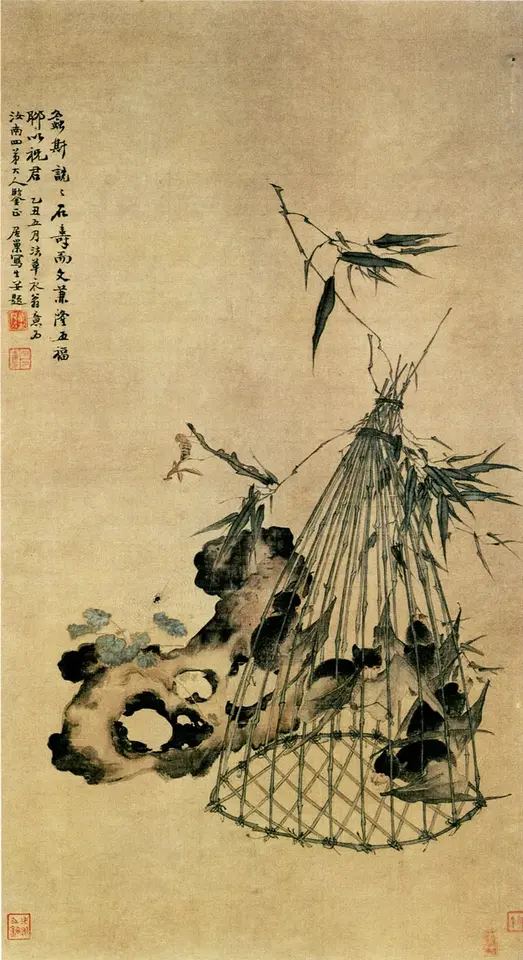
居巢
Ju Chao (1811–1865), courtesy name Shijie, art name Meisheng, was an eminent bird-and-flower painter and poet of the late Qing dynasty, widely revered as a foundational precursor of the Lingnan School of Painting. Alongside his younger cousin Ju Lian, he was celebrated across southern China as one of the Two Jus. Tracing his ancestral lineage to Baoying, Jiangsu, his ancestors relocated to Geshan Village in Panyu, Guangdong.…
Ju Chao (1811–1865), courtesy name Shijie, art name Meisheng, was an eminent bird-and-flower painter and poet of the late Qing dynasty, widely revered as a foundational precursor of the Lingnan School of Painting. Alongside his younger cousin Ju Lian, he was celebrated across southern China as one of the Two Jus. Tracing his ancestral lineage to Baoying, Jiangsu, his ancestors relocated to Geshan Village in Panyu, Guangdong. In his youth, Ju Chao entered the private secretarial staff of Zhang Jingxiu, acting judicial commissioner of Guangxi, traveling across Guilin and Nanjing before residing as an honored guest at Zhang's Ke Garden in Dongguan for nearly a decade, where he synthesized Song court realism with Jiangnan boneless painting techniques. Artistically, Ju championed direct observation from nature, excelling in capturing the birds, blossoms, and insects native to the humid subtropical climate of Lingnan. Building upon Yun Shouping's boneless method, Ju Chao and Ju Lian developed and refined the water-infusion (zhuangshui) and powder-infusion (zhuangfen) techniques. These methods produced unique optical qualities of misty translucence and delicate moisture, bridging the traditional boundary between fine-brush gongbi and freehand xieyi styles. Beyond his painterly mastery, Ju Chao was an accomplished classical poet whose poetic inscriptions resonated in perfect harmony with his painted imagery. His artistic innovations laid the direct foundation for modern Lingnan School masters Gao Jianfu and Chen Shuren, establishing him as a crucial transformative figure in modern Chinese art history.
Born in Geshan Village, Panyu, Guangdong; displayed early intellectual brilliance and studied classical Jiangnan flower-and-bird painting.
Met Dongguan notable Zhang Jingxiu and joined his secretarial staff in Guangxi, managing military and judicial affairs while sketching landscapes.
Encountered Jiangnan masters such as Song Guangbao in Guangxi, studying boneless bird-and-flower methods and advancing his craft.
Followed the retired Zhang Jingxiu to Dongguan, residing in the Ke Garden to inaugurate a golden decade of artistic production.
Following Zhang Jingxiu's death, returned to Geshan with Ju Lian, establishing the Jinxi'an studio for quiet contemplation.
Passed away at his residence in Geshan, Panyu, at the age of fifty-five, leaving his artistic legacy to be carried forward by Ju Lian.
Ju Chao's ancestral home was in Baoying County, Yangzhou Prefecture, Jiangsu Province. During the Ming-Qing transition, his forebears migrated south to Guangdong, settling in Geshan Village, Panyu County, Guangzhou Prefecture (modern Haizhu District, Guangzhou). Born into a scholarly family during the mid-Jiaqing reign, Ju Chao was physically delicate from childhood. Possessing a serene, refined disposition, he devoted himself to classical texts, historical literature, and poetry, exhibiting early genius in brushwork and painting.
During his early artistic explorations, Ju Chao looked beyond the insular painting traditions of regional Guangdong, seeking inspiration directly from Jiangnan literati lineages. He diligently studied the boneless bird-and-flower styles of Northern Song master Xu Chongsi, Yuan dynasty painter Qian Xuan, and early Qing innovator Yun Shouping, striving to unite structural strength with atmospheric elegance. This deep immersion in classical poetry and traditional ink technique established the scholarly bedrock for his later innovations in Lingnan painting.
During the late Daoguang reign, Zhang Jingxiu of an illustrious Dongguan gentry clan rose through military merit to become acting judicial commissioner of Guangxi. A cultured patron of literature and art, Zhang recruited Ju Chao with generous stipends to serve as his confidential secretary. Ju Chao thus embarked on more than a decade of administrative travel across the karst riverways of Guilin and Yangshuo.
During his secretarial tenure, Ju Chao balanced official casework with landscape exploration. Beyond observing the dramatic geological topography of southwestern China, he befriended prominent Jiangnan artists visiting Lingnan, including Song Guangbao and Meng Jinyi of Wu County, Jiangsu. Song Guangbao's boneless sketching techniques from life profoundly inspired Ju Chao. Realizing that painters must discard formulaic ancient pattern books in favor of direct engagement with the living natural world, Ju Chao sketched alongside Song, absorbing diverse styles and achieving a decisive artistic transformation.
In 1856, following his resignation from military command, Zhang Jingxiu returned to his ancestral home in Dongguan and constructed the Ke Garden, a sprawling, exquisitely landscaped scholar's estate. Treating the Ju cousins with the utmost respect, Zhang allocated the scenic pavilions Youhuang Xiaozhu and Wenhua Xiaoxie as their dedicated residences and studios.
The eight-year sojourn at the Ke Garden constituted the most tranquil, prosperous, and creative period of Ju Chao's life. Freed from worldly administrative burdens, he associated with collectors from Guangdong's four great commercial clans (Pan, Lu, Wu, and Ye), gaining access to rare private collections of Tang, Song, Yuan, and Ming masterworks. Within the garden, Ju Chao sketched relentlessly from life, capturing its exotic tropical blossoms, birds, and singing cicadas. His signature artistic style reached complete maturity at the Ke Garden, and the renown of the Ju School spread rapidly across the province.
In 1864, his patron and closest friend Zhang Jingxiu passed away. Devastated by the loss of his soulmate, Ju Chao resolved to leave Dongguan with his cousin Ju Lian, returning to their ancestral village of Geshan in Panyu. Ju Chao named his studio Jinxi'an (This Evening's Hermitage) and inscribed his hall as Xiyeshi, reflecting an attitude of detached serenity and nostalgia after years of worldly vicissitudes.
In his final years, Ju Chao lived in quiet seclusion, finding solace only in poetry, painting, and wine with Ju Lian. He maintained an exacting and disciplined standard in his art, taking several days to complete even a small fan painting, refusing to apply a single reckless stroke of color or wash. Consequently, his extant late works are universally recognized as refined masterpieces. In 1865, Ju Chao passed away at Jinxi'an at age fifty-five. Ju Lian subsequently expanded their compound into the Shixiang Garden, training generations of disciples and establishing Ju School techniques as the foundational root of the modern Lingnan School of Painting.
Ju Chao's most groundbreaking contribution to traditional Chinese painting technique was developing and perfecting the water-infusion (zhuangshui) and powder-infusion (zhuangfen) methods alongside his cousin Ju Lian, revolutionizing traditional flower-and-bird painting.
The water-infusion method involved applying wet ink or mineral pigments to raw Xuan paper or silk, and then, before the wash dried, using a clean brush loaded with fresh water to drop water directly into the colored areas. Exploiting the natural surface tension and fluid dynamics between water and mineral pigments, this technique caused the color to recede toward the margins, leaving delicate, shimmering rims of pigment that mimicked morning dew on green leaves after a Lingnan rainstorm. The powder-infusion method entailed dropping liquid white pigment onto moist petal or fruit contours, allowing the powder and base tones to blend organically, naturally evoking three-dimensional roundness and radiant morning light. By fusing these techniques with classical Song-Yuan boneless methods, Ju Chao eliminated the stiff artificiality of conventional line-and-fill drawing, endowing his compositions with remarkable atmospheric translucence and vitality.
In thematic subject matter, Ju Chao dismantled the narrow conventions of classical Jiangnan literati painting, which had long restricted bird-and-flower art to the Four Gentlemen (plum, orchid, bamboo, chrysanthemum) and isolated pines. Instead, he systematically introduced the unique flora and fauna of the subtropical Lingnan region into classical Chinese literati art.
Living across the Pearl River Delta and the water pavilions of the Ke Garden, Ju Chao portrayed over two hundred native Lingnan species. Tropical fruits such as lychee, starfruit, and longan, along with kapok flowers, frangipani, night-blooming jasmine, field weeds, praying mantises, scarab beetles, crickets, snails, and teals were captured with vivid authenticity. Dedicated to empirical sketching from nature, he and Ju Lian frequently carried lanterns into the gardens at night to observe nocturnal duels between cicadas and mantises. Ju Chao's depictions combined botanical accuracy with classical scholarly refinement, dispelling the stereotype of Lingnan as an uncultured wilderness and establishing an indigenous realistic painting tradition.
Ju Chao was not merely a master painter but an accomplished classical poet whose verse won acclaim among late Qing Guangdong intellectuals. He authored celebrated poetic collections including Shouqiu Caotang Shichao and Xiyeshi Shichao.
Unlike modern painters who focus primarily on visual impact, Ju Chao strictly adhered to the traditional literati ideal that poetry and painting share a single essence. He personally composed poetic quatrains or regulated verses for his paintings, employing sophisticated classical allusions and elegant pastoral imagery. His verse on jasmine blossoms, describing how white flowers pile like snow while evening breezes summon night moths, exemplifies his lyrical sensibility. This harmonious integration of poetic inscription, refined calligraphy, painterly realism, and classical seals elevated his flower-and-bird paintings into timeless paragons of scholar-artist culture.
Ju Chao stands as the indispensable pioneer in the historical transition of Guangdong painting from formulaic classical imitation to modern empirical sketching from life, establishing the cornerstone of the Lingnan School of Painting.
Throughout his life, Ju Chao served as the mentor and guide for his younger cousin Ju Lian. The three core tenets of the Ju School—the water-and-powder infusion techniques, direct sketching from living nature, and the representation of native regional imagery—were all theoretically formulated and clinically tested by Ju Chao during his years at the Ke Garden. Following Ju Chao's death, Ju Lian established the Shixiang Garden in Geshan, training seminal figures including Gao Jianfu and Chen Shuren. Gao and Chen subsequently studied in Japan, integrating Western perspective and atmospheric light into Chinese painting to launch the celebrated Lingnan School of Painting. The stylistic foundations and creative spirit cultivated by Ju Chao at the Ke Garden thus represent the original wellspring of modern Chinese artistic reform in southern China.
FIGURES ASSOCIATED WITH THIS DYNASTY