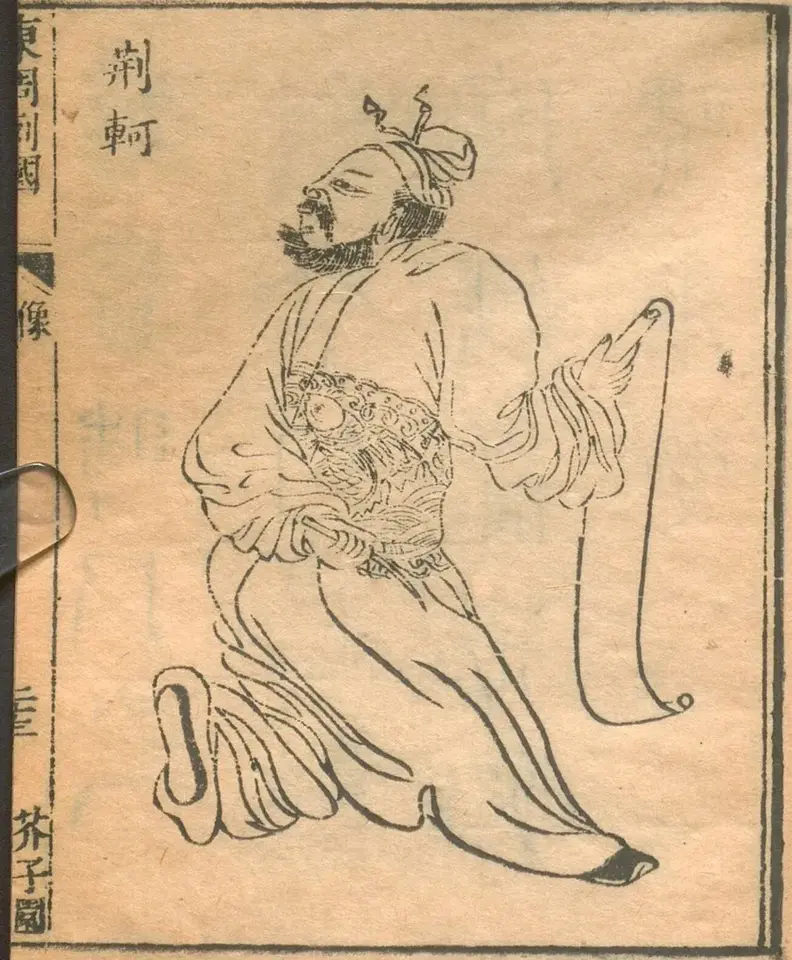
Biography
Wandering the States and Living in Yan
Jing Ke's ancestral home was Qi, but his clan later fled political turmoil and settled in Puyang within the State of Wei, where the locals addressed him as Qing Qing. From an early age, Jing Ke displayed a passion for classical histories, philosophical treatises, and the martial discipline of swordsmanship, harboring grand aspirations to stabilize the realm. In his mature years, he sought to persuade Lord Yuan of Wei with his political statecraft and swordsmanship theories, but the ruler was timid and failed to employ him. Soon afterward, the rising power of Qin seized the territory around Puyang, establishing the Dong Commandery and forcing Wei's ruling family to relocate to Yewang. Seeing Wei reduced to a helpless vassal, Jing Ke departed to travel across the various feudal states in search of an enlightened patron.
During his travels, Jing Ke conducted himself with profound emotional restraint, seeking out extraordinary talents and recluses. Passing through Yuci, he met the celebrated swordsman Gai Nie to discuss martial principles. When their viewpoints diverged, Gai Nie glared at him with silent anger; understanding the rebuke, Jing Ke quietly withdrew without uttering a contentious word and departed the district. Later, in Handan, the capital of Zhao, he clashed with the gaming master Lu Goujian during a board game; when Lu rebuked him harshly, Jing Ke simply retreated in silence. This deliberate refusal to engage in petty brawls demonstrated that Jing Ke was no reckless brawler driven by momentary impulse, but a patient man of lofty purpose who husbanded his strength for greater historic trials.
The Yan Marketplace and Tian Guang's Recognition
Leaving Zhao, Jing Ke traveled northward to the State of Yan, where the population respectfully referred to him as Jing Qing. In the Yan capital of Jicheng (near modern Beijing), Jing Ke made no immediate attempt to curry favor with wealthy aristocrats. Instead, he formed deep bonds of friendship with two men of humble background: an anonymous market dog butcher and the gifted zither player Gao Jianli.
Jing Ke had a deep love for wine. Day after day, he drank with the butcher and Gao Jianli in the bustling taverns of the marketplace. When the wine warmed their spirits, Gao Jianli would strike his zither with mournful melodies, and Jing Ke would sing aloud in rhythm in the open street, amusing themselves among the crowds. Yet shortly afterward, reflecting on the fracturing of the realm and the suffering of the common people, they would weep bitterly together as if no one else were present. Although he mingled daily with drinkers, Jing Ke remained studious and dignified, seeking out men of virtue and wisdom in every state he visited. The respected Yan elder Tian Guang recognized Jing Ke's rare moral depth, treating him with exceptional deference as a man of extraordinary capacity.
Prince Dan's Appeal and Elevation to Senior Minister
Following the ascension of King Zheng of Qin, the western power expanded relentlessly, threatening the survival of Han and Zhao. Crown Prince Dan of Yan, who had previously been held as a political hostage in Qin, fled back to Yan harboring bitter resentment over King Zheng's arrogant and dismissive treatment. Watching Qin armies destroy neighboring states, Prince Dan was consumed by dread, desperate for a strategy to avert Yan's destruction. When his tutor Ju Wu recommended forming a grand defensive alliance with Qi, Chu, and the northern Xiongnu nomads, Prince Dan rejected it as too slow, resolving instead to execute a daring assassination to compel the Qin king to return annexed lands.
Prince Dan visited the aged hermit Tian Guang to plead for assistance. Tian Guang declined due to advanced age, but emphatically recommended Jing Ke as a fearless warrior capable of bearing the fate of the state. Before parting, Prince Dan cautioned Tian Guang that the conversation touched upon supreme state secrets that must never be revealed. When Tian Guang visited Jing Ke to convey the prince's invitation, he chose to prove his eternal silence and ignite Jing Ke's sense of duty by drawing his sword and cutting his own throat on the spot.
Shaken by Tian Guang's supreme sacrifice, Jing Ke immediately visited Prince Dan's palace and relayed Tian Guang's dying words. Prince Dan knelt, wept profusely, and formally entrusted the salvation of Yan and the assassination mission to Jing Ke. Although Jing Ke initially demurred out of modest self-appraisal, he was moved by Tian Guang's martyrdom and Prince Dan's desperate sincerity, accepting the perilous charge. Overjoyed, Prince Dan elevated Jing Ke to the rank of Senior Minister, lodging him in a palatial estate and showering him with fine carriages, rare treasures, and beautiful maidens to satisfy his every wish.
Planning the Mission and the Farewell at the Yi River
In 228 BCE, Qin general Wang Jian captured Handan, seized the King of Zhao, and marched north to the southern frontier of Yan along the Yi River. Panic swept the court of Yan. Prince Dan implored Jing Ke to depart at once. Jing Ke calmly analyzed the situation, pointing out that presenting oneself empty-handed would never win access to the heavily guarded King of Qin; they required indispensable tokens that would convince King Zheng of Yan's absolute capitulation.
Jing Ke proposed two vital credentials: the severed head of General Fan Yuqi, for whom Qin offered a reward of a thousand catties of gold and ten thousand households; and a detailed topographical map of Dukang, the most fertile agricultural region in Yan. Because Prince Dan could not bear to harm Fan Yuqi, who had sought refuge in Yan, Jing Ke met privately with the exiled general. He described how King Zheng had executed Fan's parents and clan, asking Fan to sacrifice his life so that both his family's blood debt could be avenged and Yan could be saved. Filled with grief and indignation, Fan Yuqi willingly slit his own throat. Concurrently, Prince Dan spent a hundred catties of gold to purchase a lethally sharp dagger from Master Xu of Zhao, ordering weaponsmiths to quench the blade in deadly poison that caused instant death upon the slightest scratch.
Prince Dan assigned Qin Wuyang, a fierce youth who had killed a man at age twelve, to serve as assistant assassin. Aware that Qin Wuyang lacked true inner composure, Jing Ke delayed his departure, waiting for a distant comrade to accompany him. Misinterpreting this delay as cold-footed hesitation, Prince Dan pressured him to leave. Angered by the prince's distrust, Jing Ke decided to depart immediately with Qin Wuyang.
On the day of departure, Prince Dan and his retinue donned white mourning caps and robes to see Jing Ke off on the banks of the Yi River. Following the farewell sacrifice, Gao Jianli struck his zither, and Jing Ke began to sing. The song began in the weeping key of Bianzhi, bringing tears to the eyes of all the assembled knights. Then, shifting into the stirring key of Yu, Jing Ke chanted: "Wind blows mournfully and the Yi River is cold; the brave warrior departs, never to return!" The onlookers opened their eyes wide with furious resolve, their hair bristling beneath their caps. Finising his song, Jing Ke mounted his carriage and rode away toward the west, without looking back.
The Xianyang Audience and Heroic Death
In 227 BCE, Jing Ke reached the Qin capital of Xianyang. He bribed King Zheng's favored palace attendant, Meng Jia, with gifts worth a thousand gold pieces. Meng Jia reported to King Zheng that the King of Yan was terrified of Qin's might, offering Fan Yuqi's head and the fertile Dukang territory as a humble tributary gift. Delighted, King Zheng decreed the highest court protocol, the Nine Guests ceremony, to receive the Yan ambassadors in Xianyang Palace.
Surrounded by rows of armed imperial guards, Jing Ke carried the bronze box containing Fan Yuqi's head, while Qin Wuyang carried the jade scroll case containing the Dukang map. As they ascended the palace stairs, Qin Wuyang was overcome with terror, turning pale and trembling visibly. The Qin ministers grew suspicious. Turning to Qin Wuyang with a composed smile, Jing Ke stepped forward to apologize to King Zheng: "This barbarian youth from the northern frontier has never witnessed the majesty of the Son of Heaven, and therefore trembles in awe. I pray Your Majesty will overlook his breach of protocol and permit him to fulfill the mission of the King of Yan." Reassured by Jing Ke's poise, King Zheng ordered Qin Wuyang to remain below and commanded Jing Ke to bring the map before the throne.
Approaching the royal seat, Jing Ke slowly unrolled the map before King Zheng. As the final section of the scroll slipped open, the poison-quenched dagger was exposed to view. Moving with lightning speed, Jing Ke grabbed King Zheng's sleeve with his left hand while seizing the dagger with his right, striking toward the monarch's chest. Startled, King Zheng threw himself backward, tearing off his sleeve, and scrambled around the massive bronze pillar of the hall, with Jing Ke in hot pursuit.
According to Qin law, ministers present in the throne room were strictly forbidden from carrying weapons, while the palace guard stationed below could not ascend the terrace without explicit imperial command. Caught completely off guard, the unarmed courtiers looked on in panic. In this desperate melee, royal physician Xia Wuju hurled his medicine pouch at Jing Ke, briefly staggering the assassin. Below the dais, the attendants shouted: "Push the sword behind your back, Your Majesty!" King Zheng slung his long ceremonial sword behind his shoulder, drew the blade, and slashed forward, severing Jing Ke's left thigh.
Crippled and bleeding profusely on the palace floor, Jing Ke realized the mission was lost. Gathering his remaining strength, he hurled the poisoned dagger at King Zheng; the blade missed the king's body, striking a bronze pillar and scattering sparks. King Zheng advanced and struck Jing Ke eight times with his sword. Slumping against the pillar with his legs outstretched, Jing Ke laughed scornfully and spat blood, declaring: "This mission failed only because I sought to capture you alive, forcing you to sign a covenant returning the stolen territories to the feudal lords to repay Prince Dan!" Armed guards then stormed the hall and cut down the fallen hero.
Major Achievements
Formulating the Abduction Strategy to Revive the Anti-Qin League
Jing Ke's mission was not a reckless act of personal vengeance or private banditry, but a calculated geopolitical enterprise at a pivotal turning point of the Warring States era. Modeling his plan on the ancient precedent of Cao Mo, who had seized Duke Huan of Qi at Ke to compel the return of Lu's annexed lands, Jing Ke established the primary objective of capturing the King of Qin alive to extract a binding treaty renouncing Qin's conquest of the six states.
This ambitious design aimed to leverage a surgical strike to disrupt Qin's military expansion, giving the struggling eastern states vital breathing room to reform their defensive confederacy. Although this demanding political objective prevented Jing Ke from delivering an instant fatal strike in the chaos of Xianyang Palace, the strategic vision and sheer audacity of his design far surpassed the limited horizons of an ordinary assassin.
The Yi River Lament as an Immortal Standard of Heroism
Jing Ke's farewell at the Yi River represents one of the most powerful and sublime episodes in classical Chinese literature and chivalric ethics. Facing a mission with virtually no chance of survival, Jing Ke willingly shouldered the defense of a dying realm against overwhelming tyranny.
At the water's edge, accompanied by Gao Jianli's zither, Jing Ke's song—"Wind blows mournfully and the Yi River is cold; the brave warrior departs, never to return"—transformed individual mortality into a transcendent aesthetic of heroic sacrifice. Celebrated for over two millennia, this scene became an enduring cultural touchstone, symbolizing fearless dedication to honor and the defense of the vulnerable against autocratic tyranny.
The Dagger in the Map and the Clash in Xianyang Palace
The dramatic confrontation within Xianyang Palace stands as the most gripping moment in ancient Chinese political and assassination history. Utilizing Fan Yuqi's head and the Dukang map to pierce Qin's layers of security, Jing Ke penetrated the inner sanctuary of the emerging empire. When his companion faltered, Jing Ke displayed supreme composure, smoothing over the crisis with quick-witted diplomacy.
When the dagger was revealed, Jing Ke single-handedly terrorized the court of Qin, pursuing the terrified monarch around the pillar while the entire court stood paralyzed. Even when mortally wounded and mutilated, his defiant laughter and contemptuous denunciation of the tyrant reflected the unyielding moral dignity and indomitable spirit of the ancient Chinese knight-errant.