Birth in Qinshui
Born into a scholar-official clan in Qinshui, immersed in classical canons, poetry, and painting in youth.
荆浩
Jing Hao (荆浩, c. 850–c. 923), courtesy name Haoran, styled Master Honggu, was a native of Qinshui in Henai (modern Qinshui County, Jincheng, Shanxi). He was the founding patriarch of the Northern Landscape Painting School and the foremost art theorist of the Five Dynasties period. Endowed with deep Confucian erudition, poetic skill, and calligraphy, he served in minor administrative and secretarial offices in the imperial…
Jing Hao (荆浩, c. 850–c. 923), courtesy name Haoran, styled Master Honggu, was a native of Qinshui in Henai (modern Qinshui County, Jincheng, Shanxi). He was the founding patriarch of the Northern Landscape Painting School and the foremost art theorist of the Five Dynasties period. Endowed with deep Confucian erudition, poetic skill, and calligraphy, he served in minor administrative and secretarial offices in the imperial capitals Chang'an and Luoyang during the late Tang Dynasty. Following the devastating sack of Chang'an by warlord Zhu Quanzhong in 904, Jing Hao abandoned officialdom and retreated deep into Honggu Ravine in the Taihang Mountains. Cultivating farmland for subsistence, he sketched over ten thousand ancient pines directly from life, systematically integrating Wu Daozi's chiseled brushstrokes with Xiang Rong's ink washes. He authored the epochal treatise Bifa Ji (A Record of Brush Methods), formulating the foundational "Six Essentials" of Chinese landscape painting and elevating art into an ontology of natural truth. With his disciple Guan Tong, he established the monumental "Jing-Guan School," whose panoramic vertical compositions directly inspired Northern Song giants Li Cheng and Fan Kuan. His surviving masterpiece Kuanglu Mountain remains a national treasure of Chinese landscape art.
Born into a scholar-official clan in Qinshui, immersed in classical canons, poetry, and painting in youth.
Traveled to Chang'an and Luoyang, serving in minor inner court offices while studying palace art and temple frescoes.
Witnessed the devastation of the Huang Chao Rebellion, nurturing early desires for hermetic retreat into nature.
Zhu Quanzhong forcibly burned Chang'an; Jing Hao resigned office and fled northward into the Taihang Mountains.
Established a homestead in Honggu Ravine in the Taihang Mountains, farming and sketching ten thousand pine trees from life.
Completed the revolutionary landscape painting treatise Bifa Ji, codifying the Six Essentials and brushwork philosophy.
Accepted Chang'an painter Guan Tong as his foremost disciple, transmitting the core techniques of ink wash and brushwork.
Passed away peacefully in his mountain hermitage in Honggu at age seventy-four, leaving an immortal artistic legacy.
Jing Hao was born around 850 in Qinshui County, Henai. His family had cultivated classical scholarship and Confucian propriety across generations. Immersed in the Confucian canons, histories, and classical literature from youth, Jing Hao demonstrated equal mastery in poetry, prose, and calligraphy. In his teenage years, he frequently traveled throughout the mountainous landscapes of Jiyuan and Mount Wangwu.
During the High Tang, Daoist Master Sima Chengzhen had built Yangtai Palace on Mount Wangwu, leaving an enduring aura of spiritual transcendence. Visiting the mountain sanctuaries, young Jing Hao was profoundly moved by Sima Chengzhen's Daoist metaphysics and solitary ethos. These early journeys inspired his famous early landscape painting Tiantaishan Tu and deeply rooted in his heart a lifelong quest to capture the spiritual essence of nature. In his later treatise Bifa Ji, Jing Hao explicitly praised Sima Chengzhen alongside Wang Wei and Zhang Zao as masters who grasped the cosmic source of art.
Reaching adulthood, Jing Hao traveled to the twin capitals Chang'an and Luoyang to seek civil office, serving in minor administrative and secretarial posts within the inner court. In the capitals, his official duties granted him privileged access to rare Jin and Tang masterworks preserved in the imperial archives, enabling him to associate with leading court literati.
During his leisure hours, Jing Hao studied and copied Buddhist and Daoist wall murals throughout the capital monasteries. According to the Supplementary Biographies of Famous Paintings of the Five Dynasties, Jing Hao painted the celebrated mural Guanyin of Mount Potalaka on the grand hall walls of Shuanglin Temple in Chang'an. The mural integrated craggy sea-cliffs and swirling mists with the serene majesty of the Bodhisattva, pioneering the fusion of monochrome landscape with religious figural art. He also executed monumental panoramic paintings including The Gathering at the Orchid Pavilion and King Xiang of Chu Meets the Goddess, winning soaring artistic acclaim across the capital.
In the late Tang Dynasty, warlord warfare torn the empire apart. In 904, warlord Zhu Quanzhong violently coerced Emperor Zhaozong to relocate the capital to Luoyang, ordering the systematic dismantling and destruction of Chang'an's palaces, government ministries, and residential wards. Renowned architectural monuments and irreplaceable temple murals were reduced to ash and rubble.
Confronted with the total annihilation of the Tang civilization, Jing Hao realized that bureaucratic glory was ephemeral and perilous. He renounced his offices and turned his back on worldly ambitions. Carrying only painting supplies and dried grain, he traveled north into the deep, misty recesses of Honggu Ravine in Linxian, nestled within the Taihang Mountains. Honggu was flanked by towering vertical crags, waterfalls, and primeval forests. In this mountain haven, Jing Hao cleared land, built a thatch hut, and styled himself "Master Honggu," dedicating his life entirely to direct communion with nature.
Throughout his decades of solitude in Honggu, Jing Hao set out every dawn with a bamboo basket and brushes, trekking through ravines and boulders to examine the shifting mists and seasonal blizzards of the Taihang range. He observed the stark geological bone-structure of northern peaks with scientific precision.
The ancient pines clinging to the precipitous cliffs of Mount Shenzheng fascinated him. He discovered a grove of centenarian pines whose trunks twisted like coiled dragons, their armored bark withstanding centuries of freezing blizzards. Transfixed, Jing Hao sat for days upon granite boulders, "carrying brushes to sketch them, drawing tens of thousands of trees until he captured their authentic spirit." Through thousands of direct observational sketches, Jing Hao broke completely free from conventional copybooks, grasping the living vital breath (qi) animating the natural universe.
While living in complete isolation from court politics, Jing Hao maintained a profound spiritual and artistic correspondence with Venerable Dayu, abbot of Qinglian Temple in Yedu. Recognizing Jing Hao's transcendent artistic mastery, Dayu dispatched a messenger carrying six bolts of fine silk alongside a poem, requesting a painting not of endless valleys, but simply of two proud pines standing upon a sheer precipice.
Deeply touched by the abbot's spiritual resonance, Jing Hao painted a breathtaking monochrome landscape of mist-shrouded crags and solitary winter pines. In his poetic reply to Dayu, Jing Hao wrote: "Wielding my brush with unbridled freedom, peaks emerge in majestic sequence. The brush point renders cold trees slender; pale ink leaves wilderness clouds light. Crags press tightly over narrow springs; mountain roots descend to water level. Unfurling this scroll in your meditation room, it harmonizes with the truth of suffering and void." The poem revealed his absolute technical control over dry brush and pale washes, expressing the Buddhist insight of emptiness amidst a war-torn world.
During the Zhenming era of Later Liang, synthesizing decades of mountain observation with Yin-Yang metaphysics, Jing Hao authored Bifa Ji (A Record of Brush Methods), the first comprehensive, systematic landscape painting treatise in Chinese history.
In his final years, Jing Hao opened an academy at the foot of the Taihang Mountains. A young painter from Chang'an named Guan Tong traveled across provinces to become his disciple. Jing Hao poured his knowledge into Guan Tong, teaching him the secrets of ink graduation and structural brushwork. Guan Tong labored with relentless discipline, becoming so accomplished that contemporaries spoke of them together as the "Jing-Guan School." In 923, Jing Hao passed away peacefully in his Honggu hermitage at the age of seventy-four.
Prior to Jing Hao, landscape painting consisted primarily of blue-and-green mineral pigments outlined with rigid wirelines. Although ink wash emerged in the mid-Tang, brushwork and ink remained disjointed: Wu Daozi possessed "brush without ink," offering dynamic lines without tonal shading, while Xiang Rong possessed "ink without brush," offering heavy washes lacking structural bone-lines.
Jing Hao synthesized their strengths, creating the revolutionary system of "possessing both brush and ink, with moist washes and structured strokes." His brushwork rendered chiseled rock fractures with masculine strength, while his ink washes deployed five subtle tonal values of moisture, establishing the monumental monochrome ink-and-wash landscape tradition.
In Bifa Ji, Jing Hao profoundly reformulated Xie He's ancient Six Canons, establishing the "Six Essentials" of landscape painting: Vital Breath (Qi), Acoustic Resonance (Yun), Thought (Si), Scenery (Jing), Brush (Bi), and Ink (Mo).
Crucially, he introduced the philosophical distinction between "Likeness" (si) and "Truth" (zhen): "Likeness captures outer form but abandons the spirit; Truth captures both outer form and inner vitality in full abundance." He articulated the four dynamic tensions (Sinew, Flesh, Bone, and Breath) and categorized masterpieces into Divine, Marvelous, Extraordinary, and Skillful classes, elevating Chinese art theory from superficial mimetic reproduction to metaphysical truth.
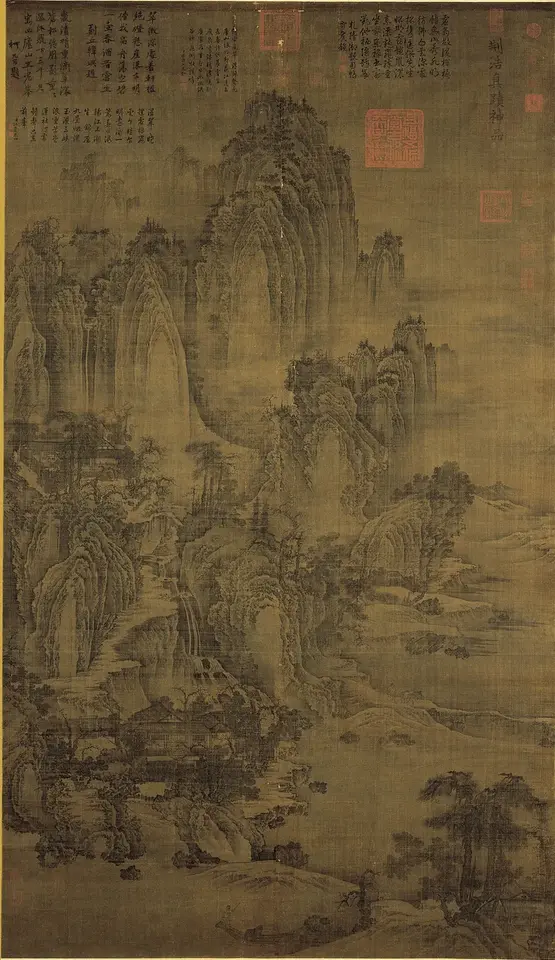
Preserved in the National Palace Museum in Taipei, the monumental silk hanging scroll Kuanglu Mountain (Kuanglu Tu) is universally revered as Jing Hao's surviving masterwork. Utilizing a tripartite vertical composition, the towering central peak pierces through rolling clouds, while waterfalls cascade past precarious suspension bridges toward fishing huts in the foreground.
His Snowy Landscape (Xuejing Shanshui Tu), preserved in the Nelson-Atkins Museum of Art, demonstrates his supreme mastery of atmospheric light, using unpainted silk and delicate gray ink washes to evoke the crystalline stillness of a mountain blizzard, standing as a pinnacle of early monochrome snowscapes.
Jing Hao's theoretical and practical breakthroughs marked the mature zenith of Chinese panoramic landscape art. Together with his disciple Guan Tong, the Jing-Guan School laid the architectural foundation for the golden age of Northern Song painting.
The founding triumvirate of Northern Song landscape—Li Cheng, Fan Kuan, and Guo Xi—directly inherited Jing Hao's monumental crag compositions, axe-cut texture strokes, and atmospheric mists. Masters across imperial history, from Su Shi and Mi Fu to Dong Qichang, venerated Jing Hao as the eternal ancestral master of traditional Chinese landscape painting.
FIGURES ASSOCIATED WITH THIS DYNASTY