Birth in Suzhou
Born on the 3rd day of the 3rd month in Wu County, originally named Zhang Kui; raised in poverty following early paternal loss.
金圣叹
Jin Shengtan (金圣叹, April 17, 1608 – August 7, 1661), originally named Zhang Kui, later renamed Jin Renrui, courtesy names Ruocai and Shengtan, styling himself Master Le'an, a native of Wu County, Suzhou Prefecture, Jiangsu Province, was an illustrious literary critic, aesthetician, and essayist of the Ming-Qing transition, universally recognized as the foremost founder of Chinese classical fiction and drama criticism. In his…
Jin Shengtan (金圣叹, April 17, 1608 – August 7, 1661), originally named Zhang Kui, later renamed Jin Renrui, courtesy names Ruocai and Shengtan, styling himself Master Le'an, a native of Wu County, Suzhou Prefecture, Jiangsu Province, was an illustrious literary critic, aesthetician, and essayist of the Ming-Qing transition, universally recognized as the foremost founder of Chinese classical fiction and drama criticism. In his youth, Jin lived in poverty and studied diligently, obtaining the licentiate (shengyuan) degree. Possessing dazzling literary talent and an untrammeled temperament, he became celebrated across Suzhou during the Chongzhen reign for mediumistic spirit-writing under the name Master Le'an, earning the awe and respect of high-ranking literati including Qian Qianyi and Ye Shaoyuan. Disillusioned with bureaucratic civil service examinations, he dedicated his life to literary commentary. In 1641, he published his annotated edition of Water Margin (The Fifth Book of Genius), boldly truncating the original hundred-chapter version to seventy-one chapters and appending an ominous dream sequence for Lu Junyi as a grand finale, complete with incisive marginal commentary. In 1656, he published his commentary on Wang Shifu's Romance of the Western Chamber (The Sixth Book of Genius), using Buddhist and emotional insights to revolutionize dramatic aesthetics. In 1660, the Shunzhi Emperor read his writings and praised him as "a master of classical prose," moving Jin to tears of gratitude. In March 1661, following severe tax extortion and the embezzlement of famine relief grain by newly appointed Wu County Magistrate Ren Weichu, Jin joined over a hundred scholars at the local Confucian Temple to mourn the late Shunzhi Emperor and petition against bureaucratic tyranny. Jiangsu Governor Zhu Guozhi fabricated charges accusing the scholars of treason and rebellion, resulting in Jin's execution in Jiangning in August 1661 ("The Temple-Crying Case"). Facing the blade with unbroken composure, he left behind poignant and witty farewell couplets. Jin Shengtan transformed the landscape of Chinese literary theory. He dismantled traditional Confucian prejudices by formulating his famous concept of the "Six Books of Genius" (Zhuangzi, Li Sao, Records of the Grand Historian, Du Fu's poetry, Water Margin, and Romance of the Western Chamber), elevating vernacular fiction and drama to canonical status alongside the ancient classics. He established a systematic methodology of narrative close reading and structural analysis—identifying techniques such as the "gray trace of a grass snake" (subtle foreshadowing) and "broken mountain ridge clouds" (narrative interruption)—which directly influenced Mao Zonggang's commentary on Romance of the Three Kingdoms and the Zhiyanzhai commentaries on Dream of the Red Chamber, while spreading to Joseon Korea and Edo Japan. Modern literary master Lin Yutang acclaimed him as "a great seventeenth-century Chinese impressionist literary critic."
Born on the 3rd day of the 3rd month in Wu County, originally named Zhang Kui; raised in poverty following early paternal loss.
Passed county examinations to become a licentiate; stripped of status temporarily for satirizing official examination topics.
Operated as Master Le'an in Suzhou, engaging in spirit-writing sessions for elite families such as Qian Qianyi and Ye Shaoyuan.
Completed and published his seventy-one-chapter commentary on Water Margin (The Fifth Book of Genius), captivating readers nationwide.
Changed his name to Jin Renrui following the dynastic transition, placing first in the county trials while abandoning official careers.
Published his annotated edition of Romance of the Western Chamber (The Sixth Book of Genius), articulating his aesthetic theory that desire does not impair true love.
Founded the Changjing Hall academy in Suzhou, lecturing on Du Fu's regulated verse and authoring Dushi Jie (The Fourth Book of Genius).
The Shunzhi Emperor praised him as a master of ancient prose; Jin bowed toward Beijing in profound emotional gratitude.
Protesting official corruption under Magistrate Ren Weichu, Jin and fellow scholars petitioned at the Confucian Temple, leading to arrest by Governor Zhu Guozhi.
Executed on trumped-up treason charges in Jiangning on the 13th day of the 7th month; his clan brother Jin Chang later compiled his manuscripts into Collected Drafts of Books of Genius from Changjing Hall.
Jin Shengtan was born on the 3rd day of the 3rd month in the 36th year of the Wanli reign (April 17, 1608) in Wu County, Suzhou Prefecture, Jiangsu Province. Originally named Zhang Kui, he adopted the name Jin Renrui for civil examinations and styled himself Shengtan and Ruocai. Having lost his father in early childhood, he endured acute poverty and isolation. Yet hardship nurtured his fiercely independent spirit and profound intellectual curiosity. Entering a private village school at age nine, he demonstrated astonishing literary intuition, effortlessly comprehending pre-Qin classical prose and Western Han histories without mechanical rote memorization.
During boyhood, Jin encountered the vernacular novel Water Margin circulating in local market stalls. Captivated by its vivid characterizations and narrative tempo, he read it repeatedly, memorizing passages and analyzing structural transitions, which laid the emotional and intellectual foundation for his lifelong career in literary criticism. In the late Tianqi reign, he earned the rank of county student (shengyuan). However, his untrammeled wit and biting satirical prose frequently offended conservative examiners; on one occasion, an essay mocking bureaucratic conventions was condemned as bizarre, causing him to be stripped of his degree. Unperturbed, Jin later re-entered the examinations under the name Jin Renrui, capturing first place across both Changzhou and Wu counties. Nevertheless, perceiving the incurable factionalism and corruption of the late Ming bureaucracy, Jin renounced imperial examinations permanently, choosing to dwell as an uncommissioned scholar among the canals of Suzhou.
During the Chongzhen reign, Jin Shengtan achieved widespread celebrity among Jiangnan elites through his spirit-writing sessions as Master Le'an. Devoted to Tiantai Buddhism and Chan contemplation, he frequented Zen temples and declared himself the reincarnation of a disciple of Tiantai founder Zhiyi, styling himself Master Le'an. From age twenty onward, he conducted séances across Suzhou, asserting that he presided over thirty deceased female spirits in the netherworld.
During the mid-Chongzhen era, Jin was invited into the households of prominent ministers and scholars, including former Vice Minister of Rites Yao Ximeng, Grand Secretary Qian Qianyi, and scholar Ye Shaoyuan. In 1632, Ye Shaoyuan's gifted seventeen-year-old daughter Ye Xiaoluan passed away shortly before her wedding day. The devastated family invited Jin to conduct a spirit-writing séance. Working the stylus beneath candle-light, Jin composed hauntingly beautiful elegiac verses capturing the intimate thoughts and spiritual depth of the departed maiden. The family wept in profound relief, publishing the transcripts in Xu Mengxunguan Shiji. Even senior literatus Qian Qianyi expressed awe, declaring that Jin's brush was possessed by divine spirits. His concept of the "Wuye Hall"—a mystical sanctuary for deceased female geniuses—captivated contemporary literati and is widely considered by modern scholars as an inspirational precursor to the Grand View Garden in Cao Xueqin's Dream of the Red Chamber.
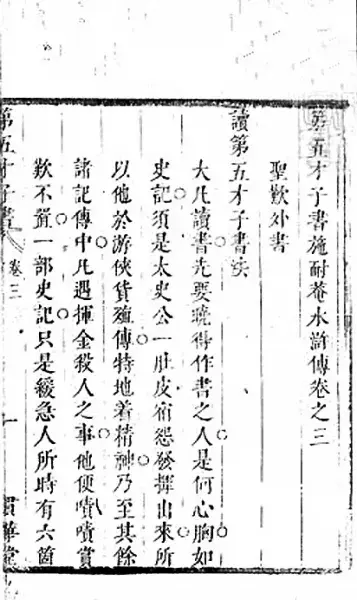
In 1641, at age thirty-four, Jin completed his revolutionary commentary on Water Margin (The Fifth Book of Genius). Up to that point, orthodox Confucian literati had dismissed vernacular novels as crude tales inciting banditry. Jin boldly proclaimed that Water Margin was a work of supreme literary genius comparable to the works of Zhuangzi, Qu Yuan, and Sima Qian.
Examining the prevailing hundred-chapter edition, Jin concluded that the final thirty chapters dealing with imperial amnesty and campaigns against Liao and Fang La were clumsy, moralizing additions written by inferior hands. Demonstrating ruthless aesthetic resolve, he truncated the text at chapter seventy-one, ending the novel with Lu Junyi's harrowing nightmare of mass execution, and provided incisive prefaces and line-by-line commentaries. The edition was an immediate sensation, superseding all competing editions to become the standard reading version throughout the Qing Dynasty.
In 1656, Jin published his annotated edition of Wang Shifu's Romance of the Western Chamber (The Sixth Book of Genius). Applying Chan concepts of reality and emptiness to human love, he rejected moralistic condemnations of the play as obscene, asserting that authentic passion was pure and sacred. He pruned the fifth act as an inferior addition, ending the drama with Cui Yingying's heartbreaking parting dream. In 1659, he established the Changjing Hall academy in Suzhou, lecturing on Du Fu's poetry and compiling Dushi Jie (The Fourth Book of Genius), attracting hundreds of disciples.
In 1660, the young Shunzhi Emperor read Jin Shengtan's commentaries in the Forbidden City, remarking to court grandees: "This man is a master of classical prose; do not view him through the lens of examination essays." When news of the imperial praise reached Suzhou, fifty-three-year-old Jin wept with joy, performing prostrations toward Beijing in heartfelt gratitude.
Tragically, this imperial recognition could not shield him from local bureaucratic malevolence. In January 1661, the Shunzhi Emperor died suddenly of smallpox. Shortly thereafter, newly appointed Wu County Magistrate Ren Weichu arrived in Suzhou. Greedy and ruthless, Ren used brutal beatings to extort back-taxes from impoverished peasants, beating several to death, while embezzling ten myriads of shi of famine relief grain from public granaries.
In early March 1661, during official mourning rituals for the late emperor at the local Confucian Temple, Jin Shengtan joined over a hundred scholars at Minglun Hall. Weeping before the imperial tablet, they decried the magistrate's tyranny and marched to the yamen of Jiangsu Governor Zhu Guozhi to present a joint petition demanding Ren Weichu's dismissal.
Governor Zhu Guozhi was deeply corrupt and in collusion with Ren Weichu. Terrified that the petition would expose his own kickbacks, Zhu arrested eleven leading scholars on the spot. Seeking to crush gentry resistance, Zhu submitted emergency memorials to the Qing regency in Beijing, falsely charging that the scholars had staged an anti-tax rebellion and profaned the late emperor's funeral altar.
The Manchu regency under Oboi, determined to terrorize Jiangnan scholar-gentry, ordered a joint military tribunal in Jiangning. Transported to provincial dungeons, Jin Shengtan endured torture with unbending dignity, insisting they had merely petitioned against corrupt officials. Nevertheless, on August 7, 1661 (13th day of the 7th month), imperial orders condemned Jin Shengtan and seventeen fellow scholars to summary decapitation, with their properties confiscated and families banished to Ningguta.
At the Sanshan Street execution grounds in Jiangning, Jin stood calm before the executioners. Requesting three bowls of wine from the supervising officer, he drank them down, laughing: "Decapitation is a painful thing; drinking wine is a joyful thing; drinking wine before decapitation is sheer delight!" Observing his weeping son Jin Yong, he uttered his famous couplet: "The lotus seed inside the heart is bitter; the pear fruit within the belly is sour"—using homophonic puns on lian (pity) and li (separation) that brought onlookers to tears. Legend records that as his head fell, two paper pellets rolled from his ears inscribed with the characters "Good" and "Pain," demonstrating his defiant humor to the final second. Following his death, his clan brother Jin Chang and son Jin Yong collected his scattered manuscripts, publishing Collected Drafts of Books of Genius from Changjing Hall to preserve his monumental critical legacy for future generations.
Jin Shengtan's crowning intellectual breakthrough was breaking the millennia-old Confucian hierarchy that separated high classical literature from popular entertainment. He formulated the landmark canon of the "Six Books of Genius": Zhuangzi (First), Li Sao (Second), Records of the Grand Historian (Third), Du Fu's Poetry (Fourth), Water Margin (Fifth), and Romance of the Western Chamber (Sixth).
By elevating vernacular fiction and stage drama to equal standing with pre-Qin philosophy and Han dynasty historiography, Jin demonstrated that literary greatness depended upon emotional vitality and stylistic genius rather than archaic decorum. His theory conferred canonical legitimacy on vernacular Chinese literature, paving the way for the golden age of Qing fiction and drama.
Anticipating modern Western narratology and New Criticism, Jin Shengtan developed a comprehensive theoretical vocabulary for analyzing narrative structure and psychological pacing in fiction. Rejecting simple moralistic judgments, he scrutinized the structural skeleton of prose narratives.
He identified dozens of artistic techniques: the "gray trace of a grass snake" (subtle foreshadowing operating across dozens of chapters), "broken mountain ridge clouds" (narrative interruption creating dramatic suspension), and "shading clouds to reveal the moon" (indirect characterization via supporting figures). He insisted that a novel must function as an organic whole, with every episode serving overarching architecture. His critical framework directly inspired the commentaries of Mao Zonggang on Romance of the Three Kingdoms, Zhang Zhupo on Jin Ping Mei, and Zhiyanzhai on Dream of the Red Chamber.
In characterization theory, Jin Shengtan articulated principles of psychological complexity and linguistic individuation. He observed that Water Margin captivated readers because "it creates a distinct personality for every one of the 108 heroes."
He demonstrated that authentic literary characters must possess multidimensional consistency: Lu Zhishen transitions from reckless brawling to solemn Buddhist renunciation without compromising his heroic core, while Li Kui exhibits cunning amid peasant simplicity. In dialogue, he established the rule that "every category of person must speak in their authentic voice." This dialectical approach rescued Chinese literary criticism from flat, moralistic stereotyping.
In dramatic theory, Jin's commentary on Romance of the Western Chamber championed the moral legitimacy of human affection with his doctrine that "desire does not impair true love." He interpreted romantic devotion as an authentic manifestation of nature, challenging rigid Neo-Confucian prudery through Zen insights.
As an editor, Jin exercised radical aesthetic authority. Convinced that late sequels diluted narrative tension, he excised the final thirty chapters of Water Margin and the fifth act of Western Chamber. While controversial among modern bibliographers, his truncated editions transformed both works into tightly structured dramatic tragedies, maximizing their emotional impact on generations of readers.
In classical poetics, Jin developed the "Section and Half-Section" (Jie and Banjie) analytical method in Dushi Jie. Moving beyond mechanical four-line stanzas, he demonstrated how regulated verse advanced thought through two-line functional shifts.
Analyzing Du Fu's masterpieces such as Autumn Thoughts and Northbound Journey, he illuminated the emotional undertones of specific diction, showing that Du Fu's greatness sprang from profound empathy for ordinary human suffering. His poetic methodology deeply influenced Qing critics, including Xu Zeng in Shuo Tangshi.
Jin Shengtan's commentaries crossed the seas during the seventeenth through nineteenth centuries, reshaping literary criticism across East Asia. In Joseon Korea, his editions of Water Margin and Western Chamber captivated scholars such as Yu Man-ju and Yi Deok-mu. Korean writers adapted his critical format to produce annotated editions of classical fiction, including Chunhyangjeon, founding the Korean tradition of novel criticism.
In Edo Japan, Confucian scholars including Yanada Tsugai and Kiyota Dansō immersed themselves in Jin's writings. Playwright and novelist Takizawa Bakin integrated Jin's structural techniques and prologue conventions into his masterworks Chōetsu Akashi and Nansō Satomi Hakkenden, demonstrating Jin Shengtan's foundational role in East Asian narrative arts.
FIGURES ASSOCIATED WITH THIS DYNASTY