Birth in Qiantang
Born into a prosperous scholarly family in Renhe County, Hangzhou, displaying childhood precocity.
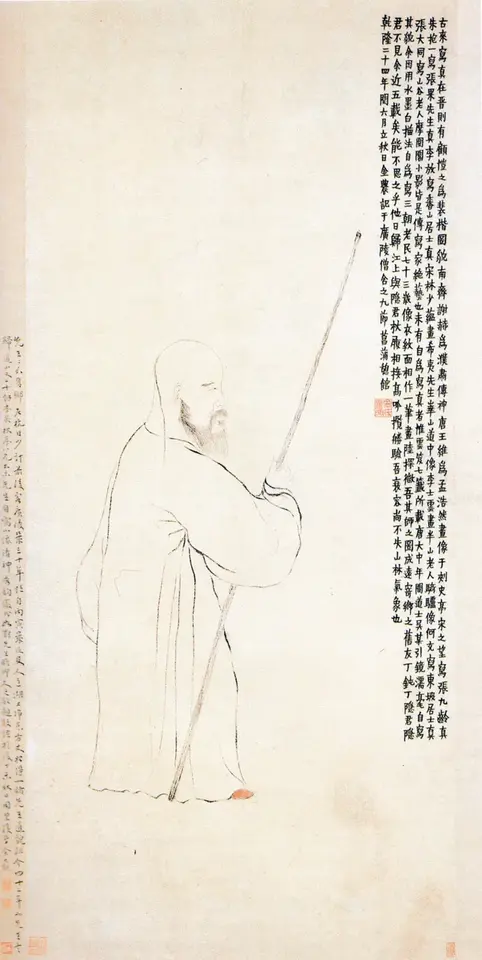
金农
Jin Nong (1687–1763), originally named Sinong, courtesy name Shoumen, and pseudonyms Dongxin Xiansheng, Jiliu Shanmin, Qujiang Waishi, and Xiye Jushi, self-styled "Elder Subject of Three Reigns" having lived through Kangxi, Yongzheng, and Qianlong, was a native of Renhe County, Hangzhou Prefecture, Zhejiang Province. He was a celebrated mid-Qing painter, calligrapher, scholar, and poet, revered as the undisputed leader and…
Jin Nong (1687–1763), originally named Sinong, courtesy name Shoumen, and pseudonyms Dongxin Xiansheng, Jiliu Shanmin, Qujiang Waishi, and Xiye Jushi, self-styled "Elder Subject of Three Reigns" having lived through Kangxi, Yongzheng, and Qianlong, was a native of Renhe County, Hangzhou Prefecture, Zhejiang Province. He was a celebrated mid-Qing painter, calligrapher, scholar, and poet, revered as the undisputed leader and central titan of the "Eight Eccentrics of Yangzhou." Studying in youth under the eminent classical scholar He Zhuo, he mastered classical philology and poetry, living as a neighbor and epigraphic partner to Ding Jing, the founder of the Xiling Seal Art Society. In 1736 (the first year of the Qianlong reign), recommended for the special imperial Boxue Hongci examinations in Beijing, he failed to gain an appointment, prompting him to abandon official ambitions and wander across Shandong, Hebei, Shanxi, Shaanxi, and Guangdong. After fifty, he settled in Yangzhou, supporting himself entirely through selling calligraphy and paintings. Jin possessed towering pride and antique erudition, accumulating thousands of rare epigraphic rubbings. In calligraphy, trimming flexible brush hairs flat, he synthesized Han-Wei clerical steles and stone cave carvings to invent the monumental "Lacquer Script" (Qishu), characterized by thick horizontal bars and hairline vertical cuts. Beginning painting earnestly at fifty-three, he developed an archaic, unvarnished style, excelling in dry-brush ink plum blossoms, bamboo, horses, and Buddhist icons, profoundly influencing modern freehand painting.
Born into a prosperous scholarly family in Renhe County, Hangzhou, displaying childhood precocity.
Traveled to Suzhou to study classical philology, poetry, and textual criticism under master He Zhuo.
Resided beside West Lake, forging a lifelong epigraphic friendship with seal carving master Ding Jing.
Recommended by Chancellor Qiu Siqin for the Boxue Hongci examination; failed and wandered through the north.
Settled in Yangzhou after widespread travels, beginning systematic painting practice at age fifty-three.
Resided in Tianning and Western Monasteries in Yangzhou, interacting with Zheng Xie and Li Shan.
His daughter died during childbirth in Tianjin, followed by his wife's death; sent away his mute concubine.
Supported himself in poverty by copying sutras, carving inkstones, and painting lanterns, attended by Luo Ping.
Died in the monk's quarters of Western Monastery in Yangzhou at seventy-six, buried in Hangzhou by Luo Ping.
In 1687 (the twenty-sixth year of the Kangxi reign), Jin Nong was born in Renhe County, Hangzhou Prefecture, Zhejiang Province. Residing along the scenic banks of the Qiantang River, the Jin family possessed affluent circumstances and refined scholarly traditions. Precocious from boyhood, Jin developed an obsession with antiquity, gathering ancient bronze seals, fragmentary stone rubbings, and classical manuscripts.
As a young man, Jin traveled to Suzhou to become a personal disciple of master He Zhuo. He Zhuo was a foremost evidentiary philologist and calligrapher highly favored by Emperor Kangxi. Under his guidance, Jin methodically explored pre-Qin and Han classics, poetic prosody, and bronze-stone epigraphy, establishing encyclopedic erudition. Returning to Hangzhou, Jin resided beside Ding Jing, the future founder of the Xiling Seal Engraver's Society. The two spent days and nights examining Shang-Zhou bronze inscriptions and Han seal impressions, cementing a lifelong artistic bond.
Between late Kangxi and Yongzheng, disdaining the rigid eight-legged examination curriculum, Jin spent over a decade wandering the empire as a private scholar. He climbed Mount Tai in Shandong, inspected the Great Wall across Hebei, traversed the Yellow River through Shanxi and Shaanxi, and sailed the Xiang River into Guangdong, exploring most of the empire. These travels broadened his perspective, granting him access to monumental cliff inscriptions and aristocratic private collections, gathering thousands of stone rubbings that provided dynamic vitality for his future artistic innovations.
Following the strict ideological control of the Yongzheng reign, Emperor Qianlong ascended the throne in 1736 and issued an imperial decree convening the special Boxue Hongci examination in Beijing to recruit celebrated non-official scholars. Fifty-year-old Jin Nong, celebrated throughout Jiangnan for his erudition, received a high-level recommendation from Director of the Imperial Academy Qiu Siqin, traveling north with aspirations of statecraft.
However, the imperial examination was dominated by bureaucratic factionalism and orthodox courtly conventions. Jin was proud and uncompromising, refusing to flatter court dignitaries. His examination essays were archaic and boldly expressive, conflicting directly with the rigid, glossy style demanded by chief examiners, resulting in his failure to place on the imperial roster.
The rejection permanently extinguished Jin's interest in official careers. Leaving Beijing in disillusionment, he composed verses lamenting the futility of courtly honors. On his return south, he carved personal seals reading "Elder Subject of Three Reigns" and "Retired Scholar of Jiangnan," resolving to remain a private commoner, supporting himself entirely through artistic labor in urban society.
In 1739 (the fourth year of the Qianlong reign), fifty-three-year-old Jin settled in the commercial metropolis of Yangzhou. Salt merchant tycoons and high officials accumulated immense fortunes in the city, cultivating a vibrant market for private art collecting that offered fertile ground for independent literati painters.
Upon arriving in Yangzhou, Jin initially supported himself by ghostwriting memorial tablets, composing prefaces, and selling family collections of rare books. Recognizing that literary remuneration was insufficient for subsistence, Jin undertook a bold artistic transformation in his fifties, devoting his full energy to painting. Possessing decades of evidentiary scholarship, calligraphic mastery, and aesthetic connoisseurship, Jin bypassed the superficial conventions of orthodox Ming and Qing painting.
Residing in simple monk's cells at Sanyi Pavilion and Western Monastery, he painted behind closed doors. Employing seal and clerical brushwork, he began painting plum blossoms at fifty-three, followed by bamboo, horses, Buddhist luohan icons, and scholar-gardens. Jin's art discarded glossy sweetness in favor of archaic awkwardness, weathered desolation, and profound intellectual wit. Regional salt magnates and connoisseurs competed eagerly to purchase his scrolls. Jin became the acknowledged intellectual leader of the innovative literati circle that included Zheng Xie (Zheng Banqiao), Li Shan, Luo Ping, and Wang Shishen, celebrated as the head of the "Eight Eccentrics of Yangzhou."
Although celebrated in Yangzhou and occasionally earning thousands of silver taels annually, Jin lived with generous carelessness. Indifferent to financial calculations, he spent his income assisting impoverished scholars and destitute neighbors, leaving his own household without savings.
In his final years, domestic tragedies struck in rapid succession. His beloved daughter Haishan died during childbirth in Tianjin, and his aging wife, who had accompanied her north, fell mortally ill from sorrow. Jin sold paintings frantically to raise traveling funds to bring her back to Yangzhou, yet she passed away shortly after returning home. Following her demise, only a mute concubine remained by his side. Unable to maintain her livelihood amidst mounting poverty, Jin sorrowfully sent her away, spending his twilight years alone in the monastic cells of Western Monastery.
Dim-sighted and infirm in old age, Jin supported himself by transcribing Buddhist sutras, carving stone inkstones, and painting paper festival lanterns. His devoted disciple Luo Ping and Luo's wife, Fang Wanyi, attended him daily with filial devotion. In the autumn of 1763 (the twenty-eighth year of the Qianlong reign), the seventy-six-year-old master passed away quietly in his monastery quarters. Leaving no estate, his burial was funded through loans raised by Luo Ping, who transported his casket back to Hangzhou to be interred on Mount Huanghe.
In the history of Chinese calligraphy, Jin Nong was an innovator of epochal significance. Since the Tang dynasty, regular and clerical brushwork had ossified into rigid conventions, while the imperial court scripts of the mid-Qing reduced writing to lifeless, symmetrical craftwork.
Jin formulated a revolutionary script known as "Lacquer Script" (Qishu). This style synthesized Han dynasty stone monuments, the Three Kingdoms Wu Tianfa Shenchen Stele, and Northern Wei cave inscriptions such as the Shimen Ming and Cuan Baozi Stele. To eliminate the rounded habit of conventional center-brush writing, Jin cut the flexible tips of his long-haired brushes flat, executing bold strokes using a flat, ink-saturated brush face.
Lacquer Script featured compressed horizontal geometry with block-like square stroke beginnings and endings. Horizontal bars were unyielding and dense like black lacquer applied with a plasterer's trowel, while vertical strokes were executed as thin hanging needles with sweeping flicked terminals. Spacing was compact between lines yet open between characters, projecting monumental architectural weight and modernist compositional tension. Lacquer Script shattered centuries of calligraphic dogma, standing as an uncompromising monument of individualist artistic liberation.
As the leader of the Eight Eccentrics of Yangzhou, Jin Nong established an original aesthetic in Chinese literati flower-and-bird painting. Since late Ming masters like Xu Wei and early Qing hermits like Bada Shanren, commercial flower painting had often degenerated into formulaic flashiness.
Beginning painting at fifty-three, Jin bypassed contemporary academic mannerisms. He achieved international fame for his depictions of flowering plum trees. Traditional painters followed the delicate, sparse branches established by Song master Yang Buzhi and Yuan master Wang Mian; Jin took the opposite approach, depicting wild, ancient, and densely blossoming plum trees.
Using dry scorched ink, he rendered twisted, archaic trunks resembling coiled iron bars, crisscrossed by tangled branches. Blossoms were dotted with alternating washes of dry and diluted ink, crowding by the thousands across withered boughs in vibrant profusion. He noted in an inscription: "One branch, two branches, tens of thousands of branches; where do the chattering birds find spring?" His plum blossoms combined the unyielding frost-defying spirit of mountain hermits with the robust vitality of popular urban culture.
Beyond plum blossoms, his dry-brush plantains, ink bamboo, and contemplative Buddhist arhat figures executed with archaic seal lines achieved consummate awkwardness (Zhuo) and natural vitality (Shengqu), establishing the permanent historical prestige of the Yangzhou School.
Beyond painting and calligraphy, Jin was an evidential philologist and literary stylist, recognized as the most erudite scholar among the Eight Eccentrics of Yangzhou.
A passionate collector of antiquity, Jin amassed over a thousand volumes of bronze and stone rubbings, displaying discerning connoisseurship in verifying ancient seal clay, roof tiles, and Han inscriptions. His prose drew from Sima Qian and Han Yu, characterized by archaic diction, published in Collected Works of Master Dongxin and Miscellanies of Dongxin.
His painted colophons—including Inscriptions on Painting Bamboo, Inscriptions on Painting Horses, Inscriptions on Painting Plum Blossoms, and Dongxin's Jottings—remain masterpieces of miniature classical prose. These inscriptions combined reflections on artistic technique, accounts of literati gatherings, and critiques of ancient masters, blending rigorous evidentiary critique with poetic sensibility, preserving foundational historical documentation on eighteenth-century Jiangnan culture.
FIGURES ASSOCIATED WITH THIS DYNASTY