Royal Birth
Born into the royal house of Silla in Geumseong; grandson of King Jinji and member of the True Bone aristocracy.
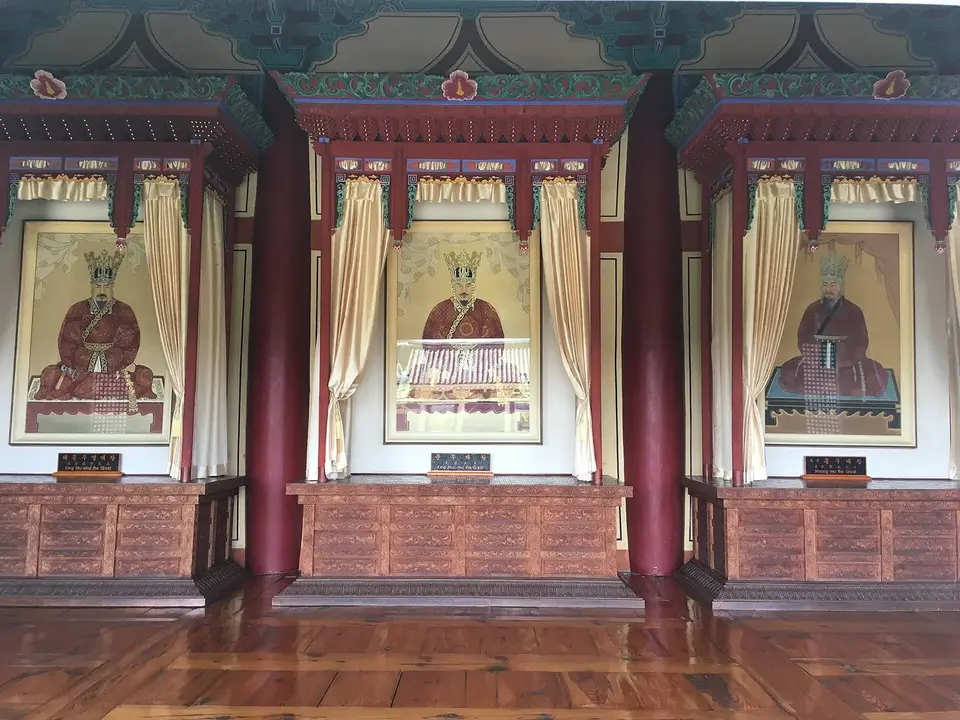
金春秋
Kim Chunchu (603–661), posthumously honored with the temple name Taejong and posthumous title King Muyeol, was the 29th monarch of the Korean kingdom of Silla, reigning from 654 to 661. The grandson of King Jinji and son of Kim Yongchun, his mother was Princess Cheonmyeong, daughter of King Jinpyeong. He was the first monarch from the "True Bone" (Jingol) aristocratic grade to ascend the throne, breaking the historic…
Kim Chunchu (603–661), posthumously honored with the temple name Taejong and posthumous title King Muyeol, was the 29th monarch of the Korean kingdom of Silla, reigning from 654 to 661. The grandson of King Jinji and son of Kim Yongchun, his mother was Princess Cheonmyeong, daughter of King Jinpyeong. He was the first monarch from the "True Bone" (Jingol) aristocratic grade to ascend the throne, breaking the historic monopoly of the "Hallowed Bone" (Seonggol) royal lineage and laying the strategic foundations for Silla's ultimate unification of the Three Kingdoms. In his early career, Kim Chunchu held prominent offices such as Ichan and forged an enduring political-military partnership with General Kim Yu-shin. Following the catastrophic fall of Daeya Fortress in 642, in which his beloved daughter and son-in-law were slain by Baekje forces, Chunchu dedicated himself to the annihilation of Baekje, embarking on perilous diplomatic missions to Goguryeo, Wa (Japan), and Tang China. In 648, he traveled to Chang'an, securing an audience with Emperor Taizong and forging the historic Silla-Tang military alliance. Returning home, he spearheaded comprehensive Tang-style reforms across Silla's court, standardizing vestments, institutions, and calendar eras. Ascending the throne in 654, King Muyeol coordinated closely with Emperor Gaozong and Tang general Su Dingfang, orchestrating a coordinated amphibious offensive in 660 that extinguished the kingdom of Baekje, forever altering the geopolitical landscape of East Asia.
Born into the royal house of Silla in Geumseong; grandson of King Jinji and member of the True Bone aristocracy.
Baekje troops captured the strategic fortress of Daeya; his daughter Gotaso and son-in-law were slain, igniting his resolve to crush Baekje.
Dispatched by Queen Seondeok to seek military assistance; resisted Yeon Gaesomun's territorial extortion and escaped detention through cunning wit.
Collaborated with General Kim Yu-shin to crush the aristocratic rebellion of Bidam, enthroning Queen Jindeok and consolidating power.
Journeyed to the Tang imperial capital with his son Kim Mun-wang, securing Emperor Taizong's commitment to a joint military alliance.
Instituted Tang court robes and official vestments across Silla; subsequently adopted the Tang imperial calendar and reign titles.
Following Queen Jindeok's demise without Seonggol heirs, the Council of Nobles unanimously elected Kim Chunchu as the 29th monarch.
Commissioned by Emperor Gaozong as Area Commander of the Yuyi Route Army; deployed Kim Yu-shin's 50,000 troops alongside Su Dingfang's Tang forces to annihilate Baekje.
Passed away from illness in Geumseong at age 59 while planning the northern campaign against Goguryeo; bestowed temple name Taejong and title King Muyeol.
During his youth, Kim Chunchu enjoyed immense prestige within the aristocratic youth corps known as the Hwarang. Historical records celebrate Chunchu's refined countenance, composed demeanor, and magnanimous character. When Kim Yu-shin assumed leadership as Pungwolju (Supreme Master of the Hwarang), Chunchu modestly accepted the subordinate rank of Vice-Master (Buje) to support him; subsequently deferring to senior masters Bojong and Yeomjang, Chunchu only assumed office as the 18th Pungwolju at the age of twenty-four. This martial-spiritual training instilled in Chunchu unyielding personal fortitude and forged deep loyalty across Silla's emerging military elite.
Beyond domestic statecraft, Chunchu displayed keen strategic interest in the maritime geopolitics of East Asia. In 647 (Queen Seondeok 16), confronting the burgeoning diplomatic axis between Baekje and the kingdom of Wa (Japan), Chunchu personally sailed across the sea on an embassy to the Yamato court. Received with immense ceremony by Emperor Kotoku and Prince Naka no Oe (later Emperor Tenji), Chunchu's erudition and commanding intellect left a lasting impression. He utilized the embassy to assess Japan's Taika Reforms, subsequently carrying letters from Wa to Chang'an during his mission to the Tang court, demonstrating extraordinary multilateral diplomatic agility.
Kim Chunchu was born in 603 during the Sui-Tang transition. His grandfather was King Jinji, the 25th monarch of Silla, while his father was the eminent noble Kim Yongchun (posthumously King Munheung Galmunwang), and his mother was Princess Cheonmyeong, the eldest daughter of King Jinpyeong. Under Silla's rigid Bone Rank system (Golpum), King Jinji's historical deposition had relegated his descendants from the supreme "Hallowed Bone" (Seonggol) caste to the elite "True Bone" (Jingol) grade. Though barred from direct primary succession, Chunchu was distinguished from early youth by commanding stature, refined intellect, and boundless statesmanship.
Recognizing that lineage prestige alone could not secure national survival, Chunchu sought alliances with rising martial clans, notably Kim Yu-shin, a scion of the annexed Gaya royal house whose battlefield renown was sweeping the realm. To cement their political union and overcome conservative noble factionalism, Chunchu married Yu-shin's younger sister Munhui (later Queen Munmyeong). This union created an indomitable partnership: Chunchu provided grand diplomatic vision and administrative authority, while Yu-shin commanded Silla's formidable military host.
During the reign of Queen Seondeok, Chunchu was elevated to Ichan, the second-highest bureaucratic rank, while simultaneously serving as Chief Administrator of the Sijeongbu, the supreme disciplinary inspection organ. He assisted the crown in stabilizing state finances and curbing aristocratic abuses, generating unprecedented social cohesion within the embattled kingdom.
In the autumn of 642 (Zhenguan 16), King Uija of Baekje unleashed an overwhelming campaign against Silla, seizing more than forty western border fortresses before besieging the linchpin citadel of Daeya (modern Hapcheon, South Gyeongsang). The fortress commander, Ichan Kim Pumseok, was slain in battle, and his wife Gotaso—Chunchu's cherished eldest daughter—was executed alongside him.
When the news reached Geumseong, Chunchu was shattered by grief. He stood leaning against a courtyard pillar, refusing to blink or acknowledge passing courtiers for an entire day. Finally breaking his silence, he uttered a ferocious vow: "Alas! Can a true man not swallow Baekje whole?" Transforming personal bereavement into an unyielding geopolitical crusade, Chunchu petitioned Queen Seondeok to dispatch him as envoy to northern rival Goguryeo to solicit military intervention.
Upon arriving in Pyongyang, Chunchu discovered that Goguryeo was under the iron-fisted military dictatorship of Yeon Gaesomun. Refusing to offer unconditioned assistance, Yeon demanded that Silla cede all territories north and west of the Jungnyeong pass as the price for an alliance. Chunchu courageously retorted: "I came to solicit aid for my sovereign in distress. For your majesty to exploit our plight and demand our sacred ancestral territory is intolerable; I would rather face execution than consent!" Yeon Gaesomun threw Chunchu into solitary confinement. Facing imminent death, Chunchu bribed counselor Sun Do-hae, who cryptically narrated the ancient fable of the turtle and the hare. Taking the hint, Chunchu deceitfully pledged to persuade Queen Seondeok to cede the land upon his safe return, securing his release. This harrowing experience convinced Chunchu that peace with Goguryeo was an illusion and that only the supreme power of the Tang Empire could liberate Silla from regional strangulation.
In early 647 (Zhenguan 21), conservative nobleman Bidam launched an armed insurrection against the crown under the slogan "female rulers cannot maintain order." As rebel forces encircled the capital, Queen Seondeok passed away amid the panic. Working in seamless coordination, Kim Chunchu and Kim Yu-shin orchestrated a brilliant tactical counterattack, crushing the rebel forces and executing Bidam along with thirty conspirators. They elevated Jinpyeong's niece, Princess Seungman, to the throne as Queen Jindeok. Through this decisive victory, Chunchu eliminated conservative resistance and consolidated supreme executive authority within his coalition.
Confronting relentless Baekje invasions, Chunchu embarked on his most fateful mission. In late 648 (Zhenguan 22), he sailed across the Yellow Sea accompanied by his son Kim Mun-wang, journeying to the Tang capital of Chang'an. Emperor Taizong, informed of the Silla prince's arrival, dispatched Guanglu Minister Liu Heng to escort him into the metropolis with imperial honors, receiving him in the grand halls of Taiji Palace. Impressed by Chunchu's regal bearing and eloquent rhetoric, Taizong celebrated him as an exemplary statesman.
During intimate private audiences, Chunchu tearfully recounted Baekje's perfidious aggression and its deliberate blockade of Silla's tribute routes to China. Deeply moved, and recognizing the immense strategic utility of utilizing Silla to pin down Goguryeo's southern flank, Emperor Taizong solemnly pledged: "We shall dispatch imperial armies to crush Baekje first, and subsequently subdue Goguryeo. Within thirty years, our combined forces shall pacify the peninsula, and all lands south of Pyongyang and former Baekje territories shall be granted to Silla!" This historic covenant cemented the unbreakable Silla-Tang military alliance.
Ascending the throne as the 29th monarch, King Muyeol recognized that the hereditary power of the Sangdaedeung (Prime Minister) and the conservative Hwabaek Council severely curtailed the royal executive. To establish a centralized administrative apparatus, the king executed a profound institutional overhaul. He reorganized the royal treasury (Pumju) into the Jipsabu (Chancellery), designating its director, the Jungsik (later styled Sijung), as the supreme executive officer directly accountable to the monarch.
This crucial institutional innovation transferred executive decision-making from the traditional clan aristocracy to royal ministers. Concurrently, King Muyeol adopted Tang legal codifications, establishing specialized judicial and legislative bureaus (Ibangbu) that transformed Silla from a rudimentary tribal confederation into a sophisticated centralized bureaucratic state governed by written statutes.
While residing in Chang'an, Chunchu closely examined Tang administrative structures, court ceremonials, and the Confucian academy. Emperor Taizong appointed Chunchu a Specially Advanced Official (Tejin) and permitted his son Mun-wang to enter the elite Imperial Bodyguard. Chunchu formally petitioned the throne to introduce Tang court vestments into Silla and requested permission for Silla royal scions to study at the National Academy in Chang'an. Taizong enthusiastically consented, presenting Chunchu with imperial brocade robes and a personal calligraphy rubbing of the Jin Cibei.
Returning to Silla in 649, Chunchu instituted comprehensive institutional Sinification with Queen Jindeok's full backing. Traditional tribal dress was abolished in favor of Tang-style robes, sashes, and official caps. In 650, Chunchu terminated Silla's independent Taehwa calendar, formally adopting the Tang imperial Yonghui era. These institutional reforms enhanced administrative centralization while aligning Silla culturally and diplomatically with the Chinese world order.
In March 654 (Yonghui 5), Queen Jindeok passed away without a direct Seonggol successor. Convening at the Hwabaek Council, Silla's highest nobility, led by Prime Minister Alcheon, unanimously proclaimed Kim Chunchu as the 29th monarch. Though initially displaying ritual modesty, Chunchu accepted the crown as King Muyeol, opening the era of True Bone monarchical governance.
Upon his accession, King Muyeol elevated Kim Yu-shin to Sangdaedeung (Prime Minister), overhauling naval forces and military logistics while maintaining constant diplomatic correspondence with Emperor Gaozong. In March 660 (Xianqing 5), Emperor Gaozong officially issued the imperial decree for the conquest of Baekje, appointing Left Militant Guard General Su Dingfang as Commander-in-Chief of an armada carrying 130,000 Tang troops across the Yellow Sea. Concurrently, Gaozong commissioned King Muyeol as Area Commander of the Yuyi Route Army.
In May, King Muyeol established his headquarters at Namcheon to oversee national mobilization, dispatching Crown Prince Kim Beopmin and General Kim Yu-shin with fifty thousand elite troops. While Su Dingfang shattered naval defenses at the mouth of the Baekgang River, Kim Yu-shin overcame General Gyebaek's desperate stand at the Battle of Hwangsanbeol. On July 12, the Tang and Silla armies linked up beneath the walls of Sabi, storming the capital. King Uija was captured at Ungjin, bringing an end to the seven-century-old kingdom of Baekje.
Entering the conquered royal capital, King Muyeol presided over a magnificent victory banquet. In symbolic retribution for the massacre at Daeya, King Uija was compelled to pour wine on bended knee for Su Dingfang and the Silla commanders, reducing the captured Baekje nobility to tears. Through eighteen years of tireless planning, King Muyeol avenged his family and doubled Silla's territory, establishing uncontested hegemony across the southern Korean peninsula.
With the southwestern front secured, King Muyeol turned Silla's national strength toward assisting the Tang in the final offensive against Goguryeo. In late 660, as Su Dingfang's legions advanced toward Pyongyang, King Muyeol mobilized immense grain supplies, overcoming blizzard conditions to provision the allied forces besieging the northern fortress.
However, decades of ceaseless diplomatic travel, grueling institutional reforms, and high-intensity military leadership had shattered the monarch's health. In June 661 (Longshuo 1), as the Goguryeo campaign hung in the balance, King Muyeol passed away suddenly in his royal palace at Geumseong at the age of fifty-nine.
The entire kingdom plunged into profound mourning. In accordance with his testament, the crown passed to his eldest son, Crown Prince Kim Beopmin (King Munmu). Emperor Gaozong suspended court audiences in Chang'an, posthumously promoting Chunchu to Senior Official of the Household and extending lavish condolences. In honor of his historic accomplishments, Silla nobles broke precedent to grant him the imperial temple name Taejong and posthumous title King Muyeol, entombing him at the western royal necropolis.
King Muyeol's preeminent historical legacy was his visionary construction of the Silla-Tang military alliance. Caught between the aggressive pincer of Goguryeo and Baekje during the mid-7th century, Chunchu correctly grasped East Asian geopolitics, crossing stormy seas to Chang'an to secure the personal commitments of Emperors Taizong and Gaozong.
This alliance introduced 130,000 elite Tang soldiers to the peninsula, decisively shattering the regional balance of power. The strategic synergy between Tang naval mobility and Silla land infantry dismantled centuries of regional stalemate, charting the irreversible path toward peninsular unification.
Prior to King Muyeol's reign, Silla monarchs were known exclusively by titles assumed during their lifetimes, lacking systematic Confucian posthumous titles or temple names. King Muyeol initiated the practice of adopting formal Chinese-style posthumous names and ancestral temple designations.
Following his demise, the Silla court honored him with the imperial temple name Taejong and the posthumous title King Muyeol. He stood as the sole monarch in Silla history to possess an official temple name of Taejong. During the Shenlong era of the Tang Dynasty, Emperor Zhongzong objected that the temple name infringed upon Emperor Taizong's imperial designation, ordering Silla to abolish it. However, the Silla court submitted an eloquent memorial detailing King Muyeol's monumental service in extinguishing Baekje and stabilizing East Asia, prompting the Tang court to grant a special imperial dispensation preserving King Muyeol's temple name in perpetuity.
Under Silla's rigid Bone Rank system, supreme sovereign power was historically restricted to the narrow "Hallowed Bone" (Seonggol) caste. With the extinction of direct male Seonggol heirs, aristocratic succession disputes threatened to tear the realm apart. Relying on his merit in crushing Bidam's revolt, his diplomatic stature, and administrative brilliance, Chunchu secured the unanimous backing of the Hwabaek Council.
His accession as the first True Bone king abolished the mechanical tyranny of sacred bloodline dogmas, restructuring the political hierarchy of the Silla court. This breakthrough revitalized administrative mobility for the Jingol and Head-Rank Six elites, infusing Silla's state apparatus with dynamism and meritocratic competence.
King Muyeol was one of the most resolute institutional modernizers in ancient East Asian history. Recognizing the organizational superiority of the Tang administrative system, he executed extensive Sinification reforms upon his return from Chang'an. Beginning with official court robes and insignia, and culminating in the adoption of the Tang calendar and reign titles, he infused Silla with imperial bureaucratic efficiency.
These structural innovations curbed the centrifugal power of tribal aristocrats, bolstered the centralized authority of the crown, and elevated Silla's diplomatic standing within the Confucian world order, earning the kingdom the revered title "Realm of Noble Gentlemen" (Junziguo).
Confronting the deep trauma of the Daeya massacre, King Muyeol demonstrated extraordinary strategic patience. For eighteen years, he avoided rash military adventures, methodically building domestic troop strength while coordinating with Tang commanders.
During the climactic 660 campaign, King Muyeol directed supply lines while deploying Kim Yu-shin's fifty thousand troops across Hwangsanbeol to converge with Su Dingfang's armada. In a campaign lasting merely four months, the centuries-old Baekje kingdom was dismantled, eliminating Silla's primary existential threat and securing vast agrarian lands and human populations.
Throughout his reign, King Muyeol demonstrated remarkable humility and magnanimity. His lifelong partnership with General Kim Yu-shin transcended clan rivalries, establishing a peerless model of mutual loyalty and harmony between sovereign and minister in East Asian historiography.
Domestically, he strengthened the disciplinary oversight of the Sijeongbu, ruthlessly punishing corruption while promoting educated Head-Rank Six scholars to high state councils. He groomed his sons Kim Beopmin, Kim Inmun, and Kim Mun-wang to be versatile statesmen, ensuring unbroken policy continuity as Silla advanced toward the ultimate unification of the Three Kingdoms.
FIGURES ASSOCIATED WITH THIS DYNASTY