Biography
Imperial Lineage and Palace Upbringing
Princess Jincheng was born around 698 into the princely residence in the imperial capital. Her grandfather was Crown Prince Zhanghuai Li Xian, the son of Emperor Gaozong and Empress Wu Zetian, and her father was Li Shouli, who inherited the title Prince of Bin (formerly Prince of Yong).
Because Crown Prince Zhanghuai had perished amidst political purges during the reign of Wu Zetian, Li Shouli spent his youth under palace surveillance until the restoration of Emperor Zhongzong in 705. Upon regaining the throne, Zhongzong restored honors to his brother's descendants, adopting the young Li Nunu as his daughter and raising her within the Daming Palace.
Within the inner court, she received an imperial education alongside the monarch's daughters. She studied poetry, court etiquette, classical histories, and Buddhist literature. Official chronicles noted that she grew up in the palace possessing gentle refinement and understanding public duties, demonstrating maturity and moral poise.
Betrothal to Tibet and Farewell at Shiping
During the late Wu Zhou and early Zhongzong eras, military competition surged along the Hexi Corridor. Tang commanders Tang Xiujing and Chen Daci defeated invading Tibetan forces along the Tao River, restoring Tang tactical advantage across Central Asia. Recognizing the costs of conflict, the Tibetan regent dowager sought matrimonial diplomacy.
In 707, the Tibetan regent dowager dispatched senior minister Xixunre to Chang'an, presenting tributary gifts of gold and horses to formally request an imperial marriage for the young monarch Tride Tsuktsen. Desiring border peace and reduced military expenditures, Emperor Zhongzong approved the alliance, conferring upon his adopted daughter the title Princess Jincheng.
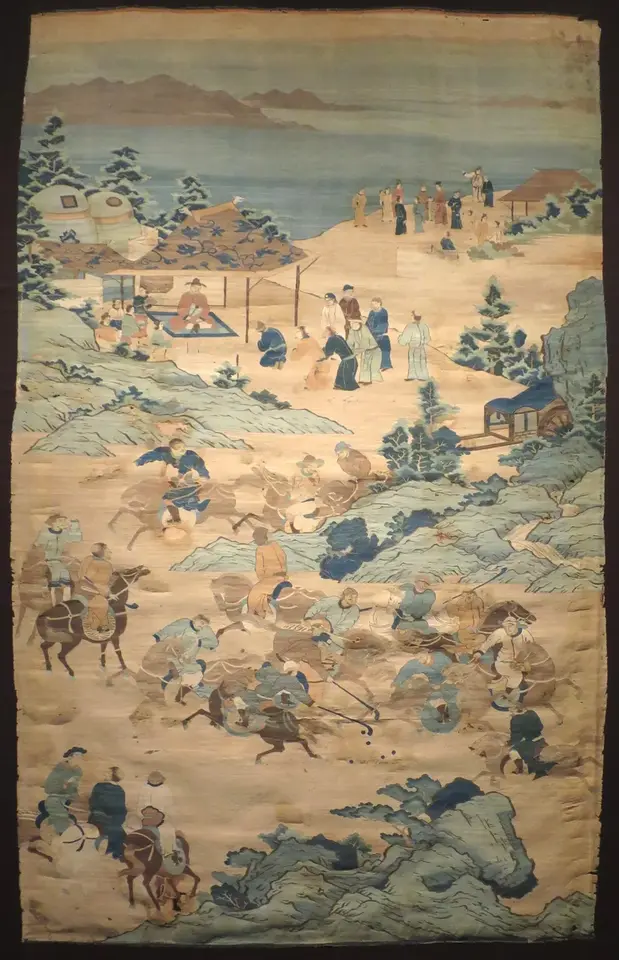
In the winter of 709, Tibetan Prime Minister Shang Zanduo arrived in Chang'an with an escort of over a thousand cavalry. In the spring of 710, Zhongzong commissioned General of the Left Militant Guard Yang Ju to command the escort. Deeply attached to the young princess, Zhongzong crossed the Wei River to Shiping County (modern Xingping, Shaanxi), erecting pavilions beside the Baiqing Lake to host a banquet for the court and foreign ambassadors.
Addressing the assembly, the emperor wept openly over sending his young daughter across distant deserts. Zhongzong commanded attendant ministers to compose farewell poems, issued an edict renaming Shiping County as Jincheng County, and granted tax remissions to local households, leaving an account of paternal affection in dynastic annals.
Royal Welcome and Walled Palace in Lhasa
The bridal retinue journeyed along the Tang-Tibetan Ancient Road traversed seven decades earlier by Princess Wencheng. Crossing the Long Mountains, traversing the Tao River, and traversing the Qinghai plateau and Sun-Moon Mountain, the entourage arrived at the Tibetan capital of Lhasa in late 710.
To welcome the imperial bride, the Tibetan monarch commanded tribes along the route to carve roads through rock and refurbish relay stations. Tride Tsuktsen met the procession outside Lhasa. Honoring her royal status, he constructed a walled palace city for her private residence, formally consecrating her as Queen (Tsenmo).
Princess Jincheng brought a substantial dowry from Emperor Zhongzong, including tens of thousands of bolts of patterned silk, classical histories, agricultural treatises, medical compendia, and a retinue of artisans skilled in metallurgy, textile weaving, brewing, and sculpture, alongside a court orchestra of Qiuci musicians. Her arrival enriched the material wealth of the Tibetan court, introducing central plains cultural influences onto the plateau.
Border Conflict and Diplomatic Mediation
However, peace was complicated by strategic rivalries. Shortly after her arrival, geopolitical competition between the two empires re-emerged along the border.
Tang Protector General of Anxi Zhang Xuanbiao launched raids into northern Tibetan territories. Resentful yet reluctant to sever the royal alliance, Tibetan ministers bribed Shanzhou Military Governor Yang Ju to petition the throne, requesting that the fertile Jiuqu region north of the Yellow River (in modern southeastern Qinghai) be granted to Princess Jincheng as her bathing appanage. Emperor Ruizong granted the request.
Jiuqu possessed pasturage and fertile soil ideal for military garrisoning and cavalry breeding, directly commanding access into the Tang heartland. Possessing this strategic territory, Tibetan commanders launched offensives into the Tao River valley beginning in 714. Tang generals Xue Ne and Wang Jun counterattacked, engaging in battles at Changchengbao and Dalaigu that cost tens of thousands of lives.
Confronted with war between her native homeland and adopted realm, Princess Jincheng endured personal sorrow. Resisting factional pressures, she advocated for civilian welfare and diplomatic peace. She warned Tride Tsuktsen against territorial aggression and secretly dispatched couriers to Emperor Xuanzong to convey peace proposals. In an imperial rescript, Xuanzong commended her: "Far away in distant frontiers, you preserve peace and loyalty; your upright integrity deserves profound praise."
Treaty of Chiling and Passing on the Plateau
Through Princess Jincheng's mediation, Tride Tsuktsen dispatched an embassy to Chang'an in 730 to offer apology and petition for peace, addressing Emperor Xuanzong as maternal uncle and restoring traditional diplomatic kinship.
In 733, with the princess's coordination, Tang and Tibetan commissioners convened at Mount Chiling (modern Sun-Moon Mountain, Qinghai) for a demarcation ceremony. The parties erected a monument inscribed with the oath: "Henceforth each side shall guard its own frontiers without encroachment." Following the treaty, border markets reopened, facilitating trade in silks, tea, porcelain, and horses, inaugurating a period of frontier peace.
In cultural life, Princess Jincheng dedicated herself to the plateau's spiritual traditions. She restored the Jokhang and Ramoche temples, retrieving the life-sized statue of the twelve-year-old Shakyamuni Buddha brought by Princess Wencheng and enshrining it in the central hall of the Jokhang Temple.
In 739 (the Tibetan Year of the Rabbit), Princess Jincheng passed away in Lhasa at the age of forty-two. The Tibetan monarch and people observed national mourning, and Tride Tsuktsen conducted state funeral rites. In 741 (the Year of the Snake), the Tibetan court held an imperial memorial service in Lhasa, recording her deeds in historical records.
Major Achievements
Fostering the Maternal-Nephew Alliance and the Treaty of Chiling
Throughout two centuries of Tang-Tibetan relations, Princess Jincheng was a vital mediator sustaining the maternal-nephew diplomatic bond (jiusheng alliance).
During the early Kaiyuan period, protracted warfare engulfed the Hexi Corridor. Despite deep hostility between border commanders, Princess Jincheng served as an anchor of reconciliation within the Tibetan court, restraining pro-war factions.
In 730, she helped draft the Tibetan memorial to Emperor Xuanzong, in which the tsenpo wrote that through the marriage of Princess Jincheng, both empires had become one family, ensuring peace for all subjects. In 733, her efforts led to the Treaty of Chiling, establishing an era of border stability celebrated by historians as an example of imperial diplomacy.
Enshrining the Buddha Statue and Restoring Sacred Temples
Princess Jincheng made contributions to the revival and institutionalization of Tibetan Buddhism.
In the decades following Princess Wencheng's death, native Bon factions carried out anti-Buddhist campaigns. Opponents had removed the sacred statue of Shakyamuni Buddha brought by Princess Wencheng from the Ramoche Temple, concealing it within a hidden corridor.
Upon arrival, Princess Jincheng used her authority as queen to locate the statue. She gilded the icon and relocated it to the central sanctuary of the Jokhang Temple, where it remains the holiest shrine of Tibetan Buddhism. Furthermore, she restored the Ramoche and Samye temples, inviting Buddhist monks from Khotan and Central Asia to translate sutras and preach, establishing Buddhism upon the plateau.
Transmitting Central Plains Crafts and Material Culture
As a cultural envoy, Princess Jincheng stimulated development across Tibetan society.
Her retinue of artisans introduced techniques of sericulture, silk embroidery, gold and silver chasing, bronze casting, and kiln ceramics to local communities. Under her patronage, Tibetan nobles studied Chinese script, and young aristocrats were sent to Chang'an to study classical philosophy at the National University (Guozijian).
In agriculture, she introduced iron plowshares, water-mill irrigation devices, and grain varieties, establishing vegetable cultivation and tree planting along the Yarlung Tsangpo River valley. Techniques of brewing, sauce making, and food preservation altered the pastoral diet of the plateau.
Pioneer of Sino-Tibetan Medical Integration
In the history of traditional Tibetan medicine, Princess Jincheng initiated the synthesis of Chinese pharmacology and indigenous Tibetan healing practices.
She brought court medical treatises and physicians to Lhasa, establishing dispensaries to treat commoners suffering from high-altitude respiratory and rheumatic diseases.
She organized teams of Chinese and Tibetan physicians to translate classical works such as the Shennong Bencao Jing and the Maijing into ancient Tibetan. Integrating these texts with native herbs and cauterization methods, they compiled the medical treatise Somaraza (The Moon King's Medical Diagnosis). The work remains a foundational cornerstone of traditional Tibetan medicine.