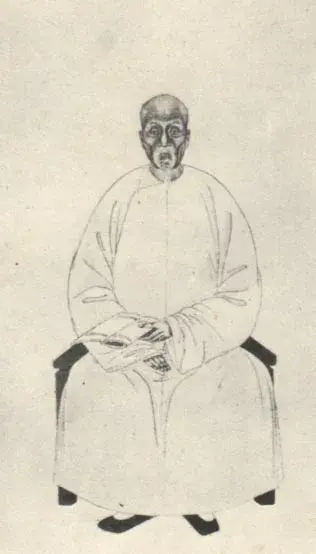
Life and Career
Classical Heritage and Early Precocious Intellect
Jiao Xun was born on March 17, 1763, in Huangjue Town, Jiangdu County, Yangzhou Prefecture, Jiangsu Province. The Jiao lineage had long engaged in agricultural scholarship, maintaining an exceptional pedigree in the study of the Book of Changes (Yijing). Both his grandfather Jiao Changfa and father Jiao Qingfeng were accomplished scholars well versed in the classics, astronomy, and computational mathematics. Nurtured within this stimulating domestic environment, young Jiao demonstrated dazzling comprehension and photographic memory.
In 1768, at the age of six, Jiao entered the family academy to study the Classic of Poetry (Mao Shi) and ancient prose style under his cousin Fan Zhenglin. In 1770, at age eight, he accompanied his grandfather to the Ruan family residence to celebrate an elder's birthday. During the feast, guests recited an inscribed poem containing the mythological name Fengyi, pronouncing it colloquially. Eight-year-old Jiao stepped forward, calmly asserting that according to ancient phonological rhymes in the Chuci, the characters must be pronounced with archaic bilabial initials rather than modern colloquial sounds. Scholar Ruan Chengxun was astonished by the boy's erudition, praised him as an intellectual prodigy, and immediately arranged the betrothal of his daughter to Jiao. This encounter laid the foundation for Jiao's lifelong intellectual brotherhood with Ruan Yuan.
Beginning in 1773, Jiao studied Xu Shen's Shuowen Jiezi under his kinsman Jiao Shi, investigating paleography, ancient phonetic categories, and script evolution. He immersed himself not merely in the Thirteen Classics, but also in pre-Qin and Han treatises on astronomy, calendrical calculation, historical geography, and acoustics, establishing the foundational knowledge that underpinned his later polymathic achievements.
Intellectual Fellowship with Ruan Yuan and Scholarly Wandering
In 1779, seventeen-year-old Jiao passed the local examinations to become a county licentiate. Around this period, he formed an intimate, enduring friendship with fellow townsman Ruan Yuan. The two young scholars met constantly in Yangzhou and rural Jiangdu to debate philological problems and classical ethics. In 1787, twenty-five-year-old Jiao completed his pioneering Illustrations of Palatial Architecture in the Classics (Qunjing Gongshi Tu). In this treatise, Jiao demonstrated that several authoritative architectural commentaries by Eastern Han master Zheng Xuan contained glaring structural contradictions, and proposed rigorous corrections.
This bold revision provoked intense pushback from Jiang Sheng, an orthodox disciple of the Wu School master Hui Dong. Jiang wrote letters sharply challenging Jiao's interpretations, leading to an extensive written debate. Through this controversy, Jiao and Ruan Yuan came to realize that the Wu School's blind deference to Eastern Han commentators had degenerated into dogmatism. In his preface to Jiao's work, Ruan Yuan enthusiastically endorsed Jiao's critical independence, formulating the guiding principle of evidential scholarship: seeking truth rather than blind deference to antiquity.
Between 1793 and 1800, when Ruan Yuan served successively as provincial director of education in Shandong and Zhejiang, Jiao accompanied him as an intimate scholarly counselor. During these travels, Jiao ascended Mount Tai, visited the Confucian temple in Qufu, explored scenic Zhejiang, and consulted rare manuscripts in public and private archives. Interacting daily with eminent scholars like Sun Xingyan, Ling Tingkan, and Wang Chang, Jiao broadened his intellectual horizon and established a nationwide reputation.
Examination Disillusionment and Seclusion at Diaogu Pavilion
Despite his towering academic stature, Jiao's pursuit of bureaucratic office was fraught with obstacles. Because his scholarship emphasized comprehensive empirical synthesis and independent judgment rather than mechanical examination rhetoric, he repeatedly failed provincial examinations. It was not until 1801, at the age of thirty-nine, that he finally passed the Shunzhi-Zhili provincial examination in Beijing to obtain the juren degree.
However, in the imperial metropolitan examination held in 1802, Jiao was rejected by conservative court examiners. Over the following years, he sat for two further examinations without success. Recognizing the mounting corruption of the Qing bureaucracy and the intellectual poverty of the examination system, forty-year-old Jiao made an unyielding choice: he abandoned all worldly aspirations for political rank and resolved never to enter an examination hall again.
Returning to his native Huangjue, Jiao feigned chronic leg illness, vowing never to set foot in commercial cities again. He restored his modest ancestral dwelling, naming it the Banjiu Study, and constructed a two-story wooden library overlooking Lake Beihu, christened Diaogu Pavilion. Surrounded by shaded willows and tranquil waters, Jiao assembled thousands of classical and historical volumes, severed worldly social entanglements, and devoted every ounce of energy to independent scholarship. He once remarked with serene contentment that although his household was impoverished, his library of thousands of books was sufficient to nourish his soul for a lifetime.
Prolific Scholarly Creation and Classical Synthesis
During his two decades of seclusion at Diaogu Pavilion, Jiao led a rigorous yet intellectually exhilarating existence. Rising before dawn, he spent entire days surrounded by mountainous stacks of texts, annotating, calculating, and writing. Contemporary scholars dubbed him the Copying Enthusiast: on one occasion when torrential rains flooded the river and entered his threshold, Jiao remained seated calmly at his southern window, copying ancient manuscripts without pause.
In his study of the Book of Changes (Yijing), Jiao recognized that previous scholars had either succumbed to superstitious Han apocrypha or indulged in vague Song-Ming metaphysical introspection. Adopting an unprecedented approach, Jiao integrated mathematical proportions, root extraction, and reciprocal permutations into the analysis of hexagram lines. After a decade of concentrated calculation and textual collation, he completed the monumental forty-volume Three Books on the Changes from Diaogu Pavilion (Diaogu Lou Yixue Sanshu) by 1806, establishing himself as the supreme master of mathematical Yijing exegesis.
Following this achievement, Jiao directed his formidable intellect toward Mencius. Since Zhu Xi had compiled the Collected Commentaries on the Four Books in the Southern Song, the Mencius had been constrained by rigid Neo-Confucian dogma, while Zhao Qi's ancient Han commentary had been neglected. Jiao resolved to construct an exhaustive new commentary that recovered the original spirit of Confucius and Mencius. Beginning in 1805, he scrutinized hundreds of classical commentaries across two millennia. After twelve years of unremitting toil, he finalized the thirty-volume Correct Meaning of Mencius (Mengzi Zhengyi) in 1817, creating the crowning glory of Qing evidential Mencian studies.
Alongside these major treatises, Jiao assisted Yangzhou Prefect Alinbao in compiling the Revised Gazetteer of Yangzhou Prefecture, collaborated with local physician Li Bing on pharmacology to produce Medical Notes of Venerable Li (Li Weng Yiji) and Book on Variolation (Zhongdou Shu), and applied rigorous empirical methods across astronomy, regional drama, and local gazetteers.
Final Scholarly Devotion and Demise
In his twilight years, though afflicted by failing eyesight and chronic ailments, Jiao's scholarly passion burned brighter than ever. Alongside classical studies, he explored algebra, geometry, acoustics, and regional drama, authoring groundbreaking scientific and theatrical treatises.
By 1819, decades of exhaustion provoked severe pulmonary hemorrhage and crippling rheumatism. Even when confined to bed, he rested against wooden bolsters, dictating editorial revisions and directing his eldest son Jiao Tinghu to collate the manuscript of the Correct Meaning of Mencius. He repeatedly reminded his sons that scholarly research must adhere strictly to factual verification without ever seeking empty fame.
On August 4, 1820, this towering master of evidential learning passed away peacefully at Diaogu Pavilion at the age of fifty-eight. Upon learning of his death, Ruan Yuan, then Viceroy of Liangguang, wept aloud in grief and contributed substantial personal funds to print and publish Jiao's collected works, known as the Diaogu Pavilion Collection. Living as an unadorned commoner scholar, Jiao enriched Chinese intellectual history with dozens of masterpieces, epitomizing the finest ideals of universal classical scholarship.
Major Achievements
Authoring the Three Books on the Changes to Revolutionize Yijing Exegesis
Among Jiao Xun's vast scholarly output, his most original and theoretical masterpiece was the forty-volume Three Books on the Changes from Diaogu Pavilion (Diaogu Lou Yixue Sanshu), comprising Exegesis of the Changes (Yi Zhangju) in twelve volumes, Outline of Diagrams of the Changes (Yi Tuluo) in eight volumes, and Comprehensive Explanations of the Changes (Yi Tongsbi) in twenty volumes. This monumental work transformed two millennia of Chinese Yijing scholarship.
Jiao argued that the Book of Changes was originally an empirical, rational system developed by ancient sages to observe cosmic patterns and govern human affairs, governed by consistent mathematical logic. Jiao systematically introduced computational algorithms, reciprocal proportions, and permutation principles into the analysis of hexagrams, formulating three fundamental interpretive laws: lateral penetration (pangtong), reciprocal interlacing (xiangcuo), and temporal progression (shixing). By applying rigorous structural rules, he deduced the shifting positions of all 384 lines across the sixty-four hexagrams, generating a harmonious and rational interpretation of previously obscure line statements. Later scholars praised the treatise for injecting a scientific spirit into traditional philosophy, representing the zenith of mathematical classical studies in imperial China.
Compiling the Thirty-Volume Correct Meaning of Mencius
While his Yijing scholarship highlighted mathematical modeling, Jiao's thirty-volume Correct Meaning of Mencius (Mengzi Zhengyi) embodied the absolute pinnacle of Qing evidential philology, universally acclaimed as one of the finest commentaries in the Thirteen Classics tradition.
Before Jiao, interpretations of the Mencius were heavily colored by Song-Ming Neo-Confucian moral metaphysics, which often imposed anachronistic ethical categories upon pre-Qin texts. Jiao reclaimed and transcended Eastern Han scholar Zhao Qi's ancient commentary, exhaustively cross-referencing dozens of commentators across imperial history. Crucially, Jiao advanced beyond pure phonological collation to reconstruct Mencius's moral philosophy. Firmly rejecting the Song Neo-Confucian doctrine of eliminating human desires, Jiao argued that Mencian benevolence and righteousness represented the natural, rational regulation of legitimate human desires through empathy (shu). Characterized by profound philological rigor and humane ethical insight, the Correct Meaning of Mencius remains the definitive standard edition in global Sinological scholarship.
Pioneering Abstract Symbolic Algebra in Jiajian Chengchu Shi and Tianyuan Yi Shi
Beyond his philological renown, Jiao was a seminal figure in the history of Chinese mathematics. His treatises Explanations of Addition, Subtraction, Multiplication, and Division (Jiajian Chengchu Shi) in eight volumes and Explanations of the Celestial Element (Tianyuan Yi Shi) in two volumes marked a historic transition from concrete numerical calculation to abstract mathematical laws.
Scrutinizing ancient mathematical classics and newly introduced Western algebraic treatises, Jiao recognized that traditional rod counting and abacus methods focused narrowly on finding specific answers without formulating abstract axioms. In Jiajian Chengchu Shi, Jiao pioneered the use of Chinese characters as abstract algebraic symbols to designate unknown variables and operations, systematically demonstrating the commutative, associative, and distributive properties of arithmetic operations. In Tianyuan Yi Shi, he synthesized the Song-Yuan polynomial algebra (tianyuan shu) with Western equations. His work earned high acclaim from leading mathematicians such as Ruan Yuan and Li Huang, occupying an honored place in the history of science.
Integrating Astronomy and Spherical Trigonometry
Jiao's scientific explorations extended deeply into observational astronomy, calendrical computation, and spherical geometry.
While assisting Ruan Yuan in drafting Biographies of Astronomers and Mathematicians (Chouren Zhuan), Jiao analyzed the mathematical strengths and weaknesses of ancient astronomers. He absorbed Western treatises including Euclid's Elements and imperial astronomical manuals, realizing that mapping celestial orbits required spherical trigonometry. Jiao authored scientific papers such as Explanations of Wheel Orbits (Shi Lun), Explanations of Ellipses (Shi Tuo), and Methods for Calculating Spherical Triangles, rigorously demonstrating focal properties of elliptical orbits and coordinate transformations between the ecliptic and celestial equator. Embracing open cross-cultural scientific inquiry, he utilized Western computational tools to elucidate ancient Chinese astronomical achievements.
Formulating a New Hermeneutics Harmonizing Scholarship and Spiritual Vitality
During the famous intellectual debate on evidential scholarship versus creative writing, Jiao made profound philosophical contributions by articulating a new vision of classical learning that integrated empirical rigor with spiritual vitality (xingling).
By the late eighteenth century, the Wu School's narrow philological focus had begun to degenerate into sterile, pedantic word-hunting. Poet Yuan Mei attacked evidential scholars for lacking spiritual vitality, claiming that only creative poetry embodied genuine human feeling. Intervening in this debate, Jiao demonstrated intellectual independence: he concurred with Yuan Mei's critique of sterile pedantry, affirming that authentic scholarship required creative vitality; yet he rejected Yuan's narrow view that spiritual vitality belonged solely to frivolous verse. Jiao argued that genuine classical learning was the consummate union of objective erudition and subjective spiritual vitality, representing the historical unfolding of human wisdom. This synthetic philosophy revitalized Qing evidential scholarship.
Establishing the Historiographical Foundations of Chinese Drama in Ju Shuo
Jiao's scholarly vision was remarkable for his pioneering academic study of traditional Chinese regional drama, a field long disdained by orthodox Confucian scholar-gentry.
While orthodox literati dismissed theatre as vulgar entertainment, Jiao recognized dramatic literature as an invaluable mirror of popular culture, vernacular linguistics, and societal psychology. Drawing upon hundreds of historical chronicles, miscellanies, and literary collections, he authored Drama Discourse (Ju Shuo) in six volumes, systematically tracing dramatic origins, role categories, theatrical troupes, and playwright biographies, thereby establishing the structural model for Chinese theatrical historiography. Furthermore, in Agricultural Talks on the Flower Divisions (Huabu Nongtan), he shifted attention from elite Kunqu opera to regional popular theatre (the flower divisions, including Qinqiang and Luantan), celebrating their vitality and moral accessibility. His treatises were hailed by modern scholars such as Wang Guowei as foundational landmarks in Chinese dramatic history.
Compiling Han Ji and Beihu Xiaozhi for Local Historical Geography
Deeply attached to his native Yangzhou, Jiao devoted extensive energy to recording local history, cultural geography, and folklore, producing Han Ji and Beihu Xiaozhi.
In Han Ji (Annals of the Han Canal) in six volumes, Jiao investigated the city defense, grand canal water conservancy, salt administration, and ancient monuments of Yangzhou since pre-Qin times, rectifying numerous chronological errors in earlier gazetteers. In the lake country where he lived, he conducted field research on irrigation channels, dykes, agricultural crops, and folklore to compile Beihu Xiaozhi (Brief Gazetteer of Lake Beihu). Combining scientific geographical accuracy with graceful prose, the work vividly documented rural society in mid-Qing Jiangnan, pioneering a micro-geographical methodology in Chinese local history.
Composing Lunyu Tongshi to Articulate Confucian Humanism
While analyzing the Mencius, Jiao sought to cleanse Confucian ethics of Song-Ming ascetic distortions by composing Comprehensive Explanations of the Analects (Lunyu Tongshi) in one volume comprising fifteen treatises, modeled after Dai Zhen's Evidentiary Commentary on the Meanings of Terms in the Mencius.
Jiao meticulously analyzed primary ethical terms such as benevolence (ren), righteousness (yi), ritual propriety (li), wisdom (zhi), loyalty (zhong), empathy (shu), and human nature (xing). He demonstrated that Confucius's concept of benevolence was not an abstract metaphysical essence, but rather the practical virtue of empathy (shu) manifested in reciprocal human interactions. Jiao maintained that all human beings possessed legitimate material desires and emotional needs, and that the duty of the sage was to harmonize and fulfill these desires rather than extinguish them under the pretext of heavenly principle. Lunyu Tongshi provided an indispensable philosophical pillar for his humanist critique of Neo-Confucian asceticism.
Collating Mao Shi Dili Shi and Botanical Philology in the Classic of Poetry
In the realm of geographical and biological philology, Jiao conducted meticulous investigations into the natural landscape and flora and fauna recorded in the Classic of Poetry (Shijing).
Dissatisfied with Wang Yinglin's Song-era treatise on poetry geography, Jiao authored Explanations of Geography in the Mao Poetry (Mao Shi Dili Shi) in four volumes. Correlating ancient feudal boundaries with modern river channels and on-site topography, he clarified long-standing disputes concerning the geographical domains of the regional Airs (Guofeng). Furthermore, he authored Explanations of Plants, Trees, Birds, Animals, Insects, and Fish in the Mao Poetry in eleven volumes alongside Sub-commentary Verification on Lu Ji. Integrating ancient pharmacopoeias with botanical observations, he identified the archaic names, morphological habits, and habitats of over one hundred species, establishing a paradigm of botanical philology.
Producing Liujing Bushu and Rectifying Ancient Han Commentaries
As a master of evidential research, Jiao produced an extensive corpus of foundational commentaries on ancient classics, epitomized by Illustrations of Palatial Architecture in the Classics and Supplementary Sub-commentaries to the Six Classics (Liujing Bushu) in twenty volumes.
In the former, he drew fifty structural reconstruction diagrams of ancient palaces, altars, and ancestral temples, calculating interior depths and column placements to resolve discrepancies among Han and Wei scholars. In Liujing Bushu, Jiao composed supplementary sub-commentaries on the Changes, Documents, Poetry, Zuo Zhuan, Rites, and Analects. Guided by the principle of completing what predecessors left unfinished and correcting what predecessors distorted, he tackled enigmatic passages that earlier commentators had avoided, rectifying ancient omissions through exhaustive textual collation.
Reconstructing Wu Shi Bencao and Pioneering Medical Philology
Believing that the rigorous philological methods of classical scholarship were equally applicable to ancient medical literature, Jiao made seminal contributions to traditional Chinese pharmacology and medical philology.
In 1792, Jiao extracted lost citations from the Northern Song imperial encyclopedia Taiping Yulan to reconstruct the lost three-kingdoms medical text Wu's Herbal (Wu Shi Bencao) in one volume. This represented the first systematic philological reconstruction of an ancient pharmaceutical text in Qing history, establishing the methodology of medical textual recovery. In clinical theory, his 1807 treatise Treatise on Chaihu Syndromes systematically analyzed Zhang Zhongjing's Treatise on Cold Damage, pioneering the methodology of syndrome-formula differentiation. He additionally documented the clinical cures of local master Li Bing in Medical Notes of Venerable Li (Li Weng Yiji) and summarized experimental smallpox variolation in Book on Variolation (Zhongdou Shu), actively promoting epidemic disease prevention.
Contributing to the Revised Gazetteer of Yangzhou Prefecture
In local gazetteer theory and practice, Jiao harmonized rigorous empirical verification with narrative clarity, profoundly influencing mid-Qing regional historiography.
In 1806, Jiao joined Prefect Alinbao in compiling the Revised Gazetteer of Yangzhou Prefecture. In the ongoing debate between Zhang Xuecheng (who favored treating gazetteers as dynastic histories) and Hong Liangji (who favored treating them as geographical surveys), Jiao championed a balanced synthesis: gazetteers must trace temporal evolution while maintaining geographical precision and celebrating civic virtue. Jiao drafted the official registers, biographies, and epigraphic treatises, rectifying dozens of administrative and chronological errors from earlier editions and producing a model provincial gazetteer.
Formulating the Philosophy of Universal Mutability and Practical Commerce
Behind Jiao's deep philological studies lay an enlightened philosophical ontology and a progressive economic perspective that championed commercial enterprise.
In ontology, Jiao advanced the doctrine that principle governs number, while number governs form, asserting that the cosmos was a perpetual process of generative yin-yang transformation. In political economy, drawing upon the Yijing concept that transformation ensures enduring prosperity, Jiao perceived the growing crisis of demographic pressure and rural poverty in mid-Qing society. He condemned state mercantilist restrictions and traditional anti-merchant prejudices, advocating the circulation of commodities and the protection of fair trade. Declaring that government policy should advance the people's natural self-interest, he articulated an enlightened, forward-looking economic vision that anticipated modern commercial thinking.