Birth in Burgundy
Born in Autun, receiving classical humanistic and mathematical education under his father's tutelage.
蒋友仁
Michel Benoist (1715–1774), known in Chinese as Jiang Youren, was a French Jesuit missionary, hydraulic architect, mechanical engineer, astronomer, and cartographer who served at the Qing imperial court for three decades. Educated in Dijon during his youth, he subsequently graduated from the Saint-Sulpice Seminary in Paris and the Jesuit novitiate in Nancy, mastering higher calculus, terrestrial mechanics, and modern…
Michel Benoist (1715–1774), known in Chinese as Jiang Youren, was a French Jesuit missionary, hydraulic architect, mechanical engineer, astronomer, and cartographer who served at the Qing imperial court for three decades. Educated in Dijon during his youth, he subsequently graduated from the Saint-Sulpice Seminary in Paris and the Jesuit novitiate in Nancy, mastering higher calculus, terrestrial mechanics, and modern astronomy under leading academicians of the Academie Royale des Sciences. Arriving in Macao in 1744 (the ninth year of the Qianlong reign), Benoist was summoned to Beijing the following year by Emperor Qianlong as a mathematician. In 1747, strongly recommended by the Italian court painter Giuseppe Castiglione, Benoist was entrusted with the engineering design and hydraulic construction of the monumental "European Palaces" (Xiyanglou) fountains in the Changchun Garden of the Old Summer Palace (Yuanmingyuan). Over twelve years of rigorous construction, he created historic hydraulic marvels including the Xieqiqu fountains, the famous Haiyantang Water-Clock with the Twelve Zodiac Bronze Heads, and the Grand Fountains of Yuanyingguan, flawlessly integrating European hydrodynamic engineering with traditional Chinese imperial architectural aesthetics. In cartography and astronomy, Benoist presented the magnificent silk Complete Map of the Terrestrial World (Kunyu Quantu) in 1760, which systematically introduced Copernican heliocentrism, Kepler's laws of planetary motion, and contemporary European telescopic discoveries to the Qing court for the first time. He subsequently integrated geodetic surveys from Xinjiang and Tibet to compile the landmark Qianlong Atlas of the Inner Court (Qianlong Neifu Yutu, or Thirteen-Tier Copperplate Map of Qianlong). Benoist passed away in Beijing in 1774 at the age of fifty-nine; Emperor Qianlong granted one hundred taels of silver for his burial at the Zhengfusi Jesuit Cemetery. He remains one of the most consequential conduits of eighteenth-century Sino-European scientific and cultural exchange.
Born in Autun, receiving classical humanistic and mathematical education under his father's tutelage.
Graduated from Saint-Sulpice Seminary in Paris; subsequently studied higher mathematics and astronomy in Nancy.
Ordained as a Jesuit priest; received advanced astronomical training from academicians of the French Academy of Sciences.
Sailed around the Cape of Good Hope to reach Macao, immersing himself in intensive study of the Chinese language.
Arrived in Beijing upon imperial decree by Emperor Qianlong to serve as a mathematician in the palace.
Appointed chief hydraulic architect of the European Palaces at Yuanmingyuan; completed the Xieqiqu fountains.
Successfully completed the Haiyantang Zodiac Water-Clock and the Grand Fountains after twelve years of work.
Presented the monumental Kunyu Quantu to Emperor Qianlong, introducing Copernican heliocentrism and Keplerian mechanics.
Initiated the compilation of the Qianlong Atlas of the Inner Court integrating new surveying data from Xinjiang.
Supervised the reprinting of the two hundred sets of the sixteen copperplate engravings of Emperor Qianlong's Western Campaigns.
Died of a stroke in Beijing at age fifty-nine; interred with royal funeral subsidy at the Zhengfusi Cemetery.
Michel Benoist was born on October 8, 1715, in Autun in the Duchy of Burgundy, France. Born into a cultivated family, his father personally oversaw his primary education, providing him with a rigorous foundation in classical Latin, mathematics, and rhetoric. During adolescence, inspired by the apostolic legacy of Matteo Ricci, Johann Adam Schall von Bell, and Ferdinand Verbiest in China, Benoist nurtured an ardent desire to serve on the China mission, notwithstanding determined family opposition.
In 1737, Benoist completed theological studies at the Saint-Sulpice Seminary in Paris, being ordained a subdeacon. He then proceeded to the Jesuit novitiate in Nancy, Lorraine, where he systematically studied differential calculus, geodesy, terrestrial physics, and celestial mechanics. Due to his exceptional intellectual gifts and sustained diligence, Benoist completed his courses early and was ordained a Jesuit priest in 1740. During years of preparation for his missionary voyage, his petition to join the China mission was formally approved. Prior to his departure from Paris, renowned astronomers from the Academie Royale des Sciences—including Joseph-Nicolas Delisle, Nicolas-Louis de Lacaille, and Pierre Charles Le Monnier—provided him with specialized training in observational astronomy, astronomical instrumentation, and contemporary cartography, agreeing to maintain regular correspondence.
In 1744 (the ninth year of the Qianlong reign), Benoist reached Macao after an arduous sea voyage. Displaying remarkable linguistic aptitude, he applied himself to the mastery of spoken and written Chinese, gaining proficiency within a single year sufficient to read historical texts and begin translating portions of the Book of Documents (Shangshu) into Latin. In 1745 (the tenth year of the Qianlong reign), Emperor Qianlong summoned Western mathematicians to Beijing to assist in court science; Benoist traveled north and was formally inducted into the palace workshops.
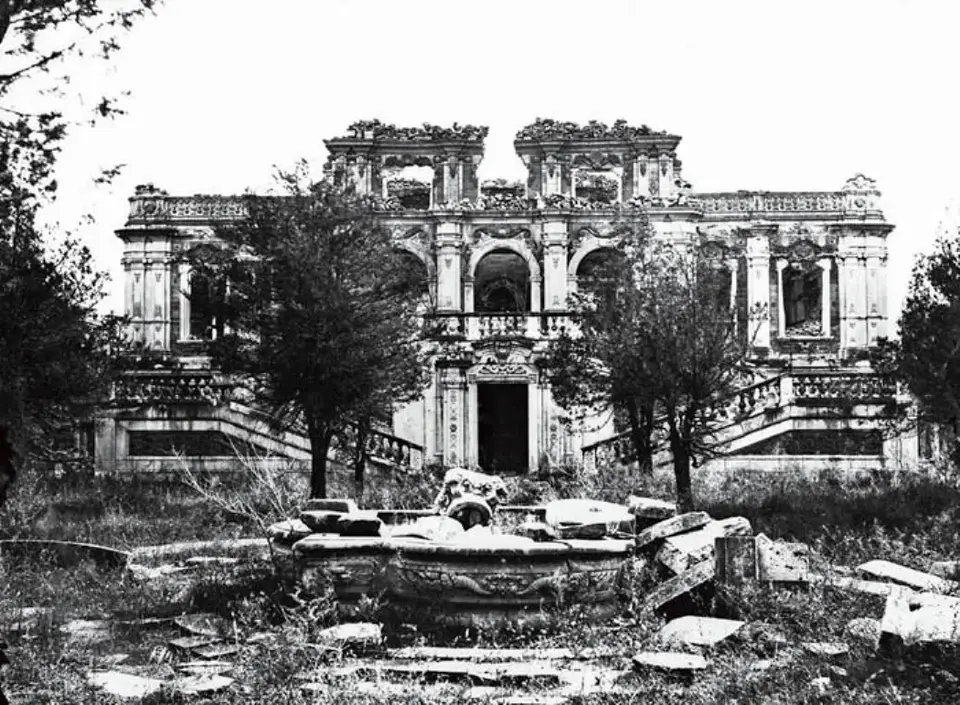
In 1747 (the twelfth year of the Qianlong reign), Emperor Qianlong decided to construct the European Palaces (Xiyanglou) in the northern portion of Changchun Garden within Yuanmingyuan, seeking to reproduce European Baroque and Rococo architectural designs. Giuseppe Castiglione, who had served as court painter for decades, vigorously recommended Benoist to the emperor, testifying to his mastery of European hydrodynamics and mechanics. Qianlong immediately commissioned Benoist to design, cast, and supervise the entire hydraulic fountain system for the Western Palaces.
That same year, the first fountain complex, Xieqiqu (Harmonious Wonder), was successfully completed, producing impressive geysers that delighted the emperor. Benoist then designed waterworks for the Water Storage Tower, the Aviary, the Labyrinth (Huanghuazhen), the Haiyantang, and the Grand Fountains of Yuanyingguan. The monumental undertaking lasted twelve years, reaching completion in 1759 (the twenty-fourth year of the Qianlong reign). Among these, the most celebrated was the Twelve Animals Clepsydra Fountain fronting Haiyantang. Positioned around a central basin were twelve bronze figures with human bodies and the heads of the Chinese zodiac animals. Utilizing an intricate mechanical water-distribution device driven by an Archimedean screw pump (termed the "Dragon Tail Wheel") housed inside the stone reservoir tower, each animal spat water into the basin for one two-hour interval corresponding to its double-hour. At midday, all twelve bronze figures jetted water simultaneously. Pressurized through underground copper pipes, the roaring fountains resonated for miles, establishing an unprecedented engineering wonder in Qing imperial history.
Following the completion of the European Palaces, Benoist enjoyed constant imperial favor, frequently being summoned to clarify geographic, calendrical, and mathematical inquiries. In 1760 (the twenty-fifth year of the Qianlong reign), on the occasion of Emperor Qianlong's fiftieth birthday, Benoist presented a monumental double-hemisphere colored world map executed on silk, entitled Kunyu Quantu (Complete Map of the Terrestrial World). Measuring 3.66 meters wide and 1.84 meters high, the map displayed the Eastern and Western hemispheres within spherical projections, flanked by nineteen astronomical diagrams and thirty-six explanatory treatises.
Within this pioneering work, Benoist presented the first systematic, comprehensive explanation of Nicolaus Copernicus's heliocentric model within official Qing imperial court documentation, alongside Johannes Kepler's first and second laws of planetary motion. He described sunspots, solar rotation, lunar topography with impact craters, the phases of Venus, the orbital periods of four Jovian moons and five Saturnian moons, Saturn's ring system, and the elliptical orbits of comets, while asserting that stars were self-luminous bodies akin to the Sun and confirming the oblate spheroidal shape of the Earth. These explanations summarized the core discoveries of seventeenth-century European astronomy achieved by Galileo Galilei, Christiaan Huygens, and Giovanni Domenico Cassini.
Following the Qing conquest of the Dzungar Khanate and southern Xinjiang, the vast territories north and south of the Tianshan Mountains were reincorporated into the Qing empire. Accurate cartographic delineation was urgently needed. In 1756 (the twenty-first year of the Qianlong reign), Benoist accompanied Grand Minister He Guozong on an expedition to the northwestern frontier, carrying out astronomical and geodetic measurements of latitudes, longitudes, and seasonal solstices across the major cities, rivers, and mountain passes of Xinjiang.
Beginning in 1761 (the twenty-sixth year of the Qianlong reign), Benoist was commanded to compile the definitive imperial atlas of Asia, entitled Qianlong Neifu Yutu (Qianlong Atlas of the Inner Court, commonly known as the Thirteen-Tier Copperplate Map of Qianlong). Using the Kangxi reign's Huangyu Quanlan Tu as a foundation, Benoist integrated the latest terrestrial surveys from Xinjiang, Qinghai, and Tibet. Employing a trapezoidal projection at a scale of 1:1,400,000, the atlas encompassed the Eurasian continent from Kamchatka to the Mediterranean and Indian Ocean, clearly demarcating Taiwan and the Diaoyu Islands within Fujian province. Benoist supervised the engraving of 104 high-precision copper plates and printed one hundred complete atlases in the palace workshops, establishing the most authoritative geographical reference for dynastic sovereign territory.
During his final years, Benoist served as superior of the French Jesuit mission in Beijing, maintaining pastoral oversight and diplomatic correspondence. Between 1773 and 1774, he executed his last major commission for the imperial court: supervising the reprinting of two hundred complete sets of the sixteen monumental copperplate battle prints illustrating the Conquest of the Western Regions, originally engraved in Paris.
In 1773, Pope Clement XIV issued the papal brief suppressing the Society of Jesus worldwide, news of which reached Beijing the following year. Having devoted his life to his order, Benoist suffered intense emotional grief, which severely compromised his health. Although Emperor Qianlong issued an edict reassuring the missionaries that their official stipends and residences would remain entirely undisturbed under imperial protection, Benoist's constitution steadily declined.
On October 23, 1774 (the nineteenth day of the ninth lunar month in the thirty-ninth year of the Qianlong reign), Benoist succumbed to a sudden stroke in Beijing at the age of fifty-nine. Emperor Qianlong expressed profound sorrow over the loss of his veteran servant, conferring one hundred taels of silver for his burial and granting permission for him to be interred in the French missionary cemetery at Zhengfusi in Haidian. Having dedicated thirty years of his life to imperial engineering and cartography, Michel Benoist was laid to rest permanently in Chinese soil.
In the architectural history of Qing imperial gardens, the hydraulic fountain system of the European Palaces at Yuanmingyuan represented the zenith of Sino-European technological synthesis in the eighteenth century. From 1747 to 1759, Benoist served as the chief hydraulic and mechanical engineer responsible for the design and construction of this massive system.
While traditional Chinese waterworks relied on gravity flow, the fountains at Changchun Garden demanded high vertical jets, layered cascades, and spinning waterwheels, posing immense mechanical challenges. Benoist deployed Archimedean screw pumps driven by gear trains to elevate water into high masonry reservoir towers, which generated hydrostatic pressure channeled through subterranean cast-copper piping to fountains at Xieqiqu, Haiyantang, and Yuanyingguan. The Haiyantang Water-Clock was the pinnacle of this achievement: twelve bronze zodiac sculptures sequentially spouted water during their respective double-hours, culminating in a collective deluge at noon. The roaring fountains created a spectacle never before witnessed in the Chinese imperial court.
Following the pacification of Xinjiang, the Qing imperial court required an authoritative atlas to establish its administrative borders and defense geography across Eurasia. Benoist was chosen to lead this cartographic endeavor.
Building upon the Kangxi Huangyu Quanlan Tu, Benoist incorporated the precise field surveys conducted across the northwest in 1756. Employing a trapezoidal projection and a uniform scale of 1:1,400,000, he constructed the monumental thirteen-tier atlas. The map covered Eastern, Northern, Central, and South Asia, providing unprecedented geographic precision regarding Central Asian khanates, Siberian borders, Tibet, and Xinjiang. Benoist directed the engraving of 104 copper plates, producing an imperial atlas that stood as a global landmark of eighteenth-century geodetic science and the definitive legal cartographic record of Qing territorial boundaries.
Earlier Jesuit scholars such as Matteo Ricci had primarily introduced the geo-heliocentric system of Tycho Brahe due to contemporary religious constraints. Benoist's presentation of the Kunyu Quantu in 1760 marked the first systematic, unreserved introduction of Copernican heliocentrism in official Qing court literature.
In his extensive commentaries, Benoist demonstrated that the Sun is the center of the solar system, with planets revolving along elliptical orbits in accordance with Kepler's laws. He detailed lunar cratered topography, the orbital periods of Jupiter's and Saturn's moons, Saturn's rings, the periodic nature of comets, and the oblate spheroidal shape of the Earth. Later examined and annotated by prominent Qing scholars such as Qian Daxin, Benoist's geographical and astronomical works provided late imperial Chinese intellectuals with foundational insights into the scientific revolution in the West.
FIGURES ASSOCIATED WITH THIS DYNASTY