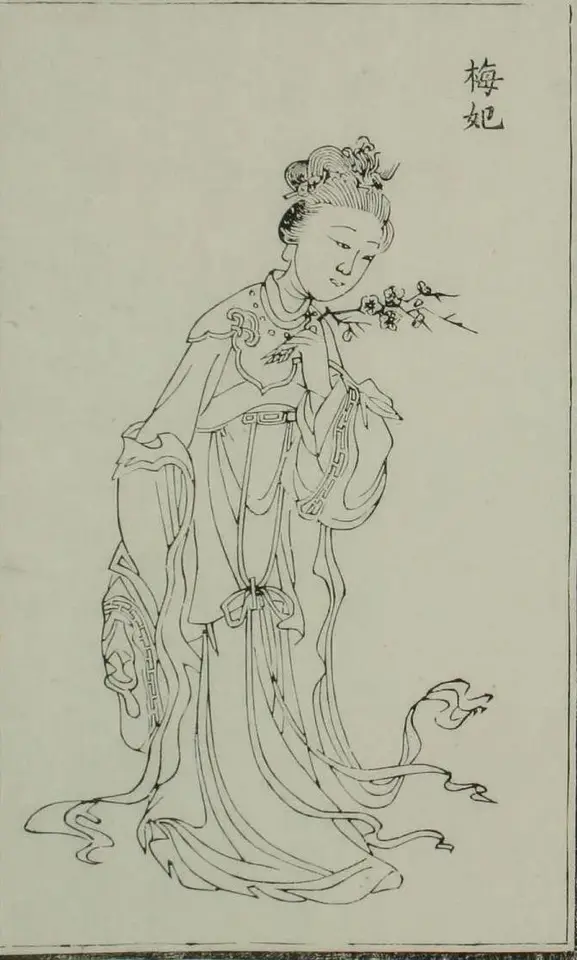
Biography
Coastal Upbringing and Early Literati Brilliance
Jiang Caiping was born in 723, the eleventh year of the Kaiyuan era of Emperor Xuanzong. Her ancestral lineage was rooted in Jiangdong Village, Huangshi Town, Putian County in Fujian. Her family was a venerable literati-physician household of coastal Min, combining traditional herbal medicine with classical scholarship.
Her father, Jiang Zhongxun, was an erudite classical scholar-physician who attained the Xiucai qualification. Siring this beloved daughter past the age of thirty, Jiang Zhongxun doted on her intensely. Under her father's tutelage, young Jiang Caiping displayed intellectual agility that astounded regional scholars. By age nine, she could recite and explain the entire Zhounan and Zhaonan sections of the Confucian Classic of Poetry. When her father affectionately asked why a young girl labored so intensely over classical texts, Caiping firmly replied: "Though a woman, I aspire to take classical sages as my models!" Her father was deeply moved and formally named her "Caiping", drawing inspiration from the ancient ode Gathering Duckweed (Caiping) in the Classic of Poetry.
By adolescence, Jiang Caiping had blossomed into an elegant young woman of graceful bearing. Unlike the prevailing aristocratic fashion in Chang'an, which prized elaborate cosmetics, gold ornaments, and heavy brocades, Jiang Caiping cultivated a natural, understated aesthetic, dressing in plain silk robes with minimal cosmetic adornment. Her poetic compositions flourished, prompting contemporaries to liken her to Eastern Jin scholar Xie Daoyun. Furthermore, she excelled in calligraphy, chess, and the white jade flute. Deeply drawn to the resilience and delicate fragrance of winter plum blossoms, her father planted dozens of rare plum varieties around their residence, nurturing within Jiang Caiping an unyielding moral fortitude.
Summons to Chang'an and Ennoblement as Consort Mei
During the later Kaiyuan era, having secured peace and prosperity, Emperor Xuanzong increasingly indulged in court luxury and palace entertainments. In December 737 (the twenty-fifth year of Kaiyuan), Consort Wu Huifei, the sovereign's long-time favorite, died suddenly following terrifying hallucinations caused by court intrigue. Devastated, Emperor Xuanzong found himself listless amidst his vast harem.
To alleviate the emperor's melancholy, chief palace eunuch Gao Lishi petitioned to travel through the southern circuits of Jiangnan, Huguang, and Lingnan to recruit talented and beautiful maidens. Reaching coastal Putian, Gao Lishi learned of Jiang Caiping's matchless beauty, profound literary learning, and musical gifts. Offering rich imperial gifts, Gao Lishi formally enlisted the fifteen-year-old maiden into the palace retinue.
Arriving in Chang'an, Jiang Caiping stepped into the imperial presence dressed in flowing white silk. In contrast to the heavy cosmetics and voluptuous figures of court ladies, her pure, serene aura struck Emperor Xuanzong like a fresh breeze. Enraptured, the emperor declared her an immortal maiden and elevated her directly to Senior Consort of the First Rank.
Learning of her passion for plum blossoms, Emperor Xuanzong commanded the imperial bureaus to plant ten thousand prized plum trees across the grounds of Xingqing Palace and Mount Li. He erected the Plum Pavilion (Mei Ting) and Plum Tower (Mei Ge), personally brush-writing the commemorative plaques. During winter snowfalls, Xuanzong strolled with Jiang Caiping beneath blooming boughs, drinking wine and composing verse. Delighted by her rapt absorption in the blossoms, Xuanzong affectionately bestowed upon her the title Consort Mei (Mei Fei) and teased her as the "Plum Blossom Spirit." For nearly a decade, Consort Mei enjoyed undisputed favor in the imperial bedchamber.
The Dance of the Flying Wild Goose and Royal Banquets
In the history of Chinese court dance, Jiang Caiping stood alongside Yang Guifei as a supreme choreographer and artistic master.
Around 740, synthesizing Han Dynasty acrobatics with Tang court suites, Jiang Caiping composed and choreographed the celebrated soft dance Dance of the Flying Wild Goose (Jinghong Wu). The choreography drew inspiration from Cao Zhi's Rhapsody on the Goddess of the Luo River, which portrayed a goddess as "graceful as a startled swan, supple as a swimming dragon." Clad in delicate flowing robes of pale white and blush pink, Jiang Caiping wielded elongated silk sleeves, revolving lightly to the piercing trills of her white jade flute. Her movements mimicked the soaring flight of wild geese through clouds, elevating classical Chinese dance to the heights of spiritual expression.
During a family feast in Linde Hall of Daming Palace, Emperor Xuanzong hosted his royal brothers—Prince of Ning Li Xian, Prince of Shen Li Hui, Prince of Qi Li Fan, and Prince of Xue Li Ye—and eagerly showcased Consort Mei's talents. Xuanzong proudly declared: "When Consort Mei plays the white jade flute and performs the Dance of the Flying Wild Goose, the entire hall radiates brilliance!"
Jiang Caiping took the stage, first performing a flute solo of haunting beauty, then soaring into the Dance of the Flying Wild Goose. The princes were spellbound. Following the performance, Xuanzong ordered rare "Rulu Zhen" wine poured into golden goblets for Consort Mei to present to each prince. Approaching Prince of Xue Li Ye, the prince, inebriated and overwhelmed by her beauty, reached beneath the table and hooked his foot around her embroidered slipper. Jiang Caiping remained composed, skillfully freeing her foot and retiring into the Plum Pavilion. When Prince of Xue knelt in shame the following morning to beg forgiveness for his drunken offense, Jiang Caiping minimized the incident before Xuanzong to preserve royal harmony. Xuanzong deeply revered her wisdom and magnanimous discretion.
Displacement by Yang Guifei and Confinement to Shangyang
However, imperial favor proved fleeting. In August 745 (the fourth year of Tianbao), the sixty-year-old Emperor Xuanzong was captivated by Yang Yuhuan, the voluptuous and vivacious former consort of Prince of Shou, formally creating her Imperial Noble Consort (Yang Guifei).
Mastering the energetic Sogdian whirl and Rainbow Feather Garment Dance, Yang Guifei catered to Xuanzong's sensual desires and established total dominance over the inner palace. The reserved, intellectual Jiang Caiping stood in sharp ideological contrast to Yang Guifei's flamboyant extravagance. Jealous of Consort Mei's enduring literary reputation, Yang Guifei relentlessly slandered her before the emperor.
As the Yang clan seized control of state administration, Yang Guifei succeeded in expelling Jiang Caiping from Xingqing Palace, banishing her to the cold and isolated Shangyang Palace in the eastern capital Luoyang. Once celebrated across the empire, Consort Mei was reduced to a lonely recluse, weeping beside overgrown courtyards.
During one cold winter, Xuanzong, reminiscing over their early romance, secretly dispatched a palace runner to transport Consort Mei via horse-cart to Cuihua Pavilion for a clandestine tryst. However, Yang Guifei burst into the pavilion unannounced. Terrified, Xuanzong hid Consort Mei behind a false wall while Yang Guifei created a violent scene, forcing Xuanzong to temporarily expel the consort from the palace. When Xuanzong returned to find Consort Mei, she had already been escorted away, leaving behind a jeweled shoe and hairpin. When the messenger returned her belongings, explaining that the emperor feared Yang Guifei's temper, Jiang Caiping smiled bitterly: "Abandoning me because he fears offending that plump maiden—is that not absolute desertion?"
The Rhapsody of the Eastern Tower and Refusing Imperial Pearls
While confined to the Eastern Palace of Shangyang in Luoyang, Jiang Caiping listened daily to the thunder of postal courier horses galloping past her gates, learning that they carried fresh lychees expedited from Lingnan solely to indulge Yang Guifei. Remembering how the empire had once vied to present her with rare plum blossoms, Jiang Caiping was overwhelmed by grief, comparing her fate to that of Han Empress Chen in the Changmen Palace.
Emulating Empress Chen's purchase of Sima Xiangru's rhapsody, Jiang Caiping offered her remaining gold to courtiers, begging them to commission a scholar to write a rhapsody to move the emperor. However, terrified of Yang Guozhong's retribution, no scholar dared accept. Weeping by candlelight, Jiang Caiping took up her own brush and composed the masterwork Rhapsody of the Eastern Tower (Lou Dong Fu).
In the rhapsody, she articulated her profound despair through classical allusion, contrasting her former glory with her present abandonment. She dispatched the text alongside her white jade flute to Xuanzong. Xuanzong was deeply moved and ashamed, but dreading Yang Guifei's wrath, he dared not recall her to Chang'an.
Later, foreign embassies presented Xuanzong with a peck of exquisite pearls. Overcome with guilt, Xuanzong secretly dispatched an imperial courier to present the pearls to Consort Mei in Luoyang. But the proud consort refused to accept wealth as a substitute for lost love. Returning the pearls, she inscribed her immortal quatrain Refusing the Gift of Pearls (Xie Ci Zhenzhu): "Long have my willow-leaf eyebrows gone unpainted; faded rouge and tears soil my crimson gown. The Changmen Palace harbors no lingering regrets; why use bright pearls to soothe my solitude?"
Reading the poem, Xuanzong was overcome with remorse and commanded the Music Bureau to set her verse to music, titling the melody Yi Hu Zhu (A Peck of Pearls), which later evolved into a prominent Cipai tune in classical Song poetry.
Martyrdom in the Rebellion and Eternal Veneration
In November 755 (the fourteenth year of Tianbao), An Lushan launched his catastrophic rebellion. Rebel armies swiftly seized Luoyang and breached Tongguan Pass, bearing down upon Chang'an.
At dawn on June 13, 756, with the capital in imminent peril, Emperor Xuanzong fled secretly through Yanqiu Gate toward Sichuan, accompanied only by Yang Guifei's family, royal princes, and elite guards. Forgotten in the chaos of retreat, the secondary consorts and palace women, including Jiang Caiping, were left abandoned to the mercy of rebel hordes.
When rebel troops breached the capital, looting and slaughtering, Jiang Caiping displayed extraordinary moral courage. Determined not to suffer humiliation at the hands of insurgents and dishonor the imperial house, she dressed herself in her cherished white silk gown, bound herself tightly in white silk, knelt in solemn prayer toward the north, and leapt into an imperial palace well, dying a martyr at the age of thirty-four.
In 757, Emperor Suzong recaptured the capitals and welcomed the retired Emperor Xuanzong back to Chang'an.
Having witnessed Yang Guifei's execution at Mawei Station and lost his throne, the elderly Xuanzong was consumed by grief and longing for the noble Consort Mei. Upon his return, he offered promotions and millions in cash for news of her fate, but found nothing. One night, Xuanzong dreamed of Consort Mei rising from mist, weeping: "When Your Majesty fled to Shu, I threw myself into a well to preserve my honor. A compassionate attendant recovered my body and interred me beneath the plum tree east of the hot spring pool."
Awakening in tears, Xuanzong rushed to the pool. Excavating beneath an ancient plum tree, attendants uncovered Consort Mei's body wrapped in brocade and white silk, her features intact.
Weeping bitterly, Emperor Xuanzong reinterred her with the highest imperial rites of a First Rank Consort, planting prized plum trees around her mausoleum and authoring an imperial eulogy. News of her martyrdom reached Fujian, where her countrymen erected Pukou Palace along the Mulan Stream, venerating her as a guardian river goddess and the patron deity of plum blossoms. Dying like a startled swan and blooming like winter plum, Jiang Caiping's noble spirit shines through the ages of Chinese cultural memory.