Mathematical Apprenticeship
Studied astronomy and algorithmic mathematics under court master Chu Yan in Kaifeng.
贾宪
Jia Xian (贾宪, dates of birth and death unrecorded, active first half of the 11th century during the Northern Song Dynasty) was an illustrious mathematician and calendrical astronomer of imperial China. He was the founding pioneer of polynomial numerical root extraction and the binomial theorem in the history of world mathematics. Studying under the preeminent court astronomer Chu Yan, Jia Xian mastered classical computational…
Jia Xian (贾宪, dates of birth and death unrecorded, active first half of the 11th century during the Northern Song Dynasty) was an illustrious mathematician and calendrical astronomer of imperial China. He was the founding pioneer of polynomial numerical root extraction and the binomial theorem in the history of world mathematics. Studying under the preeminent court astronomer Chu Yan, Jia Xian mastered classical computational treatises such as the Nine Chapters on the Mathematical Art (Jiuzhang Suanshu) and served the imperial court as Palace Officer of the Left Squad (Zuoban Dianzhi). Around 1050, he authored the landmark treatise Detailed Elucidations on the Nine Chapters of the Yellow Emperor (Huangdi Jiuzhang Suanjing Xicao). Jia Xian achieved worldwide scientific distinction by introducing the "Diagram of the Origin of Root Extraction" (the binomial coefficient table famously known as "Jia Xian's Triangle"), anticipating Blaise Pascal's arithmetic triangle by more than six centuries. He also invented the "method of root extraction by progressive addition and multiplication" (zengcheng kaifang fa), establishing an iterative algorithmic procedure for solving higher-order numerical equations that anticipated William George Horner's method by roughly 770 years. Furthermore, he formalized the "Thirteen Diagrams of Right-Triangle Transformations," profoundly advancing traditional Chinese mathematics toward abstract algebraic reasoning. His fundamental discoveries were faithfully preserved and expounded by the Southern Song mathematician Yang Hui.
Studied astronomy and algorithmic mathematics under court master Chu Yan in Kaifeng.
Penetrated the profound mathematical principles of ancient canons, mastering rod arithmetic and astronomical calculations.
Appointed Palace Officer of the Left Squad, providing computational expertise for palace engineering and timekeeping.
Formulated iterative algebraic procedures for extracting higher-order polynomial roots and deriving binomial coefficients.
Completed his nine-volume masterpiece Detailed Elucidations on the Nine Chapters of the Yellow Emperor, unveiling Jia Xian's Triangle.
Authored Collected Antiquarian Algorithms (Suanfa Xiaogu Ji) and Unlocking the Latches (Shisuo), praised by scholar Wang Zhu for mathematical brilliance.
Lectured and disseminated algebraic algorithms in the capital, profoundly inspiring contemporary mathematical thought.
Southern Song mathematician Yang Hui fully transcribed Jia Xian's Triangle and root extraction algorithms in Detailed Explanation of the Nine Chapters.
Jia Xian lived in the Northern Song capital of Kaifeng during the reigns of Emperor Zhenzong and Emperor Renzong. From his youth, he exhibited extraordinary intellectual acumen and an intuitive grasp of numerical computation and geometric relationships. In his formative years, he had the rare privilege of becoming an apprentice to Chu Yan, the most celebrated astronomer and mathematician of the early Northern Song.
Chu Yan directed astronomical timekeeping within the imperial Directorate of Astronomy, commanding peerless mastery over ancient Chinese mathematical classics such as the Nine Chapters on the Mathematical Art, Mathematical Canon of the Sea Island, and Zu Chongzhi's lost astronomical masterpiece Method of Interpolation (Zhuishu). Chu Yan maintained rigorous standards of instruction, emphasizing underlying theoretical principles over rote memorization. Under Chu Yan's mentorship, Jia Xian not only mastered the traditional manipulation of calculating rods, fraction arithmetic, and quadratic and cubic root extraction, but also constructed an unshakeable empirical foundation in planetary orbital mechanics.
While absorbing the heritage of his predecessors, Jia Xian demonstrated a bold spirit of independent inquiry. For centuries, traditional Chinese mathematical texts had focused primarily on practical applications such as land survey, tax apportionment, and granary volumes, rarely abstracting general mathematical principles. Jia Xian perceived that traditional root extraction methods were overly cumbersome and mathematically restrictive, resolving to transcend isolated problems in search of universal, standardized algebraic algorithms.
Endowed with supreme mathematical gifts, Jia Xian entered government service and attained the post of Palace Officer of the Left Squad (Zuoban Dianzhi). While nominally a junior military rank within the imperial guard establishment, this post was routinely utilized by the Song court to assign talented technicians to supervise civil engineering projects, imperial standardizations of weights and measures, palace warehouse inventories, and astronomical computations requiring precise numerical oversight.
Wang Zhu, an eminent scholar and Academician of the Hanlin Academy, recorded an invaluable contemporary account of Kaifeng's mathematical community. Wang Zhu noted that among the officials charged with celestial calculations, Chu Yan stood foremost in skill; when Chu Yan grew elderly and infirm, his disciples Jia Xian and Zhu Ji achieved imperial renown. While Zhu Ji was assigned to the Directorate of Astronomy, Jia Xian served as Palace Officer of the Left Squad. Wang Zhu emphasized that Jia Xian's "computational maneuvers were wonderfully subtle, and his books circulate widely throughout the world," demonstrating that Jia Xian enjoyed supreme prestige among metropolitan scholars and scientific circles.
During his tenure at court, Jia Xian fulfilled his technical duties while channeling his spare time into research and writing. In his metropolitan study, he arranged calculating rods to simulate multi-variable polynomial operations and numerical solutions of higher-order equations, achieving monumental breakthroughs in algorithmic theory.
Around 1050, Jia Xian completed his life's crowning scientific achievement, the nine-volume Detailed Elucidations on the Nine Chapters of the Yellow Emperor (Huangdi Jiuzhang Suanjing Xicao). In this epoch-making work, Jia Xian undertook a comprehensive structural re-examination of the 246 classical problems contained within the ancient Nine Chapters on the Mathematical Art.
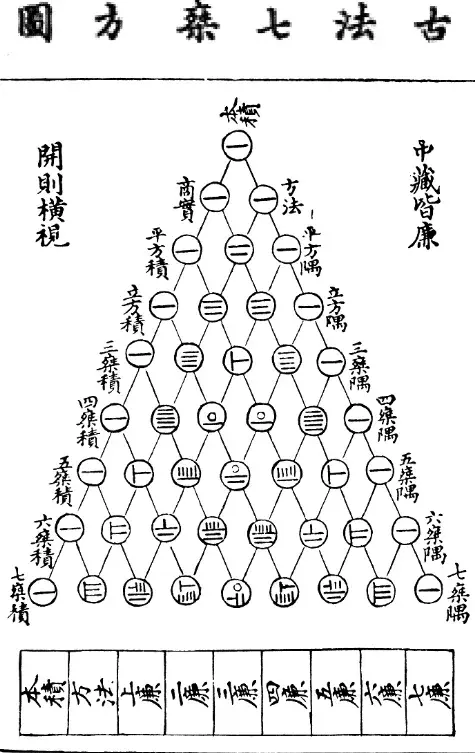
Rather than merely demonstrating arithmetic solutions, Jia Xian employed pure mathematical abstractions to reformulate ancient procedural algorithms into standardized algebraic equations. He unveiled the "Diagram of the Origin of Root Extraction," laying out binomial expansion coefficients within an elegant triangular matrix and establishing the revolutionary "method of root extraction by progressive addition and multiplication."
Beyond this magnum opus, imperial and private bibliographies—such as Jiao Hong's Ming Dynasty National History Bibliographical Treatise—recorded that Jia Xian authored the two-volume Collected Antiquarian Algorithms (Suanfa Xiaogu Ji) and a specialized treatise on equation solving titled Unlocking the Latches (Shisuo). The publication of these works marked the transition of traditional Chinese mathematics from empirical calculation toward mature abstract algebra.
Jia Xian's mathematical writings circulated widely during the mid-to-late Northern Song, exerting a profound and lasting influence on contemporary scholars. Tragically, during the catastrophic Jingkang Incident of 1127, when Jurchen Jin armies sacked Kaifeng, imperial libraries were looted and countless irreplaceable scientific manuscripts were burned or lost, including Jia Xian's original holographic editions.
Fortunately, Jia Xian's groundbreaking discoveries were preserved from oblivion by the southern mathematical tradition. In 1261, the brilliant Southern Song mathematician Yang Hui published his definitive treatise, Detailed Explanation of the Nine Chapters on the Mathematical Art (Xiangjie Jiuzhang Suanfa). With profound scholarly reverence, Yang Hui transcribed Jia Xian's mathematical breakthroughs in meticulous detail, reproducing the "Diagram of the Origin of Root Extraction" and explicitly recording that the diagram "derives from the computational treatise Shisuo, and Jia Xian employed this method."
Through Yang Hui's faithful transcriptions and analytical commentaries, Jia Xian's Triangle, the progressive addition and multiplication method, and the right-triangle transformation diagrams survived intact, recognized today as sparkling jewels in the global history of science.
Jia Xian's most universally celebrated mathematical contribution was his invention of the "Diagram of the Origin of Root Extraction" (Kaifang Zuofa Benyuan Tu), which represents the triangular table of binomial coefficients for non-negative integers, known historically as "Jia Xian's Triangle."
The triangle arranges binomial expansion coefficients in a symmetrical triangular tableau. Jia Xian presented the complete table up to the sixth order, articulating its underlying mathematical generation rule: beginning from the third row, the numbers at both flanks are one, while each internal number equals the exact sum of the two adjacent numbers directly above it. Jia Xian designated the flanking units as the "accumulated number" (jishu) and "corner value" (yusan), while referring to the interior generated coefficients as "subsidiary terms" (lian).
In world intellectual history, French mathematician Blaise Pascal published his treatise on the arithmetic triangle in 1654, whereas Jia Xian formulated his binomial triangle more than six centuries earlier. Jia Xian's Triangle illuminated the combinatorial symmetry of polynomial expansions while providing a powerful computational instrument for extracting higher-order numerical roots.
In algebraic analysis, Jia Xian established the revolutionary "method of root extraction by progressive addition and multiplication" (zengcheng kaifang fa) alongside the "progressive extraction for subsidiary terms" (zengchengfang qiulian fa). This breakthrough transcended ancient boundaries that restricted root extraction to quadratic and cubic equations, inaugurating a universal numerical algorithm for solving positive real roots of arbitrary higher-degree polynomial equations.
Traditional Chinese rod-calculation algorithms required cumbersome manual adjustments for each degree term, leading to prohibitive complexity and frequent errors as equation degrees increased. Jia Xian's progressive multiplication employed an iterative routine based on "multiplying and adding in succession." Once each quotient digit was determined, the algorithm transformed the polynomial coefficients step-by-step through synthetic division, turning high-degree root extractions into a standardized mechanical pipeline.
This algorithm is mathematically identical to the modern method of synthetic division and the Horner scheme for polynomial evaluation. While British mathematician William George Horner published his algorithm in 1819, Jia Xian's progressive addition and multiplication method anticipated Horner's achievement by approximately 770 years, demonstrating the world-leading stature of Song Dynasty algorithmic thought.
Jia Xian achieved equally pioneering breakthroughs in the geometric algebra of right-angled triangles, crystallized in his "Thirteen Diagrams of Right-Triangle Transformations" (Gougu Shengbian Shisan Tu). Re-evaluating the Gougu chapter of the Nine Chapters on the Mathematical Art, Jia Xian freed right-triangle geometry from practical land-measuring constraints.
He systematically combined the base (gou, $a$), height (gu, $b$), and hypotenuse (xian, $c$) through addition, subtraction, multiplication, and division, deriving thirteen fundamental algebraic relations. These encompassed the three primitive sides, six basic sums and differences, and four higher-order compound relations. Jia Xian asserted that these relations were to be "employed when applicable and discarded when unneeded, verified through geometric diagramming," constructing an axiomatic system of right-triangle algebra.
Applying this pure analytical framework, Jia Xian reformulated complex classical problems—such as calculating town dimensions from various city gates—into generalized quadratic equations, providing Chinese traditional geometry with powerful algebraic analytical vigor.
Jia Xian's inventions catalyzed a paradigm shift in traditional Chinese mathematical philosophy, propelling algorithmic computation from isolated empirical recipes toward systematic proceduralization and mechanicalization.
Within Jia Xian's mathematical framework, polynomial expansions, progressive root extractions, and right-triangle equation derivations were decomposed into ordered, step-by-step instructions. This algorithmic methodology, prioritizing unified cognitive routines and standardized iterative operations, closely mirrors the core principles of modern computer algorithm design.
Jia Xian's methodology nurtured the glorious flowering of the Song-Yuan mathematical school. The later mathematical masterpieces of Qin Jiushao (the method for numerical solving of polynomial equations), Li Ye (the Celestial Source method of algebraic polynomials), and Zhu Shijie (the Four Unknowns method of simultaneous polynomial systems) all derived their foundational logic from Jia Xian's progressive root extractions, collectively establishing the golden age of ancient Chinese mathematics.
FIGURES ASSOCIATED WITH THIS DYNASTY