Born in Capital
Born on the 6th day of the 6th lunar month in Beijing into a prominent scholar-official family; grasped the principles of water drainage after reading the Tribute of Yu (Yugong) at age nine.
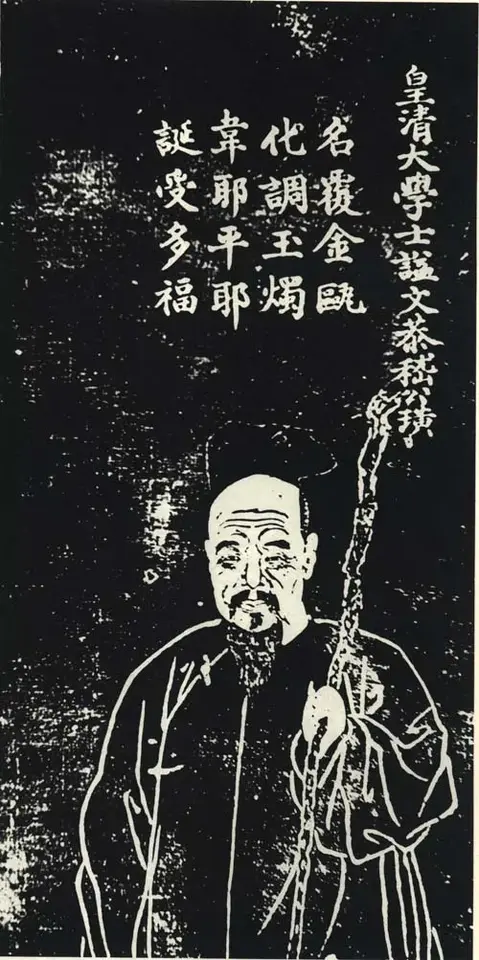
嵇璜
Ji Huang (嵇璜, July 21, 1711 – August 12, 1794), courtesy names Shangzuo (尚佐) and Futing (黻庭), art name Zhuoxiu (拙修), was a native of Wuxi County, Jiangnan (modern Wuxi, Jiangsu Province). He was an eminent statesman, hydraulic expert, hydrologist, and calligrapher of the middle Qing dynasty. As the third son of Grand Secretary Ji Zengyun, Ji Huang obtained his jinshi degree in 1730, started his career as a bachelor and…
Ji Huang (嵇璜, July 21, 1711 – August 12, 1794), courtesy names Shangzuo (尚佐) and Futing (黻庭), art name Zhuoxiu (拙修), was a native of Wuxi County, Jiangnan (modern Wuxi, Jiangsu Province). He was an eminent statesman, hydraulic expert, hydrologist, and calligrapher of the middle Qing dynasty. As the third son of Grand Secretary Ji Zengyun, Ji Huang obtained his jinshi degree in 1730, started his career as a bachelor and compiler in the Hanlin Academy, and was assigned to the Southern Study in 1736. Inheriting his father's hydraulic expertise, he served in prominent roles including Minister of Works, Minister of War, Minister of Personnel, Deputy Director-General of Jiangnan Waterways, and Director-General of Hedong Waterways. He eventually rose to Grand Secretary of the Wenyuan Pavilion, Director-General of the State Historiography Institute, and Chief Director-General for major imperially commissioned compendia including the Complete Library of the Four Treasuries (Siku Quanshu) and the Imperially Commissioned Continuation of the Comprehensive Examination of Literature. In his later years, he was awarded the title of Grand Guardian of the Heir Apparent and Chief Master of the Imperial Academy for Princes. He died in 1794 at the age of eighty-four, and was posthumously awarded the title of Grand Preceptor of the Heir Apparent and the posthumous name "Wengong". Throughout his fifty-year career, he formulated pioneering water management doctrines, demonstrated unimpeachable integrity, and gained the deep confidence of the Qianlong Emperor.
Born on the 6th day of the 6th lunar month in Beijing into a prominent scholar-official family; grasped the principles of water drainage after reading the Tribute of Yu (Yugong) at age nine.
Granted the provincial examination qualification (juren) pursuant to an imperial decree favoring children of high-ranking court dignitaries.
Passed the gengxu metropolitan examination as 66th in the second class, entered the Hanlin Academy as a bachelor, and later served as compiler.
Appointed chief examiner of the Shaanxi provincial examination and summoned to serve in the prestigious Southern Study.
Inspected waterways in Zhili, Henan, and Shandong, submitting his treatise on river dredging and labor management reform.
Submitted the landmark Eight River Defense Measures memorial after disastrous Yellow and Huai river breaches, establishing combined embankment-drainage policies.
Appointed Deputy Director-General of Jiangnan Waterways, organizing dredging and redirection of canals and lakes in Huaiyang.
Promoted to Director-General of Hedong Waterways, eliminating corrupt phantom river laborers and planting willow trees along dikes to consolidate banks.
Appointed Chief Director-General of the Siku Quanshu editorial board, overseeing the nationwide compilation of imperial archives.
Appointed Associate Grand Secretary and Minister of Personnel, subsequently elevated to Grand Secretary of the Wenyuan Pavilion.
Celebrated the sixtieth anniversary of his jinshi degree at the Enrong Banquet and marked his eightieth birthday; received personal poems from the Qianlong Emperor.
Passed away in office on August 12 at age eighty-four; honored with the title Grand Preceptor of the Heir Apparent and posthumous name "Wengong".
Ji Huang was born on July 21, 1711, in Beijing into a prominent scholar-official family whose ancestral home was in Wuxi, Jiangnan. His grandfather, Ji Yongren, died a martyr in Fujian alongside Governor-General Fan Chengmo during the Revolt of the Three Feudatories. His father, Ji Zengyun, rose to Grand Secretary of the Wenhua Pavilion and achieved nationwide fame as a master of river conservancy. Under strict paternal discipline, Ji Huang cultivated a dignified demeanor and broad classical learning. At the age of nine, while studying the ancient geographical treatise Tribute of Yu (Yugong), he perceived the fundamental hydraulic principle that successful drainage requires unimpeded discharge in the lower reaches before upstream flow can proceed smoothly, astonishing his family elders with his precocious insight.
In 1729, the Yongzheng Emperor issued an edict granting the sons of court ministers permission to bypass provincial exams and directly participate in the metropolitan examinations. Ji Huang received this grace status as a juren. In 1730, at the age of twenty, he passed the gengxu metropolitan examination, ranking sixty-sixth in the second class, and was admitted to the Hanlin Academy as a bachelor (shujishi). After completing three years of intensive archival training, he was appointed compiler (bianxiu) in 1731.
In 1734, Ji Huang was promoted to right sponsor in the Right Spring Supervisorate, and in 1735 transferred to left mentor in the Left Spring Supervisorate, simultaneously serving as chief examiner for the Shanxi provincial civil service examinations. His rigorous and transparent evaluation enabled numerous talented scholars from humble backgrounds to enter public administration. Following the accession of the Qianlong Emperor, his combination of deep literary skill and administrative clarity earned immediate court attention.
In 1736, the first year of Qianlong's reign, Ji Huang served as chief examiner for the Shaanxi provincial examination and was subsequently ordered to serve in the Southern Study (Nanshufang). The Southern Study served as an inner imperial advisory chamber where only trusted literati gathered to prepare imperial rescripts and consult on policy history. Ji Huang handled imperial poetry drafting and administrative consultations with consummate propriety, steadily gaining the emperor's esteem.
In 1738, Ji Huang retired from office upon the death of his father to observe the required three-year mourning period in his native Wuxi. Returning to the capital in 1741, he was promoted to left deputy supervisor of the Left Spring Supervisorate, concurrently serving as diarist of imperial affairs and reader-in-waiting in the Hanlin Academy. He lectured frequently before the throne, offering clear commentary on historical governance and popular welfare.
In March 1743, Ji Huang was appointed deputy transmission commissioner in the Office of Transmission, and in July was promoted to junior assistant censor-in-chief in the Censorate. While fulfilling these duties, he closely monitored recurrent dike collapses and silt buildups along the Yellow, Huai, and Grand Canal waterways in Zhili, Henan, and Shandong, resolving to apply the hydraulic expertise he had studied under his father to practical statecraft.
In January 1747, he was named director of the Court of Judicature and Revision (Dali Si), where he cleared backlogged capital cases with fairness and dispatch. In April 1748, he became senior assistant censor-in-chief, followed by appointment as senior vice minister of works in June, and subsequent transfer to vice minister of revenue in December. These senior departmental posts provided him with deep technical mastery over imperial finances, transportation logistics, and grand public works.
During the early Qianlong period, excessive silt deposition in the middle and lower Yellow River severely obstructed the Qingkou junction where the Yellow and Huai rivers converged. The lakebed of Lake Hongze continually rose, preventing the Huai River from discharging freely and causing backflows that repeatedly breached Grand Canal embankments. The rich salt-producing basins of Lianghuai and agricultural centers such as Xuzhou, Huai'an, and Yangzhou were frequently submerged, gravely threatening grain transport and the imperial economy. In the ninth year of the Qianlong era (1744), Ji Huang received secret imperial orders to inspect water conservancy projects across Zhili, Henan, and Shandong. Conducting meticulous on-site surveys of vulnerable embankment sectors, he submitted his celebrated memorial Matters on River Dredging and Construction (Hegong Shuzhu Shiyi).
In this memorial, Ji targeted the rampant abuse where local contractors and rural gentry monopolized river labor corvee, pocketing funds and producing shoddy work. He recommended that the court strictly prohibit labor contractors from profiting as middlemen, proposing instead that local authorities hire impoverished refugees directly as day laborers and pay them in cash according to construction progress. This measure coupled river engineering with famine relief while eliminating bureaucratic extortion, and the court promptly ordered its empire-wide implementation.
In the autumn of the eighteenth year of the Qianlong era (1753), heavy rains caused catastrophic flood crests along the Yellow River, breaching dikes at Yangwu in Henan and Tongshan in Jiangsu, while the Huai River broke through at Gaoyou, destroying the Cheluoba and Shaobo locks. Serving in the Ministry of Revenue, Ji Huang drafted the landmark memorial Eight Measures for River Defense and Dredging (Xuanfang Bashi), articulating an integrated strategy that superseded passive dike elevation with the scientific principle of combining embankment reinforcement with downstream flood discharge. In early 1754, Ji partnered with Minister of Works Liu Tongxun to repair emergency grass dikes along Lake Hongze's Gaoyan embankments, and in 1756, while on leave in Wuxi, he purchased wheat to sell at controlled low prices, relieving tens of thousands of flood victims.
During his first southern inspection tour in the spring of the twenty-second year of the Qianlong era (1757), the Qianlong Emperor appointed Ji Huang Deputy Director-General of Jiangnan Waterways (Nanhe Fuhezong), presenting him with an imperial poem commemorating his appointment. Low-lying lakes across the Huai-Yang corridor, including Lake Hongze, Lake Gaoyou, and Lake Sheyang, suffered from severe silt sedimentation that destroyed their flood-retention capacity, leaving floodwaters stranded for months after embankment breaches.
Upon taking office, Ji navigated small skiffs to survey outflow channels personally. He formulated the core engineering doctrine of "straightening serpentine channels, shortening distances for runoff, and dredging shallow river bottoms." He directed civil and military laborers to restore and construct sluices along the eastern dikes of the Gaoyou Grand Canal, straightening winding bends and deepening river channels to funnel stagnant floodwaters through the Mangdao River and Jinwan sluices into the Yangtze River. This eliminated regional waterlogging while securing the navigation of the Grand Canal. In 1760, during a visit to Qingjiangpu, he discovered silting hazards along the flood evacuation route into the Yangtze, recommending the excavation of the Jinwan diversion channel and constructing spillways to prevent overflows, which the throne fully adopted.
In 1767, Ji Huang was appointed Director-General of Hedong Waterways (Hedong Hedao Zongdu), assuming comprehensive authority over Yellow River and Grand Canal defenses throughout Shandong and Henan. At that time, administrative rot plagued the Hedong division. Local station officials routinely inflated rosters with fictitious "dam laborers" (bafu) to siphon grain stipends, while river crews relied on superficial clay banking that collapsed under flood crests.
Ji Huang instituted decisive reforms upon taking office. He conducted strict roll calls across all river stations, struck out fictitious and aged names, and redirected the preserved grain funds toward stocking heavy stone and timber reserves. Recognizing the friable nature of Yellow River soils, he ordered hundreds of thousands of willow and poplar saplings planted along northern and southern dike networks. Their interlaced root structures solidified earthworks, forming hundreds of li of natural biological barriers against erosion.
In 1768, having restored stability across the river systems, Ji Huang was summoned to Beijing to take office as Minister of Works, relinquishing his post in the Southern Study. Soon afterward, because minor subordinate officers in Hedong had engaged in favoritism before his arrival, Ji Huang submitted himself for official discipline and was demoted to senior vice censor-in-chief. He accepted the reprimand with humility, continuing his duties in the Censorate with diligent attention.
In 1773, recognizing his upright character and irreplaceable practical competence, the Qianlong Emperor reinstated Ji Huang as Minister of Works, later transferring him to Minister of War. In these ministries, Ji Huang supervised major state infrastructure construction, coastal defense works, and military officer evaluations.
In 1774, when the Imperial Siku Quanshu Commission was established, Ji Huang was appointed one of its chief director-generals (zheng zongcai). Working alongside Grand Secretary Yu Minzhong and Chief Compiler Ji Yun, he directed the systematic collection, text verification, cataloging, and transcription of rare manuscripts from palace holdings, regional collections, and private libraries, ensuring strict textual accuracy across the four classical bibliographic divisions.
In 1779, Ji Huang was elevated to Associate Grand Secretary concurrently serving as Minister of Personnel and Chancellor of the Hanlin Academy. Shortly thereafter, he was named Grand Secretary of the Wenyuan Pavilion and Director-General of the State Historiography Institute. He worked closely with Grand Secretary Agui in deliberation of high state affairs and supervised the compilation of imperially authorized compendia including the Imperially Commissioned Continuation of the Comprehensive Examination of Literature, the Qing Continuation of the Comprehensive Statutes, and the Qing Continuation of the Comprehensive Institutions.
Despite holding the highest civilian office, Ji Huang maintained a modest and uncorrupted domestic life. When the emperor's favorite, Heshen, amassed immense power and demanded bribes across the bureaucracy, Ji Huang steadfastly refused to pander to him. He associated closely with clean officials such as Minister of Works Zhou Yuanli, declining Heshen's repeated solicitations for calligraphy with polite tact and upholding the classical dignity of imperial ministers.
In 1786, at the age of seventy-six, feeling the onset of physical frailty, Ji Huang repeatedly submitted retirement memorials. However, because both he and the Qianlong Emperor were born in the same xinmao year (1711), the sovereign retained a singular personal affection for him. Qianlong rejected his retirement requests with an affectionate imperial poem noting "both of us share the same birth year, how could you leave me alone in the court?"
In April 1790, Ji Huang marked the diamond jubilee of his jinshi degree by attending the Enrong Banquet. In August of that year, during his eightieth birthday celebrations, the Qianlong Emperor presented him with his seventh dedicated imperial poem, comparing his ancestral loyalty to Yan Zhenqing and his political stature to the ancient Western Han grand secretaries Wei Xian and Ping Dang. The emperor conferred upon him the title Grand Guardian of the Heir Apparent and named him Chief Master of the Imperial Academy for Princes (Shangshufang Zongsifu).
On August 12, 1794, Ji Huang passed away in Beijing while still holding office as Grand Secretary of the Wenyuan Pavilion, at the age of eighty-four. The Qianlong Emperor was deeply grieved, issuing an imperial rescript granting funeral expenses, conferring the posthumous title of Grand Preceptor of the Heir Apparent, and awarding the posthumous name "Wengong". An imperial envoy was dispatched to offer sacrifices, and Ji Huang was enshrined in the Temple of Eminent Statesmen (Xianliangci).
Ji Huang's most distinguished contribution to hydraulic science was his formulation and execution of an integrated river conservancy doctrine. Submitted during the joint Yellow-Huai flooding of 1753, his Eight Measures for River Defense and Dredging (Xuanfang Bashi) abandoned piecemeal emergency responses, laying the foundational standards for mid-Qing hydraulic engineering.
The memorial detailed eight practical engineering measures: First, dredging the main channel of the Yellow River between Tongshan and Qingkou to remove sandbars. Second, repairing and grouting stone dikes along Lake Hongze during low-water seasons. Third, overhauling the three sluices of the Guiren Embankment to regulate water storage and drainage according to seasonal flows. Fourth, rehabilitating neglected relief sluices along the narrowing Shandong-Jiangsu corridor to divert surging floodwaters.
Fifth, deploying flat-bottomed barges equipped with two-hundred-pound iron rakes upstream of Qingkou to stir up bottom silt and let swift currents carry sediment downstream. Sixth, establishing specialized river inspection circuits (Fenxun Hedao Dao) to oversee the complex downstream waterways. Seventh, stockpiling sorghum stalks, willow branches, and clay bundles during winter for seasonal dike repairs in the five downstream departments of Jiangsu. Eighth, strictly prohibiting the excavation of earth near the base of dikes, requiring all embankment soil to be transported from distant borrow pits. This comprehensive synthesis of structural engineering, mechanical silt scouring, administrative reform, and logistical stockpiling secured Yellow and Huai river stability for decades.
In addition to grand strategy, Ji exhibited profound scientific insight in micro-engineering. As Deputy Director-General of Jiangnan Waterways, his twelve-character principle—"straightening serpentine channels, shortening distances for runoff, and dredging shallow river bottoms"—safely discharged high lake waters into the Yangtze.
Serving as Director-General of Hedong Waterways, Ji transformed hydraulic labor systems and pioneered ecological engineering along the Yellow River. To counter the chronic scouring and collapse of loose earthen dikes, he punished officials who performed cosmetic repairs and initiated the ecological policy of "planting willows to anchor dikes." Across hundreds of miles of embankments, he ordered the planting of hundreds of thousands of willow and poplar trees, using their dense root networks to stabilize soil and rock. This dramatically increased flood resistance while drastically lowering annual maintenance procurement costs. Concurrently, he abolished abusive subcontracting, insisting on direct official recruitment and fair cash wages for displaced refugees, perfectly harmonizing flood control with popular welfare.
Inheriting the philological discipline of the Southern Study, Ji Huang was appointed a Director-General of the Four Treasuries project (Siku Quanshu) in 1773. Over eighteen years, he led editorial committees in reviewing, collation, and cataloging thousands of historical and technical treatises. His deep practical expertise was especially pivotal in standardizing entries on geography, agriculture, hydrography, and mathematics, preserving indispensable scientific records for the late imperial era.
Renowned for his unyielding uprightness, Ji was praised by the Qianlong Emperor for never compromising principle to flatter superiors. A master of regular script calligraphy (kaishu), his brushwork was characterized by serene balance, vigor, and structural clarity, earning him frequent commissions to inscribe imperial stele texts, temple tablets, and state documents. Throughout his four decades in senior office, Ji actively identified, mentored, and promoted capable younger scholar-administrators, including Liu Yong and Weng Fanggang, creating a legacy of civic probity and scholarly excellence.
FIGURES ASSOCIATED WITH THIS DYNASTY