Birth into Central Plains Li Clan
Born in Wujin, Xiangcheng; displayed compassionate demeanor and chanted Buddhist scriptures from early youth.
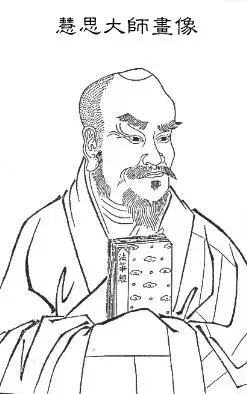
慧思
Huisi (慧思, 515–577 CE), whose secular surname was Li, was a native of Wujin in Xiangcheng (present-day Runan, Henan). He was an illustrious Buddhist prelate of the Northern and Southern Dynasties, the Third Patriarch of the Tiantai school, and the founding abbot of the monastic traditions of Mount Nanyue (Mount Heng in Hunan). Possessing natural spiritual aptitude, he left home to be tonsured at age fifteen and received full…
Huisi (慧思, 515–577 CE), whose secular surname was Li, was a native of Wujin in Xiangcheng (present-day Runan, Henan). He was an illustrious Buddhist prelate of the Northern and Southern Dynasties, the Third Patriarch of the Tiantai school, and the founding abbot of the monastic traditions of Mount Nanyue (Mount Heng in Hunan). Possessing natural spiritual aptitude, he left home to be tonsured at age fifteen and received full monastic ordination (upasampada) at twenty. He subsequently studied under Master Huiwen of Northern Qi, serving monastic duties by day and practicing rigorous seated meditation by night. Based on the Lotus Sutra, he attained the Lotus Samadhi, mastering the harmonized cultivation of meditative stability (samadhi) and transcendent insight (prajna), gaining wide renown across northern meditation centers. During the mid-sixth century, amidst pervasive warfare and doctrinal conflicts, Huisi traveled through Yanzhou and the Qi-Zhao plains. His growing prestige provoked fierce envy among rival teachers, who repeatedly conspired against him and attempted fatal poisonings. To escape political strife and persecution, Huisi led his followers south during the Chengsheng era of Southern Liang, residing at Mount Dasu in Guangzhou (modern Guangshan, Henan) for fourteen years. At Mount Dasu, Huisi pledged a solemn vow, copying the entire Perfection of Wisdom Sutra in Twenty-Five Thousand Lines in gold lettering and authoring his celebrated Vow of Resolution (Li Shiyuan Wen). During this era, Zhiyi, who later founded the Tiantai school, traversed war-torn regions to become Huisi's disciple. Huisi imparted the essence of the Lotus Sutra and meditation techniques, establishing the doctrinal cornerstone of Tiantai Buddhism. In 568 CE (Guangda 2), Huisi led more than forty disciples to Mount Nanyue in Hunan, establishing major meditation centers and becoming celebrated as "Great Chan Master Si of Nanyue." Emperor Xuan of Chen invited him to the capital Jiankang to expound the Dharma at Qixuan Temple, honoring him as Great Chan Master. Observing that southern Buddhist circles focused excessively on theoretical discourse while neglecting contemplation, Huisi vigorously championed the simultaneous cultivation of concentration and wisdom, lecturing during daylight and meditating throughout the night. Grounded in the Prajnaparamita and elevated by the Lotus Sutra, he formulated the doctrine of the "Ten Suchnesses" and established the practice of the "Lotus Peaceful and Joyful Conduct." In 577 CE (Taijian 9), Huisi passed away at the Banshan Daochang on Mount Nanyue at age sixty-three. His disciple Zhiyi developed his lineage into the Tiantai school, while Silla monk Xuanguang transmitted the Nanyue teachings to the Korean Peninsula, leaving a profound mark on East Asian Buddhist history.
Born in Wujin, Xiangcheng; displayed compassionate demeanor and chanted Buddhist scriptures from early youth.
Left secular life at age fifteen, reciting the Lotus Sutra and major Mahayana scriptures with unceasing devotion.
Received full ordination at age twenty; entered the congregation of Huiwen in Northern Qi, attaining the Lotus Samadhi.
Preached meditation in Yanzhou at age thirty-four; survived poisonings by jealous rivals and resolved to lead his disciples southward.
Traveled through Xinzhou and Yingzhou, where three disciples died of poisoned food; retreated to Mount Dasu in Guangzhou.
Resided at Kaiyue and Guanyi temples on Mount Dasu, expounding the Perfection of Wisdom Sutra to growing assemblies.
Completed the gold-lettered sutra at Qiguang Temple; authored the landmark Vow of Resolution to benefit sentient beings.
Zhiyi journeyed through war to study under Huisi; received the transmission of the Lotus Samadhi and mind-contemplation.
Led over forty disciples south to Mount Nanyue in Hunan; established meditation halls, becoming honored as the Nanyue Venerable.
Lectured at Qixuan Temple in Jiankang upon imperial invitation; championed concentration and wisdom, honored as Great Chan Master.
Gathered disciples at Banshan Daochang on the twenty-second day of the sixth month, passing away peacefully at age sixty-three.
Huisi was born in Wujin (near modern Runan, Henan) during the turbulent late Northern Wei period, hailing from the respected local Li clan. From early childhood, he showed an earnest, tranquil demeanor, taking no delight in childish games. Deeply moved by the impermanence of existence, he cultivated faith in the Buddha, frequently reciting Mahayana scriptures in abandoned temples or quiet groves. At the age of fifteen, he renounced worldly life, bidding farewell to his family to enter the monastic order.
At the age of twenty, Huisi received full monastic ordination. Following his upasampada, he realized that scholastic parsing of texts alone could never bring liberation from cyclical rebirth or direct realization of Buddha-nature. At that time, northern Buddhism was characterized by rigorous asceticism and seated meditation. Master Huiwen of Northern Qi was celebrated across the Central Plains for teaching the simultaneous cultivation of concentration and wisdom through the "Threefold Contemplation in One Mind." Attracted by this fame, Huisi traveled hundreds of miles to become Huiwen's student. During his discipleship, Huisi carried out temple labor by day and engaged in seated meditation throughout the night, rarely lying down to sleep. He integrated Huiwen's contemplation methods with the profound doctrines of the Lotus Sutra. Through unremitting perseverance, he experienced a sudden awakening during meditation, directly realizing the unhindered Lotus Samadhi. Huisi presented his realization to senior northern meditation masters such as Jian and Zui, who commended and verified his attainment, spreading his renown across the northern monastic community.
Following his awakening, Huisi traveled extensively across northern commanderies to propagate meditation practice. As he established teaching assemblies across various provinces, monastics and lay adherents gathered around him in vast numbers. To guide practitioners of diverse capacities, Huisi synthesized core meditation doctrines from both Mahayana treatises and Hinayana Vinaya collections, constructing a coherent system of Buddhist practice.
In 548 CE (the sixth year of the Wuding era of Eastern Wei), the thirty-four-year-old Huisi established a large lecture assembly in Yanzhou, expounding meditation to hundreds of listeners. However, the chaotic northern political climate and the rapid influx of diverse monks created factional tensions. Huisi's emphasis on direct spiritual insight and his soaring prestige provoked deep jealousy among sectarian teachers and established clerics. These rivals slandered him to local magistrates and secretly laced his food with deadly poison. Although Huisi survived through his mental resolve and constitution, he recognized that the northern political and religious climate had become hostile. He decided to cease his northern travels and lead his loyal disciples southward.
Moving south, Huisi and his followers passed through Xinzhou and Yingzhou (modern Wuhan, Hubei). Wherever he paused, he answered local requests to explain Mahayana doctrines of ultimate reality. Yet malice pursued him. In Yingzhou, hostile opponents poisoned the community's communal meal. Three of Huisi's senior disciples perished on the spot, while Huisi fell critically ill. Surviving this ordeal, Huisi harbored no bitterness, instead recognizing that during degenerate times, obstacles were inevitable and required greater resolve to protect the Dharma.
In 553 CE (the second year of the Chengsheng era of Emperor Yuan of Liang), fleeing warfare across the Huai River basin, Huisi led his surviving followers southward to Guangzhou (modern Guangshan County, Henan). In 554 CE, he established his residence at Mount Dasu, where he remained for fourteen years.
At Mount Dasu, Huisi lectured at Kaiyue Temple and Guanyi Temple, expounding the Perfection of Wisdom Sutra in Twenty-Five Thousand Lines (Dapin Banruo Jing) to crowds of monastics and lay followers. Troubled by the corruption and loss of manuscripts during war, he made a solemn vow to copy the entire Prajnaparamita Sutra in gold lettering to preserve the text for posterity.
In 558 CE (the second year of the Yongding era of Southern Chen), through generous support from devotees at Qiguang Temple in Guangcheng, Huisi completed the gold-lettered scripture and sealed it within an ornate chest. To mark this achievement and articulate his aspirations, Huisi authored his renowned Vow of Resolution (Li Shiyuan Wen). In this moving document, he recounted his youth, his arduous meditation training, and the poisonings he had survived in Yanzhou and Yingzhou. He made a vow to attain miraculous powers through meditation in order to safeguard the Dharma and liberate suffering beings throughout future ages. When circulating across the Jianghuai region, this vow inspired widespread admiration and attracted devoted students from afar.
During his residency at Mount Dasu, Huisi welcomed a disciple who would carry his lineage forward: Zhiyi. Amidst the chaos of the Liang-Chen transition, the young Zhiyi journeyed through war zones from Hunan to Mount Dasu to seek instruction under Huisi.
Recognizing Zhiyi's exceptional spiritual capacity, Huisi welcomed him warmly, remarking: "In former times on Vulture Peak, we listened together to the Lotus Sutra; led by past karmic affinities, you have returned once more!" Huisi imparted the Lotus Samadhi and the Samadhi of the Physical Body of Samantabhadra to Zhiyi. Under Huisi's direction, Zhiyi engaged in intensive contemplation. Upon chanting the line in the "Chapter on the Ancient Deeds of Bhaisajyaraja Bodhisattva" stating "This is true diligence; this is called the true offering of Dharma to the Tathagata," Zhiyi experienced profound awakening and attained the Lotus Samadhi.
Huisi verified Zhiyi's enlightenment and entrusted him with lecturing on the Perfection of Wisdom Sutra to the assembly at Mount Dasu. When Zhiyi reached the concept of "one mind containing myriad practices" and sought clarification, Huisi guided him: the Prajnaparamita expounds sequential stages, whereas the Lotus Sutra expounds perfect, sudden, and simultaneous realization. This insight served as the foundational bedrock upon which Zhiyi later established the Tiantai school with the Lotus Sutra as its central scripture.
In 568 CE (the second year of Guangda), having taught at Mount Dasu for fourteen years, Huisi chose to relocate to Mount Nanyue (Mount Heng in Hunan), a sacred site suitable for deep contemplation. He led over forty disciples southward to settle on the mountain.
At Mount Nanyue, Huisi cleared mountain slopes and constructed thatched hermitages, inaugurating the mountain's monastic tradition. Practicing ascetic meditation in the serene valleys, he attracted monks and lay adherents from across southern China, turning Mount Heng into a preeminent center for meditation. The master was reverently known across the empire as "Great Chan Master Si of Nanyue."
In 569 CE (the first year of the Taijian era), Emperor Xuan of Chen, having long admired Huisi's renown, dispatched an imperial envoy to invite the master to the capital city of Jiankang. Residing at the prestigious Qixuan Temple, Huisi expounded the Perfection of Wisdom Sutra. Observing that southern scholars focused on metaphysical debate while ignoring practical meditation, Huisi championed the simultaneous cultivation of concentration and wisdom. He explained scriptural meaning by day and led monks in seated meditation at night. Emperor Xuan and his ministers attended his lectures, and the monarch conferred upon him the title of Great Chan Master, elevating his prestige to its peak.
Unmoved by capital luxury and imperial patronage, Huisi returned to his austere life at Mount Nanyue. Historical records in the Continued Biographies of Eminent Monks (Xu Gaoseng Zhuan) emphasize that he observed the monastic precepts strictly, wearing coarse cotton robes throughout his life and placing mugwort leaves upon his bedding during freezing winters to withstand the cold. His compassionate asceticism was praised as a moral model.
In the summer of 577 CE (the ninth year of Taijian), the sixty-three-year-old Huisi foresaw his impending passing. He walked down from the mountain peak to Banshan Daochang, where he gathered his monastic community. With urgent compassion, he exhorted his disciples to practice the Lotus Samadhi and the Pratyutpanna Samadhi diligently to transcend birth and death.
On the twenty-second day of the sixth month of 577 CE, Huisi sat cross-legged upon his platform and passed away peacefully at Banshan Daochang. His disciples entombed his remains on Mount Nanyue. Zhiyi carried on his spiritual heritage to establish the Tiantai school, while Silla monk Xuanguang brought the Nanyue meditation lineage and Tiantai doctrines back to Korea, establishing the foundation for Tiantai teachings across East Asia.
Mastered meditation under Master Huiwen in Northern Qi, combining manual labor by day with seated contemplation by night, realizing the Lotus Samadhi through the Lotus Sutra.
Harmonized northern practical meditation with Mahayana prajna doctrines, achieving renown throughout northern Buddhist communities.
Preached meditation in Yanzhou at age thirty-four, surviving poisonings orchestrated by jealous sectarian opponents before leading his community south.
Endured a second poisoning in Yingzhou that claimed the lives of three senior disciples, maintaining unyielding devotion to safeguarding the Dharma.
Expounded the Perfection of Wisdom Sutra at Mount Dasu in Guangzhou for fourteen years, transforming the site into a center of meditation.
Completed the copying of the gold-lettered Prajnaparamita Sutra at Qiguang Temple at age forty-four, authoring the celebrated Vow of Resolution.
Welcomed Zhiyi at Mount Dasu, transmitting the Lotus Samadhi and mind-contemplation methods, and confirming his realization.
Instructed Zhiyi on the distinction between the sequential teaching of the Prajnaparamita and the sudden realization of the Lotus Sutra, providing the theoretical foundation for Tiantai doctrine.
Led more than forty disciples to Mount Heng in 568 CE, clearing land and constructing hermitages to establish Mount Nanyue as a major Chan center.
Lectured at Qixuan Temple in Jiankang upon imperial invitation by Emperor Xuan of Chen, promoting the simultaneous cultivation of concentration and wisdom, and honored as Great Chan Master.
Authored landmark treatises including Zufa Wuzheng Sanmei Famen, Fahua Anlexing Yi, Sui Ziyi Sanmei, and Dacheng Zhiguan Famen.
FIGURES ASSOCIATED WITH THIS DYNASTY