Birth in Hulao
Born into the Ji family in Hulao; demonstrated extraordinary intellect in Confucian learning and metaphysics.
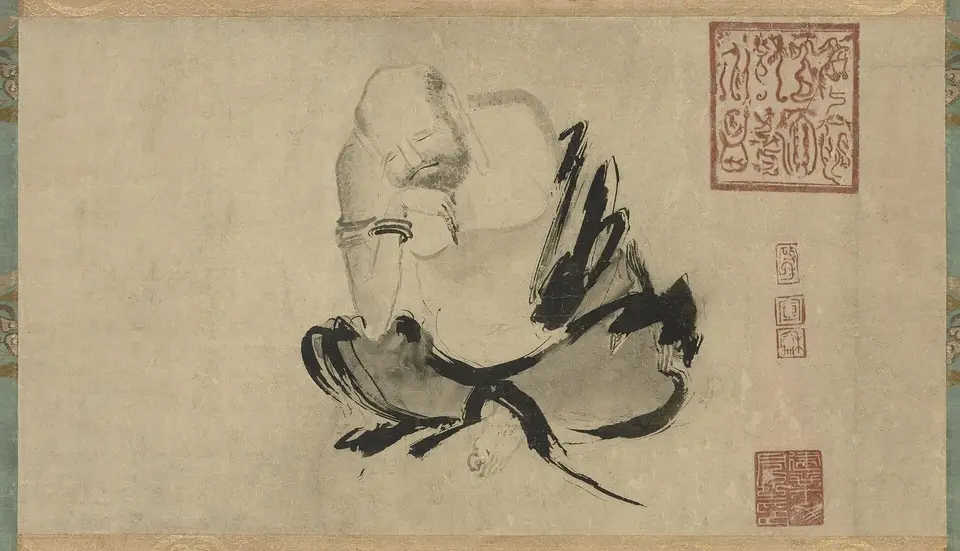
慧可
Huike (慧可, 487 – 593), secular surname Ji (姬), personal name Guang (光), courtesy styled Shenguang (神光), also known as Sengke (僧可), was a native of Hulao in Xingyang Commandery (modern Xingyang, Henan Province). He is revered as the Second Patriarch of Chinese Chan (Zen) Buddhism. In his early years as a Confucian scholar, he acquired deep proficiency in the Book of Changes and Daoist metaphysics before renouncing secular…
Huike (慧可, 487 – 593), secular surname Ji (姬), personal name Guang (光), courtesy styled Shenguang (神光), also known as Sengke (僧可), was a native of Hulao in Xingyang Commandery (modern Xingyang, Henan Province). He is revered as the Second Patriarch of Chinese Chan (Zen) Buddhism. In his early years as a Confucian scholar, he acquired deep proficiency in the Book of Changes and Daoist metaphysics before renouncing secular life. He was ordained under Chan Master Baojing at Xiangshan Temple in Longmen, Luoyang, and subsequently took the complete monastic vows (Upasampada) at Yongmu Temple, devoting himself to the study of the Tripitaka. At around forty years of age, drawn by reports of the Indian meditation master Bodhidharma at Shaolin Temple on Mount Song, Huike journeyed thither to seek instruction. Demonstrating his profound commitment by standing overnight in deep snow and severing his own left arm, he received Bodhidharma's seal of enlightenment, the famous "pacification of mind" (anxin) transmission, the robe and bowl of patriarchate, and the four-volume Chinese translation of the Lankavatara Sutra. During the Tianping era of the Eastern Wei, Huike propagated Chan teachings in the northern capital of Ye, advocating the non-duality of the phenomenal self and the Buddha. During the Northern Zhou anti-Buddhist persecution (574–577), he fled south to Mount Sikong in Anhui to preserve the sacred texts and lineage. In 593, at the age of 107, Huike was martyred in Cheng'an following slander by hostile doctrinal monks. He was posthumously canonized as Great Ancestral Chan Master (Dazu Chanshi), leaving a foundational imprint upon the sinification of Buddhist meditation.
Born into the Ji family in Hulao; demonstrated extraordinary intellect in Confucian learning and metaphysics.
Entered Xiangshan Temple in Longmen under Master Baojing; later took full monastic vows at Yongmu Temple.
Traveled to Shaolin Temple on Mount Song; severed his arm in deep snow and received Bodhidharma's transmission.
Moved to the imperial capital of Ye, actively expounding the Lankavatara Sutra and sudden enlightenment.
Fled Emperor Wu's empire-wide proscription of Buddhism, finding sanctuary at Mount Sikong in modern Anhui.
Preached outside Kuangjiao Temple in Cheng'an; falsely condemned and executed at age 107.
Huike was born into the prominent Ji lineage in Hulao. Endowed with exceptional intellectual capacity and an imposing presence, he mastered the Confucian Classics in his youth, with particular depth in the Mao Poetry and Record of Rites. He subsequently explored the philosophical texts of Laozi and Zhuangzi, realizing that secular scholarship could not resolve the existential dilemma of mortality.
During the Xiping era of Northern Wei, convinced that canonical study alone could not untangle ultimate truth, he renounced the world. He traveled to Xiangshan Temple in the Longmen Mountains near Luoyang, taking monastic tonsure under Chan Master Baojing and adopting the religious name Shenguang. He later took the complete vows (Upasampada) at Yongmu Temple. Over the subsequent decade, Shenguang immersed himself in both Hinayana and Mahayana treatises across northern monastic centers. Nevertheless, he frequently remarked to peers that textual mastery of terminology remained separate from direct realization of one's innate nature.
Around the year 527, at forty years of age, Shenguang learned that the South Indian master Bodhidharma was conducting "wall-contemplation" (biguan) at Shaolin Temple on Mount Song, teaching direct transmission outside the scriptures. Recognizing the teacher he had sought for decades, Shenguang departed his lecture halls and traveled to Shaolin Temple.
Arriving in the depth of winter, Shenguang found Bodhidharma seated silently facing a stone wall. The master paid no heed to the visitor. Shenguang stood motionless outside the cave through a heavy blizzard until morning, with snow rising past his knees. When Bodhidharma finally turned and asked what he sought through such prolonged endurance, Shenguang wept and implored the patriarch to open the compassionate gates of the Dharma to deliver deluded sentient beings. Bodhidharma observed that the supreme path demanded aeons of arduous practice and was not to be attained through superficial zeal. To demonstrate his utter disregard for physical life in pursuit of the truth, Shenguang unsheathed a sharp blade, severed his left arm, and placed the severed limb before the master.
Moved by this supreme dedication, Bodhidharma renamed him Huike (meaning "Capacity of Wisdom"). Huike then said, "My mind finds no peace; I beseech the Master to pacify my mind." Bodhidharma replied, "Bring me your mind, and I will pacify it for you." Huike paused in intense inward contemplation before declaring, "I have searched for my mind, but it cannot be found anywhere." Bodhidharma smiled and concluded, "I have thus thoroughly pacified your mind for you." Through this interchange, Huike attained awakening. He served Bodhidharma for six years, receiving the robe and bowl of transmission along with the four-volume Chinese translation of the Lankavatara Sutra. Bodhidharma charged him: "In this land of Han, only this scripture can verify the mind; practice it diligently to deliver yourself and all beings."
Following the political fracture of Northern Wei into Eastern and Western Wei, the Eastern Wei court moved to Ye. In 534, following Bodhidharma's instruction, Huike traveled north to Ye to preach. Operating without institutional hierarchy, Huike propagated meditation through everyday interactions, teaching sudden insight into the non-dual nature of existence. His radical dismissal of pedantic exegesis attracted a large following among both gentry and commoners.
However, his unconventional style provoked fierce jealousy among established monastic teachers. The scholastic master Daoheng, who commanded a monastery of over a thousand monks, condemned Huike's teachings as demonic heresy. Daoheng dispatched senior disciples to debate Huike publicly, intending to disgrace him; yet upon hearing Huike's exposition, several disciples converted on the spot and requested discipleship under Huike. Enraged, Daoheng bribed local officials to harass Huike and even dispatched assassins to assault him. Huike met each ordeal with equanimity. On another occasion, bandits severed his right arm during a highway robbery; Huike wrapped his wound in cloth and continued begging for alms without resentment, impressing observers with his absolute transcendence of ego.
In 574, Emperor Wu of the Northern Zhou initiated a comprehensive proscription of Buddhism across northern China. Following his conquest of Northern Qi in 577, imperial decrees mandated the demolition of monasteries, destruction of images, and forced laicization of the monastic community.
Recognizing the existential danger to the lineage, Huike preserved the Lankavatara Sutra and Bodhidharma's sacred robe, fleeing south across the Huai River with his disciple Sengcan. They sought refuge in the deep granite caves of Mount Sikong, situated between Taihu and Qianshan in modern Anhui Province. Living in mountain crevices disguised as laymen, Huike and Sengcan practiced silent contemplation and physical labor. During this period of seclusion, Huike formally entrusted the patriarchal robe and canonical texts to Sengcan, directing him to remain hidden in the wilderness until historical conditions stabilized, while Huike returned north to settle historical karmic debts.
Following the reunification of China under the Sui Dynasty, Emperor Wen restored Buddhism throughout the empire. Huike returned to the northern plains. Rather than residing in grand imperial monasteries, he deliberately wandered through busy marketplaces, taverns, and butcher stalls. When questioned why an enlightened master mingled in polluted places, Huike serenely replied, "I am harmonizing my own mind; of what concern is this to you?" By doing so, he shattered rigid monastic fixations on outward puritanism.
In 593, at the venerable age of 107, Huike arrived at Cheng'an County in Xiangzhou. He established a lecture platform outside Kuangjiao Temple, expounding the Lankavatara philosophy to vast crowds. Inside the monastery, the resident scholar-monk Bianhe was lecturing on the Nirvana Sutra. Envious that his entire congregation abandoned his hall to listen to Huike, Bianhe submitted a slanderous petition to the county magistrate, Zhai Zhongkan, falsely accusing Huike of spreading subversive sorcery. Without conducting an investigation, Magistrate Zhai arrested Huike and sentenced him to immediate execution.
Facing death, Huike remained utterly calm, telling his weeping disciples that he was merely fulfilling an ancient karmic debt. After making obeisance, he was executed on March 16, 593. Devastated townspeople collected his remains and interred them at Luchun, north of Cheng'an, erecting a memorial stupa. During the Tang Dynasty, Emperor Dezong granted him the posthumous title Great Ancestral Chan Master (Dazu Chanshi).
Huike's paramount historical contribution was establishing Bodhidharma's meditation teachings as a legitimate, distinct tradition within Chinese Buddhism. When Bodhidharma first introduced his radical "wall-contemplation" to northern China, his foreign idioms were widely misunderstood by native Buddhist circles. Possessing deep mastery of native Confucian and Daoist classics, Huike synthesized Indian dhyana with Chinese ontological philosophy.
By anchoring transmission in the Lankavatara Sutra, Huike provided the burgeoning Chan school with an unimpeachable Mahayana doctrinal foundation. His insight that "perceiving the physical body and the Buddha as non-dual renders all other striving superfluous" liberated spiritual liberation from scholastic pedantry and extended aeons of asceticism, reframing awakening into an immediate reality accessible within ordinary human consciousness.
Huike's unyielding fortitude during the catastrophic Northern Zhou Buddhist persecution ensured the survival of the Chan patriarchal line. While established scholastic traditions suffered near-total devastation across northern China, Huike safeguarded the patriarchal robe and core scriptures in the remote peaks of Mount Sikong.
His discernment in training and ordaining Sengcan as the Third Patriarch preserved the lamp of transmission across two chaotic decades. Through Sengcan, the teachings passed to Daoxin and Hongren at Mount Shuangfeng, directly enabling the explosion of Southern Chan under the Sixth Patriarch Huineng during the Tang Dynasty.
Huike transformed the pedagogical methodology of medieval Chinese Buddhism. Rejecting ornate Sanskritized scholasticism, he utilized clear, direct vernacular dialogue to instruct lay followers, setting the foundational pattern for the distinctive Chan gong'an (koan) literature.
His treatises, such as Essentials on Cultivating the Way and Clarifying the Mind, along with his recorded exchanges with contemporary gentry, emphasized direct awareness over ritual formalities. His willingness to inhabit urban centers and his famous maxim of "harmonizing one's own mind" demystified monastic isolation, pioneering the secular, everyday approach to enlightenment that came to define Chinese Chan.
FIGURES ASSOCIATED WITH THIS DYNASTY