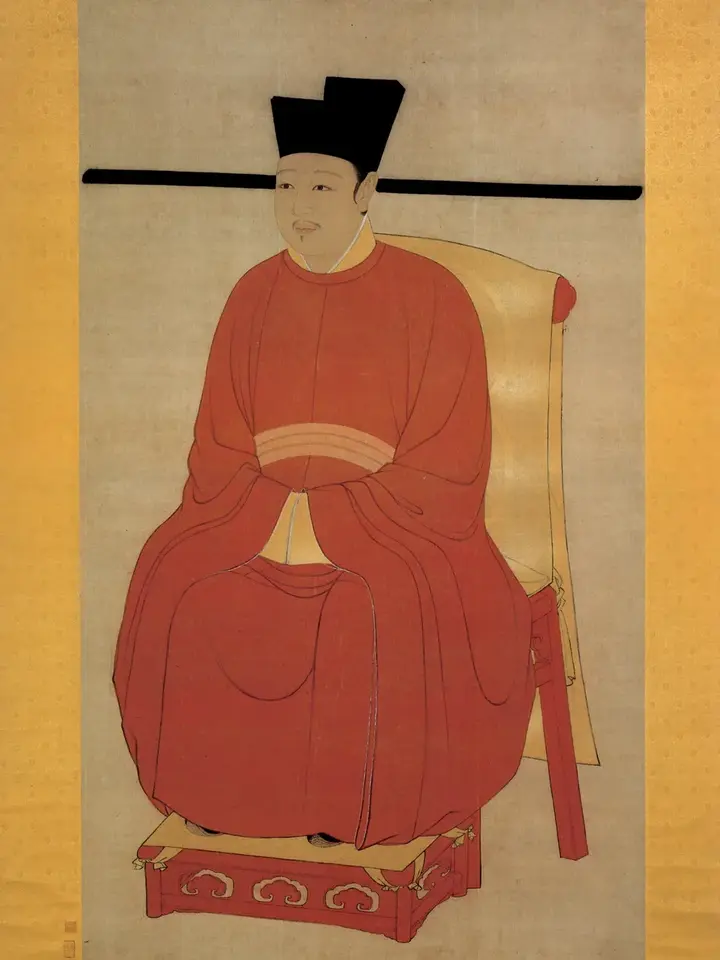
PROFILE
Huang Shen (1687–1772), original name Sheng, courtesy name Gongshou, also styled Gongmao, art name Yingpiao Zi (Master Gourd), also known as Donghai Buyi (Commoner of the Eastern Sea), was a native of Ninghua County, Tingzhou Prefecture, Fujian Province (present-day Ninghua County, Sanming City, Fujian). He was an illustrious painter, calligrapher, and poet of the mid-Qing dynasty, celebrated as a core leading master of the Eight Eccentrics of Yangzhou. Having lost his father in early childhood, Huang Shen lived in extreme poverty. To support his widowed mother, he renounced the civil service examinations, lodging in Buddhist temples to study classical literature under long-burning altar lamps and learning painting under fellow provincial Shangguan Zhou. Venturing beyond western Fujian in his youth, he traveled through Jiangxi and Jiangnan, supporting his family through selling paintings. In the early Yongzheng reign, he arrived in the bustling commercial metropolis of Yangzhou, forming close bonds with Zheng Xie (Zheng Banqiao), Li Shan, and Jin Nong, initiating an artistic revolution that transformed the Qing art world. Huang Shen occupies a pioneering milestone in Chinese figure painting: breaking free from conventional fine-line brushwork, he boldly introduced the kinetic brushstrokes of Huaisu's wild cursive calligraphy into figural drapery, creating a monumental style characterized by sweeping dynamism and structural vigor. Guided by humanitarian concern, he expanded traditional subject matter by portraying trackers, beggars, the blind, fishermen, and war refugees. Accomplished in poetry, calligraphy, and painting, he authored the Jiaohu Shichao, leaving behind masterpieces including Gathering of Beggars, Four Hermits of Mount Shang, and Su Dongpo Playing with an Inkstone.
- Courtesy Name
- Gongshou, Gongmao
- Literary Name
- Yingpiao Zi, Donghai Buyi
- Ancestral Home
- Ninghua County, Tingzhou Prefecture, Fujian Province (present-day Ninghua County, Sanming City, Fujian)
- Date of Birth
- June 14, 1687 (Kangxi 26, 5th lunar month, 5th day)
- Date of Death
- 1772 (Qianlong 37)
- Age at Death
- 86
- Highest Office
- Commoner (unappointed)
- Historical Identity
- Painter, master calligrapher, poet, core member of the Eight Eccentrics of Yangzhou
BIOGRAPHY
Chronology
- 1687 (Kangxi 26) | Birth in Western Fujian | Born into an impoverished farming and scholarly family in Ninghua; lost his father early and was raised by his mother.
- 1702 (Kangxi 41) | Apprenticing to Shangguan Zhou | Abandoned civil exams to apprentice under Shangguan Zhou, studying realistic figure and landscape painting.
- 1705 (Kangxi 44) | Studying by Altar Lamps | Lodged in desolate Buddhist temples, painting by day and reading classical canons by temple oil lamps by night.
- 1719 (Kangxi 58) | Traveling beyond Fujian | Departed Fujian to travel across Jiangxi along the Gan River and Poyang Lake, supporting himself through his art.
- 1724 (Yongzheng 2) | Arrival in Yangzhou | Reached Yangzhou to sell paintings; his vigorous brushwork caused an immediate sensation among regional patrons.
- 1727 (Yongzheng 5) | Caring for His Mother | Traveled back to Ninghua to bring his elderly mother to Yangzhou, fulfilling filial devotion for three years.
- 1730 (Yongzheng 8) | Returning to Fujian | Escorted his mother back to Ninghua upon her wish, receiving farewell poems from Zheng Banqiao and refining cursive script.
- 1751 (Qianlong 16) | Second Sojourn in Yangzhou | Returned to Yangzhou following his mother's death and mourning, spending six years at the height of his artistic maturity.
- 1757 (Qianlong 22) | Retiring to Jiaohu Lake | Departed Yangzhou permanently for Ninghua, building a lakeside retreat at Jiaohu to teach and paint.
- 1772 (Qianlong 37) | Peaceful Passing | Passed away peacefully at his native home in Ninghua at the age of eighty-six, leaving behind lasting renown.
Biography
Impoverished Childhood and Studies by Temple Lamps
On June 14, 1687 (the 5th day of the 5th lunar month in the 26th year of the Kangxi reign), Huang Shen was born on the outskirts of Ninghua County, Tingzhou Prefecture, Fujian Province. The Huang family had originally been a modest farming and scholarly household, but his father fell chronically ill and died when Huang Shen was still a child, leaving behind a young widow and a small boy.
Faced with extreme destitution, the family relied on his mother's spinning, needlework, and laundry to survive. Recognizing his intellectual gifts, his mother scraped together resources to enroll him in a village school. Huang Shen demonstrated remarkable memory, yet observing his mother's declining health and worn hands, the sixteen-year-old youth reached a decisive conclusion: recognizing that imperial examinations required years of expensive preparation without guaranteed return, he abandoned civil ambitions to study painting to provide immediate support for his mother.
In 1702, introduced by relatives, Huang Shen apprenticed under Shangguan Zhou, an accomplished local master of fine-brush figural portraits and courtly landscapes. Huang Shen practiced fine lines and ink washes scrupulously. Unable to afford candles or lamp oil at home, he lodged in dilapidated temples outside the town, copying the Book of Songs, Songs of Chu, classical anthologies, and ancient rubbings through the night beside the temple's altar lamps. This disciplined training provided him with realistic draftsmanship and classical literary grounding.
Apprenticeship and Travel beyond the Mountains
After years under Shangguan Zhou, Huang Shen's artistic prowess matched that of his teacher. Recognizing his broad talent, Shangguan Zhou encouraged him to leave the isolated mountains of western Fujian to broaden his vision across the empire.
In 1719, at age thirty-two, Huang Shen shouldered his painting materials and travel pack, bidding farewell to his mother. Crossing the Wuyi Mountains, he descended into the Poyang Lake drainage in Jiangxi Province. Living by selling his work in Nanchang and Jiujiang, he formed friendships with scholars and art collectors. The expansive waters of Poyang Lake and the misty precipices of Mount Lu broadened his artistic perspective, transitioning his style from tight precision toward expressive freedom.
During this journey, Huang Shen encountered authentic cursive calligraphic scrolls by the Tang dynasty master Huaisu. The wild energy and tempestuous cadence of Huaisu's cursive calligraphy left an impression upon him. He recognized that calligraphy and painting shared an identical aesthetic foundation: if the soaring strokes of wild cursive were fused into figural draftsmanship, it would shatter the static formulas of classical figure painting, inaugurating an expressive visual vocabulary.
Sojourn in Yangzhou and Filial Devotion
In 1724, at age thirty-seven, Huang Shen sailed down the Yangtze to Yangzhou, the wealthiest salt-trading hub in southeastern China. With its affluent salt merchant patronage and vibrant literary salons, Yangzhou was the primary national market for artistic innovation.
Upon his arrival, Huang Shen was relatively unknown, but his cursive-style figure paintings and rugged poetry captured the attention of regional literati. Connoisseurs and merchants competed to commission his works, declaring it an honor to possess a single sheet by Master Gourd. In Yangzhou, he befriended Zheng Xie (Zheng Banqiao), Li Shan, Jin Nong, and Gao Xiang—fellow iconoclastic scholars who shared his disdain for official orthodoxy. They gathered in riverside pavilions and wine shops, creating the progressive artistic movement known as the Eight Eccentrics of Yangzhou.
In 1727, having achieved financial stability, Huang Shen remembered his solitary mother in western Fujian. Unwilling to leave her alone in old age, he returned to Ninghua to escort her to Yangzhou. He established a comfortable residence for her in the city, attending to her daily needs for three years. In 1730, honoring his mother's desire to return to her native home, he escorted her back to Ninghua. At his departure, Zheng Banqiao presented him with a farewell poem praising his filial integrity and extraordinary artistry.
Reclusion, Second Sojourn, and Final Years
During the following two decades in Ninghua, Huang Shen lived quietly, attending his mother while researching calligraphy and prosody. His wild cursive calligraphy reached full maturity, marked by sweeping movement, rugged bone structure, and weathered authority.
In 1751, his mother died at an advanced age. After observing three years of mourning, the sixty-four-year-old master returned to Yangzhou, driven by affection for former companions. Although older peers like Jin Nong and Li Shan were aging, Huang Shen's reputation stood at its zenith. During this second six-year sojourn, his artistic output achieved effortless mastery; his brushwork acquired a poignant gravity reflecting decades of worldly observation.
In 1757, at age seventy, Huang Shen returned permanently to Ninghua. Residing beside Jiaohu Lake, he styled himself the Old Man of Jiaohu, living simply, painting, and tutoring disciples. In 1768, at eighty-two, he completed an album of floral studies while resting on his sickbed. In 1772, the master passed away peacefully at his Ninghua home at the age of eighty-six.
Major Achievements
Integrating Cursive Calligraphy into Expressive Figure Painting
In the evolution of Chinese figure painting, Huang Shen was an innovator who redefined expressive draftsmanship.
From the Six Dynasties master Gu Kaizhi and Tang painter Wu Daozi through Ming master Chen Hongshou, traditional figure painting had relied on delicate iron-wire or orchid-leaf linear contours. By the mid-Qing period, figure painting had degenerated into bloodless formulas. Huang Shen broke with convention by grafting the brushwork of Tang cursive masters Huaisu and Zhang Xu into figural depiction.
When painting, he moved his brush with velocity, utilizing center-tip and side-tip techniques across raw xuan paper. His lines resembled withered vines and bent iron wires, alternating between angular turns and fluid arcs. In drapery folds, he juxtaposed parched ink and diluted washes, creating rhythmic volume and kinetic force. This methodology opened new possibilities for Chinese expressive figure painting, providing crucial inspiration for modern painters like Ren Bonian, Wu Changshuo, and Qi Baishi.
Pioneering Realist Themes of Underclass Life
While contemporary literati painters occupied themselves with idealized Daoist immortals or leisure pastimes of the elite, Huang Shen remained grounded in common life, driven by deep humanitarian empathy.
Having grown up in poverty, Huang Shen understood the struggles of the underprivileged. In commercial Yangzhou, he observed the contrast between merchant wealth and urban misery. Directing his brush toward marginalized populations, he created realistic depictions of civilian hardship.
His masterpiece Gathering of Beggars (National Art Museum of China) depicted disabled beggars, blind mendicants, and starving refugees wandering the streets in winter. Portraying ragged garments and gaunt faces with empathetic veracity, the painting served as a critique of social inequality. Works such as The Firewood Gatherer, The Fisherman, and The Boatman celebrated the quiet dignity of working people, breaking literati prejudice and establishing a monument in Chinese realistic art.
Leadership among the Eight Eccentrics of Yangzhou
Within mid-Qing Yangzhou, Huang Shen stood alongside Zheng Banqiao and Jin Nong as a leader of the Eight Eccentrics of Yangzhou.
The movement rebelled against the orthodox academic imitation championed by the Four Wangs, declaring that art must express authentic individual spirit. Among the group, Huang Shen was unique in emerging from humble origins, maintaining independence throughout his life through selling his work rather than relying on bureaucratic patrons.
He shared a close intellectual bond with Zheng Banqiao, who admired his draftsmanship and filial conduct. Huang Shen and his peers united poetry, calligraphy, painting, and seal carving, shifting Chinese painting from private scholar studios into public urban visual culture, spearheading modern artistic renewal.
The Synthesis of Poetry, Calligraphy, and Painting
Huang Shen was celebrated across Jiangnan as a master of the "Three Perfections"—poetry, calligraphy, and painting.
In calligraphy, he specialized in wild cursive, developing dynamic compositional tension and dry-brush flying-white textures imbued with the weight of ancient bronze inscriptions. His bird-and-flower paintings drew from Xu Wei and Chen Chun, featuring ink washes executed with expressive freedom; his landscapes displayed untamed distance, capturing the atmospheric economy of Yuan masters.
In literature, Huang Shen read classical canons diligently, modeling his verse after High Tang poets. In his late years, he gathered his poetry into the four-volume Jiaohu Shichao. Chronicling Jiangnan landscapes, Fujian customs, and itinerant hardships, his poems possessed authentic emotional resonance, forming an integrated artistic legacy with his visual creations.
Relationships
- Lifelong Artist Friend: Zheng Xie (Zheng Banqiao, 1693–1765), core master of the Eight Eccentrics of Yangzhou, who maintained decades of close friendship with Huang Shen and wrote poems praising his work.
- Artistic Colleague: Li Shan (1686–1762), courtesy name Futang, one of the Eight Eccentrics of Yangzhou who associated closely with Huang Shen in advancing artistic reform.
- Artistic Colleague: Jin Nong (1687–1763), courtesy name Shoumen, leader of the Eight Eccentrics of Yangzhou, born in the same year as Huang Shen, who frequently exchanged calligraphic insights.
- Early Mentor: Shangguan Zhou (1665–c. 1750), prominent painter from Changting, Fujian, noted for fine-brush figure painting, who instructed young Huang Shen.
- Mother: Name unrecorded, who raised Huang Shen through hardship; Huang Shen brought her to Yangzhou for three years, celebrated across the region for his filial piety.
Historical Evaluations
- Zheng Xie (Zheng Banqiao), Poem Presented to Huang Shen: "I love viewing ruined murals in ancient temples, yet such sights are hard to find in the mortal world; today in Jiangnan I meet Master Gourd, whose brush maneuvers across ten thousand autumns."
- Li Dou, Records of the Painted Boats of Yangzhou: "Huang Shen excelled in cursive calligraphy, modeling Huaisu. In figure painting, he drew from ancient lore; first studying under Shangguan Zhou, he later employed wild cursive brushwork, executing figures with unconstrained vigor and majestic momentum."
- Zhang Geng, Guochao Huazheng Lu: "Huang Shen excelled in figures, occasionally painting landscapes and flowers with wild charm. His cursive followed Huaisu, bold and uninhibited, creating an independent school."
- Qi Baishi: "Among painters of past dynasties, I revere Huang Yingpiao and Xu Qingteng most; their soaring, kinetic elegance is truly divine."
- Draft History of Qing, Volume 504: "Huang Shen, courtesy name Gongshou, native of Ninghua. Skilled in cursive calligraphy and figures, his brushwork was vigorous, frequently portraying farmers and townspeople, standing as a bulwark of the Yangzhou School."
Related Entries
- Eight Eccentrics of Yangzhou
- Zheng Banqiao
- Jin Nong
- Li Shan
- Shangguan Zhou
- Gathering of Beggars
- Huaisu