Birth in Chengdu
Born into a distinguished artistic household in Chengdu, learning painting and observation of nature from his father Huang Quan.
黄居寀
Huang Jucai (黄居寀, 933–after 993), courtesy name Boluan, was an eminent bird-and-flower painter of the Former and Later Shu and early Northern Song dynasties, and the definitive master of the \"Huang Family Opulence\" court academic painting tradition. Born into an illustrious artistic lineage as the youngest son of the master painter Huang Quan, he inherited his father's delicate meticulous brushwork (gongbi) and naturalistic…
Huang Jucai (黄居寀, 933–after 993), courtesy name Boluan, was an eminent bird-and-flower painter of the Former and Later Shu and early Northern Song dynasties, and the definitive master of the \"Huang Family Opulence\" court academic painting tradition. Born into an illustrious artistic lineage as the youngest son of the master painter Huang Quan, he inherited his father's delicate meticulous brushwork (gongbi) and naturalistic coloring. During the Guangzheng era of Later Shu, he served as Hanlin Painter-in-Attendance, producing extensive palace murals and folding screens. Following Later Shu's conquest by Song in 965, he entered the Song court, earning deep esteem from Emperors Taizu and Taizong. Entrusted with heading the Hanlin Painting Academy and authenticating classical masterpieces across the realm, he rose to Grand Master for Court Audiences and Assistant Minister of the Court of Imperial Entertainments. Under his stewardship, the meticulous, richly pigmented Huang style became the official standard for academy recruitment for nearly a century. Surviving masterpieces include Partridge and Sparrows among Brambles and Doves on Bamboo and Rock.
Born into a distinguished artistic household in Chengdu, learning painting and observation of nature from his father Huang Quan.
Appointed Hanlin Painter-in-Attendance in the Later Shu court, collaborating with his father and brothers on imperial murals.
Later Shu surrendered to Song; Huang relocated to Kaifeng, where Emperor Taizu reappointed him Hanlin Painter-in-Attendance.
Highly favored by Emperor Taizong, placed in charge of the Hanlin Painting Academy and tasked with authenticating ancient artworks.
At age sixty-one, served as imperial envoy to Chengdu, painting famous Buddhist and landscape murals at Shengxing Temple before his death.
Huang Jucai was born in Chengdu during the founding years of the Later Shu regime. His father, Huang Quan, was the preeminent master of bird-and-flower painting who pioneered the aristocratic style of meticulous line work and vibrant mineral coloration. Immersed in this artistic atmosphere from boyhood, Huang Jucai copied ancient masterpieces and studied the physical plumage, anatomy, and behavioral nuances of birds and animals under the tutelage of his father and brothers.
During the reign of Meng Chang, the last ruler of Later Shu, the arts flourished in Chengdu. Admitted to the imperial painting academy for his technical excellence, Huang Jucai was granted the rank of Hanlin Painter-in-Attendance. Alongside his elder brothers Huang Jubao and Huang Jushi, he assisted his father in executing monumental palace murals and decorative screens across the royal pavilions. Combining refined brushwork with keen natural observation, his artistic prowess was hailed by contemporaries as rivaling that of his father.
In 965 (Qiande 3), Emperor Taizu of Song conquered Later Shu, and Meng Chang surrendered. Huang Jucai migrated to the northern capital of Kaifeng alongside the displaced court. Having long admired the artistic fame of the Huang family, Emperor Taizu received Huang Jucai with generous favor, reconfirming his appointment as Hanlin Painter-in-Attendance and charging him with decorative commissions.
With the accession of Emperor Taizong, Huang Jucai's prestige rose still higher. An avid connoisseur of calligraphy and painting, Taizong issued nationwide searches for ancient masterworks, appointing Huang Jucai to authenticate, grade, and catalog the acquisitions. Drawing upon his profound connoisseurship, Huang purged forgeries and organized an immense imperial collection. In recognition of his service, the court conferred upon him the ranks of Grand Master for Court Audiences, Assistant Minister of the Court of Imperial Entertainments, and Pillar of State, along with the privileged Purple and Gold Fish Pouch.
Under imperial patronage, Huang Jucai exercised absolute authority over the Hanlin Painting Academy. Examination standards for prospective court painters were calibrated entirely against the aesthetic conventions of the Huang family. Artworks adhering to the meticulous contours, opulent colors, and realistic detail of the Huang canon gained admission, whereas alternative idioms were excluded, securing the absolute dominance of \"Huang Family Opulence\" in early Northern Song court art.
In 993 (Chunhua 4), at the age of sixty-one, Huang Jucai was dispatched by Emperor Taizong on an imperial mission to Chengdu. Returning to his native Sichuan after nearly three decades, he was received with great honor. During his stay, he painted monumental murals at Shengxing Temple, including Dragons and Water, Mount Tiantai, and Streams and Rocks. These dynamic compositions drew widespread admiration from local scholars and artists.
Upon concluding his mission, Huang returned to Kaifeng, where he passed away at an advanced age shortly thereafter.
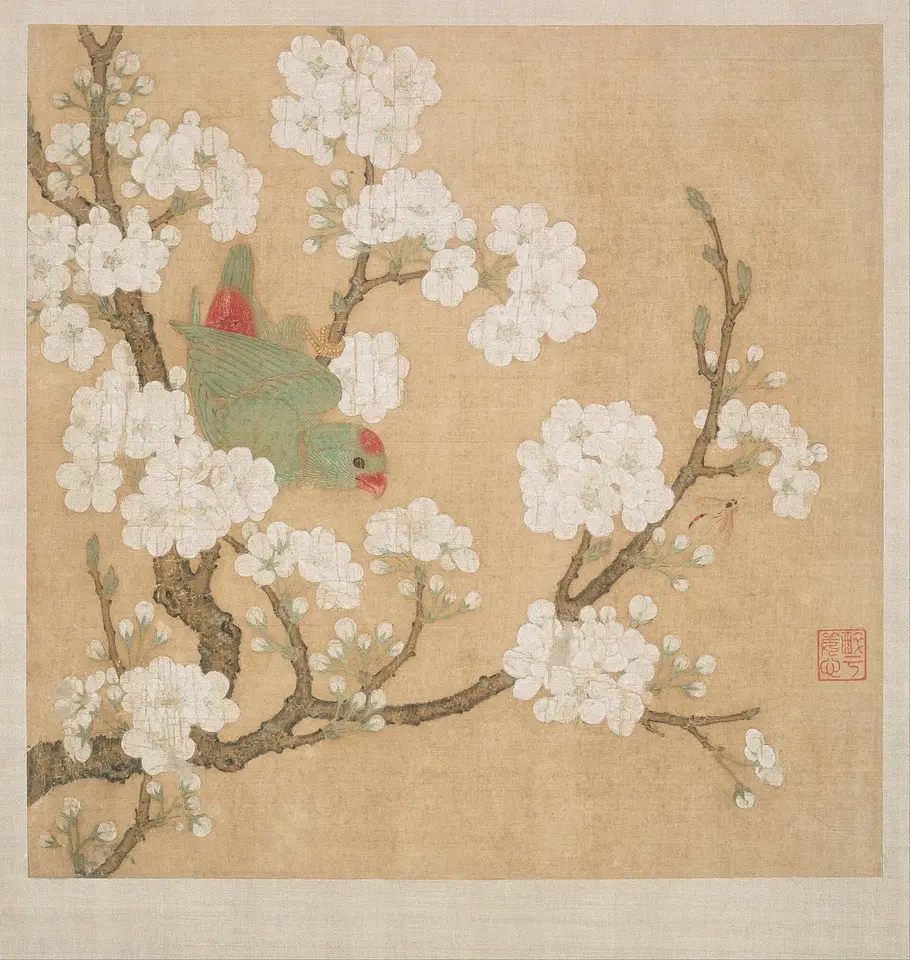
In the history of Chinese bird-and-flower painting, the Five Dynasties witnessed the emergence of two contrasting traditions: the rustic untrammeled style of Xu Xi and the aristocratic opulence of Huang Quan and Huang Jucai. Heading the imperial academy under Song, Huang Jucai codified his family's techniques into the canonical orthodoxy of the imperial court. The Huang technique employed delicate, faint ink contours layered with rich mineral pigments such as cinnabar, azurite, and malachite, concealing brush traces to achieve sumptuous visual splendor. This aesthetic regime dominated the Northern Song court for almost a century until Cui Bai and Su Shi fostered the literati painting movement.
Huang Jucai's authentic surviving works are exceptionally rare. His hanging scroll Partridge and Sparrows among Brambles, preserved in the National Palace Museum in Taipei, is universally acclaimed as a supreme monument of early Northern Song painting. Employing a central axis composition, it depicts a partridge leaning toward a mountain stream beside a boulder, surrounded by seven sparrows perching or fluttering among thorny branches. The painting demonstrates remarkable ornithological accuracy, distinguishing mountain sparrows from common house sparrows. Combining archaic Tang decorative elegance with Song empirical naturalism, the work bears Emperor Huizong's autograph inscription \"Huang Jucai's Partridge and Sparrows among Brambles\" and seals from Song, Ming, and Qing imperial collections.
FIGURES ASSOCIATED WITH THIS DYNASTY